Sunday, July 16, 2006

f-ed up

Israel does Iran’s bidding
Tagged as:

In college, I had a giant friend who told me that little guys were constantly picking fights with him: on the playground, in bars, everywhere. He was a really gentle guy, but it just drove him nuts. “They just want to prove themselves in a fight with me,” he would tell me. “It’s gotten to the point that I do not even like to go out.”


Is Israel the giant or the small guy? I would say a little of both. My allegory does not make any sense at all, and I probably should just delete it. What I really want to know is how could Israel allow itself to be lured into a war that will only serve to strengthen its enemies? It’s no secret anywhere that Iran is suspected of being behind Hezbollah’s kidnapping. It’s also no secret that Iran finances Hezbollah. There are even murals of Iranians “martyred” in battles fought with Hezbollah. Iran wants so many issues on the UN Security Council’s plate that no meaningful decisions can be reached. Now there is North Korea, Iran, and Israel to deal with. That’s quite a big serving.

Israel’s costly mistakes in Lebanon have been widely critiqued by many generally favorable to Israel. What makes them repeat those mistakes? Someone tell me.

Laura Zittrain Eisenberg argues that clear borders are essential for Israel (MERIA Volume 4, No. 3 - September 2000). In her section on Israel’s entry into Lebanon’s civil war she points out this crucial mistake:

Begin relished the irony in the Jewish State rescuing oppressed Christians, while the rest of the world stayed mute. But Beirut was not Berlin, and Begin's insistence on viewing the Maronite situation in European, post-Holocaust terms removed him further from Lebanese realities than any of his predecessors.


A larger quote here:

Do Good Fences Make Good Neighbors?: Israel and Lebanon after the Withdrawal
Who is on the other side?

(The Israeli Perspective)

In the early 1980s Israel made its most dangerous blunder in assessing the intentions and relative power of its Lebanese friends and foes. Up until the 1970s the Zionist/Israeli exaggeration of a friendly Christian community of allies in Lebanon caused minimum damage because Israel did not predicate policy upon that faulty precept. While the increasingly unrealistic perception of a Maronite partner perhaps precluded the Yishuv from pursuing a more realistic and productive Lebanon policy, it had not exposed it to any special political or military threat. The same held true for the first two decades of Israeli statehood. But once the Lebanese civil war began in 1975, Israel fell into the common trap of relying on religious shorthand, Christian vs. Muslim, to distinguish the nature and intentions of the key actors and began to pursue policy in Lebanon accordingly.

But in actuality, the conflict was one between Maronites trying to preserve their traditional political and economic privileges in Lebanon versus everyone else trying to seize a larger piece of the Lebanese pie for themselves. Israel's interests in Lebanon were not "Christian" at all, but rather dictated by standard strategic political thinking, which made any anti-PLO (and later anti-Hizballah) force a potential ally. (17) Differences within and among the Israeli cabinet, military and intelligence services concerning the desirability and capability of the Phalange as an ally are well-documented in the many accounts of the 1982 war. There was general agreement over the usefulness of forcing the PLO away from the northern border and even destroying the organization, if possible, but Prime Minister Menahem Begin used the Maronite angle both in formulating strategy and in appealing to Israeli public opinion. Deeply steeped in the historical lore of Maronite friendliness, few Israelis initially balked at the depiction of Lebanese Christians threatened with genocide and a natural harmony of Christian and Israeli interests in the face of mutual Muslim, Palestinian, and Syrian foes.

Begin relished the irony in the Jewish State rescuing oppressed Christians, while the rest of the world stayed mute. But Beirut was not Berlin, and Begin's insistence on viewing the Maronite situation in European, post-Holocaust terms removed him further from Lebanese realities than any of his predecessors.

Despite behind-the-scenes diplomatic activity, support for the SLA, and its own military operations in July 1993 (Operation Accountability) and April 1996 (Grapes of Wrath), Israel failed to suppress Hizballah. Fatalities ran at 20-30 IDF soldiers per year. Attempting to avoid roadside bombs, the IDF began to ferry its soldiers to security zone bases by helicopter, a plan that worked only until a collision between two helicopters in February 1997 claimed 73 lives. From that tragedy the "Four Mothers" group was born, a grassroots movement initiated by four mothers of sons serving in Lebanon, with the goal of compelling the government to withdraw all Israeli troops from Lebanon. (18) The organization introduced and legitimized the concept of unilateral withdrawal in national debate, its message driven home by the relentless procession of IDF body bags from Lebanon. Hizballah had succeeded in making the security zone untenable.


(The Lebanese Perspective)

Israel was so focused on the PLO and its Lebanese and Syrian allies that it neglected to evaluate properly the Lebanese Shi`a's politicization in the early 1970s, marked by the rise to leadership of Musa al-Sadr, and the formation of Shi'a organizations such as Amal and the Islamic fundamentalist Hizballah. Although some Shi'a supported the Palestinians and the PLO, others--angered at oppressive PLO domination and PLO cross-border attacks that invited Israeli retaliatory strikes against their villages--responded to Israel's anti-PLO invasion of 1982 with relief and support. But as hostilities dragged on 1982, Israeli forces settled into the south, building new roads, posting road signs in Hebrew, commandeering facilities, and establishing bases or detention camps. These steps caused Israel to change in many Shi'a eyes from liberator to occupier. Despite the fact that a majority of the FLM and SLA foot soldiers were Shia, Israel had neither recognized nor rewarded the Shi'a as potential allies, taking their continued acquiescence for granted.

By 1985 Amal, founded to champion Shia rights within Lebanon, was being outgunned by Hizballah, which proclaimed a pan-Islamic fundamentalism. Funded by Iran and encouraged by Syria, Hizballah sought to drive the Israelis back across the border. Frequent declarations by the organization also stated an intention to remove Israel from Palestine and Jerusalem, as well. It is ironic that the PLO, target of the 1982 invasion, became Israel's peace partner in 1993, while many of the previously friendly Shi'a of south Lebanon joined Israel's new Hizballah enemy.


Missed Opportunity?

Hindsight is always 20/20, but it does appear that Israel missed a critical opportunity for salvaging some benefit from the 1982 invasion in the year or two immediately afterward. Unlike the situation in 1978, the PLO was really gone this time, and although the alliance with the Phalange had already soured, relations were still good with the Christians and Shia of south Lebanon. Had Israel withdrawn at that time, and/or accurately recognized the sensibilities and needs of the south Lebanese people, it might have earned the trust of a population genuinely interested in seeing the border quiet and secure. In a reflective post-withdrawal interview, Israel's coordinator for activity in Lebanon, Uri Lubrani, similarly suggests that Israel could and should have redeployed to the international border in 1984. (19) By failing to identify and accommodate the south Lebanese actors who remained after the PLO's expulsion, Israel helped provoke the creation of Hizballah, an enemy equally or more punishing than the PLO had ever been.


Unfortunately for everyone, we are living in a time of inferior leaders.

Wednesday, July 12, 2006

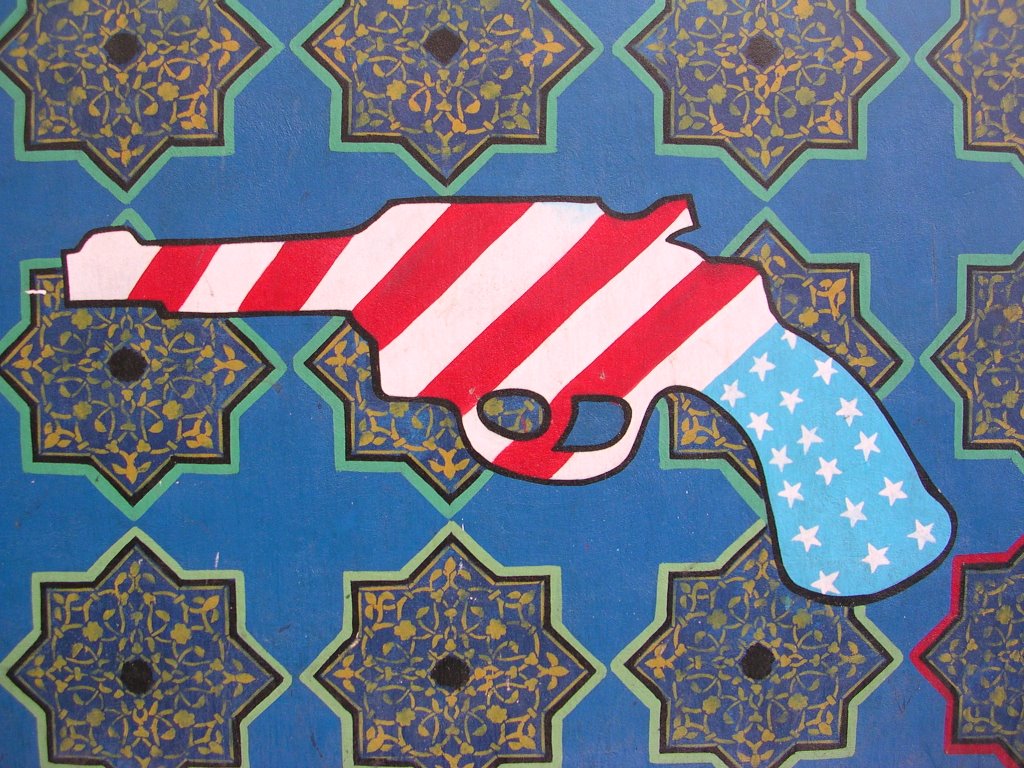
About the revolver

Tagged as:

(response to Matt’s question)

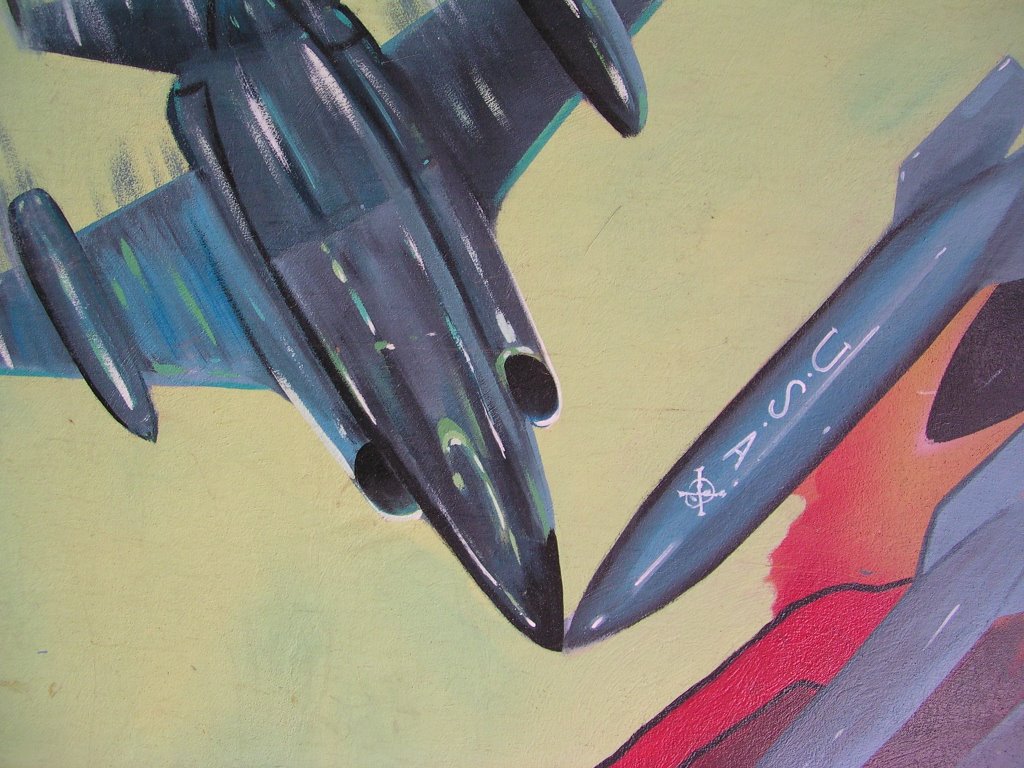
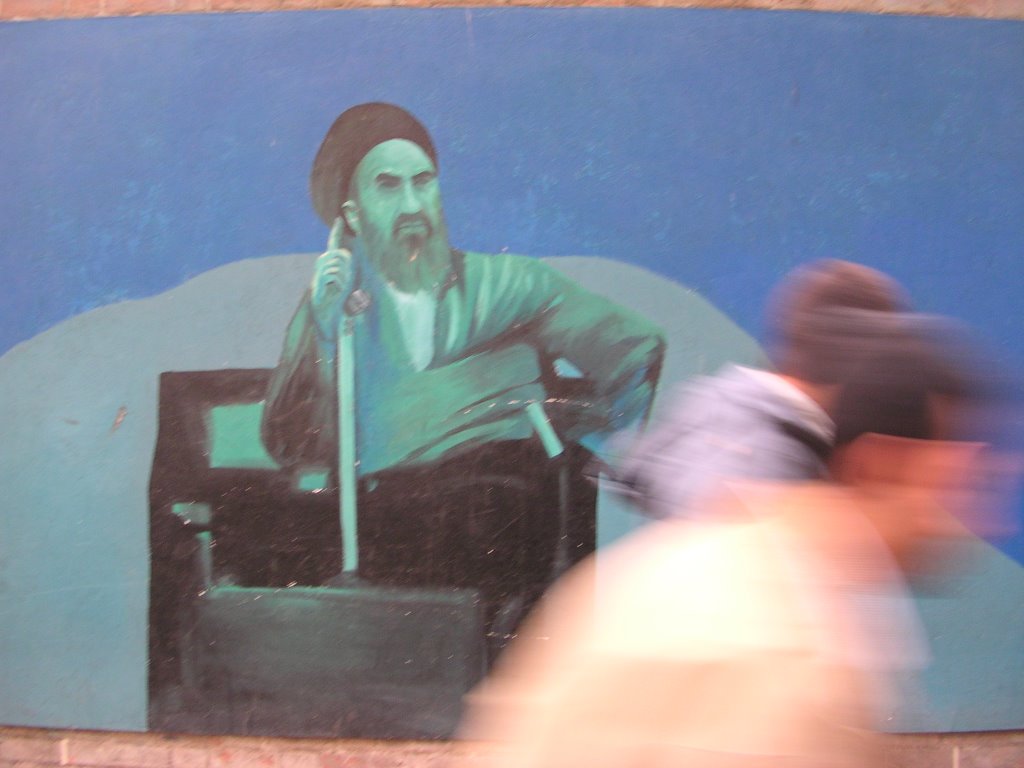
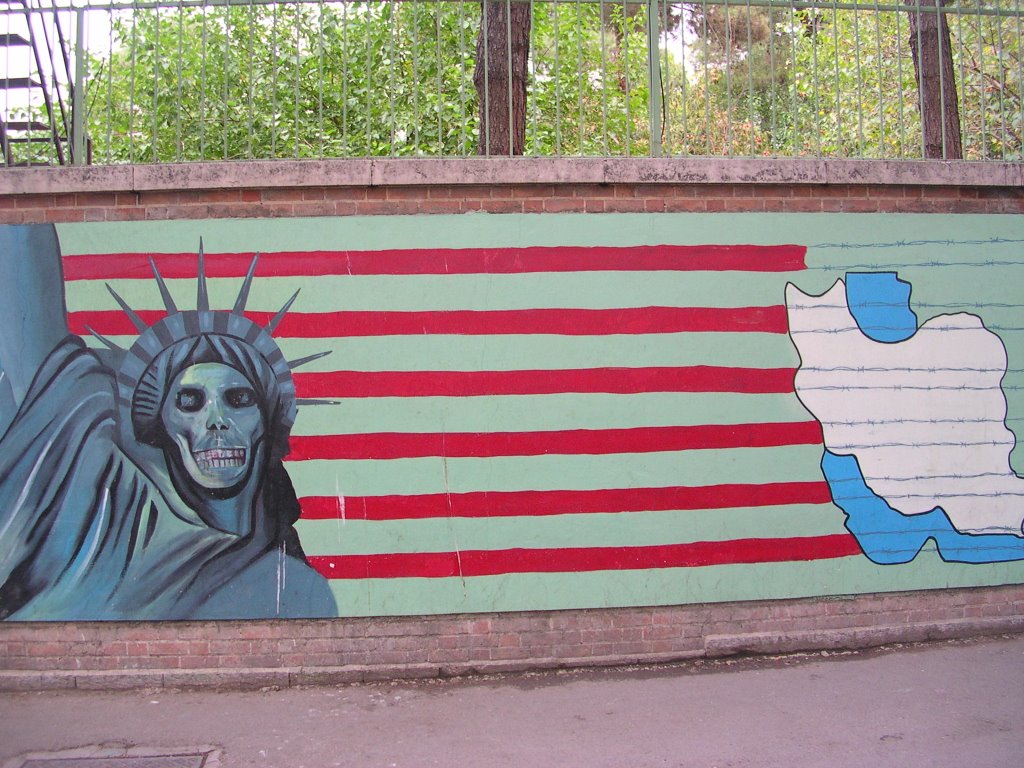
The photo of the revolver that is featured in this blog is from a mural in front of the former American Embassy. I am posting a few photos of that mural so that you get an idea of what it looks like.


Tuesday, July 11, 2006

Head Butt

Tagged as:

Like every other football crazed nation, Iranians are talking about the World Cup and Zidane’s head butt. In fact, this has been the primary topic of conversation for two days now. I just read a couple of my Iranian friends Materazzi’s description of the incident translating it into approximate Farsi. The lines:

'I did not call him a terrorist. I am not a cultured person and I don't even know what as Islamist terrorist is.'

He added: 'For me the mother is sacred, you know that.'


…Got a big laugh from my friends. “How Iranian of him,” Niloofar laughed. By this, she meant the way that Materazzi admits to insulting Zidane but does not rule out an insult to Zidane’s family, just one to his mother.
ESPNsoccernet - World Cup - Materazzi admits to insulting Zidane: "Materazzi, 32, told Gazetta dello Sport: 'I held his shirt for a few seconds only, then he turned to me and talked to me, jeering.

'He looked at me with a huge arrogance and said, `If you really want my shirt I'll give it to you afterwards'. I replied with an insult, that's true.'

Materazzi has not elaborated on what he did say, but one report suggested he responded with: `I'd rather take the shirt off your wife'.

He has denied, however, some of the more vile insults referring to his wife or sister or calling him a terrorist.

'It was one of those insults you're told dozens of times and that you often let fall on a pitch,' Materazzi said.

'I did not call him a terrorist. I am not a cultured person and I don't even know what as Islamist terrorist is.'

He added: 'For me the mother is sacred, you know that.'"

Sunday, July 09, 2006

Fun in the Sun

Tagged as:

I thought I would write at least once in awhile during the past two weeks, but I did not. Why didn’t I? I cut the tip of a very important typing finger, and it hurt to type. Oh yeah, I also went to a friend’s wedding in a normally cold country that was in the grips of its three-week summer so it was sunny and gorgeous every day so we went to the beach and swam in the ocean and I actually wore a bikini in front of men and women and little children and big and small dogs and was still one of the most covered up women on the beach. I rode a bicycle, wore a summer dress, and spoke freely and openly with everyone. I slept a lot. I drank a lot less than I do in Iran, but I drank good wine and good beer instead of the staples available to us here. Friends returned from Greece with homemade red wine. They were excited about it, but I told them I had had enough homemade wine in the past few years.

I returned with Iran Air. Once again, I did not want to get on the plane, but then, once on, I had fun. I sat next to an ex-pat Iraqi family whose parents have taken refuge in Iran. Their parents are too scared to travel back to Baghdad. They like Iran. In the row next to ours was a couple who had not been in Iran for 15 years. They were beaming. Excited to see family and eat Iran’s famous sheep’s head and foot soup (calepache). (Talk about foot in mouth…) When we were just above Tehran, the man leaned to look out the window and shouted: “There is calepache everywhere in this city!” We landed to a great burst of applause from the passengers.

Everyone was covered up while we were still in the airport. I did not wear my headscarf until we landed. Soon, many of the women had taken theirs off as well. Iran Air is often carrying people who have not been in Iran in years and years. Those women cover every strand of hair on their heads: not from religious passion, but from fear.

The cold European country was filled with women in hijab: all of whom would be arrested in Iran for bad hijab. Hijab, as I have said before, is all about fashion. Moroccan women, for instance, wear tight-fitting scarves, form-fitted to their hair, and tied behind their necks. Then they wear long skirts, with tight tops, lots of jewelry and fashionable shoes. They look great. Why? Because, as so many Muslim evangelists tell me, hijab is a signal that the woman’s body is not part of the social discourse: it’s all about respect. Hijab is supposed to protect women from prying eyes and sexual violence, but I very much doubt that it does any of those things. Talk to any man: western or eastern: they are obsessed with women in hijab.

Hijab makes the women’s body the center of social discourse: all it does is eroticize the body. I’ll tell you what takes women’s bodies out of social discourse: it’s thousands of topless women at the beach.


More on hijab:
The Veil: Resistance or Repression?

Scarf and Make-up: the Modern Face of Islam

Women in Islam, veiled oppression or stigmatized misconception
http://www.bbc.co.uk/dna/ww2/A5838410#footnote10

A Pearl In Its Shell


Arab Feminists on Women's Rights: Cats and Dogs in the Developed World Have More Rights than Women in the Arab and Muslim World

Saturday, June 24, 2006

Fun

Tagged as:

1. “Some people think Iran is a hell because young people can’t go to discos or drink beer in bars. They have no imagination of what it means to have fun.”

M: “I grew up in the country, so Iran is a great place for me to have fun. You can never be disappointed by the nature here.”

ET: “It’s true that Iranians have a kind of fun that is really special and enjoyable, but I do believe that being young in Iran is a bit of a problem.”

1: “What do you mean?”

ET: “Well, you are always watched. There is so much pressure from family and from society.”

1: “Who says that?”

ET: “I see that myself. I see how young people have to put so much control on themselves because there is so much control on them.”

2: “That’s the first way to learn to lie. For instance, we get some money. Our parents ask us how we plan to spend it. We tell them a lie. We lie even when there is no reason to lie. We do not tell our parents where we are going or who we are going with. We do not tell them anything true. We are a lying people.”

ET: “All Iranians say that about themselves.”

Y: “What I like about working in Iran is that when I get angry in a meeting, the Iranians do not hold it against me. When the meeting is over, they slap my back and we are friends again. They know it is business. When I do business in Saudi Arabia, they do not accept the difference between business anger and personal anger.”

3: “Iranians show their emotions.”

ET: “No, Iranians are very controlled.”

3: “Do you think so?”

ET: “Particularly the women.”

4: “The women are really manipulative.”

1: “Because we have to be. That’s the only way for us to survive.”

K: “That’s what I always say. I’m with you.”

ET: “If the law were more fair, women would be less manipulative.”

1: “That’s true.”

Y: “The men are ruled by women.”

3: “No, it’s just natural here.”

ET: “Married men are like children. They cannot even feed themselves.”

2: “Our generation is better.”

ET: “Your generation is a lot better. I see a lot more 50-50 in younger couples.”

1: “Every generation has its lazy men and domineering women.”

2: “If you talk to ten young people in their 20s, only 2 will tell you that they want to get married. The others do not want to get married.”

1: “We have learned to lie so well that we don’t want to enter into a relationship of trust.”

2: “We had to learn to lie.”

3: “Do you wish the revolution never happened?”

2: “Of course I wish it never happened. We have fallen so far behind the rest of the world.”

1: “Me… I think the revolution has been a good thing. It has made us much more careful. We don’t believe things so easily. We think things through more carefully. Our decisions are more deliberate.”

Wednesday, June 21, 2006

Closing Time

All over Iran, businesses are closing early again today for a chance to say farewell to the world cup team. Keivan predicts a 3-0 loss for Iran. “Don’t say that,” Mohamad protests. “Everything you’ve said has come true.”

“It’s all Keivan’s fault,” I respond.

---

Was in a meeting with some Iranian businessmen. One was telling us that he went to Dubai to buy some hardware for his business. “They didn’t sell it to me. They won’t sell to Iranians.”

“Sanctions?”

“No, it’s not sanctions. They just won’t sell to Iran. The Arabs do not want to sell to Iran.”

“You’re sure it wasn’t sanctions?”

“I’m sure. They said to me: we won’t sell to Jews. I said, hey, I’m a muslim. My name is Mohamad, how can I be Jewish? They kept telling me they don’t sell to Jews.”

All of the men laughed. That was the end of that.

I was left thinking of the Brooklyn Mullah. He appears on Iranian tv every once in awhile and lectures on scripture. He has a really thick Brooklyn accent that shifts into what sounds to me like perfect Arabic when he needs to quote something. Last time I saw him he was speaking of the sheitan (devil) and identifying his works. It’s all so disorienting for me: the accent, the sermon, the black turban: I keep thinking he is a rabbi, but then what’s all this about hadith?

I think it was Lenny Bruce who said that all New Yorkers are Jewish. I guess the Brooklyn Mullah is no exception.

Saturday, June 17, 2006

Weekly Hike


Tagged as

I spent more time as a passenger than actually hiking this past Friday because traffic was so bad. First we got behind a long line of diesel spewing trucks going through winding mountain roads. Then there was a series of minor fender benders. Then there were the small towns where people were driving in and out of stores and kebabis and turning our 3 lane “highway” into a 6-lane highway: 5 lanes in the direction of Tehran, 1 lane in the direction north.

At one point we were stopped at a military checkpoint: on the lookout for bad hijab, alcohol, and unmarried men and women traveling together. Our driver gave the military guys some lip: just enough to let them know how unhappy she was being stopped. She refused to fix her hijab which wasn’t so bad anyway. They eventually waved us through without checking our trunk.

It probably helped that I am so foreign looking.

“Do you think I was too mouthy?”

“No, just mouthy enough,” I answered.

There were a lot of patrols at the mountain, but for the most part they seemed in good spirits. One sergeant (I recognized the stripes from the Beetle Bailey cartoon sergeant) was even joking with passing hikers about using his baton on them. It may sound like a macabre joke, but it was sweet.

Just after we saw this sergeant we did see soldiers leading three men and one woman down the mountain. One had his gun half-raised towards the back of the woman. In Iran it’s hard to tell when people are being arrested because they are actually breaking a real law or when they are being arrested arbitrarily. Who knows in this case?

I have seen the Iranian police control violent men with a degree of gentleness unimaginable in America. For instance, a man who went into a violent tantrum after learning that his seat on the bus had been sold to someone else was gently led away by the police when they showed up. This man had broken several windows, attacked bystanders and employees of the bus service, and was still squirming and twisting when the police led him away: without hand cuffs, without shooting him, without beating him.

There are a lot of different kinds of police in Iran.

Speaking of which, since last week’s game with Iran, we had heard about Iran’s new motorcycle cops: a band of tough-looking, clean shaven guys riding serious motorcycles. Powerful motorcycles are forbidden in Iran, so the site of 20 guys on brand new motorcycles is surprising. We saw them on our way home from the mountains. One group was riding south from the north of Iran, one riding north from Tehran. These guys were wearing form-fitting motorcycle gear that may be bullet proof for all I know. One even had a leather Red Bull jacket on. Do you think this was official dress? They have black helmets that hide their faces and look like they walked out of some Hollywood Commando movie. They look very, very unIranian.

Wednesday, June 14, 2006

Rumor of the week

Tagged as:

Under Construction has a description of post-game “celebrations” on Vali Asr Street.

Keivan’s doctor elaborated on the rumor I heard from the taxi driver that the mullahocracy specifically prohibited victory in Iran’s game with Mexico “Ali Daei works for intelligence,” the doctor told him while checking his blood pressure. “Did you see the way he was just running up and down the field? He wasn’t really part of the game. He was just moving.”

Many others have repeated the rumor which is at once funny and pathetic. This rumor is traveling through the over 40 age group. Young people are not passing this one on and laugh when they hear it. What it presumes is that Iran is such a great team that a couple of people can make a decision to win or lose. This rumor feeds right into Iranians combined sense of superiority and inferiority.

The World Cup is a great way to take your mind off nukes, sanctions, and despair. Hurray world cup!

Tuesday, June 13, 2006

I wrote an article

It's based on the notes I took for this blog. It's for the Prospect.

The Prospect has a good article that I only discovered yesterday: "Misreading Iran (again)."

BTW, didn't the Americans look tiny and boyish compared to the giant warriors on the Czech team? I was happy the score did not go to 4-0. Keivan''s brother was rooting for a 6-0 win for the Czechs.

Monday, June 12, 2006

Sourakh, sourakhesh mikonand…

Tagged as:


Well, not exactly. “The mullahs did not want us to win. They told the players: ‘make sure you lose.’”

“No way.”

“You didn’t grow up here. You don’t know the lengths they would go to to keep us off the streets and to keep us from celebrating. We are a rich country with a great culture, but they have ruined us.”

When I got to my destination, I asked the people there what they think of the driver’s comments. “He’s crazy. The Iranian team played well; they just did not win.”

I have never been more invested in a game. You might think this is strange, but I really wanted Iran to win. Friends of ours took us to a football party in a young couple’s apartment in Tehran. The Iranian flag was draped over the door. We were welcomed into the couple’s home with sincere warmth.

The apartment was draped with flags. Faces were painted green and white; young women wore team t-shirts; horns were blaring; the music was loud. Within minutes a tray filled with vodka was passed around the room. The stereo was blaring Arash’s “Iran… Iran…” It was repeated so often that night, that I learned the words. It goes something like We are Iranian until we die; we speak in one voice: Iran, Iran…

It rhymes in Persian.

The room was crowded. The game started. Iran attacked and attacked and attacked. Each attack was met with wild cheers, “Imagine what the stadium must be like,” Keivan said. “This place is so loud.” They looked good, but it was Mexico that scored the first goal.

The Iranians first booed then cheered the Mexican goal. “This is good for Iran, now they will play better.”

They did play better and scored a goal to tie the game 1-1. The room went wild! There were fireworks in the streets.

Halftime arrived. I went outside for a bit of fresh air. “I was just in Europe,” a young man told me. “Every time I said I was Iranian, they said Ahmadinejad. I said we did not elect him. They don’t understand how we Iranians can love our country and hate our government.”

“My Iran is here,” the face-painted man said to me as he pointing to the apartment. “It is not there.” He pointed outside. “I love my Iran. My people are happy inside and sad outside.” He was practicing his English with me. I think most Iranians would be surprised to hear themselves called “my people” by a young medical student, but I might be wrong.

“Pray for my team,” a young woman said to me. “It moves me that you care about us.”

“God willing, we will win,” another added.

“They might even win,” Keivan said.

“Tying would be a victory.”

There was so much good humor and hope that when at 9:10 Iranian time, the Mexicans scored their second goal, no one despaired. When they scored their third goal within minutes, the room went quiet. All of Tehran went quiet.

A young man with green and white face paint, wrapped in an Iranian flag went into the bathroom to sulk. He sat on the ground with his head in his hands.

I wanted to cry.

A few minutes after the game, we were dancing to Arash songs. The sulking young man told me, “We are good losers. That is our problem. When we win we say it is from God; when we lose we say it is from God. That is why we are always losers. We are victims.” Posted by Picasa

Sunday, June 11, 2006

World Cup

Tagged as:

While the west may be worrying about AN’s nasty appeal to neo-Nazis worldwide and how that will be played out in Iran’s first game tonight: Iranians are just eager to celebrate a victory and have some public fun. (See Michael Slackman’s article: World Cup Tests Iranians' Ability to Have Fun in Public)

You would be hard-pressed to meet an Iranian in Iran who even knows what a nazi is (unless it’s a girl’s name, and then it is pronounced with a buzzing z rather than a ts z), let alone a neo-nazi.

For a great insight into Iran AND Iran’s sympathy with Germany, read: My Uncle Napoleon. The story takes place in a family compound in Tehran during world war 2. Nothing else provides more insight into Iran than this book. There is no analysis of Iran that even comes close to Iraj Pizishkzad’s rendition of Iranian society and culture.

Predictions: This morning’s taxi driver predicts a tie; Keivan predicts a 3-1 loss; Mohamad a 2-1 win; Niloofar thinks that it will be a 2-1 loss or a tie. "She's become Mexican," Mohamad complains. "She's not Iranian anymore." Everyone here believes that Mexico is a strong team. Iranians, however, need at least one victory in the World Cup. There is an eagerness to return to the streets for a bit of celebration.

Saturday, June 10, 2006

The Lost World

Tagged as:


Another Spring day in Iran...

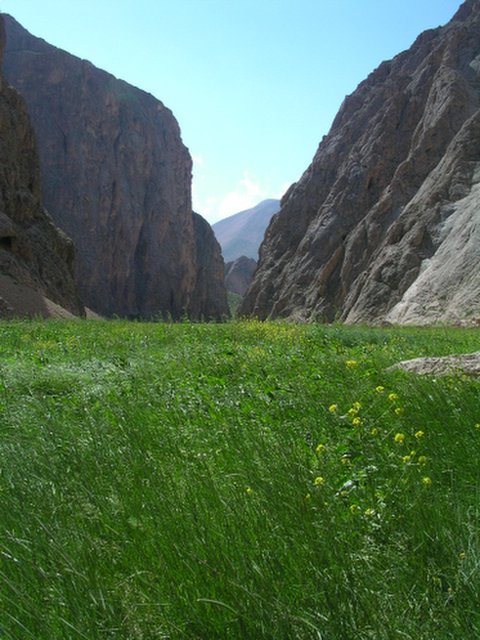
A co-hiker described the place we went to as "The Lost World." Every time we turned the corner there was an unexpected landscape. We went from arid rock to meadow to swamp all in the course of an afternoon's hike. I am such a flatlander: every time we hike, 3 years olds pass me, Iranians laugh at me, and I never fail to fall on my ass at least once. It's great to live in the mountains for a change.

We went through a gourge to arrive at the first meadow where Iranian families and friends were picnicking and singing. A group of women had taken off their scarves and were drumming and singing in lovely high voices. Two young men walked arm in arm smoking a waterpipe. A young man prayed while his friends drank tea. Families made kebabs while fathers sang for their children. This was all capped off by the sounds of crickets and the smell of wild mint. I thought I was in a kind of paradise, and I was not alone: my companions felt that way too.

If you want to know what Iran could be: go for a hike. Posted by Picasa

Tuesday, June 06, 2006

Negotiations

Tagged as:

Iranians and Americans share one quality that is unimaginable to my European, particularly northern and western European, friends: the ability to act in unexpected ways. (I had originally written “illogical” but settled for unexpected…) What about when Reagan sold Iran arms through Israeli intermediaries? That was unexpected, wasn’t it? From both sides, wouldn’t you agree?

Then AN has, in my mind, the normal reaction to learning of the atrocities of the holocaust: shock and disbelief. Wouldn’t it be odd if that upon learning of the holocaust he was anything but shocked? We in the west respond as though he is denying the holocaust like a westerner who grew up with the knowledge of the holocaust might. Wow, then he gets a rise out of us and just goes on and on and on…Against logic and reason. But perhaps expected…


But then, I see, that there are Americans who are selling fashion gear that says “Nuke Iran.” While Bush may plan to nuke Iran, these guys think of it as a fashion statement. What the f*** is wrong with them? (I refuse to link to their site.)


So, despite the fact that negotiations are offered and negotiations are rebuked, despite the fact that most people I know think there is a 50-50 chance of Iran getting attacked…

I believe in the power of the unexpected. I believe in the success of negotiations.

---

What are the chances of the Iranian team winning the world cup?

Well, we hear that the regime is inviting football celebrations this year instead of discouraging them.

Tajrish

Went up Tehran’s hill to Tajrish where we shopped for framing supplies, fruits and vegetables, manteaus, and slippers. I love going there and being in the crowd of shoppers.

The bazaar at Tajrish is dank and rundown. When you arrive to the bazaar, you are greeted with shrimp, fish, sheep’s heads and tongues and feet, turkeys, chickens, and gorgeous fruits and vegetables. You walk down a narrow passageway that takes you by some premium produce stands selling fresh ginger packed in cotton, cherry tomatoes, and avocados. Then you smell pickled vegetables, pickled garlic, and barbecued liver. The light comes down in neat shafts from windows in the high ceiling. The place is packed with every kind of person Tehran has to offer. A lot of commerce passes in and out of the dank bazaar.
When we came out of the bazaar on the other side, we drank fresh melon ice drinks and watched men selling contraband. A well-dressed man approached this guy with an envelope filled with money. Drugs? Payola?

The young guy accepted the envelope, looked around and saw that the crowd did not care one whit about him and then walked over to a bush where he pulled out a white plastic bag filled with not the expected drugs, but dvds filled with western films.

The well-dressed man made his selections and walked away. The plastic bag returned to the bushes.

I finished my melon drink.

Tuesday, May 30, 2006

Best Spring Ever


Rain and wind and grand lightning storms have conspired to make this a glorious spring in Tehran. We’ve had wind so strong that it breaks lightbulbs, blows over potted trees, opens closed windows and chimney flues, and unties headscarves. It also carries the city’s pollution away.

I’ve been trying to go walking in the mountains every weekend to savor the clear views of Tehran and smell all the honeysuckle and wild flowers blooming: a great change from diesel fumes.

A man in a white Peykan drove us home from a trip to Jamshidiei Park. His windshield was cracked and there was a photo of his father under the mirror. “This car is 40 years old. It’s a junker,” the man says.

“How can you say it’s a junker?” my co-hiker asks. “What other car runs for 40 years? You think the new Peugeots will run for 40 years? Will the Prides run for 40 years?”

“You’re right. This car has served me well.”

“Is that your father?” I ask.

“He died before the New Year.”

“May he rest in peace,” my friend says.

“I miss him. It was just the two of us. I miss him.”
We stop at a traffic light. A man with a violin plays “Tanha Mundam” (I am left alone). He comes to our window. The driver beckons him over. “Play for me. My heart needs music.”

The light turns green and we give the violinist tips.

“He was good,” I say.

“He knows one song,” the driver replies.

“They all know just one song,” my friend replies.

Sunday, May 28, 2006

Iran Chief Eclipses Power of Clerics - New York Times

Good article

Iran Chief Eclipses Power of Clerics - New York Times: "In this theocratic system, where appointed religious leaders hold ultimate power, the presidency is a relatively weak position. In the multiple layers of power that obscure the governance of Iran, no one knows for certain where the ultimate decisions are being made. But many of those watching in near disbelief at the speed and aggression with which the president is seeking to accumulate power assume that he is operating with the full support of Ayatollah Khamenei.

'Usually the supreme leader would be the front-runner in all internal and external issues,' said Hamidreza Taraghi, the political director of the strongly conservative Islamic Coalition Party. 'Here we have the president out front on all these issues, and the supreme leader is supporting him.'"

Saturday, May 27, 2006

conversation cont'd (see a couple of posts back)


“If the Americans had not gone to Afghanistan, the Taliban would still be in power, and the women would still be in burkhas. Am I right? We need a hand outstretched in friendship now.”

“Oh c’mon… We don’t know how to take that hand. Every night the VOA tells us about democracy, and how we will have the support of the US if we just take the first step, and we do not take the first step.”

“How can we take that step? We need a helping hand.”

“Our problem is that we are essentially lazy,” K says.

“Lazy? You think so?”

“We don’t care about quality or about detail. Our 3000 year-old culture has not improved in 3000 years. All we do is whine and blame others for all of our problems.”

Man 2 lowers his head and shakes it. Man 1 smiles and says and nods his head in agreement.

K continues, “We don’t care about our own country. We don’t care about building our country. We must be the only country in the world whose citizens could care less what becomes of their country.”

“Not the only.”

“Okay. Maybe not. But my point is that instead of thinking ‘how can I improve my country?’ we think, ‘How can I line my pockets?”

“It’s the fault of the mullahs.” Man 2 makes a swirling gesture above his head to indicate their telltale turbans.”

“I don’t accept that,” K says. “After world war 2 Germany was destroyed. With the help of the Marshall Plan, they were able to rebuild. They could rebuild because they care about themselves and take responsibility for their own problems.”

“That’s what I am talking about,” Man 2 says. “Exactly. They got a helping hand.”

“But they knew what to do with it.”

“And they had Konrad Adenauer. Who do we have?” Man 1 says.

“It is the fault of the mullahs that we are this way.”

Tuesday, May 23, 2006

Dress code

It is ironic that Iran’s hijab requirement for all women despite religious beliefs has the opposite effect than described by the questionable and erroneous article stating that minorities will be required to wear identifying markers. If the regime really wanted to have visual identifiers for religious minorities, it could lift hijab requirements for non-Muslim women. This would have the intended effect without the negative publicity. In fact, many would welcome this development as a sign of progress. Hmmm…

Many religious minorities wear their own identifying markers: many Jewish men wear yarmulkes and many Christian women wear prominent crosses. It is really the Bahai who are the most oppressed. They are seen as apostates and have an extremely difficult life in Iran.

Good article Iran’s Jews by Angus McDowall:Iran's Jews struggle in the shadow of Holocaust denials

http://news.independent.co.uk/world/middle_east/article549814.ece

Monday, May 22, 2006

I’m tired of my blog…

Tagged as:

“There’s nothing to write about.”

“You’ve been here too long,” I tell my friend who keeps his own blog about Iran. “Everything seems normal to you.”

“That’s the problem, I know. I try to get away, but it’s still too normal. What’s strange is that every time I go abroad, all the talk is about Iran. Here we just laugh things off. There they take everything seriously. My God, this talk of flying gas chambers is really outrageous.”

“I feel like I am getting sucked into the hysteria. All I write about is political anymore. Dress code, nukes… it’s all getting on my nerves. If I don’t write about it, then I am dragged into it.”

“Oooohh… I see you wore your lovely red-striped ethnic identification clothing tonight.”

“Just another piece of mass hysteria.”

“The problem is Conrad Black’s paper publishes it and then everyone starts linking to it. The retraction gets less attention than the rumor.”

“People think that Iranians are as obsessed with the nuclear issue as they are, but in reality people here just have to deal with the every day pressures.”

“As if there is not enough to worry about… Like frigging taxis overcharging you, shopping, funerals…”

Everyday Pressures

“What do you think of Iran?” a nurse asks me.

“If I had never worked here, I would love it.” She laughs. “You’re lucky. You work with women. I have to work with men.”

“Iranian men break their promises.”

“Tell me about it…” Just then K opens the door of the doctor’s waiting room. “Except for my husband.” All of the women in the room laugh.

From the doctor’s office, I tag along with K as he heads downtown for an informal business meeting. I am tagging along. Their work completed, the men gather for tea and cigarettes. They are soon deep in conversation about Iran.

“The only honest thing an Iranian ever says is that Iranians are liars,” K says.

“Aha. Exactly,” Man 1 says.

“It’s gotten so much worse since the revolution. It’s all the fault of Jimmy Carter and the mullahs,” Man 2 says.

“We have 3000 years of history, but all we do is blame others for our problems. It’s the fault of the British, the Americans, on and on…”

“But shouldn’t they take some responsibility? Didn’t the British and Americans conspire to bring down Mossadegh? Was that our fault?”

“For a few million tuman, they were able to bring down a government: all they had to do is bribe a few people. We sell ourselves out cheap.”

more later...

Saturday, May 20, 2006

Found...


See it in context: http://president.ir/eng/

Thanks to Opip

Wednesday, May 17, 2006

The Hirsi Ali Case: "Voltaire and Erasmus Are Spinning in their Graves" - International - SPIEGEL ONLINE - News

The Hirsi Ali Case: "Voltaire and Erasmus Are Spinning in their Graves" - International - SPIEGEL ONLINE - News:
"Holland's most famous immigrant -- Ayaan Hirsi Ali -- has been stripped of her citizenship overnight following television revelations about news that's long been public: she lied a little on her application for asylum years ago. The controversial decision by the country's immigration minister has sparked outrage, and many are calling it a dark day for Dutch democracy.
"


This is the subject of conversation here: Iranians may be Eddie Haskells, but the Dutch are Mother Superiors: stern but caring (as the one from the Flying Nun is described; often making bad decisions because of sanctimony.

We are family

Tagged as:

“T have you been to Hawaii?”

“No, but I want to go. My cousin is there, and I would love to visit him.”

“You see your cousins?”

“Yes.”

“You mean, you have contacts with cousins?”

“Of course. When I was home I say a lot of my cousins. I attended several family events.”

“Eeehh… The mullahs always tell us that your families are broken.”

“Some are. Some are not.”

“Just like ours. They tell us that you leave home at 18.”

“Just because we leave home does not mean that we do not love and respect our families. The mullahs tell you that leaving home means that our families are broken. I tell you that’s not what it means. They tell you we care more for our cats and dogs than for our children. That’s bullshit.”

“Bullshit, yanni chi?” (What does bullshit mean?)

Yesterday the news was filled with guidelines for de-uglifying Americans. (Thank god we’re still beautiful in Iran ;-) ) The tips are simple politeness. While I agree with being polite, I do not think we should be polite to the point of letting people tell us that liberal democracy is bad, that we are decadent, and that our families are broken.

“Did you know that over 50% of all American marriages end in divorce?” K asked his sisters a couple of years ago.

“100% of Iranian marriages end in divorce,” they laughingly responded. “Only we still have to live together.”

We are often ready to let the enlightened non-West define us as decadent, selfish, and individualistic. Well, some of us are. Some of us are not. After living in Iran where Inshallah or God’s will absolves the population of responsibility, I would say that we are not alone when it comes to facing our social problems. Here, individualism is masked as community because people do not often challenge the will of the community. Iranians can be just as willfully individualistic as the best of us…They just do it in private. Many Iranians live like perpetual high school students: hiding their private lives under a mask of propriety and manners like grown-up Eddie Haskells.

Europeans and Americans (to a lesser extent) look at themselves critically on a regular basis. Let’s just talk about crime: Why do we know our crime rate? Because we examine our crime rate. We also report crimes that other cultures do not.

“A woman came before me,” an Iranian judge told us. “She was Russian and had been assaulted by a couple of men. She was terrified to tell me about it. I could tell that she did not trust me. I had to gain her trust, reassure her that she would not be punished for the crimes of the men. It took awhile before she could trust me enough to tell me what happened to her. This is what I have to fight all day: the idea that we will not help.”

Sunday, May 14, 2006

My Baby She Wrote Me a Letter

Tagged as:


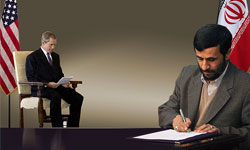
AN is in the foreground, pen in hand, looking pensive; Bush is shown in the background, sitting in a simple chair, reading the letter on his lap. A woman reads the 18-page letter in stumbling Farsi.

That was Iranian tv a few nights ago. Why oh why didn’t I take a picture of the screen?

“When I read that letter,” a friend tells us, “I sat down and composed a 5-page letter to our president myself. Who does he think he is writing in that tone of voice? Everything he thinks he is saying about America is a problem here in Iran.”

“It could not be just 1-page, could it? Or even 5-pages? No, it had to be 18 pages. And can you imagine Bush reading PBUH Jesus Christ(PBUH)… What the hell is that supposed to mean?”

“You know when we lost it? It was during the ceremony to celebrate uranium enrichment with that blue dancing figure.”

“That was so James Bond, wasn’t it?”

“No we lost it long before that… How about when we saw Khomeini in the moon?”


Refs…
The man in the moon

One of the strangest occurrences in the revolution happened in late November 1978. A rumor circulated like wildfire that a pious old lady in the holy city of Qom had found a hair of the Prophet’s beard in the pages of the Qur’an. The same evening an apparition had informed the saintly lady that the faithful would be able to see the face of the Imam Khomeini in the full moon on 27 November. No one bothered to ask how the old lady knew that the hair belonged to the Prophet or whether any such old lady existed in the first place. Within a single day almost everyone had heard the rumor and millions of people gathered on the rooftops on the promised day and waited for the full moon, shouting “Allah Akbar.” Tears of joy were shed and huge quantities of sweets and fruits were consumed as millions of people jumped for joy, shouting “I’ve seen the Imam in the moon.” The episode, a masterly coup was, probably plotted by Beheshti, who had a remarkable understanding of popular psychology in Iran.


La lettre de Mahmoud Ahmadinejad à George W. Bush

From Iran, With Something Less Than Love


Iranian Leaders Watch Dance Celebrating Iran's Uranium Enrichment Capabilities

Tuesday, May 09, 2006

Negotiating with Iranians

So here it is: tips and tricks for negotiating with Iranians.

Iranians do not care if they lose. This makes them dangerous negotiators. People, particularly Iranians, always argue with me on this point, but I remain unshaken.
They are tough because they are so rarely desperate. If they are desperate they either lose big in negotiations or have learned to hide it so well that the other negotiator will eventually fold.

Iranians negotiate everything. It is never safe to presume that you and an Iranian have the same idea concerning the subject of the negotiation. Let’s say that you are negotiating for a chicken dinner. You spend 1-month talking about this chicken dinner. You finally come to an agreement and it is time for the Iranian to present you with your chicken dinner. What you end up is a sandwich that you share with a live chicken. Anyone who has seen The Beverly Hillbillies turkey dressing episode will understand. (I surprisingly cannot find a good reference to this episode online. Let’s see, what I remember is that Granny asks Mr. Dreysdale to dress the turkey for Thanksgiving. He puts the turkey in a 3-piece suit and leads him to the Clampett’s for dinner.)


1. Never threaten.
Iranians do not respond well to threats. State your intentions at the beginning of the negotiations. State the consequences of failed negotiations. It is important to be prepared to accept the consequences before you state them. If you are unwilling to accept the consequences, do not state them.

2. Flatter the Iranian.
Always appeal to an Iranian’s vanity. Flatter him with everything and anything you can imagine. Bring him flowers, cologne, sparkling grape juice. Appeal to his honor and his pride. Call him by honorifics that he does not deserve: like doctor or engineer. Ask him to do you a favor.

3. Do not flinch when insulted.
Just make sure that you find a way to inflict a worse insult, preferably in the form of flattery.

4. Never show desperation.
While you may remind an Iranian of a deadline, you must not show any desperation to meet the deadline.

5. Do not ever trust an Iranian negotiator who acts like he is your friend.
You are about to get screwed big time.

6. Do not warn, act.
Let’s say the negotiations are now failed. At this point, you need to act. If you lack the will to act, then you broker rule 1. You threatened.

WARNING: Everything I wrote above may be wrong. I, myself, am never successful in negotiations with Iranians because I am too optimistic. I always think that this time things will be different...

Sunday, May 07, 2006

110

…Iran’s 911.

Saw a police minibus parked on Jordan Street. A bunch of young girls were crowded around it, their big hair lifting their scarves high above their heads.

What does proper Islamic dress mean? “It’s just fashion,” a friend answers. Holland’s Moroccan women who choose to wear Islamic dress all by themselves would be subject to harassment in Iran. Why? Fashion. That’s all.

A friend was picked up. “I knew enough to call 110 when the military police started harassing me and my friend. I mean, their job is to pick up wayward soldiers, not harass women. I got through to the police. ‘Give the phone to the military police,’ they told me.”

She did. The police told them that the way the two women were dressed was none of their business. “Hand the phone back to the women,” the officer on the other line said.

“We told them to leave you alone and quit harassing you. We will call back in ten minutes to make sure you are okay.”

The police called back in three minutes. They called again in ten minutes and again in twenty.

There are so many different police-type organizations roaming the streets of Iran: the Basigi on motorcycles, traffic cops who lazily direct the traffic into bigger and bigger jams, military police just kind of hanging out, diplomatic police, intelligence, and the police police, to name a few.

This is why when some mullahs got upset about plastic manikin breasts, only a few of the offending plastic breasts actually got sawed off. “Why didn’t all of them get sawed off?” a visiting friend asked me.

“Because the police actually have to *want* to enforce that law. It’s too perverse for most of them.”

Anyway, lesson here… call 110 no matter who approaches you with no matter what kind of id.

Tuesday, May 02, 2006

No way, she’s not American

Tagged as:
Got into a taxi. The driver was speaking funny English to me: “Where from?”

“America.”

“Amrika! Bah bah!”

The four men in the cab started laughing and talking amongst each other. They are thrilled to have an American in their midst. The guy in front is telling the others that I am not really American. “One of her parents must be Iranian. Americans don’t come to Iran.” He doesn’t realize that I speak Persian.

“No, no her husband is Iranian. I am sure.”

The guy up front persists. “No she is maybe English or German.”

“He doesn’t think I am American, does he?”

The driver laughs. “We told him your husband is Iranian.”

The driver begins to sing. The passengers are now discussing Condoleza Rice. “She is funny,” says the guy up front. (Funny=ba namak, which is literally “with salt”)

“No, she is sour,” the driver says. Works better in Persian.

“Now that one before her…”

“Powell?”

“No the big woman. What was her name?”

“Albright,” offers a passenger.

“She’s a woman to love. Big, beautiful. Like me.” The driver is big, tall, and vivacious if not beautiful. “I would like to court her.”

“Albright?”

“Yes. I want me a big American woman.”

“They say that Rice was spurned by an Iranian man and that she now has it in for Iran.”

“I’ve heard that,” I tell them. Probably from Iranians.

“Is it true?”
“I don’t know.”

Monday, May 01, 2006

Happy May Day

AN said that Israel was like a prison, and I responded “Iran is the prison.” I was loathe to board the plane to Iran, but somehow managed to get myself on the flight. Once I did, it was a party in the sky: a plane filled with slightly inebriated Iranians laughing and talking the whole way back to Tehran.

“You must really love your husband to come back,” they joke.

The baby next to us laughed for the entire flight. She had several rows of playmates.

“You must serve more alcohol on this flight than any other flight,” I comment.

“Yes we do. At least we serve more than on any other flight to the Middle East. They board already a bit drunk.”


Iranians make heroic efforts to lead normal lives. They are ignoring the threat of sanctions as best they can, focusing instead on AN’s spending. He is holding huge government meetings all over the country. When questioned on the huge expenditures for each meeting, he is reported to have responded: “We just have tea and bread for breakfast: no cheese.” This has made for some good taxi conversations.

People tell me that AN is going to let women into football games (google blog search blocked for “ahmadinejad women football”) and make the hijab optional (no one believes this). For some bizarre reason having to do with prayer times, Iran decided not to spring forward this year, so now we are only 1 ½ hour ahead of Europe. Some say this is costing Iran tons of money. The cost is most certainly offset by the amount of money the government would have to pay if it served cheese for breakfast.


Sometimes I am happy to be back. Everything is funnier in Iran.

Friday, April 21, 2006

Dazed and Confused

Hard to post about Iran when all the focus is nuclear. I am just dazed and confused...

I am sitting in a library in America. It is a fabulous place. I am surrounded by activity: people typing, whispering, researching, reading, checking out books and "other media." I am not worried about anyone looking over my shoulder or tracing my internet activity. I don't care.

Libraries are such amazing places. Live in a country like Iran for awhile and experience the locking away of knowledge and you'll want to leave your entire estate to your local public library ...

The past two weeks have been filled with family, celebrations, severe storms, and an explosion of spring.

Expect more next week... Until then happy holidays and happy spring.

Tuesday, April 04, 2006

Happy Sizdeh Bedar

One of my favorite holidays!

Part of me wishes I had been in Iran instead of in a tornado shelter with my heart beating fast and the power out. Woke up to find our most beautiful tree snapped in two, part of the roof gone, and our neighbor's fence just sliced at the base like someone sawed it off.

First time I have been scared in a storm since I was a child.

Friday, March 31, 2006

Talking to Americans about Iran

Iranians who read this should know that people in the West are afraid of you. They have no clue who you are. They see you only through Ahmadinejad. “When Khatami was in power, America argued that they could not improve relations because he had no real power. Now America says that Ahmadinejad *does* have real power and that is why they cannot negotiate with him.” That’s K’s take.

Most Americans do not read newspapers which is a shame because most newspaper journalists have a more nuanced view of Iran than the one presented on tv. I see and read arguments all of the time for bombing Iran to prevent Iran from bombing us or some other country. I can’t link to them because I cannot tell if they are parody or real arguments. If they are real, then they are engaged in some strange, circular logic. If they are parody, then they just are not funny enough.

It’s been a long time since we Americans engaged in war on our own soil. We have no idea what it does to a country and to the character of a population. In Iran, people are exhausted from war and revolution. People are just plain tired. Why would they want to face it again? Iranians live a chaotic life. There is no sense of security or peace or calm. When you are there, you barely notice this because it is pervasive. When you leave Iran, you notice. You notice because the part of you that is constantly worried rests and the rest of you feels so full of energy and optimism that you can barely contain yourself.

This is what I tell Americans: there is no other country in the world with a more pro-American population and that people in Iran are kind and generous to me. Especially when they discover that I am an American. People also ask about hijab: I do have to wear hijab, but not a burka or a chador: just a headscarf and a jacket that covers my butt. I can wear pants. I can wear a jacket so tight that every line of my bra shows. I can wear sandals and capris. I don’t have to cover my bangs or the back of my hair. People then ask about Iranian Jews. I cannot answer this question because I really do not know what their lives are like.

One commenter asks “What do Iranians think of AN?” The short answer is I do not know. The long answer is that he is supposed to deliver them from corruption. But that is the long answer.

Anyway, happy Jill Carroll has been freed.

Wednesday, March 29, 2006

American is weird too

So I am on vacation.

America is funny. First meal: a corned beef sandwich on rye with pickles, a potato pancake, and kishke. Yum.

Watched the Daily Show and laughed a lot. The regular news is a pastiche of stories about missing children, child molestors, and murderers. The news channels seem to be yearning for another terrorist attack on American soil. CNN is anchored by a bunch of sentimental airheads (or are they just faking it?). Watching Fox is like being at a party where everyone is on drugs except you. No fun unless you drink the cool-aid.

I am trying to avoid news about Iran. It’s depressing. I am too confused about everything. My cousin said to me, “I used to wonder how you could live in Iran and then I thought, ‘I live in Missouri for god’s sake. I don’t agree with any of our policies. I hate Bush. What’s the difference?’”

There is a difference. I told him. “I know,” he said.

We were at a Bat Mitzvah party. There was an open bar. Teen age boys and girls were dancing together. We were not worried about the police raiding the party. We were drinking moderate amounts of alcohol. No one got drunk. Couples were openly showing affection. (Affection, not lust.) It was relaxing, fun, low-key. I almost cried. Maybe I did cry.

Everyone said they wanted to hear about Iran. We did not really have time to discuss it. It was enough to be together.

Had lunch with my dad’s old farts club. It was me and a bunch of old men. One came over from Turkey, another survived pogroms in Poland, all had lived through WW 2 either here or in Europe. Turns out my 83-year old cousin is a veteran of the Battle of the Bulge. Why didn’t I know? How much don’t I know?

Miss hearing Persian. Miss the activitity. Don’t miss the chaos. Don’t miss pollution. Do not miss the traffic. It’s so cold that I am practically wearing hijab everywhere I go...

Thursday, March 23, 2006

Vacation!

Hoo ha! On our first vacation in a long, long time. The flight from Iran was uneventful. By the end of our flight, not one woman was wearing a headscarf. "You would see more women in headscarves on any flight in Europe or the US," I told K. Turns out I was right. On the US leg of the trip, more women were in hijab in our 10-row area than on the entire flight from Tehran.

At dinner with friends we were talking about Iran. "Sorry to say," said K, "But Iranians who are not in Iran don't know shit about what is going on there."

"We've been gone a day, and I don't know what's going on there!" I added.

It's true. I feel so distant so soon. Here, everyone is talking about sanctions and bombing and the only thing you only hear the worst possible things about Iran. People seem to think that I lived in a state of suspended fear which is not at all true. At the same time, the pressure that you feel in Iran is even more obvious when you leave. When you are there, it surrounds you on all sides like air pressure, so you just kind of get used to it. You know you feel pressure, but pressure feels normal. When you leave, you feel this huge weight released from you: it's almost physical. It *is* physical. I feel like a balloon; I feel so light.

Thursday, March 16, 2006

Burning flags

Still blocking satellite news...at least in our neighborhood. K was watching Iranian news. Lots of nuclear discussion: "America goes against international will" kind of stuff. At one point he started laughing, "They are saying that people were using American and Israeli flags to make the bonfires for Char Shanbe Soori." (Last Tuesday night of the year.)

"Your place was empty," my sister-in-law tells me. "We built a fire at the head of the street. The whole neighborhood came out. There was loud music and dancing. We stopped each car that went by and made everyone in the car get out to dance. Really, it was fun."

The taxi drivers had their own spin "They wanted to stop us from celebrating, so we celebrated even more," a driver tells us.

It really did seem as though all of Tehran was out with fireworks, music, and bonfires. The air in our neighborhood was so thick with smoke that we could not even see.

Hence... the burning flags.

Wednesday, March 15, 2006

Give me your red!

I love the New Year’s festivities in Iran. Last night was the last Tuesday evening of the Iranian year (why it’s celebrated is beyond me…). This day is celebrated with fireworks and bonfires. The tradition is to jump over a fire while saying: Give me your red and take from me my yellow. Our hosts lit 6 small bonfires that we jumped over 3 times each. We were joined by children, a teenage girl who took off her chador when convinced that she should join us in leaping over the flames, a few old men, us middle-aged foreigners, & young and middle-aged Iranians. It was great fun. “Play with fire.” That’s the message.

“We wanted to put a tire on the bonfire to remind us of the days of the revolution,” one of the older men joked. “But we didn’t want to scare the foreigners.”

“Oh they wouldn’t be scared,” our Iranian friend assured the men. “They would just be angry with you for further polluting the air.” This got a hearty laugh.

There were easily 10x more fireworks than last year. “If anyone wanted to bomb Iran, tonight would be the night,” K joked. “No one would notice.” All of our foreign friends expressed fears of Molotov cocktails, but I have never seen anything of the kind. “Where did you get that idea?” Iranians told them. I asked my Iranian friends about it but they just looked at me like I was crazy. “Foreigners think we are violent.” “Iranians told them about the Molotov cocktails,” I tell them.

Thursday, March 09, 2006

That Seventies House

Tagged as:

All of our news channels were blocked the past few days (except VOA: “Their news is 20 years old,” K commented.). Presumably it was to prevent us from becoming alarmed over the nuclear talks in Vienna. Who knows? Monday, K woke me up at 5 in the morning to tell me there would be no sanctions. “There was no evidence of intention to make a bomb.” Of course, the talks were still continuing…

Entertainment in Iran runs to two extremes: the news and mindless entertainment which is how we found ourselves mesmerized by MTV and The Seventies House. Three presidents that served in the 1970s? Eisenhower, Roosevelt, & Nixon. (Not out answers, of course). When was the bicentennial? 1972. Which country held 70 American’s hostage in 1979? Guatemala. This was followed by a disco carwash dance contest.

“And they want to bomb us?!”

Yes. I said “us.” It’s time for a vacation.

Monday, March 06, 2006

Waiting for Sanctions

Tagged as:

We have been trying to think of sanctions that would actually work. Here are a few targeted at the ruling classes:

1. Force the Iranian team to negotiate with itself. (Oops! They already are!)
2. Make them source all materials and services within Iran. (That’ll teach them.)
3. Have the regime try to get money from itself without bribing anyone.
4. Force them to meet deadlines.
5. Don’t serve tea to any Iranian officials.
6. Make them use the Iranian medical system themselves (no intermediaries allowed! Let them see what it’s like to find out the drug they need is only available on the black market.)
7. Don’t let them watch football until they meet the EU’s demands.
8. Force them to drink only homemade Iranian vodka.

Monday, February 27, 2006

Request to news organizations covering the Iran nuclear issue!!!


“Why do Iranians mistrust everything the government tells them, but trust their spin when it comes to the nuclear issue?” We were wondering last night. If you have followed the nuclear issue at all, then you know that it is reported that Iranians support their government in this issue. Yet, when you hear Iranians on the street respond to reporters (and to me and to K…) they always say “We support nuclear ENERGY.” You would be hard-pressed to find an Iranian who would say “We need nukes. We are willing to be isolated for nukes.”

The standard line in Iran is that the West wants to prevent it from having nuclear knowledge and nuclear POWER. Not arms…

Iranians watch CNN, BBC World, VOA, Euronews… I do too. I have yet to hear a reporter say that the West does not want to limit Iran’s access to nuclear energy, just to nuclear arms. It may seem obvious to you, but it is not obvious here. It’s such a simple thing to do. Please let Iranians know the difference between the West’s position and their own government’s spin.

Taxi Talk


“Where else do you have such poverty next to such wealth?” a young taxi driver asked. (A lot of places…) “These rich young men buy $200,000 cars with their father’s money and then lie around all day, while we live in the south of the city struggling to make a living. It breaks your heart. With all that we could have. We have four seasons, oil, good people who have become liars and cheaters, but it is all stolen from us. Sometimes I am just so tired of the pressure.”

“I picked up this American. He did not speak Persian, and I do not have many words of English. I had to take him to the airport. The whole way he was nervous, afraid. I could see him almost shaking. I kept thinking why is he so nervous? And then I realized that I had not shaved for several days, and my beard was full. He was afraid of my beard. He thought I was a terrorist and that I would cut off his head. When we got to the airport he said “Tank you, tank you, tank you,” a thousand times. I helped him with his luggage. Obviously he was happy he still had his head.”

I laughed.

“We have a problem with out religion. It is a religion of force.”

I argued, “No it’s religion mixed with politics.”

“No,” he responded. “It is our religion. We are the ones with all of the terrorists, aren’t we? It is every religion. We are a good people who have become bad with religion just like the Christians were bad a thousand years ago. Now they do not have religion and they are better.”

I said, “No it’s still politics. Islam is the biggest religion in the world, it’s no wonder that it also has its problems.” But he stuck to his guns.

“I always had Jewish friends and Christian friends and Muslim friends and Bahai friends and Zoroastrian friends. We went to each other’s houses. We drank and ate together. We sang and danced together. What do I have against Christians or Jews or Israelis? Nothing. I have nothing against them. My Christian friend came to me and asked, ‘Do you think I am dirty?’

‘Dirty, why?’

‘Doesn’t your religion say that Christians are dirty?’

‘Eeeh baba, what difference does that make? Why would you suddenly become dirty after being my friend for 14 years? Do you think I am dirty?’”


Older man, big, white knit skullcap, loose-fitting maroon suit

“Every night I go to sleep dreaming of waking up to find the American military telling me what to do. This is the dream of many Iranians. The mullahs are terrible. They steal our money. I say they should leave our country. Leave us alone. They have enough money. They can all buy houses in Denmark.” Laughs at his own joke.

“Aren’t you afraid of them?”

“Aren’t you afraid of dogs?” (Actually no…)

Long Time...

...No write


Just sick of politics I guess. I forgot how to write about day-to-day life because it seemed there was no day-to-day life. But there was. There were the mountains, the taxi drivers, the jokes, the kindnesses, shopping, worrying.

Speaking of worrying… In the past 27 years Tehran has grown from something like 4 million to something like 20 million. “That doesn’t include the Afghans,” someone told us the other night. “They try to disappear into the crowd.”

The buildings are still going up. Everywhere we go, there is the sound of jackhammers, the smell of tar, and the sight of steel frames going up into the air. I thought the building would slow down when sanctions were threatened, but it’s sped up. Maybe the owners are worried about increases in the prices of building materials.

“I am so confused,” a recent returnee and very dear friend tells me and K. “I was coming from the airport with my dad, and I asked him, ‘where are we?’ he told me the name of the street. I always remembered this street as so beautiful, and now it was just ugly. Really ugly. Tehran is an ugly city.”

I have learned to find Tehran beautiful in its own way.

Thursday, February 16, 2006

Losing my sense of humor…

Tagged as:
Sung to the tune of REM’s song…

“Did you know that a German paper has published a cartoon of the Iranian national team as suicide bombers?”

I laugh. K doesn’t think it’s funny. “It’s an insult to the Iranian people, not to our government.”

“I am sure that they did not caricature the individual players.”

“It is still our team.”

The paper's editors are clueless as to why portraying athletes as terrorists might have outraged Iranians. "The absurdity of the situation is obvious," editor Gerd Appenzeller writes in an opinion piece. No one, he argues, would ever believe that the Iranian team would show up armed -- nor would the Bundeswehr be present on the soccer pitch. "The illustrator makes that clear," he explains. "The Iranians' faces, just like those of the Germans, are those of peaceful everyday people -- the boys next door" -- not rabid terrorists. The paper said it "regretted the Iranian reactions to the caricature" and that it would be hard to explain the domestic political debate over deploying the Bundeswehr during the World Cup to the Iranians.


Don’t joke about football in Iran… the riots will really start!

“Iran deserves it. They advertise for suicide bombers, train them, reward them. What do they expect?”


“Now an Iranian paper is sponsoring a contest for cartoons about the Holocaust.”

“That’s sick.”

“That’s where free speech gets you…”

“No one is making fun of the Iranians who were gassed during the war with Iraq. They are not the subject of cartoons. Surely you see the difference.”

“Of course I see the difference. But when I go to Europe people see me as a terrorist. That’s what bothers me.”

Iranians know that the rest of the world sees them as terrorists. It really, really disturbs them. But they are out of control of their image abroad. It’s been hijacked.

“Why can’t we be a normal country?”

“What’s normal?”

“You know, modern. A place where people are not scared.”

I have said this before, and I’ll say it again: the biggest lesson I have learned in Iran is that free speech is more important than democracy. Iranians all have opinions. They know how to talk, and they speak their minds. What they cannot do is organize. I can tell you what I think as long as I don’t tell three strangers what I think. I can disagree with government actions as long as I don’t try to get anyone else to act on my ideas. Talk is okay. Action is not. Free speech is action.

Gene (in the comments section) asks about the bus drivers in Iran. Do people know what is going on? I don’t know. We have heard sympathy for them. But it’s very quiet. Think of these drivers… They are AN’s natural constituents: poor, hardworking, most likely observant. And they are arrested and put in prison for demanding living wages! AN would probably call them “imaginary,” just as he did when Christianne Amanpour asked him about the plight of people similar to these drivers.

This is a regime that punishes its supporters more than its detractors. There is absolutely no news of the plight of the bus drivers in Iran. There is very, very little discussion of it.

Well, I'll make sure to look for the union label and remember the depth of gratitude I owe to the unions and guilds who spent centuries creating dialog, free speech, and democracy. (Do you think that might actually be the case? I am not a historian of democracy or of unions/guilds... just wondering.)

Tuesday, February 14, 2006

Nerves & Giggles

Tagged as:

Irritable bowel syndrome, ulcers, panic attacks, headaches, and other nervous disorders… Almost everyone I know in Iran suffers one of these ailments.

One more: “Why don’t Iranians just overthrow their government…” and I am going to puke. Ever overthrown a regime? Not an easy thing… I assure you.

“My aunt has the bill, I swear I have seen it myself, for the 4 bullets that were used to execute her son. When she asked: ‘where is his grave?’ she was shown a mass-grave where hundreds of others were also buried. This was 20 years ago.”

We were talking about the cartoon furor which, despite what you might think, is not such a furor in Iran. Not that Iranians are not observant Muslims, just that they are sick to death of the manipulation of Islam for political ends. (For those of you who read Dutch:read Erdbrink's eye-witness account of the demonstration in front of the Danish embassy.)

“The mullahs have always controlled our understanding of Islam,” a friend tells me. “They are losing that control here. Partly it’s because of the revolution. We have to study the Koran in school. Now, we ourselves know what is in it. We don’t need the mullahs.”

Iranians also have experience with limits on their freedom of humor. It was a capital crime to make fun of a mullah. Now it’s the number 1 Iranian past time. (How else could a frankly pro-Islamic film like Marmulak get banned? BTW, if you have not seen it, see it. It is great!) As a rule, Iranians are highly unlikely to support any efforts to limit their freedom of humor.

“Did you know that it is impossible to pick a mullah’s pocket?” a friend asks me. “It’s just too deep.”

Monday, February 06, 2006

Sister called, “Has cartoon-mania hit your neighborhood yet?”
“If it’s not on the cartoon channel, I don’t see it.”
I laughed.

The cartoons are now part of the nuclear crisis in Iran.

“The Muslim world is vigilant”, Haddad-Adel said. “As they have expressed outrage and protest at the desecration of the prophet of Islam, they will not keep silent against bullying remarks under the pretext of a resolution of the UN nuclear agency”.


“Give me a letter asking the American soldiers not to kill me,” a friend asks me. It’s half a joke, half serious. Iranians really worry about the effects of being referred to the Security Council.

“You mean even the Russians voted against us?” a taxi driver asks in disbelief. K explains for him.

“Only Syria, Venezuela, and Cuba voted against the resolution.”

“Syria, Venezuela, and Cuba? You mean the Chinese voted against us too?”

“The IAEA does not trust that Iran has told the full truth.”

The driver just accepts this. Like very other Iranian, he knows there is no arguing with that comment.

“Why do we have such bad luck?” the driver asks.

“Well we have a president who cannot even accept the fact that 6 million Jews were killed in gas chambers and asks for Israel to be wiped off the map. Not even the Palestinians ask for this, but we have to.”

“What difference does that make?”

“What if Bush said that there was no war with Iraq and that over 1 million people did not die in that war? How do you think that would make us feel?”

Destination reached. An informal gathering that includes Iranians, Iraninan-kharigi, an Indian or three or four, some Australians, and us…

Talk of cartoon mania. “I could start a riot in India with these two posters.” Shows us the Ali and Hossein posters that grace the streets of Iran.

“Some Iranians tell me that those paintings are not really of Ali or Hossein, but of their friends.”

“I was visiting family who showed me a light-up painting of Ali. They did not say it was of one of his friends.”

“We also have a friend who keeps a 300-year old painting of Mohammad hidden in her bedroom. ‘They say there are no paintings of Mohammad, but I have one,’ she brags.”

“But still, it’s a pretty lame expression of free speech. Especially given the fact that the Muslim communities in Northern Europe feel so marginalized and under attack, which, of course, does not excuse the reaction.”

“Muslims are thinned skin.”

“You have to have a thicker skin in this world…”

After much discussion an agreement was made: “Mono-cultures are bad.”

Well my friend the entomologist agrees. She always told me that mono-cultures can be quickly destroyed by disease.

Saturday, February 04, 2006

Adventures of Mr.Behi: We still can or we never could?

Adventures of Mr.Behi: We still can or we never could?

Just enjoying this post from Mr. Behi:

There is a lovely story about one of the old comic legend in Iranian literature that talks about the day he shouted in the middle of the main square of his town that he was still as powerful as when he was 20. People gathered around that 60 year old guy and asked for proof.

He took them to the country side where there was a big rock along side of the river. He started pushing the rock so hard for some minutes and then gave up. After restoring his breath he claimed: "See, I could neither move this when I was 20".

The Iranian president claimed :" We STILL have means to confront the west".

Cartoon-mania

Speaking of sense of humor…

Cartoon-mania has swept the airwaves. Free speech? Blasphemy? K and I have been discussing it. We argued a bit about free speech. I have been disgusted – yes that is the right word – by the arguments on both sides: the cartoon supporters and the cartoon detractors. Both are a bit incoherent and dogmatic. As if free speech demands the printing and reprinting of the cartoons ad nauseum… and as if blasphemy is a legitmate legal ruling in today's world.

In America
, we have come to a kind of truce. What do most Americans know? That in polite society only Jews make Jewish jokes; only Blacks use the “n” word; only Poles make Polish jokes… and everybody gets to pick on the dominant culture. That’s the way that minorities protect themselves. It wasn’t an easy truce to come to… and it is violated. I see it as a manners issue, not a free speech issue.

Party Talk

Tagged:
We attend more parties in Iran in two months than we do in two years elsewhere.

It’s not like you can say “Hey, let’s go for a couple of beers after work.” No, you have to organize something, go to someone’s house, climb a mountain… something like that.

There are certain patterns to parties. For instance, Iranian parties are filled with couples who look like they stepped out of a high-school prom photo even though they are way over high-school age. You always have somewhere to wear your prom dress or suit in Iran, that’s for sure. Especially if that prom dress is strapless and low cut and that suit is trendy but not a tux. Some Iranian parties involve loud music and dancing. Others involve chatting in a living room, playing cards and backgammon. Of course there are the rumored orgies, but I have never met anyone who was actually invited to one.

Anglo parties are pretty casual with women and men complaining about hijab and Iran, dressed in jeans, and little to no effort on hair and makeup.

Intellectual parties are filled with women in long embroidered shirts, men in natural fiber vests, alcohol, some excellent dancing by the older set (the younger set just sits and talks), and lots and lots of talk.

They *can* be mixed.

“Why didn’t I study the culture of Brazil? Why did I have to choose the Middle East? I miss fun,” a friend lamented.

“When I go home, I am amazed at the level of fun. I mean I watched movies in a parking lot, drinking a beer. That was fun! I would be willing to fight for fun.”

“I used to think sitting outside having a beer in a café in a park was a bore. Now I dream about it.”

“It’s never boring in Iran, but it isn’t all that fun either.

“Which is why everyone feels that the situation in Iran is so unstable. I mean, if it were fun here, then people would feel more secure. They would feel like there was a future here.”

“Every bit of fun is stamped on.”

My friend in America always told me that paranoid powers have no sense of humor. “They say that the Nixon administration had no sense of humor.” Well this one filters satire on the internet and puts political humorists in prison.

(BTW, wanted to post this on Wednesday night, but I was late for a party)

Monday, January 30, 2006

Just north of Tehran


Can you believe that a short car ride north of Tehran you can be in the mountains hiking in deep snow? Wish I could ski...

Snow!

Sunrise in Northern Tehran. Gotta' love that snow.

Negotiation

Tagged as:

…Spent the week watching K negotiate a relatively small contract with Iranian vendors. The days were filled with offers immediately rebuked, prices rising 20% in a matter of hours, and general miscommunication, subterfuge, and ambiguity.

“Why didn’t you just send them packing?” a European friend asked us when we described our week to her.

“We were agreeing,” K explained. Our friend gave a knowing laugh.

Finally a contract was signed. Everyone seemed happy.

The next day the signatory an K were in a meeting. “I need 3 weeks more to complete the project.”

“You signed the contract.”

(3-hour discussion boiled down to 2 sentences.)

The signatory broke the contract, and it all started again with someone new…

So when we heard Jack Straw say that the Iranians were the most difficult negotiators he had ever dealt with, all we could do was laugh.

Thursday, January 26, 2006

Taxi Talk

Tagged as:

Got into a car that smelled like cat pee… I imagined that the windows were left open one night and Tehran’s cats made use of the car.

We passed a fancy hair salon for men with wall length headshots of long haired men. “I’ve never lived anywhere else where men were as fussy about their hair,” I commented.

“Hey,” said K, “it’s all we’ve got.”

“If you go to South Tehran with that kind of hair, you get arrested,” our driver told us. “Too much gel and they get you. We have no freedom.”

That got him started…
“I don’t understand why we are making all this fuss about nuclear energy. We have bombs with anti-Israel slogans painted on them and we want to know why Israel is afraid of us having nuclear capabilities. I cannot understand why our two countries are not friendly in the first place. We were friends. We Iranians have nothing against Israel. Why do we have to pretend that we do?”

I am thinking that my Persian is failing me. I just sit and let the driver do all of the talking. When we get out of the car, I ask K if I understood him correctly. “You did,” he tells me. “A lot of Iranians feel the way he does.”

The day before an accountant told me that Israelis were crazy. “Don’t you agree?”

“Well, given the fact that so many of them were born in Iran, I would say that if they are crazy you are crazy.”

“You got me,” he admitted.

Iranians are so baffled by the world’s response to AN’s anti-semetic comments. I have said this over and over: they have no idea of the true history of World War II. They never heard of the holocaust. They cannot understand the emotional/historical impact of AN’s rhetoric. Frankly, most Iranians cannot understand why the rest of the world pays attention to AN when they themselves do not.

P.S. Thanks to Troy Z. for this link . Great insight...

Wednesday, January 18, 2006

There is a mouse in the wall and it has ears…

New Persian lesson of the day… In Iran it’s not that “the walls have ears,” but that "the mouse in the wall has ears…"

I was speaking with a group of Iranians about nothing in particular and learned that saying as well as this one: “He left his hat backstage…” which is what you do when you lose control of a situation.

My “teachers” were calling me Miss America. “I just cannot remember your name,” the ringleader explained. “I hope you do not mind being called Miss America.”

“Why don’t you invite Bush to visit you here?” One asked me.

“Do you really want a visit from Bush?”

“I think if Bush came to Iran, he would see what a peaceful people we are and he would put the whole world’s minds to rest. Don’t you agree?”

I laughed. One of the group added, “When you do not visit Iran, you think we are an awful people… that we are terrorists, right?”

“Right,” I agreed. “That is the way the world sees you.”

“But we are nice. We do not want to fight anyone. We are peaceful.”

“You are,” I agree.

Iranians are worried about being bombed. Many are already making predictions about where. Apparently housing prices have dropped in a certain neighborhood of Tehran.

Oprah

Tagged as:

I caught an episode of Oprah when her guest was Jamie Foxx. Laughed a lot. My host said to me, “This is what gives life: a comedian. This regime just wants to make us cry all the time. They want to take away our laughter.”

The next day, I was in a taxi. The driver said to me: “We never laugh anymore. All we do is cry. That’s all we are allowed to do.”

“Don’t you watch Barareh Nights?” I asked.

“You got me,” he answered. “That *does* make me laugh.

Barareh Nights is the current rage on Iranina tv. It is really stupid if you are not familiar with current Iranian culture. If you are, then it is funny: the ridiculous accents, the silly scenarios, the jealousy, bribery, and petty vindictiveness. It’s all funny. JIGGAR… (that last endearment is for my Iranian readers...)

Lotsa Snow

We watched as the snow just fell and fell and fell. For days it has been so overcast that you could not see the mountains a few miles away (thank god it was not pollution blocking our view). For two days now, we have had sun which has has revealed the white moutains surrounding Tehran. (I promise to post pics) There are lots of tall pines in Tehran, so it did not take too much snow to make the northern and colder part of the city look like a Christmas postcard.

All this and nuclear negotiations too! For 2 years I have been arguing with Iranians about their nuclear ambitions. Sharon’s stroke has provided me with yet another argument. You’ll note that Sharon is being treated in a hospital in Jerusalem, not in Paris or Berlin or New York. Which head of state in the rest of this region would receive critical care within his own country? Iran has great doctors, minimal medical ethics, little investment in infrastructure, and almost nothing invested in research. Yet, the official line is that the West is keeping them from “scientific” research. Iran could have brilliant, groundbreaking medical research and medical care if the priorities were on healthcare instead of proving to the world they can do something the Americans did 60 years ago.

All the n-bomb does is bring you more enemies.

Sunday, January 08, 2006

Isolation…


I need to reopen the conversation on isolating Iran through sanctions. Let’s start with this presumption: the mullahs are not going anywhere. They will not be overthrown or pushed out because of a few puny sanctions. In fact, the political-fundamentalists among them will be strengthened by sanctions because it will mean that most of the population will become dependent on their good graces. Sanctions also mean that the group in power will become the lone voice inside of Iran. It’s already hard enough to have any diversity of opinion.

The regime welcomes the threat of attack. The only way for them to unite is against a common enemy. Unity is what they long for. Unity is what they do not have. Achieving unity presupposes a common enemy.

So, isolating Iran plays into the hands of the political-fundamentalists by making them an even stronger voice in this country and by giving them an enemy. Hurray.

Iran is not waiting to become America or Europe. Iran minus the regime does not equal freedom or democracy as much as Iranians would like you to believe. You need to have a public debate and free speech before you get democracy. That’s a lot harder than it might sound.

The publicly sanctioned arguments are those of degrees here in Iran. They do not represent true opposition. Those involved meticulously filter the voices that get heard. When they fall out with those in power, their voices are also filtered. Lo and behold! They are surprised that after a career of keeping others quiet, they can longer be heard.

Wednesday, January 04, 2006

I am a "cosmopolitan"

Hurray! A category for me.

Taxi Talk


(Visual: Driver, big bear of a man in his late 50s. Close-cropped white hair. Expansive smile.)

Me: “Wow. There is so much traffic today.”
Driver: “It’s all from British intelligence. It’s their way of disrupting our lives.” (jokes)
K: ”It’s a good thing my wife is American.”
Driver: “We wish the CIA was here tying up traffic. Long live the CIA! When are they getting here?”

Perhaps he was secretly referring to the goldmine of information provided by the CIA itself: [CIA Gave Iran Bomb Plans, Book Says]

*****

(Visual: Driver small bear of a man, young: early to mid 20s; close-cropped dark hair, goatee.)

Driver: “Islam is not our religion. We should all be Zoroastrians. That’s really ours. We pray in Arabic! What language do you pray in? I am sure it is not Arabic. Can you imagine the imposition of this religion on our culture?

Actually, I can. That’s the way the world works. But I keep my mouth shut, and he continues:

“How would you feel if your husband took another wife? I’ll tell you that I would never approve of my wife taking another husband! Why should she be happy if I took another wife?”

*****

(Visual: Driver, small, thin, older: maybe early 60s; white knit cap on his head typical of village men, grey wool suit coat)

Driver: “Our country has really fallen apart. We have no freedom, no nothing anymore.”

Me: “I always wonder what people mean when they say ‘freedom’?”

Driver: “We were freer during the time of the Shah. We were going to be more free. At least we could drink and women could wear whatever they wanted. Now we can’t even do that. Now women wear almost nothing because they are forced to wear hijab. Sometimes I think it would be better for women to walk around naked than to wear what they wear now. There is too much pressure. All of our lives are lived under pressure.”

ShareThis