I am so sad…
For so long, our blog has been exempt from the kinds of commenter fist fights that we are having now.
Listen… Despite what you all might think, I love Iran. Yes, you read correctly. I love the country. That might be why both Keivan and I can be so critical sometimes. It is out of a kind of passion for what Iran is, was, and can become.
Iran is far from monolithic or doomed… It is diverse and delightful and filled with people who are unbelievably welcoming. Can you imagine Iranians traveling to America or Europe and being met with sincere kindness by 99.9% of the people they run across? Yet, when I travel Iran, I *am* met with kindness. Yes me. An American. I tell everyone who asks that I am American. Yes I do. I tell everyone. I tell the Revolutionary Guards and the soldiers and the police and the school girls and their mothers and brothers and fathers and friends. I tell cab drivers and business men and oil execs and refugees. Everywhere I go, I am met with kindness. When Iranians say to me, “It’s your government we hate, not you.” I say, “The government represents me. I may not have voted for it, but you must hold me and other Americans responsible for its actions.” Yes. They should, but they don’t.
The West sees images of Iranians throwing smoke bombs and burning flags and shouting down with America… You don’t see the 16-year old girl trying out her English with me. You don’t see the soldiers who greet me with jokes. You don’t see the families who have served me countless dinners. You don’t see any of this.
The West has chosen to demonize Iran. I don’t agree with Iran’s politics; I don’t agree with its legal system; I don’t agree with a lot of things here. Iran is flawed. Well aren’t we all…?
Do I have to turn off the comments for awhile? I will start deleting comments that are not civil and self-serving. I hate to do that... I will not delete comments of people who disagree with me or others as long as they are civil. You are on notice.

Showing posts with label travel. Show all posts
Showing posts with label travel. Show all posts
Saturday, April 21, 2007


Wednesday, November 22, 2006
Yazd...
Categories: iran, travel
Having problems uploading images will try again later... (Sunday maybe)
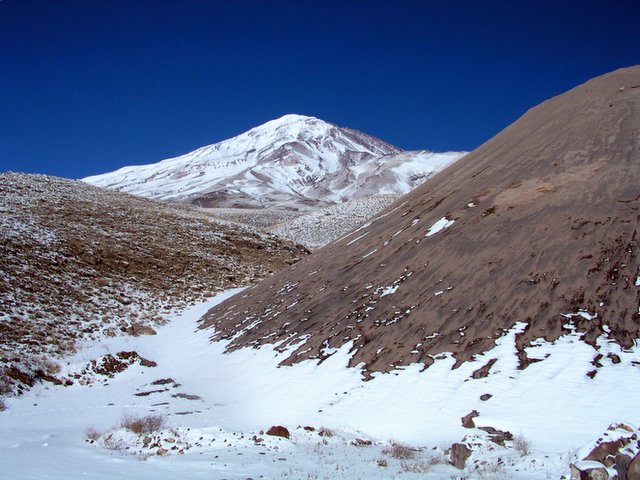
The thing about traveling in Iran is that you aren’t just traveling through space, you are traveling through time. The space is already dramatic enough… a short trip takes you from Tehran north into a lush forest and south into the desert. It also takes you to a village where people heat with wood or an oasis where people gather water from an underground stream.
You can go from the emerging cosmopolitanism (yes, even here) of Tehran to fundamentalist Islamic culture in a short drive.
Our trip to Yazd (Keivan wrote two trip reports and is working on a third, so I will just write about Yazd) was a bit like that. I mentioned earlier that on the way, we met Moses -- that was not his name, but he looked more like Moses than Charlton Heston or Michaelangelo’s statue – and his wife who was equally Old Testamenty in a long embroidered dress, with two thick black braids, and a well-groomed unibrow (not a contradiction! Among some Iranians a woman with a well-groomed unibrow is sexy. At first I thought it was bizarre; now I also find it attractive.) The two run a bizarre guest house in an oasis somewhere in the desert, so who knows, maybe they wandered there.

But Keivan will tell you about that…
I’ll tell you about Yazd, a city on the Silk Road that is just amazingly beautiful. We hired a guide to ensure that we didn’t get lost its mazelike streets. He took us to all the highlights: the huge towers of silence where the Zoroastrians used to leave their dead to be eaten by vultures. “The practice stopped when the city got too close to the towers and people started finding bits of bodies in their gardens,” our guide explained. Boys on motorbikes rode up and down the hills leading to the stone tanks that used to hold the dead.
It was Al Qods Day when we were there, which means huge anti-Israel, anti-American rallies. Our part of Yazd, despite being a revolutionary city, had a pretty lukewarm rally when the cameras were off… turn the cameras on and you see something else entirely. The group we saw seemed to be barely interested. Its leader tried to get the crowd worked up, but to no avail.
I know that we just saw one small leg of the march; I know that huge crowds turned up, but what we saw was impressive for being so unimpressive. I was, frankly, relieved.
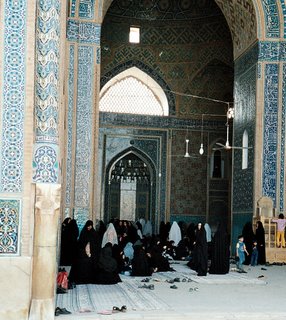
The highlight of our day was a visit to the Friday Mosque where huge groups of women were participating in a gathering said to be of help women with problems getting pregnant. The women had taken over the mosque and were exchanging fabric and measuring each other for colorful chadors. Other women were there for help finding a man. First they read their fortunes from the inside of walnuts (like tea leaves or coffee grounds); then they climbed to the dome of the mosque and walked around it 7 times while saying special prayers.
What?
You heard me. Walnuts, fabric exchanges, and circling the dome…
“The 135th generation of David is buried here,” our guide told us. “Every year, Jews from all over Iran make a pilgrimage to his grave. The funny thing is that when they leave there is no sesame halvah left anywhere in Yazd.”
Some traditions are the same all over the world…
Having problems uploading images will try again later... (Sunday maybe)
The thing about traveling in Iran is that you aren’t just traveling through space, you are traveling through time. The space is already dramatic enough… a short trip takes you from Tehran north into a lush forest and south into the desert. It also takes you to a village where people heat with wood or an oasis where people gather water from an underground stream.
You can go from the emerging cosmopolitanism (yes, even here) of Tehran to fundamentalist Islamic culture in a short drive.
Our trip to Yazd (Keivan wrote two trip reports and is working on a third, so I will just write about Yazd) was a bit like that. I mentioned earlier that on the way, we met Moses -- that was not his name, but he looked more like Moses than Charlton Heston or Michaelangelo’s statue – and his wife who was equally Old Testamenty in a long embroidered dress, with two thick black braids, and a well-groomed unibrow (not a contradiction! Among some Iranians a woman with a well-groomed unibrow is sexy. At first I thought it was bizarre; now I also find it attractive.) The two run a bizarre guest house in an oasis somewhere in the desert, so who knows, maybe they wandered there.

But Keivan will tell you about that…
I’ll tell you about Yazd, a city on the Silk Road that is just amazingly beautiful. We hired a guide to ensure that we didn’t get lost its mazelike streets. He took us to all the highlights: the huge towers of silence where the Zoroastrians used to leave their dead to be eaten by vultures. “The practice stopped when the city got too close to the towers and people started finding bits of bodies in their gardens,” our guide explained. Boys on motorbikes rode up and down the hills leading to the stone tanks that used to hold the dead.
It was Al Qods Day when we were there, which means huge anti-Israel, anti-American rallies. Our part of Yazd, despite being a revolutionary city, had a pretty lukewarm rally when the cameras were off… turn the cameras on and you see something else entirely. The group we saw seemed to be barely interested. Its leader tried to get the crowd worked up, but to no avail.
I know that we just saw one small leg of the march; I know that huge crowds turned up, but what we saw was impressive for being so unimpressive. I was, frankly, relieved.
The highlight of our day was a visit to the Friday Mosque where huge groups of women were participating in a gathering said to be of help women with problems getting pregnant. The women had taken over the mosque and were exchanging fabric and measuring each other for colorful chadors. Other women were there for help finding a man. First they read their fortunes from the inside of walnuts (like tea leaves or coffee grounds); then they climbed to the dome of the mosque and walked around it 7 times while saying special prayers.

What?
You heard me. Walnuts, fabric exchanges, and circling the dome…
“The 135th generation of David is buried here,” our guide told us. “Every year, Jews from all over Iran make a pilgrimage to his grave. The funny thing is that when they leave there is no sesame halvah left anywhere in Yazd.”
Some traditions are the same all over the world…
Monday, November 20, 2006

Sunday, November 19, 2006

Saturday, October 28, 2006
Next to Natanz
Categories: iran, travel,
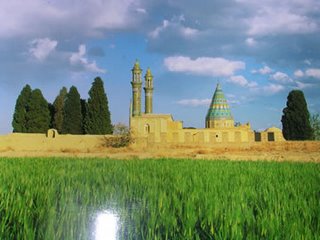
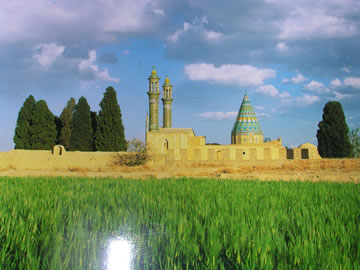
Keivan's account of day 2 of our road trip. All pictures shamelessly stolen...Actually, we are having problems uploading images... so will update.
I am happy to sit in the front seat of the car. On my way to Kashan the day before, when I was sitting 7 hours in the back of the car, I had a lot of time to think of ways to get the women to let me sit in the front seat for the rest of our trip to Yazd. When I realized that I could sit in the front without any tricks or games it made me feel very good.
Kay is driving; we agree to eat in the car in order to save some time. It is not even a couple of minutes after leaving Fin Garden just outside of Kashan when we get lovely bread, cheese, and tomato sandwiches passed to us from the back of the car where Esther and Cay are sitting.
Can you look at the map and tell me how far we are from Natanz? Kay asked me.
She shows me a map of Iranian highways. I guess she doesn't know that we Iranians cannot read maps. I take the map and at the same time I get a sandwich to eat; I have the map on my legs trying very hard to find first where we are: I am not sure if Kay realized that I was having such a hard time just finding Natanz.
We are almost 80 kilometers from Natanz where we will stop for a short visit to a 1000 year old Sufi mosque with the attached 700 year old Imamzadeh-ye Abd al-Samad – that is if we can find it.
The Imamzadeh Abd al Samad caretaker must be so happy that not long ago the city of Natanz became internationally know for its nuclear site. I am almost 100% sure that more people have visited this small town since theat announcement than in the last 1000 years. Now Ahamdinejad has even added the nuclear facility to the list of Iran’s tourist attractions.
Driving by the site, I finally realize for the first time with my own eyes why Americans and Israelis (since I don't want to make my British travel companions mad/sad, I will leave them out of this) are so mad about this site. It looks like they cannot do anything to it to destroy it since behalf of a couple of anti-airplane guns everything else is deep underground.
I have to admit that I am really happy to see it with my own eyes, but now that I am seeing it I realize again that what I am seeing is not any different than seeing it on TV. What you see on tv is what you get in person, and what you get is not much. I wish I could see those guys coming out with the barrel deep underground or wherever it is: that's got to be the most famous shot of Iran's nuclear facilities. It is true that all of us Iranians should be happy with our achievement making anatomic bomb nuclear energy, because if you look carefully at the famous barrel picture, there are at least 7 people holding it. That just shows how effective we are with time, resources, and work management.
I have seen a lot of mosques, but Imamzadeh Abd al Samad which was a big Islamic complex in the 14 century, is now on the top of my list of places to visit if you are in Iran. It is really gorgeous and fucking fantastic, you can never imagine you will see something like this in a very small town in the middle of the country. It took us 5 times going up and down the road to find it, and if it was not for the 35 people we asked for directions we would still be looking for it.
Imamzadeh Abd al Samad again proves my theory that Iranians cannot keep places well. If this old building was in any European country, you would have an extra beautiful place to visit. There was no sign on the highway to it, when you are inside you can feel the place screaming for help. I know you cannot just start fixing things if you don't have resources, but my question is how can we say we don't have resources when we spend billions on things we don't need? So much money is wasted in Iran and we still don't have money for renovating lovely places like Imamzadeh Abd al Samad.
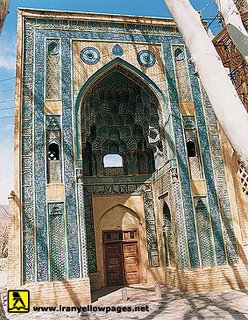
Picture taken from internet... website on pic... Not as good as the picture we would have taken had our camera not gone on the fritz...
We still have a long way to go. In the car we talk about almost everything, or should I say: Esther is talking non-stop and Kay and Cay are responding with their low voices. I have a hard time to follow what they are saying so I only make small comments here and there and usually nobody cares.
One thing I need to advise all Iranians traveling with their foreign friends not to do is; don't tell them that Iran has 4 seasons, Oh man, you cannot do that. Even though we may know we have the best spring, summer, fall, and winter, don't say that loud and clear to any foreigner. They will never stop laughing at you and will use it against all of your other correct points.
The minute I mentioned our four seasons they started a long and painful attack. In the next couple of days, Kay alone brought this subject up 7,123, 456 times and every time I knew where we were heading.
Oh Yeah, this is the most ridiculous of all, Kay said.
What do you mean? Cay asked in surprise.
Iranians think they are the only country in the world that has 4 seasons, Esther answered. I always make fun of them, Esther continued
Do you mean 4 seasons at the same time? Cay asked.
Esther said, No, just 4 seasons. I don't think Cay knows that Esther and Kay and I are having political discussion.
Oh god what did I do? I asked myself. I cannot say to Kay you may have 4 seasons (I still don't believe it) but you also have 364 days of rain during the year. I know if I say that I will be in big trouble.
This thing about 4 seasons made our trip more fun. We or better to say they referred to it as much as they could, and we did that for different reasons.
Driving to Nain we realize we may be way late with getting to our evening’s final destination in the middle of the fucking desert.
Our visit to Nain impressed my travel companions more than it did me. It was fun to get there right before eftar. In the last 10 minutes before prayers a lot of men and women showed up at the old tenth century Jameh mosque. The sky was impossible blue and the mosque looked beautiful against that sky. We drank tea. When it was time to leave, Esther got ready to drive. It was her first time driving in Iran, and I was getting nervous.
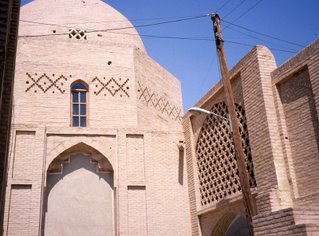
Photo taken from the Wikipedia site on Nain... obviously not as good as the one in our heads...
Keivan's account of day 2 of our road trip. All pictures shamelessly stolen...
I am happy to sit in the front seat of the car. On my way to Kashan the day before, when I was sitting 7 hours in the back of the car, I had a lot of time to think of ways to get the women to let me sit in the front seat for the rest of our trip to Yazd. When I realized that I could sit in the front without any tricks or games it made me feel very good.
Kay is driving; we agree to eat in the car in order to save some time. It is not even a couple of minutes after leaving Fin Garden just outside of Kashan when we get lovely bread, cheese, and tomato sandwiches passed to us from the back of the car where Esther and Cay are sitting.
Can you look at the map and tell me how far we are from Natanz? Kay asked me.
She shows me a map of Iranian highways. I guess she doesn't know that we Iranians cannot read maps. I take the map and at the same time I get a sandwich to eat; I have the map on my legs trying very hard to find first where we are: I am not sure if Kay realized that I was having such a hard time just finding Natanz.
We are almost 80 kilometers from Natanz where we will stop for a short visit to a 1000 year old Sufi mosque with the attached 700 year old Imamzadeh-ye Abd al-Samad – that is if we can find it.
The Imamzadeh Abd al Samad caretaker must be so happy that not long ago the city of Natanz became internationally know for its nuclear site. I am almost 100% sure that more people have visited this small town since theat announcement than in the last 1000 years. Now Ahamdinejad has even added the nuclear facility to the list of Iran’s tourist attractions.
Driving by the site, I finally realize for the first time with my own eyes why Americans and Israelis (since I don't want to make my British travel companions mad/sad, I will leave them out of this) are so mad about this site. It looks like they cannot do anything to it to destroy it since behalf of a couple of anti-airplane guns everything else is deep underground.
I have to admit that I am really happy to see it with my own eyes, but now that I am seeing it I realize again that what I am seeing is not any different than seeing it on TV. What you see on tv is what you get in person, and what you get is not much. I wish I could see those guys coming out with the barrel deep underground or wherever it is: that's got to be the most famous shot of Iran's nuclear facilities. It is true that all of us Iranians should be happy with our achievement making an
I have seen a lot of mosques, but Imamzadeh Abd al Samad which was a big Islamic complex in the 14 century, is now on the top of my list of places to visit if you are in Iran. It is really gorgeous and fucking fantastic, you can never imagine you will see something like this in a very small town in the middle of the country. It took us 5 times going up and down the road to find it, and if it was not for the 35 people we asked for directions we would still be looking for it.
Imamzadeh Abd al Samad again proves my theory that Iranians cannot keep places well. If this old building was in any European country, you would have an extra beautiful place to visit. There was no sign on the highway to it, when you are inside you can feel the place screaming for help. I know you cannot just start fixing things if you don't have resources, but my question is how can we say we don't have resources when we spend billions on things we don't need? So much money is wasted in Iran and we still don't have money for renovating lovely places like Imamzadeh Abd al Samad.

Picture taken from internet... website on pic... Not as good as the picture we would have taken had our camera not gone on the fritz...
We still have a long way to go. In the car we talk about almost everything, or should I say: Esther is talking non-stop and Kay and Cay are responding with their low voices. I have a hard time to follow what they are saying so I only make small comments here and there and usually nobody cares.
One thing I need to advise all Iranians traveling with their foreign friends not to do is; don't tell them that Iran has 4 seasons, Oh man, you cannot do that. Even though we may know we have the best spring, summer, fall, and winter, don't say that loud and clear to any foreigner. They will never stop laughing at you and will use it against all of your other correct points.
The minute I mentioned our four seasons they started a long and painful attack. In the next couple of days, Kay alone brought this subject up 7,123, 456 times and every time I knew where we were heading.
Oh Yeah, this is the most ridiculous of all, Kay said.
What do you mean? Cay asked in surprise.
Iranians think they are the only country in the world that has 4 seasons, Esther answered. I always make fun of them, Esther continued
Do you mean 4 seasons at the same time? Cay asked.
Esther said, No, just 4 seasons. I don't think Cay knows that Esther and Kay and I are having political discussion.
Oh god what did I do? I asked myself. I cannot say to Kay you may have 4 seasons (I still don't believe it) but you also have 364 days of rain during the year. I know if I say that I will be in big trouble.
This thing about 4 seasons made our trip more fun. We or better to say they referred to it as much as they could, and we did that for different reasons.
Driving to Nain we realize we may be way late with getting to our evening’s final destination in the middle of the fucking desert.
Our visit to Nain impressed my travel companions more than it did me. It was fun to get there right before eftar. In the last 10 minutes before prayers a lot of men and women showed up at the old tenth century Jameh mosque. The sky was impossible blue and the mosque looked beautiful against that sky. We drank tea. When it was time to leave, Esther got ready to drive. It was her first time driving in Iran, and I was getting nervous.

Photo taken from the Wikipedia site on Nain... obviously not as good as the one in our heads...
Wednesday, October 25, 2006
Trip report, part 1
Categories: iran, travel, kashan
Keivan's tale of our trip... Pictures are from postcards due to camera malfunction.
How can I get to Kashan from here? I asked our driver in the restaurant. We were sitting about 6 hours from Tehran but it was like we were in a different world completely.
Oh Kashan, there are a couple ways, the best way is if I take you to a point where you can go directly to Kashan, He answered
I think he felt bad for me because I had such a bad day, and he wanted to do something nice for me.
I don't want to take you way off of your way, I said.
Yes, Oh, No problem, it will only add 50 kilometers to our trip.
I agree and am happy that I do not have to change 3 different cars to get to Esther.
I call Esther on our friend's mobile to let her know that I will be in Kashan in 4 hours, Sounds good, Esther told me. She was very worried about me and what happened in the meeting that I won't talk about on this blog, but I decided not to talk to her about it until we were back from our trip.
We headed toward Kashan, but we did not get close. A couple of hours later we found out we took the wrong way. We were only 120 Kilometers from Esfahan when we had to turn around.
It took me more than 7 hours to get in our room in Kashan. It was nice to see Kay and her friendly friend Kay in Kashan. (oh yeah I know what you thinking, two Kays, I found out when the Kays were born a lot of names ware banned by the British government and that is why a lot of girls were named Kay. It's a bit like Fatima in Iran, and I know you are asking when were they born? but I cannot get into that because this almost cost me a seat in the car)
So before I can go ahead with this post I need to explain one thing since I am going to refer to her many times, how do you know which Kay I am talking about? I can't use, nice or tall, or friendly, or these kinds of words, since they are both nice, tall, and friendly, so the second Kay will be Cay. You should know she has a very nice smile.
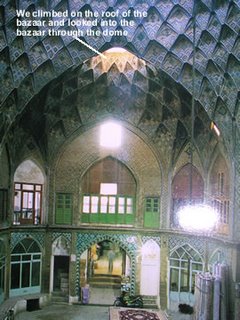
Finally, I arrive in Kashan. I love the way Kashanis speak. This is my first time in Kashan, so I need to get to know this city better considering the short time we have in Kashan. It is a very beautiful city with great old houses and a nice bazaar. Esther thought the young men were not nice mainly because we did not see very many women outside.
At dinner in the Yalda restaurant, where Kay and Esther really want to go, we sat down to eat. Esther and Kay have at least two things in common: first of all they both like food, almost any food, and secondly they can get their way with selection/sharing food. I have almost known from the beginning of our trip in Kashan that I will never get my way with selecting food on this trip, My two attempts to get a lovely kebab were harshly turned down. I do have to admit that they really know what they want and they get really good food… Still, I missed my kebab, even after I tried to use Cay's need for a taste of Iranian Kebab as an excuse to order one. I got very dirty looks after that suggestion. (Editors aside: Kay works in Iran, but Cay was only here for one week) We had excellent food that night in Kashan (Aside 2: if you go, ask for the restaurant run by the English lady. The appetizer of liver was especially good) with a couple of good looking guys waiting on us that helped make our only night there lovely. If those guys knew how much some of us were talking about them, they would not have been able to sleep for nights.
Categories: iran, travel, kashan
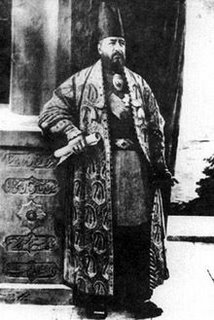
Next morning when we left Kashan after a lovely visit to the bazaar where Kay got herself a lovely small silk carpet, I know we will have fun. I really liked the fact that the guys in the bazaar did their best to sell goods in very gentlemanly way, here I mean not pushy like guys in Esfahan. We finally left Kashan, after a short visit to nicely design, but badly kept up Fin garden where Amir Kabir was killed. Seeing a visit to the Hamam where Amir Kabir was killed reminded me of more things, like how could they put that ugly man in a glass room and call it Amir Kabir? he looked like anybody but AK.
We are in the car. Natanz next, but first let me know if you want more.
Keivan's tale of our trip... Pictures are from postcards due to camera malfunction.
How can I get to Kashan from here? I asked our driver in the restaurant. We were sitting about 6 hours from Tehran but it was like we were in a different world completely.
Oh Kashan, there are a couple ways, the best way is if I take you to a point where you can go directly to Kashan, He answered
I think he felt bad for me because I had such a bad day, and he wanted to do something nice for me.
I don't want to take you way off of your way, I said.
Yes, Oh, No problem, it will only add 50 kilometers to our trip.
I agree and am happy that I do not have to change 3 different cars to get to Esther.
I call Esther on our friend's mobile to let her know that I will be in Kashan in 4 hours, Sounds good, Esther told me. She was very worried about me and what happened in the meeting that I won't talk about on this blog, but I decided not to talk to her about it until we were back from our trip.
We headed toward Kashan, but we did not get close. A couple of hours later we found out we took the wrong way. We were only 120 Kilometers from Esfahan when we had to turn around.
It took me more than 7 hours to get in our room in Kashan. It was nice to see Kay and her friendly friend Kay in Kashan. (oh yeah I know what you thinking, two Kays, I found out when the Kays were born a lot of names ware banned by the British government and that is why a lot of girls were named Kay. It's a bit like Fatima in Iran, and I know you are asking when were they born? but I cannot get into that because this almost cost me a seat in the car)
So before I can go ahead with this post I need to explain one thing since I am going to refer to her many times, how do you know which Kay I am talking about? I can't use, nice or tall, or friendly, or these kinds of words, since they are both nice, tall, and friendly, so the second Kay will be Cay. You should know she has a very nice smile.
Finally, I arrive in Kashan. I love the way Kashanis speak. This is my first time in Kashan, so I need to get to know this city better considering the short time we have in Kashan. It is a very beautiful city with great old houses and a nice bazaar. Esther thought the young men were not nice mainly because we did not see very many women outside.
At dinner in the Yalda restaurant, where Kay and Esther really want to go, we sat down to eat. Esther and Kay have at least two things in common: first of all they both like food, almost any food, and secondly they can get their way with selection/sharing food. I have almost known from the beginning of our trip in Kashan that I will never get my way with selecting food on this trip, My two attempts to get a lovely kebab were harshly turned down. I do have to admit that they really know what they want and they get really good food… Still, I missed my kebab, even after I tried to use Cay's need for a taste of Iranian Kebab as an excuse to order one. I got very dirty looks after that suggestion. (Editors aside: Kay works in Iran, but Cay was only here for one week) We had excellent food that night in Kashan (Aside 2: if you go, ask for the restaurant run by the English lady. The appetizer of liver was especially good) with a couple of good looking guys waiting on us that helped make our only night there lovely. If those guys knew how much some of us were talking about them, they would not have been able to sleep for nights.

Categories: iran, travel, kashan
Next morning when we left Kashan after a lovely visit to the bazaar where Kay got herself a lovely small silk carpet, I know we will have fun. I really liked the fact that the guys in the bazaar did their best to sell goods in very gentlemanly way, here I mean not pushy like guys in Esfahan. We finally left Kashan, after a short visit to nicely design, but badly kept up Fin garden where Amir Kabir was killed. Seeing a visit to the Hamam where Amir Kabir was killed reminded me of more things, like how could they put that ugly man in a glass room and call it Amir Kabir? he looked like anybody but AK.

We are in the car. Natanz next, but first let me know if you want more.
Monday, October 23, 2006
Road Trip!
Categories: iran, travel
Who doesn’t love a road trip? The wind, the road, the car, wide open empty spaces? Ya gotta’ love it.
Iranians are mostly afraid of the desert. “You will die there,” they say. They prefer to stay away from Dasht-e Kavir with its infamous sand storms that were in large part responsible for the failed Carter-era hostage rescue attempt. Iranians call thembaad gir gerd-baad: whirling wind or tornado. (In the Atlantic Monthly, I read that Iranians call them “haboob,” but a google search seems to reveal that haboob is an Arabic word for the high altitude clouds of sand that are caused by the desert thunderstorms.)
Okay, so the point is, we did not die. We saw wild camels, heard jackals, wandered off into the dunes, stayed at an oasis, ate the best dates in the world, met Moses – or at least a man who looked just like we imagine Moses to look – had great food, and saw some of the villages that dotted the famous silk route.
We also had three cameras on our trip, but still no pics. Tantalizing, isn’t it? Our two digital cameras failed. We are depending on the cheap film camera for our images. Wish us luck.
References:
Great photo of Dasht-e Kavir at NASA
The Desert One Debacle
Definition of Haboob
See a great picture of a haboob
(Well at least it was great when I visited the site)
Nice article about the names of wind: They Call the Wind Maria
Who doesn’t love a road trip? The wind, the road, the car, wide open empty spaces? Ya gotta’ love it.
Iranians are mostly afraid of the desert. “You will die there,” they say. They prefer to stay away from Dasht-e Kavir with its infamous sand storms that were in large part responsible for the failed Carter-era hostage rescue attempt. Iranians call them
Okay, so the point is, we did not die. We saw wild camels, heard jackals, wandered off into the dunes, stayed at an oasis, ate the best dates in the world, met Moses – or at least a man who looked just like we imagine Moses to look – had great food, and saw some of the villages that dotted the famous silk route.
We also had three cameras on our trip, but still no pics. Tantalizing, isn’t it? Our two digital cameras failed. We are depending on the cheap film camera for our images. Wish us luck.
References:
Great photo of Dasht-e Kavir at NASA
The Desert One Debacle
Definition of Haboob
See a great picture of a haboob
(Well at least it was great when I visited the site)
Nice article about the names of wind: They Call the Wind Maria
Sunday, October 15, 2006
Wedding Bells
The long post I promised... I will post pictures sometime soon...
Categories: iran, qashquai, travel
Trip made just before Ramadan
"Where are your fellow travelers from?" the police officer asks Keivan as we are about to board the train.
"The Global Arrogance," Keivan answers. The police officer laughs, stamps our tickets and sends the three of us through the gates where we hurry to meet the overnight train.
The train leaves the station exactly on time. A couple of minutes after departure, a porter comes by with clean sheets. We fold the seats down and make our beds. "This is great," our British friend says. "I just love the train. It's so comfortable, so great to sleep in."
"The cabins were larger when I was a kid," Keivan comments. It's his first train trip in Iran in more than 25 years.
"No, you were smaller. Trust me."
At 5 the train stops and we are woken up by the call to prayer booming in over PA system.

"They never let you forget where you are," our friend says sleepily.
We pull into the train station and take a cab into the city where we are meeting friends of friends who will take us out to a Nomad encampment some 2 ½ hours outside Esfahan.
We make our way through highways, small towns, dirt roads, gravel roads, and tarred roads and, after a spot of car trouble, head towards our destination where there is one teenage boy and some sheep.
"They're at the wedding," he tells us. "They'll be back in a couple of hours."
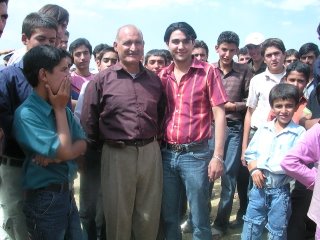
There are weddings everywhere in the encampments. We passed one on the way here and now our hosts are at another. We manage to get ourselves invited and are quickly surrounded by huge groups of young and old, women and men, boys and girls, all curious about the two foreigners in their midst. "George Bush is very, very dangerous," a teenage boy says to me.
"Aren't you afraid of me?" I ask jokingly.
"Afraid of you… No!" they laugh. "You are afraid of us!"
"Terrorist," says a boy pointing at his own chest. The others laugh. They know we think of them as terrorists.
"Take off your scarf," an older man tells me. "There are no religious police here. We do not care. You should feel free. We are free here."
"Did you know that Qom has a huge Bridgestone tire factory?" one of the men asks me.
"Really?"
He answers by circling his hand above his head in the shape of a turban. I am so gullible.
"Take off your scarf," another man says to me.
"Really it's okay," the man who brought us here tells me.
I refuse, but everyone assures me that it is fine. They do so often and with sincerity.
"Our scarves are for decoration," a woman tells me. "It is fine to take your scarf off here."
The women wear flowered headbands and transparent black lace scarves. Their long braids come out the back. Most have two long side curls framing their faces – a bit like Chassidic boys.
"Have you ever heard of BlackENdeker?" a man asks me. It takes me awhile to realize that he means Black and Decker.
"Is America better or Iran better?"
"Do you have any children?"
"How old are you when you marry?"
"Do you think that our women are beautiful?"
"We had many American teachers here before the revolution. There was Mr. Harmon and Mr. Ryder and many others." Among the over 40 crowd there are some who do speak pretty good English.
My friend and I are ushered to one of the many women's tents. Keivan and the two men who brought us here are guided to the men's area. The women's tent is crowded with women and children and a fair sampling of young men who are here to flirt.
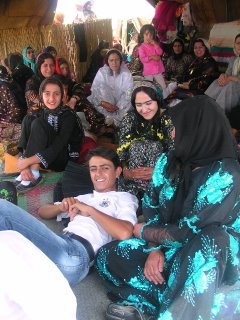
The children tell me that my Persian is bad. The women tell me that it is good. It's my accent that is bad, they explain.

Every once in awhile, a man comes up to the tent and says something in a gruff voice (Speaking a Turkish dialect, so I do not understand). The women then make fun of him and he laughs. I am not sure what this whole play is.
"It's time to go get the bride," I am told after a lunch of koubideh and rice with zereshk. Yum. You could taste the life in the kebab. (Sorry to my vegetarian readers…) I am sure our sheep was alive the day before.
"You need to go meet the bride," the family of the groom assures me. They usher us off towards the waiting cars.
Keivan, Megan, and I hop onto the back of a pickup truck. The women inside offer to get out, but we insist on our right to speed through the desert on the pack of a pick-up. Wouldn't you?
We are not alone. Another couple joins us. "We had an American living with us 35 years ago," the man tells us. "Louis Beck."
"Louise Beck?"
"Yes. Louise."
(A later google search reveals her real name: Lois Beck.)
"She was here for four years."
Megan turns to me, "I would love to do that."
"Me too," I respond. "She must be an anthropologist."
"We are 2000 years behind you," the man says. "But you have moved ahead too quickly. Your life is like a prison to us. What can compare with our stars? Our sky?"
We arrived at the tent of the bride who had just spent hours having hair removed. After spending the past few hours having her hair painfully remover, her eyebrows were trim and elegant. She was in a white gown and surrounded by women and girls.
"Dance!" The women command me.
"There's no music."
"Don't worry. We'll clap."
I dance. Megan is too shy to dance. Instead she laughs at my missteps. So do the other women.
We go outside the tent to join the circles of dancing people. They give me a couple of scarves to swing over my shoulders and make fun of my inability to pick up the steps. What can I say… It took me 14 years to learn the hora. I'm that bad, and I don't care.
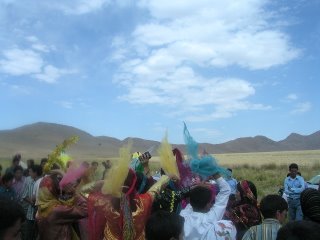
Never pass up the opportunity to dance. As my great Aunt Rose always said, there are plenty of opportunities to mourn.
The Blanket
We take a break from the wedding to go pick up Megan's blanket. She is exchanging a digital radio for a heavy wool blanket. We sit with the family.
"Where are our pictures?" The older woman demands of our guide: Ahmad.
"I'll make you a copy of the CD and bring it to you next week."
"You won't bring it," the woman says to him. "Give us the CD, and we will make a copy and give it to you."
"I see Khosro every week. I will give him the CD. I promise."
I ask permission to take pictures. "Only if you give us copies," the woman tells me.
"Absolutely," I agree.
"Do you have farming where you are from?" the man of the family asks me.
"A lot. My parents live in one of the biggest farming communities in the world."
"Are there sheep."
"Yes."
"What kind?"
"They are not like yours. They are white with curly hair."
"Do they have pink faces like cows?"
"Kind of."
"Oh. You have Israeli sheep."
"They are similar to the sheep in Israel. That's true."
"Israeli sheep are too wild for us. They are difficult to care for."
"That's what my friend's father tells me," I answer. "He had thousands and thousands of sheep. He said they only liked him" I want to say that they were too emperamental, but I don't have the Persian word for temperamental.
The radio and the blanket switch hands.
"Don't trade that radio away," our young guide Hamid says. "Sell it to me, if you want to get rid of it."
Hamid wanders around the area with the radio until he finds a spot that gives him good reception.
"Don't worry. I am keeping this radio."
We take some pictures, say our goodbyes, and head back to Esfahan."
Categories: iran, qashquai, travel
Trip made just before Ramadan
"Where are your fellow travelers from?" the police officer asks Keivan as we are about to board the train.
"The Global Arrogance," Keivan answers. The police officer laughs, stamps our tickets and sends the three of us through the gates where we hurry to meet the overnight train.
The train leaves the station exactly on time. A couple of minutes after departure, a porter comes by with clean sheets. We fold the seats down and make our beds. "This is great," our British friend says. "I just love the train. It's so comfortable, so great to sleep in."
"The cabins were larger when I was a kid," Keivan comments. It's his first train trip in Iran in more than 25 years.
"No, you were smaller. Trust me."
At 5 the train stops and we are woken up by the call to prayer booming in over PA system.

"They never let you forget where you are," our friend says sleepily.
We pull into the train station and take a cab into the city where we are meeting friends of friends who will take us out to a Nomad encampment some 2 ½ hours outside Esfahan.
We make our way through highways, small towns, dirt roads, gravel roads, and tarred roads and, after a spot of car trouble, head towards our destination where there is one teenage boy and some sheep.
"They're at the wedding," he tells us. "They'll be back in a couple of hours."
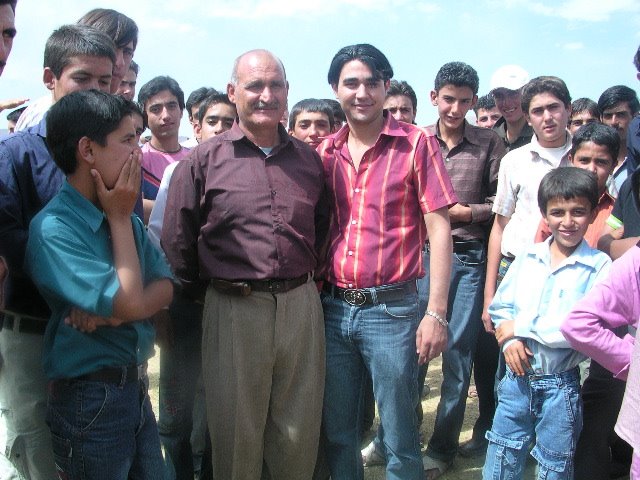
There are weddings everywhere in the encampments. We passed one on the way here and now our hosts are at another. We manage to get ourselves invited and are quickly surrounded by huge groups of young and old, women and men, boys and girls, all curious about the two foreigners in their midst. "George Bush is very, very dangerous," a teenage boy says to me.
"Aren't you afraid of me?" I ask jokingly.
"Afraid of you… No!" they laugh. "You are afraid of us!"
"Terrorist," says a boy pointing at his own chest. The others laugh. They know we think of them as terrorists.
"Take off your scarf," an older man tells me. "There are no religious police here. We do not care. You should feel free. We are free here."
"Did you know that Qom has a huge Bridgestone tire factory?" one of the men asks me.
"Really?"
He answers by circling his hand above his head in the shape of a turban. I am so gullible.
"Take off your scarf," another man says to me.
"Really it's okay," the man who brought us here tells me.
I refuse, but everyone assures me that it is fine. They do so often and with sincerity.
"Our scarves are for decoration," a woman tells me. "It is fine to take your scarf off here."
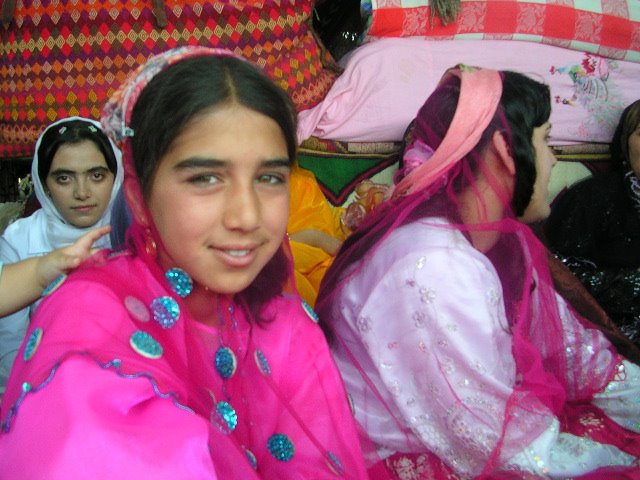
The women wear flowered headbands and transparent black lace scarves. Their long braids come out the back. Most have two long side curls framing their faces – a bit like Chassidic boys.
"Have you ever heard of BlackENdeker?" a man asks me. It takes me awhile to realize that he means Black and Decker.
"Is America better or Iran better?"
"Do you have any children?"
"How old are you when you marry?"
"Do you think that our women are beautiful?"
"We had many American teachers here before the revolution. There was Mr. Harmon and Mr. Ryder and many others." Among the over 40 crowd there are some who do speak pretty good English.
My friend and I are ushered to one of the many women's tents. Keivan and the two men who brought us here are guided to the men's area. The women's tent is crowded with women and children and a fair sampling of young men who are here to flirt.
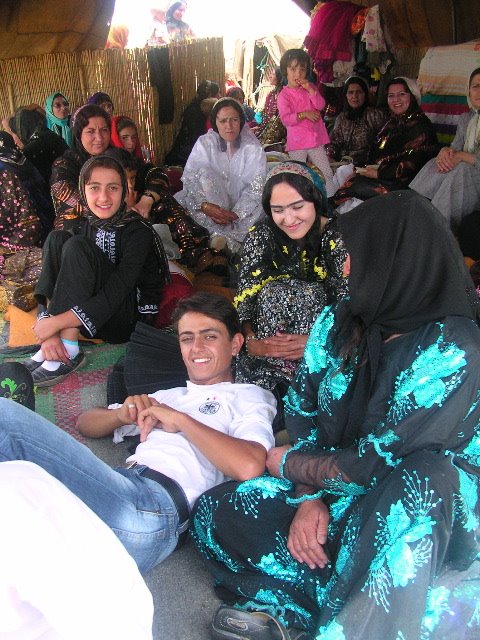
The children tell me that my Persian is bad. The women tell me that it is good. It's my accent that is bad, they explain.
Every once in awhile, a man comes up to the tent and says something in a gruff voice (Speaking a Turkish dialect, so I do not understand). The women then make fun of him and he laughs. I am not sure what this whole play is.
"It's time to go get the bride," I am told after a lunch of koubideh and rice with zereshk. Yum. You could taste the life in the kebab. (Sorry to my vegetarian readers…) I am sure our sheep was alive the day before.
"You need to go meet the bride," the family of the groom assures me. They usher us off towards the waiting cars.
Keivan, Megan, and I hop onto the back of a pickup truck. The women inside offer to get out, but we insist on our right to speed through the desert on the pack of a pick-up. Wouldn't you?
We are not alone. Another couple joins us. "We had an American living with us 35 years ago," the man tells us. "Louis Beck."
"Louise Beck?"
"Yes. Louise."
(A later google search reveals her real name: Lois Beck.)
"She was here for four years."
Megan turns to me, "I would love to do that."
"Me too," I respond. "She must be an anthropologist."
"We are 2000 years behind you," the man says. "But you have moved ahead too quickly. Your life is like a prison to us. What can compare with our stars? Our sky?"
We arrived at the tent of the bride who had just spent hours having hair removed. After spending the past few hours having her hair painfully remover, her eyebrows were trim and elegant. She was in a white gown and surrounded by women and girls.
"Dance!" The women command me.
"There's no music."
"Don't worry. We'll clap."
I dance. Megan is too shy to dance. Instead she laughs at my missteps. So do the other women.
We go outside the tent to join the circles of dancing people. They give me a couple of scarves to swing over my shoulders and make fun of my inability to pick up the steps. What can I say… It took me 14 years to learn the hora. I'm that bad, and I don't care.

Never pass up the opportunity to dance. As my great Aunt Rose always said, there are plenty of opportunities to mourn.
The Blanket
We take a break from the wedding to go pick up Megan's blanket. She is exchanging a digital radio for a heavy wool blanket. We sit with the family.
"Where are our pictures?" The older woman demands of our guide: Ahmad.
"I'll make you a copy of the CD and bring it to you next week."
"You won't bring it," the woman says to him. "Give us the CD, and we will make a copy and give it to you."
"I see Khosro every week. I will give him the CD. I promise."
I ask permission to take pictures. "Only if you give us copies," the woman tells me.
"Absolutely," I agree.
"Do you have farming where you are from?" the man of the family asks me.
"A lot. My parents live in one of the biggest farming communities in the world."
"Are there sheep."
"Yes."
"What kind?"
"They are not like yours. They are white with curly hair."
"Do they have pink faces like cows?"
"Kind of."
"Oh. You have Israeli sheep."
"They are similar to the sheep in Israel. That's true."
"Israeli sheep are too wild for us. They are difficult to care for."
"That's what my friend's father tells me," I answer. "He had thousands and thousands of sheep. He said they only liked him" I want to say that they were too emperamental, but I don't have the Persian word for temperamental.
The radio and the blanket switch hands.
"Don't trade that radio away," our young guide Hamid says. "Sell it to me, if you want to get rid of it."
Hamid wanders around the area with the radio until he finds a spot that gives him good reception.
"Don't worry. I am keeping this radio."
We take some pictures, say our goodbyes, and head back to Esfahan."
Saturday, August 12, 2006
Memorial
Tagged as: Iran culture
“Oh my god, haven’t you heard what’s been going on with the UK.?”
“I heard something about a bomb on an airplane when I was in a taxi, but I thought it was just the normal stuff.”
“My god, no. It’s not normal,” my friend tells me. We are sitting in a fashionable Tehran restaurant. I have arrived there straight from the airport after having been in Iran’s hot Khuzestan Province. She and Keivan explain the events of the last 36 hours to me.
“We only had the television on for 30 minutes so that everyone could watch Nargess,” I explained. (Nargess is the newest serial to sweep Iran. Everyone is watching it.)
I was in Khuzestan attending the year-memorial for my friend who died last year. It was a much less hectic and heart-wrenching affair than the funeral. We’d all had a year of mourning, crying, and bouts of depression behind us. This does not mean that any of us miss her any less, it’s just that the months leading up to her death and the months following her death were overwhelming and difficult for many, many people and that now, most of her family and friends were recovering.
It was a relief to see everyone again. I have not traveled too far from Tehran (except outside Iran) since the funeral. Khuzestan was a blistering 48 degrees C. This is the type of heat that can only be described as a moving wall that has weight and force and sound. You can almost hear it: at least you can imagine hearing it: Whoooosh.
First there was a ceremony in the mosque. There were about 150 women there: almost all of them wearing the same black knee-highs, darker at the toes and heals with a dark black band across the top. The mosque was chilled to shivering. “In Khuzestan they are used to the heat,” everyone told me. Oh yeah, then why are their homes and offices and mosques kept so cold? They are only used to staying inside, not to the heat.
We had about 2 ½ hours of chanting followed by ½ hour of a sermon. All the while, children were playing, there were the requisite operatic mourners, and a quorum of chadoris who hide their faces under their chadors, shake their shoulders as if hysterically crying, and then emerge dry-eyed.
From the mosque we went to the cemetery. Close by was the year memorial for the family who died in what I assume was a car crash. Last year I thought it was only a son and father who had died because there were only two pictures. This year it was clear that there was a third death: probably a woman, maybe the mother. My heart burned (as Iranians would say) for that family. How do you come to terms with such a quick death. The men were clearly heart broken. They were sobbing. The women sat dry-eyed while the children handed out sweets to the gathered crowd.
Our own ceremony was under a tent to protect us from the hot sun. Even so, the marble tombstone was too hot to touch. After the ceremony, we went to lunch. Children who did not attend the memorial came for the lunch. It’s hard to imagine how people survive mourning without children around. It’s impossible to resist their joy and playfulness. You could see the lights switch on in the eyes of their aunts and uncles who had lost their mother and sister.
“Oh my god, haven’t you heard what’s been going on with the UK.?”
“I heard something about a bomb on an airplane when I was in a taxi, but I thought it was just the normal stuff.”
“My god, no. It’s not normal,” my friend tells me. We are sitting in a fashionable Tehran restaurant. I have arrived there straight from the airport after having been in Iran’s hot Khuzestan Province. She and Keivan explain the events of the last 36 hours to me.
“We only had the television on for 30 minutes so that everyone could watch Nargess,” I explained. (Nargess is the newest serial to sweep Iran. Everyone is watching it.)
I was in Khuzestan attending the year-memorial for my friend who died last year. It was a much less hectic and heart-wrenching affair than the funeral. We’d all had a year of mourning, crying, and bouts of depression behind us. This does not mean that any of us miss her any less, it’s just that the months leading up to her death and the months following her death were overwhelming and difficult for many, many people and that now, most of her family and friends were recovering.
It was a relief to see everyone again. I have not traveled too far from Tehran (except outside Iran) since the funeral. Khuzestan was a blistering 48 degrees C. This is the type of heat that can only be described as a moving wall that has weight and force and sound. You can almost hear it: at least you can imagine hearing it: Whoooosh.
First there was a ceremony in the mosque. There were about 150 women there: almost all of them wearing the same black knee-highs, darker at the toes and heals with a dark black band across the top. The mosque was chilled to shivering. “In Khuzestan they are used to the heat,” everyone told me. Oh yeah, then why are their homes and offices and mosques kept so cold? They are only used to staying inside, not to the heat.
We had about 2 ½ hours of chanting followed by ½ hour of a sermon. All the while, children were playing, there were the requisite operatic mourners, and a quorum of chadoris who hide their faces under their chadors, shake their shoulders as if hysterically crying, and then emerge dry-eyed.
From the mosque we went to the cemetery. Close by was the year memorial for the family who died in what I assume was a car crash. Last year I thought it was only a son and father who had died because there were only two pictures. This year it was clear that there was a third death: probably a woman, maybe the mother. My heart burned (as Iranians would say) for that family. How do you come to terms with such a quick death. The men were clearly heart broken. They were sobbing. The women sat dry-eyed while the children handed out sweets to the gathered crowd.
Our own ceremony was under a tent to protect us from the hot sun. Even so, the marble tombstone was too hot to touch. After the ceremony, we went to lunch. Children who did not attend the memorial came for the lunch. It’s hard to imagine how people survive mourning without children around. It’s impossible to resist their joy and playfulness. You could see the lights switch on in the eyes of their aunts and uncles who had lost their mother and sister.
Monday, May 01, 2006
Happy May Day
AN said that Israel was like a prison, and I responded “Iran is the prison.” I was loathe to board the plane to Iran, but somehow managed to get myself on the flight. Once I did, it was a party in the sky: a plane filled with slightly inebriated Iranians laughing and talking the whole way back to Tehran.
“You must really love your husband to come back,” they joke.
The baby next to us laughed for the entire flight. She had several rows of playmates.
“You must serve more alcohol on this flight than any other flight,” I comment.
“Yes we do. At least we serve more than on any other flight to the Middle East. They board already a bit drunk.”
…
Iranians make heroic efforts to lead normal lives. They are ignoring the threat of sanctions as best they can, focusing instead on AN’s spending. He is holding huge government meetings all over the country. When questioned on the huge expenditures for each meeting, he is reported to have responded: “We just have tea and bread for breakfast: no cheese.” This has made for some good taxi conversations.
People tell me that AN is going to let women into football games (google blog search blocked for “ahmadinejad women football”) and make the hijab optional (no one believes this). For some bizarre reason having to do with prayer times, Iran decided not to spring forward this year, so now we are only 1 ½ hour ahead of Europe. Some say this is costing Iran tons of money. The cost is most certainly offset by the amount of money the government would have to pay if it served cheese for breakfast.
…
Sometimes I am happy to be back. Everything is funnier in Iran.
“You must really love your husband to come back,” they joke.
The baby next to us laughed for the entire flight. She had several rows of playmates.
“You must serve more alcohol on this flight than any other flight,” I comment.
“Yes we do. At least we serve more than on any other flight to the Middle East. They board already a bit drunk.”
…
Iranians make heroic efforts to lead normal lives. They are ignoring the threat of sanctions as best they can, focusing instead on AN’s spending. He is holding huge government meetings all over the country. When questioned on the huge expenditures for each meeting, he is reported to have responded: “We just have tea and bread for breakfast: no cheese.” This has made for some good taxi conversations.
People tell me that AN is going to let women into football games (google blog search blocked for “ahmadinejad women football”) and make the hijab optional (no one believes this). For some bizarre reason having to do with prayer times, Iran decided not to spring forward this year, so now we are only 1 ½ hour ahead of Europe. Some say this is costing Iran tons of money. The cost is most certainly offset by the amount of money the government would have to pay if it served cheese for breakfast.
…
Sometimes I am happy to be back. Everything is funnier in Iran.
Wednesday, March 29, 2006
American is weird too
So I am on vacation.
America is funny. First meal: a corned beef sandwich on rye with pickles, a potato pancake, and kishke. Yum.
Watched the Daily Show and laughed a lot. The regular news is a pastiche of stories about missing children, child molestors, and murderers. The news channels seem to be yearning for another terrorist attack on American soil. CNN is anchored by a bunch of sentimental airheads (or are they just faking it?). Watching Fox is like being at a party where everyone is on drugs except you. No fun unless you drink the cool-aid.
I am trying to avoid news about Iran. It’s depressing. I am too confused about everything. My cousin said to me, “I used to wonder how you could live in Iran and then I thought, ‘I live in Missouri for god’s sake. I don’t agree with any of our policies. I hate Bush. What’s the difference?’”
There is a difference. I told him. “I know,” he said.
We were at a Bat Mitzvah party. There was an open bar. Teen age boys and girls were dancing together. We were not worried about the police raiding the party. We were drinking moderate amounts of alcohol. No one got drunk. Couples were openly showing affection. (Affection, not lust.) It was relaxing, fun, low-key. I almost cried. Maybe I did cry.
Everyone said they wanted to hear about Iran. We did not really have time to discuss it. It was enough to be together.
Had lunch with my dad’s old farts club. It was me and a bunch of old men. One came over from Turkey, another survived pogroms in Poland, all had lived through WW 2 either here or in Europe. Turns out my 83-year old cousin is a veteran of the Battle of the Bulge. Why didn’t I know? How much don’t I know?
Miss hearing Persian. Miss the activitity. Don’t miss the chaos. Don’t miss pollution. Do not miss the traffic. It’s so cold that I am practically wearing hijab everywhere I go...
America is funny. First meal: a corned beef sandwich on rye with pickles, a potato pancake, and kishke. Yum.
Watched the Daily Show and laughed a lot. The regular news is a pastiche of stories about missing children, child molestors, and murderers. The news channels seem to be yearning for another terrorist attack on American soil. CNN is anchored by a bunch of sentimental airheads (or are they just faking it?). Watching Fox is like being at a party where everyone is on drugs except you. No fun unless you drink the cool-aid.
I am trying to avoid news about Iran. It’s depressing. I am too confused about everything. My cousin said to me, “I used to wonder how you could live in Iran and then I thought, ‘I live in Missouri for god’s sake. I don’t agree with any of our policies. I hate Bush. What’s the difference?’”
There is a difference. I told him. “I know,” he said.
We were at a Bat Mitzvah party. There was an open bar. Teen age boys and girls were dancing together. We were not worried about the police raiding the party. We were drinking moderate amounts of alcohol. No one got drunk. Couples were openly showing affection. (Affection, not lust.) It was relaxing, fun, low-key. I almost cried. Maybe I did cry.
Everyone said they wanted to hear about Iran. We did not really have time to discuss it. It was enough to be together.
Had lunch with my dad’s old farts club. It was me and a bunch of old men. One came over from Turkey, another survived pogroms in Poland, all had lived through WW 2 either here or in Europe. Turns out my 83-year old cousin is a veteran of the Battle of the Bulge. Why didn’t I know? How much don’t I know?
Miss hearing Persian. Miss the activitity. Don’t miss the chaos. Don’t miss pollution. Do not miss the traffic. It’s so cold that I am practically wearing hijab everywhere I go...
Thursday, March 23, 2006
Vacation!
Hoo ha! On our first vacation in a long, long time. The flight from Iran was uneventful. By the end of our flight, not one woman was wearing a headscarf. "You would see more women in headscarves on any flight in Europe or the US," I told K. Turns out I was right. On the US leg of the trip, more women were in hijab in our 10-row area than on the entire flight from Tehran.
At dinner with friends we were talking about Iran. "Sorry to say," said K, "But Iranians who are not in Iran don't know shit about what is going on there."
"We've been gone a day, and I don't know what's going on there!" I added.
It's true. I feel so distant so soon. Here, everyone is talking about sanctions and bombing and the only thing you only hear the worst possible things about Iran. People seem to think that I lived in a state of suspended fear which is not at all true. At the same time, the pressure that you feel in Iran is even more obvious when you leave. When you are there, it surrounds you on all sides like air pressure, so you just kind of get used to it. You know you feel pressure, but pressure feels normal. When you leave, you feel this huge weight released from you: it's almost physical. It *is* physical. I feel like a balloon; I feel so light.
At dinner with friends we were talking about Iran. "Sorry to say," said K, "But Iranians who are not in Iran don't know shit about what is going on there."
"We've been gone a day, and I don't know what's going on there!" I added.
It's true. I feel so distant so soon. Here, everyone is talking about sanctions and bombing and the only thing you only hear the worst possible things about Iran. People seem to think that I lived in a state of suspended fear which is not at all true. At the same time, the pressure that you feel in Iran is even more obvious when you leave. When you are there, it surrounds you on all sides like air pressure, so you just kind of get used to it. You know you feel pressure, but pressure feels normal. When you leave, you feel this huge weight released from you: it's almost physical. It *is* physical. I feel like a balloon; I feel so light.
Wednesday, December 08, 2004
Response to email
I am responding to this email in the blog, because it is filled with questions that I often receive in emails. It’s from Samantha:
Hello,
I came accrossed your blog "A view from Iran." Firstly, I would like to say that it is quite well written and would like to thank you all for writing your opinions and perspectives when such might not be the best option in a highly regulated society.
Me: Thanks. Anybody who says that the blog is well-written must be smart, charming, and most wonderful.
Anyway, am I right in thinking that one of the writers is an American woman?
Me: That would be me. T.
Someday, probably within the next three years I would like to visit Tehran perhaps for only a week or two, but if possible working with a social work/development initiative.
I am curious as to the challenges big and small an American woman living in Tehran might face beyond the obvious regulations regarding wearing hijab/chador and gender segregations. For instance how do women seek public transport, accommodations etc?
Me: Public transport is no problem. The buses and metros are sex-segregated – Thank God. If you are a woman getting on to a crowded subway car, wouldn’t you rather be in a car crowded with women than one crowded with men? Women smell better. Plus they are nicer when packed in like sardines. The metros also have family cars that both men and women can ride in.
Women ride in the back of city buses. You often see buses half-filled with men practically standing on one another for space while the women are leisurely sitting. It’s not fair, but it works to our advantage.
Intercity buses are not nearly as sex-segregated. Families and couples can sit together, but a single man cannot sit next to a strange single woman.
Minibuses are just crowded. Shared taxis are also crowded. It’s a great place for Iranians on dates because physical proximity (think: sitting on one another’s laps) is permissible.
Accommodations are different for foreigners than for Iranians. Only on rare occasions would a foreign woman be hassled over accommodations.
How does one deal with nationalist contempt (or indeed not deal at all.) Is Iran "safe?" I am not really sure where to start with my questions, so any advice you give is welcomed.
Me: I have NEVER experienced any nationalist contempt. Iranians love foreigners (oh, that is if you are not Afghani or Arab.) On top of that, they adore Americans. I mean, we could not be more loved in Texas itself. It’s such a pleasure being loved. I have often used this space to encourage my fellow citizens to treat Iranians like princes and princesses when you meet them. That’s the way they treat me.
I always tell people that there is no one with more access in Iran than a western woman. We get access to both men and women. The dangers that exist in Iran are no different (for us) than the dangers we face in our own countries. I am not saying that Iran is the safest place on earth. All I am saying is that if you are not coming here to organize a revolution, then you should be okay by keeping up the normal defenses that you would anywhere else.
I am responding to this email in the blog, because it is filled with questions that I often receive in emails. It’s from Samantha:
Hello,
I came accrossed your blog "A view from Iran." Firstly, I would like to say that it is quite well written and would like to thank you all for writing your opinions and perspectives when such might not be the best option in a highly regulated society.
Me: Thanks. Anybody who says that the blog is well-written must be smart, charming, and most wonderful.
Anyway, am I right in thinking that one of the writers is an American woman?
Me: That would be me. T.
Someday, probably within the next three years I would like to visit Tehran perhaps for only a week or two, but if possible working with a social work/development initiative.
I am curious as to the challenges big and small an American woman living in Tehran might face beyond the obvious regulations regarding wearing hijab/chador and gender segregations. For instance how do women seek public transport, accommodations etc?
Me: Public transport is no problem. The buses and metros are sex-segregated – Thank God. If you are a woman getting on to a crowded subway car, wouldn’t you rather be in a car crowded with women than one crowded with men? Women smell better. Plus they are nicer when packed in like sardines. The metros also have family cars that both men and women can ride in.
Women ride in the back of city buses. You often see buses half-filled with men practically standing on one another for space while the women are leisurely sitting. It’s not fair, but it works to our advantage.
Intercity buses are not nearly as sex-segregated. Families and couples can sit together, but a single man cannot sit next to a strange single woman.
Minibuses are just crowded. Shared taxis are also crowded. It’s a great place for Iranians on dates because physical proximity (think: sitting on one another’s laps) is permissible.
Accommodations are different for foreigners than for Iranians. Only on rare occasions would a foreign woman be hassled over accommodations.
How does one deal with nationalist contempt (or indeed not deal at all.) Is Iran "safe?" I am not really sure where to start with my questions, so any advice you give is welcomed.
Me: I have NEVER experienced any nationalist contempt. Iranians love foreigners (oh, that is if you are not Afghani or Arab.) On top of that, they adore Americans. I mean, we could not be more loved in Texas itself. It’s such a pleasure being loved. I have often used this space to encourage my fellow citizens to treat Iranians like princes and princesses when you meet them. That’s the way they treat me.
I always tell people that there is no one with more access in Iran than a western woman. We get access to both men and women. The dangers that exist in Iran are no different (for us) than the dangers we face in our own countries. I am not saying that Iran is the safest place on earth. All I am saying is that if you are not coming here to organize a revolution, then you should be okay by keeping up the normal defenses that you would anywhere else.
Wednesday, September 22, 2004
Normal Life
What does normal life feel like?
K and I recently took a trip to Europe where there seem to be many more devout Muslims than in Iran. The Islamic women wore a range of clothing from complete veil to simple scarf. Islamic dress seems to be more a matter of culture than religion. For instance, Moroccan women use tight black scarves to tie their hair back behind their head. The scarves are form-fitted to their own hair and have interesting knots in them. Turkish women wear their scarves pinned in some complex way on their heads. Their scarves are mainly drab with the occasional drab flower printed onto the scarf. Many of these devout women wear clothes that could get them arrested in Iran. (No wonder devout Iranian women chafe at the restrictions on dress.) Despite this, none of the devout women we saw in Europe showed even a strand of hair.
This is not the case here. I have seen women in chadors with fringe showing. The newest fashion is to wear a scarf that covers neither the front nor the back of the hair. This means that women with long hair let it hang down out of the back of the scarf.
When K and his family and I went out to eat the other night, I was wearing one of the longest manteaus to be seen that evening. Mine reaches my knees. It's last year's model. The newest fashions just cover the ass. I don't really feel like keeping up with manteau fashion myself. I'll just wear mine until it falls apart.
Why do I write this? Because I want to tell you what normal feels like. Normal is that religious and devout women have friends who are secular. Normal is having observant cousins and atheist cousins. Normal is a Republican woman married to a Democratic man.
My great aunt kept kosher, my grandmother (her sister) loved bacon (the other kosher meat), my grandfather's sister shaved her head and wore a wig. K's mother never took off her headscarf. He has a photo of me in a swimming suit sitting next to his mother in her scarf and long shirt. We are both happy. That's normal.
We recently had dinner with some friends in a hidden restaurant with actual atmosphere and professional service. There were all sorts of people there: families with all of the women in chadors and families with women barely wearing headscarves. Our host managed to procure whiskey for us, which meant that we were actually eating and drinking in a nice restaurant. It all felt so frigging normal.
Normal is such a simple thing.
K and I recently took a trip to Europe where there seem to be many more devout Muslims than in Iran. The Islamic women wore a range of clothing from complete veil to simple scarf. Islamic dress seems to be more a matter of culture than religion. For instance, Moroccan women use tight black scarves to tie their hair back behind their head. The scarves are form-fitted to their own hair and have interesting knots in them. Turkish women wear their scarves pinned in some complex way on their heads. Their scarves are mainly drab with the occasional drab flower printed onto the scarf. Many of these devout women wear clothes that could get them arrested in Iran. (No wonder devout Iranian women chafe at the restrictions on dress.) Despite this, none of the devout women we saw in Europe showed even a strand of hair.
This is not the case here. I have seen women in chadors with fringe showing. The newest fashion is to wear a scarf that covers neither the front nor the back of the hair. This means that women with long hair let it hang down out of the back of the scarf.
When K and his family and I went out to eat the other night, I was wearing one of the longest manteaus to be seen that evening. Mine reaches my knees. It's last year's model. The newest fashions just cover the ass. I don't really feel like keeping up with manteau fashion myself. I'll just wear mine until it falls apart.
Why do I write this? Because I want to tell you what normal feels like. Normal is that religious and devout women have friends who are secular. Normal is having observant cousins and atheist cousins. Normal is a Republican woman married to a Democratic man.
My great aunt kept kosher, my grandmother (her sister) loved bacon (the other kosher meat), my grandfather's sister shaved her head and wore a wig. K's mother never took off her headscarf. He has a photo of me in a swimming suit sitting next to his mother in her scarf and long shirt. We are both happy. That's normal.
We recently had dinner with some friends in a hidden restaurant with actual atmosphere and professional service. There were all sorts of people there: families with all of the women in chadors and families with women barely wearing headscarves. Our host managed to procure whiskey for us, which meant that we were actually eating and drinking in a nice restaurant. It all felt so frigging normal.
Normal is such a simple thing.
Wednesday, September 15, 2004
Bob Ross, The Joy of Painting, and a truck stop in Qom
We were on our way to Khorram Abad when we stopped to have tea and eggs at a truck stop in Qom. I like this particular truck stop, which is also a motel, because the restrooms are so frigging clean. There is a courtyard leading to a small mosque and the restrooms for men and women. Painted on the wall is a mural clearly inspired by Bob Ross via his television show: "The Joy of Painting."
Who knows when we first discovered Bob Ross and his happy trees, big brushes, and palette knives? It must have been channel surfing one day and hearing his soothing voice say "There…" My sister watched it with her husband to be all through college. "It was the perfect program for Sunday morning when you'd been out too late." (She probably meant: Sunday afternoon.)
The fact is Bob Ross is everywhere and appears just when you need him. He's like the Virgin Mary. I used to believe that the next great religion would have Elvis as its prophet, but now I am convinced that Bob Ross is a more likely candidate. He has to be much more popular worldwide than Elvis. Take Iran, for example, his show appears on television here and his kits and books are translated and prominently displayed in bookstore windows. Elvis, however, is nowhere to be found. (Although Metallica, The Eagles, and Eminem are all popular.)
I am not sure what makes him so compelling. Posters at the Jump the Shark website talk about his afro and his soothing voice and his anti-cool confidence. Maybe that's it. There is also something so cool about watching someone create a painting or drawing right before your eyes. To me it does not matter how much I may or may not like the style. It is a kind of magic. (I am still mesmerized by Mr. Drawing Board from Captain Kangaroo) And what is amazing is that people actually can learn the Bob Ross style. I saw a whole show of Bob Ross paintings created by a 7th grade art class. I was pretty amazed. Learning the style gave these kids so much confidence.
It's soothing too, to be in a strange country, close to its theological heart, and see a mural clearly inspired by Bob Ross. It's as though his ultra-mellow voice is speaking to you from the painting itself. For those of you traveling to Iran, you can check out the mural on the road leading from Tehran to Qom (unfortunately, you cannot get there from the reverse direction.). There is a motel on the right side of the road that has good pizza, good eggs, good coffee, and clean restrooms. This is not the only Bob Ross inspired painting in Iran. I will pay more attention in the future and list more of them.
Who knows when we first discovered Bob Ross and his happy trees, big brushes, and palette knives? It must have been channel surfing one day and hearing his soothing voice say "There…" My sister watched it with her husband to be all through college. "It was the perfect program for Sunday morning when you'd been out too late." (She probably meant: Sunday afternoon.)
The fact is Bob Ross is everywhere and appears just when you need him. He's like the Virgin Mary. I used to believe that the next great religion would have Elvis as its prophet, but now I am convinced that Bob Ross is a more likely candidate. He has to be much more popular worldwide than Elvis. Take Iran, for example, his show appears on television here and his kits and books are translated and prominently displayed in bookstore windows. Elvis, however, is nowhere to be found. (Although Metallica, The Eagles, and Eminem are all popular.)
I am not sure what makes him so compelling. Posters at the Jump the Shark website talk about his afro and his soothing voice and his anti-cool confidence. Maybe that's it. There is also something so cool about watching someone create a painting or drawing right before your eyes. To me it does not matter how much I may or may not like the style. It is a kind of magic. (I am still mesmerized by Mr. Drawing Board from Captain Kangaroo) And what is amazing is that people actually can learn the Bob Ross style. I saw a whole show of Bob Ross paintings created by a 7th grade art class. I was pretty amazed. Learning the style gave these kids so much confidence.
It's soothing too, to be in a strange country, close to its theological heart, and see a mural clearly inspired by Bob Ross. It's as though his ultra-mellow voice is speaking to you from the painting itself. For those of you traveling to Iran, you can check out the mural on the road leading from Tehran to Qom (unfortunately, you cannot get there from the reverse direction.). There is a motel on the right side of the road that has good pizza, good eggs, good coffee, and clean restrooms. This is not the only Bob Ross inspired painting in Iran. I will pay more attention in the future and list more of them.
Tuesday, May 25, 2004
Marmulak (Lizard)
One of our stops on our travels around Iran was Khorramabad. We stopped there to visit the castle-like structure that dominates its skyline. From our short visit, I can say that Khorramabad is kind of a strange place. It is a city dominated by men. The women you do see mainly wear chadors or simple black. Even beige seems colorful. On the other hand, under the women's chadors, you can catch a glimpse of sequins, flowers, and bright, bright colors. According to our Iranian friends, most of the men from Khorramabad were sepa, pasdaran, or basigi. This means they were either volunteers or in the elite forces. This is a religious city where people take their daily prayers seriously. I say this, because as we were ascending into the castle we heard a group of men joking with each other. The older men were teasing a young man about his decision to study to become a "marmulak." Everyone, especially the young man, laughed. Later, when we were walking on the streets, we heard "Marmulak!" from a cab filled with young men. The appellation was directed at the cleric who was walking nearby.
Marmulak is the Persian word for lizard. It is also, by far, the most popular movie in Iran. It is Iran's Shrek 2. Everyone we meet in Iran is talking about the movie. "I had to wait 2 hours for a ticket," one of our young friends told us. "But it was great. The best movie of the year. No doubt."
From what I can gather, Marmulak is a series of comic sketches that poke fun at Iran's clerics. K and I tried to see it last week, but the line for tickets stretched several blocks. Last week was supposed to be the last night of the movie. The government belatedly decided to pull it from the theaters. "It is a symbolic gesture," K's nephew told me. If Khorramabadis are making jokes at the expense of the clerics, the film has already permeated every level of society.
You can get bootleg copies of the film at stores all over Iran. Some are even selling the uncensored version, which many of the people we spoke with saw. "It has 20 more minutes of uncensored comedy," K's brother told us. "You have to see it."
One should not make the mistake of thinking that just because Iranians are laughing at their clerics that they have lost their faith in Islam. Praise for the film has come from some of our most religious friends. K's sister, who is a believer, loved the movie. Iranians, I think, have lost faith in their clerical elite and in the utopian vision of an Islamic society. All well and good I think.
Marmulak is the Persian word for lizard. It is also, by far, the most popular movie in Iran. It is Iran's Shrek 2. Everyone we meet in Iran is talking about the movie. "I had to wait 2 hours for a ticket," one of our young friends told us. "But it was great. The best movie of the year. No doubt."
From what I can gather, Marmulak is a series of comic sketches that poke fun at Iran's clerics. K and I tried to see it last week, but the line for tickets stretched several blocks. Last week was supposed to be the last night of the movie. The government belatedly decided to pull it from the theaters. "It is a symbolic gesture," K's nephew told me. If Khorramabadis are making jokes at the expense of the clerics, the film has already permeated every level of society.
You can get bootleg copies of the film at stores all over Iran. Some are even selling the uncensored version, which many of the people we spoke with saw. "It has 20 more minutes of uncensored comedy," K's brother told us. "You have to see it."
One should not make the mistake of thinking that just because Iranians are laughing at their clerics that they have lost their faith in Islam. Praise for the film has come from some of our most religious friends. K's sister, who is a believer, loved the movie. Iranians, I think, have lost faith in their clerical elite and in the utopian vision of an Islamic society. All well and good I think.
Friday, May 14, 2004
Joop, aged 16, Netherlands
It seemed like every foreigner traveling in Iran during the past couple of weeks was either from France or the Netherlands. The French women wore their scarves either in turbans (like the clerics in Iran) or barely covering their hair. Few, if any of them, bothered with a manteau. The Dutch women, on the other hand, were much more conservative. Some of them even wore long manteaus and hoods instead of scarves. Still, they managed to look stunning.
During our spring travels we met up with a great family from the Netherlands and did some traveling together. Their son, Joop, was quite the attraction. Tall, blond, and cute, he attracted notice from Iranians of all ages. I am sure that almost every Iranian with a camera who crossed our path has a photograph of Joop. He was photographed with babies, young women, old women, young men, old men; women in chadors and women wearing their sexy manteaus. Joop has to have been the most photographed person in Iran during the last month. I doubt that more photos were taken of even Khatami. Joop handled it exceedingly well despite the fact that we Westerners are fairly squeamish about having our photos taken.
I thought that it would be impossible for us to see a taller person than Joop during our travels. He is well over 6 feet (but normal in his class in the Netherlands, can you believe that? "It's because we Dutch sleep so much," his mother told me), but with all of the Dutch tourists in Iran, we did manage to see two men who were taller.
What surprised me most about the Dutch tourists was how little they spoke with another. "We can talk when we get home." So many times we found ourselves in situations where Iranian or American tourists would have talked to each other and shared their experiences, but the Dutch were silent with one another.
The Dutch, however, speak with everyone else. Iranians seemed particularly drawn to the Dutch family we were traveling with and engaged them in all sorts of discussions. What surprised K and I the most was how many soldiers came up and talked to them. "They are not allowed to speak with foreigners," K explained. Many of the soldiers leapt into discussions about politics and culture that surprised me. It seems that Nicholas Kristof had similar experiences during his trip to Iran.
Shy no more
It is impossible to be shy in Iran. Sure, Iranians can feel shyness, but they cannot act on it. Even the shyest child has to learn to carry on a conversation. Iran is curing me of any last vestiges of shyness that may have lingered from my teen years (I think I became more shy as a teen than I was as a child.) In Iran you are expected to discuss your age, your weight, your family state, and any other bit of personal information with anyone who asks. You may be asked to dance or sing at a family gathering, and it would be terrible to say no, no matter how uncomfortable it makes you. (Not that I did not say no hundreds of times, it's just now that I have learned to play along, I have much more fun everywhere.)
It is with my new brazen personality that I embarked on our spring travels. This means that I talked to all sorts of people I would have not spoken to before. In addition, I allowed myself to be the center of attention more than once without retreating into a corner and blushing until my face felt like it would burn off.
It is fun not to be shy. I would recommend Iran as a cure for those of you facing any issues with shyness. Mind you, you'll have to stay long enough that you are no longer annoyed by all of the attention you will receive, but it will be worth it.
During our spring travels we met up with a great family from the Netherlands and did some traveling together. Their son, Joop, was quite the attraction. Tall, blond, and cute, he attracted notice from Iranians of all ages. I am sure that almost every Iranian with a camera who crossed our path has a photograph of Joop. He was photographed with babies, young women, old women, young men, old men; women in chadors and women wearing their sexy manteaus. Joop has to have been the most photographed person in Iran during the last month. I doubt that more photos were taken of even Khatami. Joop handled it exceedingly well despite the fact that we Westerners are fairly squeamish about having our photos taken.
I thought that it would be impossible for us to see a taller person than Joop during our travels. He is well over 6 feet (but normal in his class in the Netherlands, can you believe that? "It's because we Dutch sleep so much," his mother told me), but with all of the Dutch tourists in Iran, we did manage to see two men who were taller.
What surprised me most about the Dutch tourists was how little they spoke with another. "We can talk when we get home." So many times we found ourselves in situations where Iranian or American tourists would have talked to each other and shared their experiences, but the Dutch were silent with one another.
The Dutch, however, speak with everyone else. Iranians seemed particularly drawn to the Dutch family we were traveling with and engaged them in all sorts of discussions. What surprised K and I the most was how many soldiers came up and talked to them. "They are not allowed to speak with foreigners," K explained. Many of the soldiers leapt into discussions about politics and culture that surprised me. It seems that Nicholas Kristof had similar experiences during his trip to Iran.
Shy no more
It is impossible to be shy in Iran. Sure, Iranians can feel shyness, but they cannot act on it. Even the shyest child has to learn to carry on a conversation. Iran is curing me of any last vestiges of shyness that may have lingered from my teen years (I think I became more shy as a teen than I was as a child.) In Iran you are expected to discuss your age, your weight, your family state, and any other bit of personal information with anyone who asks. You may be asked to dance or sing at a family gathering, and it would be terrible to say no, no matter how uncomfortable it makes you. (Not that I did not say no hundreds of times, it's just now that I have learned to play along, I have much more fun everywhere.)
It is with my new brazen personality that I embarked on our spring travels. This means that I talked to all sorts of people I would have not spoken to before. In addition, I allowed myself to be the center of attention more than once without retreating into a corner and blushing until my face felt like it would burn off.
It is fun not to be shy. I would recommend Iran as a cure for those of you facing any issues with shyness. Mind you, you'll have to stay long enough that you are no longer annoyed by all of the attention you will receive, but it will be worth it.
Wednesday, May 12, 2004
Mohammad, aged 12, Shiraz
May 11, 2004
Well it's been a little more than 10 days. I am currently sitting under a mulberry tree beginning this account of my spring travels. The mulberries in this tree are white, not the reddish-purple I am accustomed to. When I asked how long until they would be ripe, I was told that they were ripe now. I spent a good half hour feasting on white mulberries.
Mohammad, aged 12, Shiraz
If you have met Mohammad, aged 12, of Shiraz who is practicing his English, please email me (responses@gmail.com). I met him and so, I am certain, did every foreign tourist to Shiraz. We met at Hafez's tomb, where his father and another man were trolling for tourists who could help young Mohammad practice English. He had been studying for a year and already his English was better than that of most of the translators that I have met in Iran. As we spoke, his father urged him to get me to talk faster and ask more difficult questions. I think the conversation was more difficult for me than for Mohammad.
Hafez's tomb was really wonderful. It was packed with tourists and Shirazis alike. People surrounded the grave reciting Hafez's poems to each other. Most squatted by the grave and placed two fingers on its marble slab and whispered a quiet prayer. Mohammad told me that they were whispering verses of the Koran.
I had heard a lot about Shiraz before going there. All over Iran, Iranians told me how wonderful the people of Shiraz were. Iranians complain about each other incessantly, but when it comes to the people of Shiraz and Rasht (I haven't been there yet), they have nothing but good things to say.
I was prepped to fall in love with Shiraz, so it should be no surprise that I did. "The people here are educated," K said. "That's why they are so friendly and why they care so much for their city."
We had lunch in a really wonderful place: a restored bathhouse. Every single person in Shiraz tells you to eat there, so we did. An amazing threesome played and sang traditional music. I would have been happy to pay to see them (which we did, since the food was more expensive when the band was playing.) Children danced. People snapped their fingers. (You haven't heard fingers snapped until you have heard Iranians snap their fingers.) I told K that the whole place felt one beer away from being on its feet dancing.
I read that Hafez was offered several court postings but turned them all down because they required that he leave Shiraz. After going to Shiraz, I have a better understanding of why he would want to stay there.
Well it's been a little more than 10 days. I am currently sitting under a mulberry tree beginning this account of my spring travels. The mulberries in this tree are white, not the reddish-purple I am accustomed to. When I asked how long until they would be ripe, I was told that they were ripe now. I spent a good half hour feasting on white mulberries.
Mohammad, aged 12, Shiraz
If you have met Mohammad, aged 12, of Shiraz who is practicing his English, please email me (responses@gmail.com). I met him and so, I am certain, did every foreign tourist to Shiraz. We met at Hafez's tomb, where his father and another man were trolling for tourists who could help young Mohammad practice English. He had been studying for a year and already his English was better than that of most of the translators that I have met in Iran. As we spoke, his father urged him to get me to talk faster and ask more difficult questions. I think the conversation was more difficult for me than for Mohammad.
Hafez's tomb was really wonderful. It was packed with tourists and Shirazis alike. People surrounded the grave reciting Hafez's poems to each other. Most squatted by the grave and placed two fingers on its marble slab and whispered a quiet prayer. Mohammad told me that they were whispering verses of the Koran.
I had heard a lot about Shiraz before going there. All over Iran, Iranians told me how wonderful the people of Shiraz were. Iranians complain about each other incessantly, but when it comes to the people of Shiraz and Rasht (I haven't been there yet), they have nothing but good things to say.
I was prepped to fall in love with Shiraz, so it should be no surprise that I did. "The people here are educated," K said. "That's why they are so friendly and why they care so much for their city."
We had lunch in a really wonderful place: a restored bathhouse. Every single person in Shiraz tells you to eat there, so we did. An amazing threesome played and sang traditional music. I would have been happy to pay to see them (which we did, since the food was more expensive when the band was playing.) Children danced. People snapped their fingers. (You haven't heard fingers snapped until you have heard Iranians snap their fingers.) I told K that the whole place felt one beer away from being on its feet dancing.
I read that Hafez was offered several court postings but turned them all down because they required that he leave Shiraz. After going to Shiraz, I have a better understanding of why he would want to stay there.
Thursday, April 29, 2004
Spring Travel
April 28, 2004
You guys are going to have to forgive me if I spend my free time enjoying Spring in Iran instead of writing for this Blog. Spring here is pretty frigging great. First, Tehran is as clean as it can possibly be. You can actually smell flowers instead of smog. The sky is a bright blue and the mountains are sparkling. We are driving around, visiting different people and places, looking at the young green and the random red wildflowers. We actually drove through a part of Iran that was pristine (I am afraid to say where we were, because I don't want to see plastic bags and other unburnable trash blowing through the country side next time we go there) and empty. We drove for an hour and only saw two other cars. We did see several herds of sheep: several Nomadic tribes are moving to their summer homes right now, so you see a lot more herds moving by the side of the road now.
Looking forward to more Spring travel. Stop by here in about 10 days, maybe I will come inside then…
You guys are going to have to forgive me if I spend my free time enjoying Spring in Iran instead of writing for this Blog. Spring here is pretty frigging great. First, Tehran is as clean as it can possibly be. You can actually smell flowers instead of smog. The sky is a bright blue and the mountains are sparkling. We are driving around, visiting different people and places, looking at the young green and the random red wildflowers. We actually drove through a part of Iran that was pristine (I am afraid to say where we were, because I don't want to see plastic bags and other unburnable trash blowing through the country side next time we go there) and empty. We drove for an hour and only saw two other cars. We did see several herds of sheep: several Nomadic tribes are moving to their summer homes right now, so you see a lot more herds moving by the side of the road now.
Looking forward to more Spring travel. Stop by here in about 10 days, maybe I will come inside then…
Tuesday, September 30, 2003
The Cubs
My family has been praying for the Cubs. I want to encourage everyone who reads this to join us. This is an equal opportunity, non-denominational request. We don’t care who you pray to, just say a prayer for the Cubs.
For any Iranians who might be reading, the Cubs are Chicago’s beloved baseball team. They have never won the World Series. My father claims that part of the problem is that the fans are so loyal. “The owners don’t think they have to pay for great players because Cubs fans are loyal whether they win or lose.” For us fans, and for quite a number of quasi fans, the Cubs winning the World Series would be the equivalent of Iran winning the world cup.
Women’s Dress
My sister reminded me that I have always been averse to dress codes. “Remember when you got kicked out of PE [physical education class] because you wouldn’t wear the gym suit?” Well it was a stupid gym suit. That’s why I would not wear it.
When I was little I always wanted to wear pants to school because we had to wear dresses. If I had grown up in post-revolutionary Iran, I probably would have been a super-fem. Who knows?
Someone from Austin recently wrote asking what she should wear when she comes to Iran for a tour. Since I have not yet recovered my old emails, I will answer her here. So here you go woman from Austin:
If you are on a tour, you are most likely visiting places that other tourists visit, so just relax. Get yourself a nice scarf. I recommend something big that is heavy enough to sit on your head without being tied tightly around your neck.
When we visit cities that are used to tourists, we see women visitors casually dressed. Many simply wear headscarves. Some wear big shirts and loose fitting pants. Some wear long jackets. Some wear floor length skirts and long sleeved shirts.
Don’t worry about dressing like Iranian women. As a foreigner, everyone cuts you a lot of slack here. Just dress modestly. Since you are coming in the Fall, the weather will be cool enough so that the headscarf and any other outer clothing you wear won’t be a burden.
If you are going to small towns off the beaten path, you may be more comfortable with a longish lightweight jacket in a subdued color. Otherwise, women here are wearing increasingly bright colors: pink, baby blue, and even orange are fairly common. K’s sisters commented that their local newscaster was wearing a yellow scarf (more like a hood than a scarf) the other night. Cream and black are still the most common.
My family has been praying for the Cubs. I want to encourage everyone who reads this to join us. This is an equal opportunity, non-denominational request. We don’t care who you pray to, just say a prayer for the Cubs.
For any Iranians who might be reading, the Cubs are Chicago’s beloved baseball team. They have never won the World Series. My father claims that part of the problem is that the fans are so loyal. “The owners don’t think they have to pay for great players because Cubs fans are loyal whether they win or lose.” For us fans, and for quite a number of quasi fans, the Cubs winning the World Series would be the equivalent of Iran winning the world cup.
Women’s Dress
My sister reminded me that I have always been averse to dress codes. “Remember when you got kicked out of PE [physical education class] because you wouldn’t wear the gym suit?” Well it was a stupid gym suit. That’s why I would not wear it.
When I was little I always wanted to wear pants to school because we had to wear dresses. If I had grown up in post-revolutionary Iran, I probably would have been a super-fem. Who knows?
Someone from Austin recently wrote asking what she should wear when she comes to Iran for a tour. Since I have not yet recovered my old emails, I will answer her here. So here you go woman from Austin:
If you are on a tour, you are most likely visiting places that other tourists visit, so just relax. Get yourself a nice scarf. I recommend something big that is heavy enough to sit on your head without being tied tightly around your neck.
When we visit cities that are used to tourists, we see women visitors casually dressed. Many simply wear headscarves. Some wear big shirts and loose fitting pants. Some wear long jackets. Some wear floor length skirts and long sleeved shirts.
Don’t worry about dressing like Iranian women. As a foreigner, everyone cuts you a lot of slack here. Just dress modestly. Since you are coming in the Fall, the weather will be cool enough so that the headscarf and any other outer clothing you wear won’t be a burden.
If you are going to small towns off the beaten path, you may be more comfortable with a longish lightweight jacket in a subdued color. Otherwise, women here are wearing increasingly bright colors: pink, baby blue, and even orange are fairly common. K’s sisters commented that their local newscaster was wearing a yellow scarf (more like a hood than a scarf) the other night. Cream and black are still the most common.
Subscribe to:
Posts (Atom)