Showing posts with label negotiating. Show all posts

Wednesday, November 05, 2008

10. Tips about dealing with Iran for President-elect Obama

My long-term companion turned to me this morning and said, “The regime better watch out now. They can no longer argue that America doesn’t want to talk. With Obama as president, they can’t keep making America their enemy.”

He’s right; an Obama presidency means “all options are REALLY on the table.”
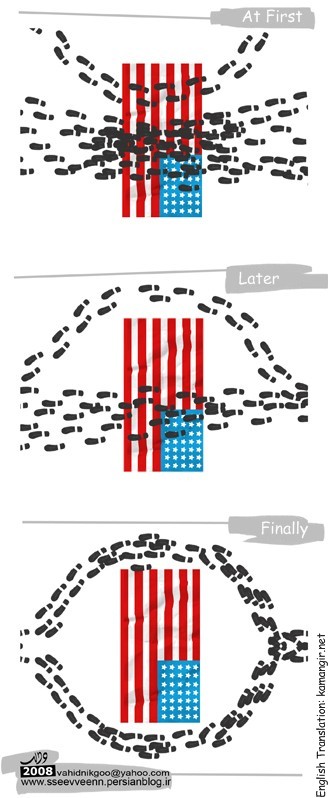
Stepping on the flag by Vahid Nikgoo (Thanks to Kamangir for the translation of this cartoon from Vahid Nikgoo's blog)

Of course President-elect Obama will have his Iran experts: people who have studied the country’s politics, society, revolution, history, and language more thoroughly than I would ever dream of doing. There are people who know the rules of taarof better than Iranians themselves and who understand the historical roots of certain forms of behavior better as well. There will be people who have examined the DNA of Iran’s leadership and who know just how many misspellings were in that fake Oxford diploma (It sounds as though it was forged by the same people who sold my friend fake Johnny Walker whiskey featuring a label with 17 misspellings.) I won’t let this stop me from offering my free advice to the next president.

1. Bluster is bad
Do not make threats that will not or cannot be carried out. Ever. There are circuitous ways to threaten Iran, if that is necessary. This means, of course, explaining to Americans that diplomacy is a subtle game and that we cannot always come out and condemn or threaten openly and still expect to be taken seriously. Direct bluster simply makes us look weak.

(related posts: Interview 3: Gary Sick talks about negotiating with Iran
Negotiating with Iranians)

2. Don’t say that you respect the history of the great people of Iran…
…And then revoke visas while people are in flight to the US, detain them without reason, or insult their intelligence.

3. Temper the demands for transparency
Demanding immediate transparency from Iran is like demanding that all Americans learn a second language. Tomorrow.

Have you ever worked with someone from Iran? And by from Iran, I mean someone who has not had the opportunity or need to adapt to the new culture? Many (not all, by any stretch of the imagination) have what my friend calls a “bazaari mentality.” There are secrets, deals, patronage, and negotiations ad nauseum. Decision-making is a very private affair and the reasoning behind a decision is deemed unnecessary. (I know that Iranians are not alone in this... just saying that it comes naturally)

Iranian culture is not, by nature or nurture, a transparent culture. Look, Ahmadinejad can’t even give a straight answer to a question about the ages of his children. The very power structure of Iran’s government is a secret even to those participating in it. It is secret, even though it is openly documented. Even where there are NO secrets, many of my Iranian friends construct secrets and conspiracies. (Earthquake in Bam: underground nuclear testing; fire at mosque: explosion, let's not even get into 9/11, the holocaust, or the moonwalk...)

A friend of mine, who has become Americanized, wondered why his own father would tell people he ate kebab for lunch when instead he ate chicken with rice. “What’s wrong with chicken?” he asked, baffled. “Why did my father feel like he had to tell people he ate kebab?”

There have to be ways to ease into a transparent relationship, rather than demand one. How? Ask the experts.

4. Doubt and challenge your experts
The first thing I learned when I went to Iran is that my expat Iranian friends did not have any idea what Iran was like. They had frozen it in time, at its very nastiest. Once I got past this, I realized that their view was extremely limited by their class and geographical location. Many of the people I spoke with extrapolated the feelings of all Iranians based on the feelings and beliefs of their own family members. I have been guilty of this as well, but not nearly so desperately as many of the people I met inside and outside Iran. Iran is a seriously classist society. Seriously. It's also "placist." Here's one of my favorite examples (one that I heard tens, if not hundreds, of times):

Why do people think we have camels in Iran? There are no camels in Iran. (News flash: I saw a camel on Dibaji Jonubi in Tehran!)

The next thing I learned is that experts can be too, let's say, "expert." Knowing the historical, cultural, and linguistic roots of certain forms of behaviors means attributing meaning where there may be none. Iran, like the US, has a culture that changes. It is a dynamic, modern culture where every single action is not necessarily as self-aware or as historically rooted as the experts think it is. Society is still changing in Iran. Many of the young people we met there have cut all ties with tradition: some consciously, some in a nihilistic manner, and some for no reason at all.

5. All Iranians hate the regime…
NOT. Even those who tell me quite openly and vehemently that they hate the regime don’t really hate them. I know that so many people I know and love would love to believe that what they really long for is freedom and democracy, but what I saw in Iran were strong familial efforts to control the behavior of their children. Some use the regime as an excuse, albeit a valid one. Allowing their children the social freedom that nearly all adolescents and young adults long for could bring them into dangerous conflict with the religious police. Ok, I’ll give them that. Despite that, I sincerely believe that despite social changes in some social classes in Iran and some cosmopolitan areas, most families in Iran want to control their families.

6. Do not fall for the argument that Western culture is decadent…
If you cannot argue in favor of Western culture, then do not negotiate with the regime in Iran. If you cannot argue in favor of our family values and our society, just surrender now. If you cannot argue in favor the rights of women and minorities, give up hope. If you cannot champion free speech with all of its messiness, all is lost. If you cannot be proud of our open debates and disagreements, don't even go to Iran.

7. Walk a mile in their shoes…
Attempting to empathize with our foes has been demonized, yet there can be no meaningful peace until we start to do that. Empathy does not require capitulation, but it can lead to real discussions and more productive negotiations. Americans cannot continue to view the world only in terms of our own self-interest. We have to at least be able to imagine the interests of others.

Here are some places to start:
Sardasht: Iran's rallying cry, root of nuclear ambitions, by Borzou Daragahi

About the Iran Coup, 1953 and in the NYT

If you're really ambitious, read My Dear Uncle Napoleon.

And don't forget to visit the blogs in my blogroll and keep up with Global Voices.

8. Remember, Iranians still educate some of the best engineers in the world at Tehran University, their best political analysts are realistic and sharp, and many get their news from a variety of sources.

It does not make sense to speak to Iranians as though they are a nation of children.

9. The next revolution will not be televised…

When I tell my Iranian friends that I believe the current regime has infiltrated society to such an extent that it cannot be easily or happily removed, they tell me that Iran is full of surprises. It even surprises itself. I know that it surprised me.

10. Absolutely gotta repudiate torture, close Guantanamo, and observe the Geneva Convention.

And here is one tip for Iran's regime:

Do not make the mistake of thinking that an Obama presidency means that you can pull a Khrushchev. You have no choice now but to negotiate in good faith.

Tuesday, July 22, 2008

Diplomacy is like a Persian Carpet...


Gotta' love this quote:

Mr Jalili likened diplomacy to Iranian carpets, "which go ahead in millimetres". He said: "Our diplomacy is also delicate and precise and, God willing, it will have a beautiful, delicate and long-lasting end."

(read more)

Tuesday, August 28, 2007

Interview 3: Gary Sick talks about negotiating with Iran

This is a long post, but I learned so much from my interview with Gary Sick, and I am certain my readers will also be interested.

Gary Sick served on the National Security Council under three U.S. presidents: Ford, Carter, and Reagan. He was the principal White House aide on Iran during the time of the Iranian Revolution.


I met Gary Sick for a couple of seconds when Kamran had an assignment to photograph him for an article about the “October Surprise.”(1)
We went to his New York apartment, photographed him outside, and left. He probably does not even remember, but I do.

Gary Sick was in the Carter administration during the taking of the American embassy by revolutionary Iranian students. His discussion of that time, the difficulty of the negotiations, and the analysis of steps, missteps, and surprises is compelling and concise. He was gracious enough to lend me some of his time for an interview. That interview is for the book I am writing about Iran.

With his permission, here are some excerpts from that interview. (All emphasis mine)

You were involved with Iran during a particularly confusing moment. Americans had been taken hostage in their embassy by revolutionary students, and no one was really sure who was in charge. How did this effect negotiations?

It was absolutely the centerpiece of our negotiation efforts. Iran was still in the revolutionary process. There was no real power center. Khomeini was certainly a power center, but he was in the shadows during the early days; his words were important, but he did not exert overt control. I think that was the way he wanted it at the time.

We had no one to negotiate with. We talked to various contacts we had, talked to various power centers, we just had to hope that we could get some word in. Eventually this worked, and we did make contact. We found Bani Sadr and Ghotbzadeh who were the president and the foreign minister at the time, but who turned out not to have any real power. We reached an agreement with them, but it was shut down by Khomeini who ultimately fired Bani Sadr.

Today it may be difficult to deal with Iran, but you know who the power centers are: negotiations have to start with Khamenei, of course, but take into account the majles [Parliament], the office of the presidency, Rafsanjani, and the bazaar, among others.

In Iran, most decisions are consensus decisions, made by a group of power centers.

Negotiating with dictatorships is easy.
In dictatorships, you know exactly who to talk with and where the power is. In Iran this is not true at all. There are many power centers, and those power centers can be opaque. Iranians often use this to their advantage in negotiations.

...


What about the personal style of a negotiation?

Iranians seem to think they have an extra negotiation gene, a bargaining gene, one that is peculiar to Iran and a source of great pride. The Iranians I dealt with seem to think they can outwit, out-bargain anyone,
and they take great pride in this. This is another way that Americans and Iranians really differ. Americans do not grow up thinking their success or personal identity is determined by how well they bargain or that they can out-bargain or outwit anyone. It's just not part of our culture or our upbringing. It certainly is not a source of national pride.

As a result, Americans put into negotiations with Iranians are often at a disadvantage.

...

Iranians report that they feel that the West would like to trick them into agreements that end up making them feel cheated. Where do you think this feeling comes from? Do you have any ideas about what is needed to gain the trust of Iranians when negotiating?

The West did try to take advantage of Iran, there are no two ways about that. Look at the British oil deal, which gave an unfair advantage to the British and unfair terms to the Iranians. Look at the great powers kicking out the shah's father. Iranians earned their right to suspicion and paranoia.

That overall sense of grievance, prevalent in Iran and throughout the Middle East in general, that sense that Muslims are discriminated against,humiliated, badly regarded, again repeatedly humiliated in political terms: that grievance runs through the Middle East very strongly. These grievances are important to understanding the rise of political Islam. And it is not totally wrong. It is true that many of these countries have been victimized, but many also acknowledge they have assisted in that victimization. Their own governments have been terrible in promoting and protecting the self-interest of their citizens. They have failed at creating governments that can compete in the global marketplace of ideas. I meet people from the region all the time who desperately want to see better governance. They want better governance.

At least one of the factors that led to these humiliations is that they have been victimized by the rest of the world who portray them as backwards and incompetent and dangerous. This is an idea that they sometimes play into as well: Arabs and Iranians. An example of this is the discussion that occurred in the Arab world after 9/11. Arabs -- and I am talking about educated sources: magazine editors, intellectuals, professors -- claimed that Arabs could not carry out this type of operation. They argued that Arabs are completely inadequate to the task: it was just too complicated. Arabs were too incompetent and that is why the Mossad or CIA or some other organization had to have been responsible for 9/11. This was a serious argument We could not carry out something that big, many Arabs said.

The dilemma, which includes Iran, is that they are aware of their own shortcomings and how these shortcomings make them vulnerable, but they do not know how to address them.

....

When I was in Iran, most of the processes (both private & public) seemed paralyzed by a general fear/inability to make decisions. Is this also the case at the diplomatic level? Overall, how do you view the Iranian government's decision-making process? What kind of influence do the IR's negotiators have?

Iran is not a decisive culture. This is another contrast between Americans and Iranians. Americans, because of their move West and taking all these big decisions, well this has made it a decisive culture. Americans take big decisions and the responsibility for these decisions. Iranians do not have this same culture. And part of this is because the US history has been that we are rich and growing. Even if we make a mistake we can recover form it. You know what Churchill said, "The Americans always do the right thing...after trying all the other alternatives." Well, once we've tried everything else, we eventually find the right way.

We can make mistakes and get,away with it. In the US we believe that ultimately our strength will get us to a point where we can recover from anything, whether this is really still the case or not is unclear.

In Iran they have a sense that they are living a lot closer to the breaking point. Mistakes made can destroy their lives and even their country.

That does not mean that they do not make decisions. They do make decisions. For example, I believe that Iran has an actual nuclear policy. It's a real policy and they are pursuing it.

When the US decided that preemption was the new policy, the Bush administration immediately published a policy paper announcing preemption as a permanent addition to US national strategy. Iranians on the contrary do not announce their policies. They do not wave a banner and say "This is our policy, come and read it." They are more subtle and indirect.

One of the best descriptions I heard to describe this is that America is a football culture: it's all about confrontation and open head-to-head competition. Iran is more of a chess culture that proceeds with a subtlety of moves. They are always thinking three steps ahead, trying to make the opponent look foolish, trapping somebody so that they think you are doing one thing when you are really doing another.

This is a great source of misunderstanding between us.
Iranians think that we do not mean what we say, that there must be something else behind our words. For out part, Ahmadinejad makes a statement and we think that statement is the policy.

...

Many people talk about taarof (The Iranian system of manners) and taqieh (a doctrine which permits Shia to lie in order to survive persecution) when they talk about dealing with Iranians. How important do you see these aspects of Iranian culture?

Elements. I don't think that Iran or even Muslims or Middle Easterners are the only people who lie or dissemble or pretend to do one thing when they want to do another. From what I understand about our current dealings with Iran: a lot of what we are doing is pretending to be bigger, stronger and more dangerous than we really are. That kind of dissembling is something we do as well. It's just something we don't do very well. Iran is also trying to make us believe that they are bigger and stronger than they actually are.

Iranians just have more experience and skill
at dissembling than we do.

I do have this worry: because of their bargaining gene, Iranians always feel that they can get another 2 or 3 percent, so they always go for more. When they get an offer that meets 90% of their terms, they think that maybe they can get 93%. In the end this kind of negotiation means that they may lose the whole thing. Squeezing everything out of your opponent may backfire.

And it is not just Iran that does this. I've watched the US negotiate or not negotiate with Iran on the nuclear issue for the past 15 years. The kind of deal we could have gotten in 1990 or 91 would look so good to us now, but we wanted more.

We lost 50% of the game, yet we are still maintaining an all or nothing approach to the negotiations.

With regard to Iran...look at what they've done with foreign investment from oil companies. They need the foreign investment, but they squeezed so hard and drove such a hard bargain, that many companies said that it just is not worth it. Why should we do this? We've lost all of our profit margin in negotiations, we'll make ourselves unpopular with the US, who needs it? They walked away. Oil executives told me that the Iranians would negotiate vigorously and endlessly. Negotiate and negotiate and negotiate. When they thought that an agreement had been reached, it would start all over again. Finally Western companies said forget about it; it's just not worth it. They want to be there, but it is not possible. Iran is paying a very high price for this.

Iran has done great damage to its own interests by over negotiating.

There is some worry that the same is true with their nuclear policy with the whole inalienable right rhetoric. Insisting on the right to do something stupid, might not be best policy in the end. It seems that there are some in Iran who care more about the principle at stake than having a functioning nuclear program.


(1)

October Surprise refers to a controversial book that Gary Sick wrote after serving on the National Security Council under Ford, Carter, and Reagan. The book documents evidence of secret negotiations between the Reagan campaign and the revolutionary clerics in Iran that ultimately led to a nefarious arms deal involving the Nicaraguan contras, Israelis, and revolutionary clerics in Iran. It is not the only book or article that Sick has written about Iran, he is also the author of the influential All Fall Down: America’s Fateful Encounter with Iran and many articles.

back to text

Thursday, March 29, 2007

Negotiating,,, Redux


Iranian rebuttal shown via BBC World

Any diplomat who has ever worked in Iran can tell you that negotiations rarely go your way once the issues become public.

The problem is that in a case like this one: where 15 British sailors were nabbed while boating in troubled waters, in front of 2 journalists, which pretty much meant that there was no way of keeping the event quiet. This also meant that there was no way to have a kind of low-key negotiation behind-the-scenes.


It is only normal that the British public would demand a show of strength from its government. Unfortunately, it is likely that this show is also jeopardizing the negotiations. As Keivan and I have learned in much, much lower stakes negotiating, any show of desperation or demand is met by stonewalling and backtracking. Many Iranians seem to have no concept of win-win negotiating, which makes them dangerous.

“If I am not screwing you, you must be screwing me,” is how many Iranians seem to think of the negotiating process.

I am sure that the British politicians and diplomats understand all this, but now they are stuck with a public “ratcheting up” that just may end up meaning a few months of detention for the British sailors. Hope I am wrong.

Sunday, November 12, 2006

Bluffing

Really interesting article in the Los Angeles Times

Found via Christopher Dickey's blog: The Shadowland Journal: Of Persians, Poker, Bluster and Bluffs:


..At least 250 years before our country was founded, Persians were playing bluff-based card games with decks of four suits: coins, goblets, polo mallets and scimitars. In the late 18th century, their vying game As-Nas (My Beloved Ace) became the prototype for the 20-card French game poque. Introduced by Napoleon's troops to New Orleans, poque evolved into 52-card poker on Mississippi steamboats in the decades after the Louisiana Purchase. Union and Confederate soldiers played the game between battles, then brought it home to every state and territory. By 1970, when the first World Series of Poker was hosted by Benny Binion at his Horseshoe Casino in downtown Las Vegas, the variation of choice was no-limit Texas hold 'em. During the next 36 years, the number of challengers in the main event mushroomed from seven to 8,773, including players from 56 countries. But only one country besides the U.S. has produced more than one champion: Iran."


Oh, and a note to some secret friends: it seems that Iran *did* indeed invent poker.

Tuesday, May 09, 2006

Negotiating with Iranians

So here it is: tips and tricks for negotiating with Iranians.

Iranians do not care if they lose. This makes them dangerous negotiators. People, particularly Iranians, always argue with me on this point, but I remain unshaken.
They are tough because they are so rarely desperate. If they are desperate they either lose big in negotiations or have learned to hide it so well that the other negotiator will eventually fold.

Iranians negotiate everything. It is never safe to presume that you and an Iranian have the same idea concerning the subject of the negotiation. Let’s say that you are negotiating for a chicken dinner. You spend 1-month talking about this chicken dinner. You finally come to an agreement and it is time for the Iranian to present you with your chicken dinner. What you end up is a sandwich that you share with a live chicken. Anyone who has seen The Beverly Hillbillies turkey dressing episode will understand. (I surprisingly cannot find a good reference to this episode online. Let’s see, what I remember is that Granny asks Mr. Dreysdale to dress the turkey for Thanksgiving. He puts the turkey in a 3-piece suit and leads him to the Clampett’s for dinner.)


1. Never threaten.
Iranians do not respond well to threats. State your intentions at the beginning of the negotiations. State the consequences of failed negotiations. It is important to be prepared to accept the consequences before you state them. If you are unwilling to accept the consequences, do not state them.

2. Flatter the Iranian.
Always appeal to an Iranian’s vanity. Flatter him with everything and anything you can imagine. Bring him flowers, cologne, sparkling grape juice. Appeal to his honor and his pride. Call him by honorifics that he does not deserve: like doctor or engineer. Ask him to do you a favor.

3. Do not flinch when insulted.
Just make sure that you find a way to inflict a worse insult, preferably in the form of flattery.

4. Never show desperation.
While you may remind an Iranian of a deadline, you must not show any desperation to meet the deadline.

5. Do not ever trust an Iranian negotiator who acts like he is your friend.
You are about to get screwed big time.

6. Do not warn, act.
Let’s say the negotiations are now failed. At this point, you need to act. If you lack the will to act, then you broker rule 1. You threatened.

WARNING: Everything I wrote above may be wrong. I, myself, am never successful in negotiations with Iranians because I am too optimistic. I always think that this time things will be different...

Monday, January 30, 2006

Negotiation

Tagged as:

…Spent the week watching K negotiate a relatively small contract with Iranian vendors. The days were filled with offers immediately rebuked, prices rising 20% in a matter of hours, and general miscommunication, subterfuge, and ambiguity.

“Why didn’t you just send them packing?” a European friend asked us when we described our week to her.

“We were agreeing,” K explained. Our friend gave a knowing laugh.

Finally a contract was signed. Everyone seemed happy.

The next day the signatory an K were in a meeting. “I need 3 weeks more to complete the project.”

“You signed the contract.”

(3-hour discussion boiled down to 2 sentences.)

The signatory broke the contract, and it all started again with someone new…

So when we heard Jack Straw say that the Iranians were the most difficult negotiators he had ever dealt with, all we could do was laugh.

ShareThis