Showing posts with label iran. Show all posts

Saturday, March 24, 2012

Unveiling Iran


My piece on two series of photographs -- Listen by Newsha Tavakolian and Chador by Kamran Ashtary is up on the Swiss publication, Neuland Magazin:

In 1978 and 1979, life in Iran drastically changed. This was especially true for women and girls, who once again found themselves and their bodies the focus of revolutionary change. Decades earlier they'd been forced to give up the veil in the name of modernity. Now they were forced to put it back on. They could no longer sing or dance in public. Iranian photographers Newsha Tavakolian and Kamran Asthary use their work to respond to a world fundamentally changed.
Click here to read more and to see the photographs.


Saturday, September 25, 2010

Hope, Votes & Bullets

Hope, Votes & Bullets

We have been working our asses off in a book that features the work of bloggers, writers, and others whose lives were effected by what happened in Iran in 2009. Today, the book was delivered. Here is an internet preview. We'll let you know when it goes on sale. For those of you who facebook, be sure to "like" us over on Facebook.

HVB_Final Cover 730mm_Printer file

Thursday, December 03, 2009

The train to the future in Iran

A friend who just returned from Iran and a visit to family and friends, “Everywhere I went, the message was clear. ‘We are happy with the support of Iranians all over the world, but we do not want their political advice. It is their support we want, it gives us strength.’”

One of her friends, who is a teacher, had this to say about young people in Iran:

“It’s as though the young people are on a train that has already left for the future. They don’t care about the past. Only the future. They like Mousavi because he is not charismatic and because he knows that he is on their train. He said, ‘I follow you,’ not the other way around. They do not want leaders right now. They are not idealistic. They say, ‘Rafsanjani, if you are on our train, fine. If not, stay on the platform.’ For them, Iran is already moving towards a new future.”


Cross-posted at United4iran.

Tuesday, December 01, 2009

Letters to the President: thoughts on the documentary


Sunday, I saw the movie, Letters to the President, which is one of the movies we are going to be showing at the 12-12 Studio /K event in Amsterdam. It was heartbreaking and entertaining and not at all what I expected. The blurb made me feel like I was going to see something vaguely supportive of Ahmadinejad’s policies, but that’s not the story I saw in the movie at all. It was a much more powerful critique of Ahmadinejad's economic policies because it allowed the story to unfold without taking sides.

After the movie Kamran spoke, I got into a bit of a tiff with someone who wanted to lecture me about the October Surprise and America’s responsibility for the Iran-Iraq war, and we met up with a friend who had just returned from Iran. She grew up in a village not so different from the villages Ahmadinejad traveled through during the course of the film. She told us what one of her cousins said, “This regime has turned us into beggars.” Our friend went on to explain, it makes them beg for a yearly subsidy of about $50 a year that no longer even covers the cost of two kilos of meat: that’s how much prices have increased in the past couple of years.

One of the other speakers, Nikita Shabazi, claimed that Ahmadinejad’s regime brought more people out of poverty than any other, which is why she would have voted for him had she been dragged kicking and screaming to the polling booth. She quoted The Brookings Institute as her source for this data. Here is what I find when I go the Brookings Institute for information:

Significantly, during the first two years of the Ahmadinejad Administration (2005-06) inequality worsened in both rural and urban areas, possibly because higher inflation hurt those below the median income level more than those above it. This is not so much an indication that Ahmadinejad was insincere in promising redistribution but how difficult it is to redistribute income without fundamental changes in the country’s distribution of earning power (wealth and human capital) and political power, which determines access to government transfers from oil rent.


The author goes on to show a steady decline in poverty, since its high in 1988. This is an achievement that can hardly be attributed to the Ahmadinejad presidency.

If you are in Amsterdam, please join us for the 12-12 event. Petr Lom will be there to discuss his movie, along with many others.

Monday, November 30, 2009

A Message from an American Family to your Khanavadeh


I hope that people in Iran will be able to see this video, I uploaded the smallest version available. If you'd like to see it in higher quality, check out the youTube link or the Vimeo link.

The struggle for justice and civil rights is a long and difficult one. Good luck...

Wednesday, March 25, 2009

Black banners


If I lived in Iran, I would have a closet filled with black just to keep up with all the mourning I would have to do. It’s not as though I do not grieve here in Amsterdam as well, it’s just that I don’t wear black.

If I were in Iran, I would be painting a black banner. It would say that the young man who died was dearly loved by me and that I would never forgive him for dying.

If I were in Iran, I would be mixing orange syrup into cold water and passing out tea and dates filled with walnuts to each new guest.

If I were in Ahwaz, families would be camping in the park a few blocks away, enjoying the new year’s vacation and the perfect weather. They would walk by the house covered in black banners and know that a young person had died. They would nod their heads in sympathy and thank god for the good fortune to be healthy and whole.

But I am in Amsterdam. At least it is dreary. I couldn’t take a cloudless day right now.

Monday, March 23, 2009

Obama's Norouz Message

Kamran and I have guest posts up at Harry's Place. (Mine is Naivety, Diplomacy, and Threats and Kamran's is Obama’s positive New Year message to Iran, even though Kamran originally called it a Wolf in Sheep's Clothing.

Here are excerpts:

A Wolf in Sheep's Clothing:

The Iranian regime wants us Iranians to believe that President Obama is a wolf in sheep’s clothing. This message is their response to Obama’s election and policies regarding talks with Iran. Don’t forget that Ahmadinejad said that a black man could never be president of America. That means they were not prepared to deal with someone who would publicly offer a hand for dialogue and a better relationship.

Is President Obama sincere in his attempts to start a better relationship with Iran? We still need to wait and see. What is clear by now, is that if his policy of engagement fails it won’t be the fault of the US alone. It is fine if Obama want to quote our beloved poet, Saadi, to show respect and understanding of our long history, but we have heard this before, we have been there, and we know that game very well,

The US needs to come up with concrete steps and let us Iranians know what they are offering publicly. The one thing that Iranians from all walks of life agree on is our desire to be an independent nation. We won’t accept anything less.

There are a lot of measures that the US government can take to build trust. Not all of those have to do with the Iranian government’s willingness to start dialogue with the US. I see Obama’s New Year message as positive, but we need more than that.

At the same time the response of Ayatollah Ali Khamenei, the Supreme Leader of Iran, can be understood as nothing other than asking the US to go down on its knees and beg for forgiveness and take responsibility for the manipulation of the last 500 years of Iranian society. His demand for changes without discussion is the same as the American policy of demanding preconditions for talks.
Read the rest

--

Diplomacy, Naivety, and Threats

Everywhere I went in Iran, I met people who claimed to despise the actions of their government and the clerical regime. Taxi drivers, hotel clerks, waiters, government employees, mothers, fathers, accountants and butchers all expressed dismay and disgust at the Iranian government. Yet after four years living there I realized that despising the regime is a kind of national sport in Iran. It’s not new or even confined to the current regime. A nineteenth century French diplomat described Persians as “full of adoration for the country itself, they do not believe in any means of running it.” (You can read that quote in Fariba Adelkhah’s great book Being Modern in Iran.) The only politicians Iranians respect are those, like Mossadeq, who never had the opportunity to screw up because they were removed from office forcibly. While the actions of their government have very real consequences for the daily life of every single citizen of Iran, in reality most Iranians see it as superfluous: at best, defenders of Iran’s national interests; at worst, another tyranny to survive.

Since my stay in Iran, I have come to see the sanctions and the lack of diplomacy as counter-productive. The lack of official diplomacy with Iran since the revolution has, on one hand, been a boon for America’s image in that country. It meant that I was welcomed and beloved in every corner of Iran, despite what you might think if you are a viewer of Fox News. It’s fantastic to be an American in Iran. In fact, I doubt there is a more pro-American population outside of Texas. Why? Because we have not compromised with a corrupt and despised regime as we have in other parts of the world. That said, I don’t see that the lack of diplomacy and the sanctions have done any favors for Iran’s opposition or its people. The sanctions have strengthened the most powerful supporters of the regime who now have a stranglehold on the economy; read Abbas Milani’s article “U.S. Foreign Policy and the Future of Democracy in Iran.” (pdf). They have forced millions of Iranians into dependency on the government itself for work, food and basic necessities.

Read the Rest

Friday, January 09, 2009

Photos, blogs, and the continuing attack on women's rights

Just in case my loyal fan base has been wondering what I am up to... well it's obvious that I am not blogging... Here's an update on some of the things that have kept me busy for the past month:


Iason Athanasiadis has a show of photographs of Iran up at the Craft and Folk Art Museum in Los Angeles. Many of my friends know the photographer, so I know how dedicated he is to getting a good photo. If you can't make it to his show, you can still buy our book.


Blogging Basiji


Apparently Iran's Revolutionary Guards are embarking on a 10,000 blog campaign. Hamid Tehrani writes about their efforts at Harvard's Internet and Democracy blog. From the tone of his article, it sounds as though the effort will be as successful as Orrin Hatch's ballads:

The presence of 10,000 Basiji blogs without interesting content and quality will fail to attract readers or promote any ideas. The Islamic Republic’s state-controlled media has been a failure for three decades. The Iranian regime in recent years launched several TV channels, but even poor-quality satellite dishes became a must-have for millions of Iranians to access banned foreign films, music clips or news.


Iranian regime terrified of a few women


They are so terrified of women that they are harassing women's rights activists claiming that they compromise national security and then harassing the lawyers who defend them. Shirin Ebadi's home and office were invaded by state actors. They closed down her office and have been coming up with increasingly ridiculous charges against her. From an LA Times article:

"They were looking for some excuses to shut down our center and increase pressure on us," said Mohammed Seifzadeh, another Iranian human rights attorney and confidant of Ebadi.

Then authorities accused Ebadi of evading taxes on cases she took without pay. Tax officials came to her office several days ago to inquire about financial records, which Ebadi said were not at the office.

Ebadi called the tax fraud allegation absurd, saying she hasn't charged any of her clients for legal work in 15 years.

"If the law and legal procedures are taken into consideration, I am not a tax dodger," she said. "But if . . . they treat us outside the law, they can do whatever they want."


Finally, I have been working a on a group blog: Riveter Posts. If you want to keep up with daily life in Iran, I urge you to read Catharina's accounts. She's been living in Iran for more than forty years now and is sharing her experiences with us now. Here's a short post she wrote on repairing her house:

I knew it was going to be bad, but in reality it’s so much worse than I thought it would be. I could live with the painters, who only broke a glass table, scratched up a solid wooden cabinet, dropped and broke some porcelain statues and made a mess when they sanded the walls and ceilings. I survived all of that. But then arrived a very nice gentleman who would repair and fix my parquet floor. At the same time some carpenters would fix the stairway and several doors to the bathrooms. They took the doors with them so they could fix them in their own workshop. So there I was: radiators taken outside as the floors beneath them needed fixing (and it was freezing at night), not a toilet or bathroom in the house with a door, and my whole house, including everything stored inside the closets, covered with a thick layer of dust because of the abrasing of the parquet floors. That’s when I started to cry. And what a coincidence! It was Tasua when all of Iran cries for the death of Imam Hossein. This was the first time ever that I cried with them.

Monday, December 15, 2008

An eye for an eye

Wrath and the desire for revenge: those must be the most human emotions. When I meet people who are forgiving and compassionate in the face of great personal disaster, I am in awe. I think I have met two such people. Well, maybe one. But trust me, his forgiveness is awe-inspiring, compassionate, and smart. It's also completely baffling. I mean, who wouldn't want to personally torture the executioners of a loved one?

As much as we might enjoy a Dirty Harry film or a Charles Bronson revenge flick, the reality of "an eye for an eye" is a gruesome one that reveals the darkest part of our humanity. (I almost wrote "lizard brain," but couldn't actually imagine a lizard committing an act of vengeance.) Thomas Erbrink's article in Sunday's Washington Post, about a young woman blinded and disfigured in an acid attack by a spurned lover who has successfully lobbied to have her attacker blinded by acid, graphically illustrates the moral problems at the heart of legal systems that allow for vengeance. The very legality of corporal punishment, no matter how rare or common it might be, allows victims and their families to unleash their dark revenge monsters.

This monster exists inside most of us. I mean, how could it not? It's only natural to want to revenge a wrong. Imagining a vicious crime committed against me or someone I love is enough to make my blood boil... the reality of it... well that would be even worse.) Reading Erdbrink's article, made me feel incredibly sad that such a vicious crime was committed in the first place, and that the woman and her family have spent so much time and energy to ensure that the perpetrator gets a dose of his own medicine by having 5 drops of acid placed in each of his two eyes. Will fewer men stalk and harm women as a result? Somehow, I doubt it.

On a closing note, a few weeks ago, a friend told us the story of a European woman who was raped in Iran and who called for the men accused of the rape to be executed. This case was particularly difficult for European diplomats who spend so much of their time in Iran campaigning against the death penalty. The second one of their own citizens had the opportunity, she called for execution.

This is what the law is for: to protect us from the worst of ourselves, not to transform us into vigilantes.

Other blogs discussing this:

Sharazad

Here, There, and Everywhere

Feministe

I know there are a lot more, and even more in Persian, but I'll stop there. I do want to borrow a comment left by Mrss at The Kvetcher:

In this culture (which I know something of, though I’m American.) It’s likely that if they blind him, his family will force a close female relative (a younger unmarried sister or cousin most likely) to dedicate the rest of her life as his full time caregiver. She will never be allowed to marry or pursue a career or education, and she will have no choice in this. In this respect, I would rather he die than destroy another innocent woman’s life.

Wednesday, November 05, 2008

10. Tips about dealing with Iran for President-elect Obama

My long-term companion turned to me this morning and said, “The regime better watch out now. They can no longer argue that America doesn’t want to talk. With Obama as president, they can’t keep making America their enemy.

He’s right; an Obama presidency means “all options are REALLY on the table.”

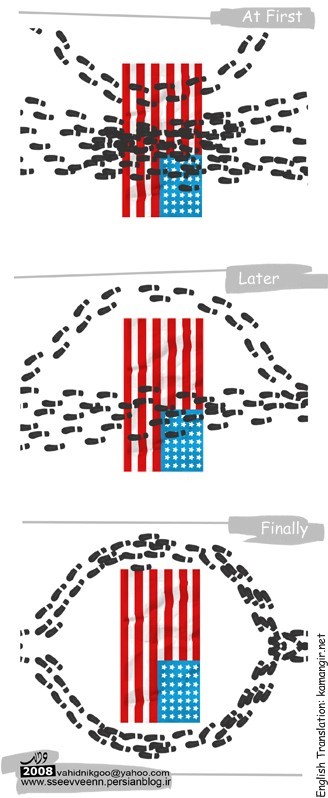
Stepping on the flag by Vahid Nikgoo (Thanks to Kamangir for the translation of this cartoon from Vahid Nikgoo's blog)

Of course President-elect Obama will have his Iran experts: people who have studied the country’s politics, society, revolution, history, and language more thoroughly than I would ever dream of doing. There are people who know the rules of taarof better than Iranians themselves and who understand the historical roots of certain forms of behavior better as well. There will be people who have examined the DNA of Iran’s leadership and who know just how many misspellings were in that fake Oxford diploma (It sounds as though it was forged by the same people who sold my friend fake Johnny Walker whiskey featuring a label with 17 misspellings.) I won’t let this stop me from offering my free advice to the next president.

1. Bluster is bad
Do not make threats that will not or cannot be carried out. Ever. There are circuitous ways to threaten Iran, if that is necessary. This means, of course, explaining to Americans that diplomacy is a subtle game and that we cannot always come out and condemn or threaten openly and still expect to be taken seriously. Direct bluster simply makes us look weak.

(related posts: Interview 3: Gary Sick talks about negotiating with Iran
Negotiating with Iranians)

2. Don’t say that you respect the history of the great people of Iran…
…And then revoke visas while people are in flight to the US, detain them without reason, or insult their intelligence.

3. Temper the demands for transparency
Demanding immediate transparency from Iran is like demanding that all Americans learn a second language. Tomorrow.

Have you ever worked with someone from Iran? And by from Iran, I mean someone who has not had the opportunity or need to adapt to the new culture? Many (not all, by any stretch of the imagination) have what my friend calls a “bazaari mentality.” There are secrets, deals, patronage, and negotiations ad nauseum. Decision-making is a very private affair and the reasoning behind a decision is deemed unnecessary. (I know that Iranians are not alone in this... just saying that it comes naturally)

Iranian culture is not, by nature or nurture, a transparent culture. Look, Ahmadinejad can’t even give a straight answer to a question about the ages of his children. The very power structure of Iran’s government is a secret even to those participating in it. It is secret, even though it is openly documented. Even where there are NO secrets, many of my Iranian friends construct secrets and conspiracies. (Earthquake in Bam: underground nuclear testing; fire at mosque: explosion, let's not even get into 9/11, the holocaust, or the moonwalk...)

A friend of mine, who has become Americanized, wondered why his own father would tell people he ate kebab for lunch when instead he ate chicken with rice. “What’s wrong with chicken?” he asked, baffled. “Why did my father feel like he had to tell people he ate kebab?”

There have to be ways to ease into a transparent relationship, rather than demand one. How? Ask the experts.

4. Doubt and challenge your experts
The first thing I learned when I went to Iran is that my expat Iranian friends did not have any idea what Iran was like. They had frozen it in time, at its very nastiest. Once I got past this, I realized that their view was extremely limited by their class and geographical location. Many of the people I spoke with extrapolated the feelings of all Iranians based on the feelings and beliefs of their own family members. I have been guilty of this as well, but not nearly so desperately as many of the people I met inside and outside Iran. Iran is a seriously classist society. Seriously. It's also "placist." Here's one of my favorite examples (one that I heard tens, if not hundreds, of times):

Why do people think we have camels in Iran? There are no camels in Iran. (News flash: I saw a camel on Dibaji Jonubi in Tehran!)

The next thing I learned is that experts can be too, let's say, "expert." Knowing the historical, cultural, and linguistic roots of certain forms of behaviors means attributing meaning where there may be none. Iran, like the US, has a culture that changes. It is a dynamic, modern culture where every single action is not necessarily as self-aware or as historically rooted as the experts think it is. Society is still changing in Iran. Many of the young people we met there have cut all ties with tradition: some consciously, some in a nihilistic manner, and some for no reason at all.

5. All Iranians hate the regime…
NOT. Even those who tell me quite openly and vehemently that they hate the regime don’t really hate them. I know that so many people I know and love would love to believe that what they really long for is freedom and democracy, but what I saw in Iran were strong familial efforts to control the behavior of their children. Some use the regime as an excuse, albeit a valid one. Allowing their children the social freedom that nearly all adolescents and young adults long for could bring them into dangerous conflict with the religious police. Ok, I’ll give them that. Despite that, I sincerely believe that despite social changes in some social classes in Iran and some cosmopolitan areas, most families in Iran want to control their families.

6. Do not fall for the argument that Western culture is decadent…
If you cannot argue in favor of Western culture, then do not negotiate with the regime in Iran. If you cannot argue in favor of our family values and our society, just surrender now. If you cannot argue in favor the rights of women and minorities, give up hope. If you cannot champion free speech with all of its messiness, all is lost. If you cannot be proud of our open debates and disagreements, don't even go to Iran.

7. Walk a mile in their shoes…
Attempting to empathize with our foes has been demonized, yet there can be no meaningful peace until we start to do that. Empathy does not require capitulation, but it can lead to real discussions and more productive negotiations. Americans cannot continue to view the world only in terms of our own self-interest. We have to at least be able to imagine the interests of others.

Here are some places to start:
Sardasht: Iran's rallying cry, root of nuclear ambitions, by Borzou Daragahi

About the Iran Coup, 1953 and in the NYT

If you're really ambitious, read My Dear Uncle Napoleon.

And don't forget to visit the blogs in my blogroll and keep up with Global Voices.

8. Remember, Iranians still educate some of the best engineers in the world at Tehran University, their best political analysts are realistic and sharp, and many get their news from a variety of sources.

It does not make sense to speak to Iranians as though they are a nation of children.

9. The next revolution will not be televised…

When I tell my Iranian friends that I believe the current regime has infiltrated society to such an extent that it cannot be easily or happily removed, they tell me that Iran is full of surprises. It even surprises itself. I know that it surprised me.

10. Absolutely gotta repudiate torture, close Guantanamo, and observe the Geneva Convention.

And here is one tip for Iran's regime:

Do not make the mistake of thinking that an Obama presidency means that you can pull a Khrushchev. You have no choice now but to negotiate in good faith.

Monday, August 04, 2008

Pioneering HIV/AIDS Doctors charged with fomenting revolution


Hamid Tehrani at Global Voices is asking why Iranian bloggers are not speaking out about the arrest of two prominent AIDS physicians:

As the XVIII International Aids Conference started on August 3 in Mexico, two internationally recognized Iranian HIV/AIDS specialists who were supposed to attend the meeting, are being held in prison accused of planning to overthrow the Iranian state.

The two physicians, Kamira and Arash Alaie, are brothers, and have pioneered educational and harm reduction campaigns among drug users, prostitutes, and prison inmates in Iran and throughout the Middle East. They were arrested last month, and have had no legal representation.


I don't know enough to comment. I remember that when I was in Iran it was very difficult to get information in the first place. I also know that despite the fact that Iran has an active AIDS prevention policy, many see the disease as a punishment for sinful behavior. Despite the fact that the society is extremely homosocial, Iranians are homophobic. I have to say, that I hope that it's simply a matter of not knowing rather than not caring.

Kamin Mohammadi has a post about the two doctors up at Arabisto.

Kamin writes:
I cannot imagine that my friend and his brother, who have devoted their lives to helping the people of our country, could pose any possible threat to it. I cannot speak for the Islamic Republic's motives nor can I pretend to have any intimate knowledge of the brothers' activities. But I think the sterling work of the Alaei brothers should be able to speak for itself.


Both she and Tehrani link to this online petition and you can join this campaign over at Facebook.

Saturday, August 02, 2008

Amsterdam is for Iranians


It's summer, and Amsterdam is filled with visitors from Iran here to visit family and enjoy the cool, long days. Our visitor, an old family friend, told us, "I've come from Hell and landed in Heaven."

Last night at a party with other friends visiting from Iran, he lamented the fact that his teenaged daughter was stopped by the morals police for showing too much hair. "Look how free you are here," he said. "Nobody bothers you. You can cover your hair, not cover your hair, drink a beer in the park. Nobody cares."

Some of our friends have been telling me that Obama said that if Iran does not agree to the nuclear demands made by the UN, then Israel will bomb them. This seemed a bit extreme even for an American politician. I found the quote, which is here:

"Nobody said this to me directly, but I get the feeling from my talks that if the sanctions don't work, Israel is going to strike Iran."

I get the feeling from reading that quote that Obama's been talking to a lot of hardliners. It's just a feeling though.

Even though all readers of this blog know that I am against an attack, I think it's important to remember that Iran does regularly threaten Israel. These are not all empty threats either. Iran funds Hezbollah and Hamas, even if it does not control them. So the fact that Obama would get a feeling that Israel might attack is not so surprising.

Sunday, July 27, 2008

Hints for Brian Williams for His Interview With Ahmadinejad

Ahmadinejad with empty pockets on the cover of Time

UPDATE: You can see the interview and leave a comment about it at Newsvine. My POV, is that there is no way to interview AN without also providing him with a platform. If you insult him, you lose. If you cut him off, you lose. If you are polite, you lose. Nice tie, though.

Omid Memarian supplies hints for interviewing Ahmadinejad.

Here's my response to a couple of his hints:
2- Don't use a rude tone in order to appear aggressive...

Exactly. Iranians are masters of the excruciatingly polite insult. Best to practice up ahead of time. Overt aggressiveness plays to his strength and makes people think he's been unfairly treated.

3- It's his answers, not your questions, that are important...

This may be true. But don't just let him babble on and on about things unrelated to the question. If you ask him about the Holocaust, he responds with the Palestinians (why doesn't anyone ever respond that the Balfour Declaration predates the Holocaust?)... I recommend firmly, but gently herding him into a direct response to the question.

4- Research Iranian cultural codes. For example, do not wear a tie to the interview. For Ahmadinejad and other Iranian officials, a tie is a symbol of capitalism...

This is a crock of shit. Who cares if the tie is a symbol of capitalism? Wear it! In my experience, Iranians are smart enough to know that we Westerners have our own cultural codes. I completely, totally disagree with this kind of pandering. The only reason for removing your tie is the heat of a Tehran summer not what Ahmadinejad or anyone else would think.

It's more important to know how conversational formalities work than to not wear a tie.

5- Don't ask cliché questions...

What is a cliche question? (Read the full list at the Huffington Post http://www.huffingtonpost.com/omid-memarian/a-few-hints-for-brian-wil_b_115168.html)

read more | digg story

Tuesday, July 22, 2008

Muhammad Sahimi: Wish to be Poor and Unemployed? Support Military Attacks on Iran


Muhammad Sahimi: Wish to be Poor and Unemployed? Support Military Attacks on Iran

Posted using ShareThis

Salimi makes some interesting points about how an attack on Iran would threaten US economic and physical security. In the end, though, he makes the same argument that is heard time and time again: that there is no evidence that Iran is building nuclear weapons. In fact, the IAEA report (which I have only partly read) states that IRAN claims it is not developing nuclear weapons. It does not state that the IAEA agrees (or disagrees) with that claim. The report is a sensitive diplomatic document. They are unwilling to state anything that they cannot factually prove. A diplomat I know told me that any trained diplomat reading the IAEA report can tell that it does not categorically state that Iran is not pursuing a nuclear weapons program.

Salimi also says that an attack on Iran would make the attack on Iraq look like "child's play":

But, if Iran is attacked by the U.S. and/or Israel, its response will make the Iraq war look like child's play. Why? Because Iran is very different from Iraq. As I stated in a 2006 op-ed that I co-wrote with the 2003 Nobel Peace Laureate Shirin Ebadi, Iranian nationalism, which has its roots in Iran's 4000 years of proud written history and many glorious contributions to humanity, is extremely strong.

Couple this nationalism to the Shi'ites 1300 years old tradition of martyrdom in defense of their homeland and religion. Add to it the belief of many commanders of Iran's Revolutionary Guards (Iran's elite military) that they should have been killed in the Iran/Iraq war and, therefore, have lived at least 20 years more than their "natural" life. That means that they will fearlessly fight back, if Iran is attacked. The result is a powerful and volatile mixture of proud nationalism and religion which, should Iran be attacked by the U.S. and/or Israel, will engulf the entire region in fire.


While I do not doubt the strength of Iranian nationalism, I think one could just as easily make the argument for Iranian (national, if not governmental) pragmatism and instinct for survival as for their fierceness. There is evidence of this as well.

That said, I don't doubt that an attack on Iran (especially one that goes horribly wrong) would engender a new wave of enemies against the US and Israel. I just wonder if those enemies would necessarily be Iranian.

Sunday, July 20, 2008

Blackouts, inflation, and sanctions


The same rice that I just bought in Amsterdam for $4 a kilo is $8 a kilo in Iran. Tea, according to friends who were just visiting, is up to $30 a kilo. When a friend asked her mother in Tehran what she should bring her from Amsterdam, the mother joked "rice and tea."

When a friend told me that there were blackouts in Tehran and that the sanctions were really having an effect, I thought he was joking. I thought he thought that I had become a doomsayer, like so many who no longer live in Iran, and was just feeding my hysteria. Turns out he was not joking. You can read about Iran's economic problems in an article by Thomas Erdbrink: Oil Cash May Prove A Shaky Crutch for Iran's Ahmadinejad

A small coterie of developers, oil traders and businesspeople with lucrative government contracts are profiting from the oil boom. Shiny new BMWs crowd the streets of northern Tehran, where real estate prices have doubled or tripled and where luxury developments can command $2,000 per square foot.

But the majority of Iranians have suffered from the inflation that analysts say is partly the result of government spending. Asgar Eskandiary, 32, a teacher, said he thanked God for the health insurance he bought years ago because it paid for a sinus operation. Otherwise, he and his wife would have had to spend rent money on the operation and "we would have lost our apartment for sure," he said, drinking a warm Coke at a fast-food restaurant where a blackout to save energy had deterred other customers.

Every visit to the supermarket brings unpleasant surprises, he said. The price of milk powder, which the couple needs for their infant son, increased from the equivalent of $3 to about $4.30 in just over a year's time. He makes the equivalent of about $540 a month and "can barely cope," he said. "We spend all we have for our small baby."

The teacher said he saw only one solution. "I want to write a letter to Supreme Leader Ayatollah Ali Khamenei. He needs to bring back the experts, people who know about economy. The government doesn't know what they are doing."

...


"We simply can't transfer money, which means that we can't buy spare parts for our factories," said Bodagh Khanbodagi, honorary president of the private Iranian-German business chamber. German export credits backing trade with Iran totaled about $730 million last year, about half the value of German export credits in 2006 and one-fifth that in 2004, according to a report by the Congressional Research Service released this month.

"Nobody's coming over, and I don't see any minister visiting here in the near future," he said, sipping tea in an office decorated with pictures of himself with German and Iranian dignitaries.

Saturday, July 19, 2008

Suicide is painless it brings on many changes


`Within thirty years, we will have the technological means to create superhuman intelligence. Shortly after, the human era will be ended.' (Vernor Vinge, NASA VISION-21 Symposium, 1993)

Benny Morris, who often predicts that Iran is out to annihilate Israel,has another op-ed piece about why Israel needs to mount a nuclear attack against Iran in the NYT.

But should Israel’s conventional assault fail to significantly harm or stall the Iranian program, a ratcheting up of the Iranian-Israeli conflict to a nuclear level will most likely follow. Every intelligence agency in the world believes the Iranian program is geared toward making weapons, not to the peaceful applications of nuclear power. And, despite the current talk of additional economic sanctions, everyone knows that such measures have so far led nowhere and are unlikely to be applied with sufficient scope to cause Iran real pain, given Russia’s and China’s continued recalcitrance and Western Europe’s (and America’s) ambivalence in behavior, if not in rhetoric. Western intelligence agencies agree that Iran will reach the “point of no return” in acquiring the capacity to produce nuclear weapons in one to four years.

Which leaves the world with only one option if it wishes to halt Iran’s march toward nuclear weaponry: the military option, meaning an aerial assault by either the United States or Israel. Clearly, America has the conventional military capacity to do the job, which would involve a protracted air assault against Iran’s air defenses followed by strikes on the nuclear sites themselves. But, as a result of the Iraq imbroglio, and what is rapidly turning into the Afghan imbroglio, the American public has little enthusiasm for wars in the Islamic lands. This curtails the White House’s ability to begin yet another major military campaign in pursuit of a goal that is not seen as a vital national interest by many Americans. (If you are not registered at NYT, Harry's Place has the entire piece posted.)


(Emphasis mine)

So, since everyone already knows that a conventional attack will fail since Iran has already planned for a conventional attack by building duplicate sites, far underground, and dispersing facilities all over the country, shouldn't we already jump to the nuclear option?

Which means what exactly? Just how much of Iran needs to be nuked in order for Israel to be safe?

My answer is this: this kind of war will never ever be won. It is impossible. Destroying Iran as an enemy only means creating new enemies in new places.

Hey, believe me, I understand why Israel feels the necessity to have a nuclear deterrent. I understand why its survival depends on being a bad ass. Iran getting nukes scares me. Anyone familiar with this blog will know that I have consistently taken an anti-nuke stance.

I do not want to see Israel destroyed any more than I want to see Iran destroyed. I am hoping that, on all sides, calmer heads will prevail. (But, as a Sci-Fi aficionado, I fear the coming singularity.)

It is useful to note that Iran sees itself as alone among enemies in much the same way that Israel sees itself. The threats go in all directions. Iran saw itself abandoned by the world when villages in the province of Kurdistan were gassed:

In total 360 chemical bombs were dropped on Iran against both military and civilian targets resulting in 100,000 casualties. There are now still some 45-52,000 people in Iran suffering severely from these attacks, many of them civilians who were not involved in the war but were just trying to live their lives.

What’s important to say at this point is that Iran is the only country in recent history that has had weapons of mass destruction used against it, and this by Iraq in full view of the international community which did nothing to help.

(From a text by Kamin Mohammadi)


(I actually remember that the official view of the US at the time was that the chemical attacks never took place.)

In conclusion (finally!), the premise of the argument for a nuclear attack against Iran is this: the regime is suicidal and willing to bring about the end of their own world. Everyone knows that a nuclear attack against Israel will assuredly result in devastating attacks against Iran. So, the regime must be suicidal to launch such an attack.

This begs the question: is a preemptive strike against Iran also suicidal for Israel? I think it is. Maybe not immediately, but eventually.

Friday, July 18, 2008

Sunday, July 13, 2008

Blogging in Iran

Azadeh at Radio Zamaneh has an interesting interview with a disabled man who discovered blogging. He discusses how blogging made him feel less isolated and opened him up to a whole new world. As a result of this experience, he has set up all sorts of others in Iran with their own blogs.

If you can read or listen (I listened
), it's a great interview.

Thursday, July 10, 2008

Iran missile test redux


Kamangir points out that a photograph published of the recent missile tests is from the same test that was photographed 2 years ago.

Check out his blog and compare the pictures for yourself.

Update: This just in from AFP:

Photographs published on the Iranian Revolutionary Guards website showed four missiles taking off from a desert launchpad.

But one of the missiles had apparently been added to the photograph using elements from the smoke trail and dust clouds from two of the other missiles.

After being shown the photograph by AFP, Mark Fitzpatrick of the London-based International Institute for Strategic Studies (IISS) said: "It very much does appear that Iran doctored the photo to cover up what apparently was a misfiring of one of the missiles.

"The whole purpose of this testing was to send a signal so Iran both exaggerated the capabilities of the missile in their prose and apparently doctored the photos as well."

Tuesday, July 08, 2008

Student demonstration in Tehran


This is the first time I have seen a video like this one. Usually videos of demonstrations are taken from inside the crowd. This one is taken from the Ministry of Interior in Tehran and you really get to see the size of the crowd. It seems that the people taking the video are trying to zoom in on faces, possibly for later identification.

This demonstration commemorates the student protests of 1999 . Maybe someone with better ears than ours can understand what is being said by the video makers and the students.

ShareThis