Showing posts with label hijab. Show all posts

Saturday, March 24, 2012

Unveiling Iran


My piece on two series of photographs -- Listen by Newsha Tavakolian and Chador by Kamran Ashtary is up on the Swiss publication, Neuland Magazin:

In 1978 and 1979, life in Iran drastically changed. This was especially true for women and girls, who once again found themselves and their bodies the focus of revolutionary change. Decades earlier they'd been forced to give up the veil in the name of modernity. Now they were forced to put it back on. They could no longer sing or dance in public. Iranian photographers Newsha Tavakolian and Kamran Asthary use their work to respond to a world fundamentally changed.
Click here to read more and to see the photographs.


Sunday, July 29, 2007

I had a dream...

... that I was in Iran, wearing hejab, and that none of the Iranian women were.

Friday, June 22, 2007

What people we meet want to know about Iran

Question 1: Hejab

It's true. We have been a bit lax communicating with you dear readers. We have been busy and not busy at the same time. Perhaps it's best to say that we are distracted.

I thought you, particularly you Iranian readers, would be interested in what the people we meet want to know about Iran. Here goes:

Did you have to wear a burqa?


No. I have never worn a burqa, but it would not surprise me if in a few years we all were wearing one. It seems to be the perfect solution to the harsh rays of the sun. In fact, I never saw an Iranian woman in a burqa. In the south, near Bandar Abbas, I did see women in masks:


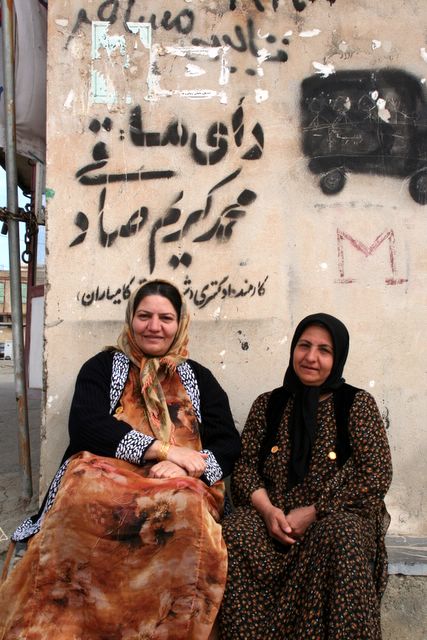
Most Iranian women wear a simple scarf:


or a fashionable scarf (left)or a chador (right):


But I never saw a burqa. I bet you could find a woman or two in Iran in a burqa, I just never saw them.

Next post... Question 2: Is there a chance that there will be political change in Iran?

Have you got a question? Post it in the comments.

Thursday, April 26, 2007

Bad Hejab

“Nuclear power is our inalienable right,” the staff of my favorite supermarket greets me as I walk into the bustling store. “It’s all your fault that the police are outside picking up women.” They are joking of course. They like to make fun of me when I come into the store.

Some people I know have yet to see the packs of police ushering women into awaiting minibuses, but my regular stomping grounds are in the heart of bad-hejabland. “At least the police are polite here,” a taxi driver tells me. They have to be polite. They are being watched by neighbors with cameras and internet connections. “You should see them over at some of the other spots. They are really going after women with force and being rough.”

A few nights ago Iranian tv featured some official denying that women had been picked up by force. “We’re just talking to them. We have not begun arresting anyone.”

“It’s nothing,” everyone says to me. “They do this every year.”

“I’ve been here more than three years, and I have never seen the police so organized about picking up women before. I’ve never seen them flag down cars before.”

“You’re right,” people admit.

Say whatever you would like: that we are wrong to take this issue so seriously, that most Iranians support the crackdown on hejab, that this will pass… I will tell you this: enforcing hejab makes me feel insecure and mistrustful. I am nervous walking down the street. I do not trust anyone. Why should I? I am wearing this scarf and manteau by force. Therefore, there can be no trust. If I had come to the decision to wear hejab on my own, and wore it because of choice, faith, or even subtle social pressure, that would be different. But I wear hejab because of force and that force has been even more visible the past week. Force will never allow me to make a religious choice of my own free will. It's a ridiculous notion.

The crackdown is a very visible symbol of oppression. So, some men are being picked up (or spoken with) for wearing ties or too much hair gel. That hardly compares to the insecurity of being a woman.


Links:

Anger at Iran dress restrictions

Islamica Community Forums: Anger at Iran dress restrictions

Iran police move into fashion business

Iran police swoop on slipping headscarves

Summer Veil Program in Iran, By Kamangir

Sunday, April 22, 2007

Riding with dogs in taxis

“Please fix your scarf,” the taxi driver said to me. “Not because of me, but because the religious police are checking. I don’t care what you wear.”

“It’s not good enough?”

“Make it good enough for them.” I fumed a bit and then retreated into my thoughts. Up front Keivan and the driver discussed the crackdown on hejab.

“I was taking a young woman and she had her small dog with her. The religious police pulled us over. They said, We are impounding your car, arresting the girl, and letting the dog loose on the streets where it will be killed. I said, Hajh Agah, (Mister Hajh: a term of respect given to a man who has made pilgrimage to Mecca) you can’t do that. How can you take my car from me? How will I earn a living? And this young woman, what is wrong with her hejab? She is properly covered. There is no law against having a dog. And you have to consider that maybe the dog was sick, and we just came from the veterinarian.”

Riding in the car was testimony to the fact that he was able to talk his way out of the arrest and that the dog survived.

Hejab crackdown...

“The news is reporting that 93% of the population approves of the crackdown on hejab,” our cab driver told us.

“If that is true, there is no need to enforce hejab,” I responded.

“Don’t the women have mothers? Fathers? Brothers? Sisters? What business is it of the government,” the driver added. “On my wedding day, my wife asked me: What is your opinion of hejab? I said, What you wear is your business. All I want is your heart. If your heart is mine then you can wear whatever you want. If your heart is not mine, then wearing ten chadors won’t make a difference.”

The traffic on Jordan was, as usual, crawling. Since yesterday afternoon flocks of smiling religious police added to the traffic slowdown by standing on the street peering into each car that passed by. Above each checkpoint, another flock stood with a minibus and young women that they have pulled over for bad hejab.

And it isn’t just hejab, as my next post will tell you.

Pictures of Iranian women in hijab here.

Tuesday, April 17, 2007

Sisters, Modesty is Like Angel Making You

Okay, I made that up. But it is not too far from the type of English you might really read on a billboard in Iran.

Which brings me to announcements of a planned increased religious police presence on the streets of Iran: the authorities have announced that they are going start arresting annoying people and enforcing hijab.

What does that mean? What is proper hijab/hejab? Who are public nuisances? Listen, people may argue that enforcing hejab is Iran’s version of keeping topless men out of restaurants… But my question is this: if it is the same then do thousands of clothing police roam the streets of Santa Cruz intimidating topless men trying to get into restaurants? It seems to me that if the police have to regulate personal behavior then the rules are in need of a bit of a review.

Sunday, July 09, 2006

Fun in the Sun

Tagged as:

I thought I would write at least once in awhile during the past two weeks, but I did not. Why didn’t I? I cut the tip of a very important typing finger, and it hurt to type. Oh yeah, I also went to a friend’s wedding in a normally cold country that was in the grips of its three-week summer so it was sunny and gorgeous every day so we went to the beach and swam in the ocean and I actually wore a bikini in front of men and women and little children and big and small dogs and was still one of the most covered up women on the beach. I rode a bicycle, wore a summer dress, and spoke freely and openly with everyone. I slept a lot. I drank a lot less than I do in Iran, but I drank good wine and good beer instead of the staples available to us here. Friends returned from Greece with homemade red wine. They were excited about it, but I told them I had had enough homemade wine in the past few years.

I returned with Iran Air. Once again, I did not want to get on the plane, but then, once on, I had fun. I sat next to an ex-pat Iraqi family whose parents have taken refuge in Iran. Their parents are too scared to travel back to Baghdad. They like Iran. In the row next to ours was a couple who had not been in Iran for 15 years. They were beaming. Excited to see family and eat Iran’s famous sheep’s head and foot soup (calepache). (Talk about foot in mouth…) When we were just above Tehran, the man leaned to look out the window and shouted: “There is calepache everywhere in this city!” We landed to a great burst of applause from the passengers.

Everyone was covered up while we were still in the airport. I did not wear my headscarf until we landed. Soon, many of the women had taken theirs off as well. Iran Air is often carrying people who have not been in Iran in years and years. Those women cover every strand of hair on their heads: not from religious passion, but from fear.

The cold European country was filled with women in hijab: all of whom would be arrested in Iran for bad hijab. Hijab, as I have said before, is all about fashion. Moroccan women, for instance, wear tight-fitting scarves, form-fitted to their hair, and tied behind their necks. Then they wear long skirts, with tight tops, lots of jewelry and fashionable shoes. They look great. Why? Because, as so many Muslim evangelists tell me, hijab is a signal that the woman’s body is not part of the social discourse: it’s all about respect. Hijab is supposed to protect women from prying eyes and sexual violence, but I very much doubt that it does any of those things. Talk to any man: western or eastern: they are obsessed with women in hijab.

Hijab makes the women’s body the center of social discourse: all it does is eroticize the body. I’ll tell you what takes women’s bodies out of social discourse: it’s thousands of topless women at the beach.


More on hijab:
The Veil: Resistance or Repression?

Scarf and Make-up: the Modern Face of Islam

Women in Islam, veiled oppression or stigmatized misconception
http://www.bbc.co.uk/dna/ww2/A5838410#footnote10

A Pearl In Its Shell


Arab Feminists on Women's Rights: Cats and Dogs in the Developed World Have More Rights than Women in the Arab and Muslim World

Tuesday, May 23, 2006

Dress code

It is ironic that Iran’s hijab requirement for all women despite religious beliefs has the opposite effect than described by the questionable and erroneous article stating that minorities will be required to wear identifying markers. If the regime really wanted to have visual identifiers for religious minorities, it could lift hijab requirements for non-Muslim women. This would have the intended effect without the negative publicity. In fact, many would welcome this development as a sign of progress. Hmmm…

Many religious minorities wear their own identifying markers: many Jewish men wear yarmulkes and many Christian women wear prominent crosses. It is really the Bahai who are the most oppressed. They are seen as apostates and have an extremely difficult life in Iran.

Good article Iran’s Jews by Angus McDowall:Iran's Jews struggle in the shadow of Holocaust denials

http://news.independent.co.uk/world/middle_east/article549814.ece

Sunday, May 07, 2006

110

…Iran’s 911.

Saw a police minibus parked on Jordan Street. A bunch of young girls were crowded around it, their big hair lifting their scarves high above their heads.

What does proper Islamic dress mean? “It’s just fashion,” a friend answers. Holland’s Moroccan women who choose to wear Islamic dress all by themselves would be subject to harassment in Iran. Why? Fashion. That’s all.

A friend was picked up. “I knew enough to call 110 when the military police started harassing me and my friend. I mean, their job is to pick up wayward soldiers, not harass women. I got through to the police. ‘Give the phone to the military police,’ they told me.”

She did. The police told them that the way the two women were dressed was none of their business. “Hand the phone back to the women,” the officer on the other line said.

“We told them to leave you alone and quit harassing you. We will call back in ten minutes to make sure you are okay.”

The police called back in three minutes. They called again in ten minutes and again in twenty.

There are so many different police-type organizations roaming the streets of Iran: the Basigi on motorcycles, traffic cops who lazily direct the traffic into bigger and bigger jams, military police just kind of hanging out, diplomatic police, intelligence, and the police police, to name a few.

This is why when some mullahs got upset about plastic manikin breasts, only a few of the offending plastic breasts actually got sawed off. “Why didn’t all of them get sawed off?” a visiting friend asked me.

“Because the police actually have to *want* to enforce that law. It’s too perverse for most of them.”

Anyway, lesson here… call 110 no matter who approaches you with no matter what kind of id.

Saturday, November 12, 2005

Sex Appeal

A friend of mine is convinced that Westerners are erotically obsessed with the hijab. “They love the photograph of the chadori with the rifle and the basij headband,” she raves. “It turns them on. I swear.”

Maybe. After all the “adult” shelves are filled with nun fantasies… It’s the same outfit more or less.

We had dinner with a couple vacationing in Iran. “This is how much the whole hijab thing affected me,” the man told us. “After just one week here I felt like a twinge of excitement watching a strange woman take her headscarf off when we would come inside a house. I felt like such a voyeur. I was constantly trying to imagine what the women were wearing under their hijab. Tell me what was it?!”

“A spaghetti strap, skin-tight top and stretch pants,” I answered.

Friday, August 26, 2005

Tips for Journalists Visiting Iran

After living here for two years, after reading countless articles about Iran, after viewing news spots and listening to radio spots about Iran, I want to offer a few quick pointers to journalists coming to Iran.

Tarof:
Tarof is a complicated system of manners than can make it extremely difficult for a visiting journalist to get a straight answer.
a. Iranians would rather agree to do something than to admit that they cannot help you.
b. An initial "no" or "yes" should not be taken seriously. If permission is not granted initially, keep asking. It pays to be persistent.
c. Most Iranians you meet will invite you to their homes. If you agree to go, please understand that your visit may cost them a lot of money. They might not really want you to come. It might be too expensive for them.
d. If an Iranian invites you to a party where alcohol is served, you might want to remember just how expensive that alcohol is. They may love to see you, but resent the amount that you drink. Try to show some restraint. A case of beer costs 70,000 tuman. Cheap, brand name whiskey costs 50,000 tuman. This is not cheap even for a westerner. Imagine what it means to an Iranian.

Outside/Inside:
This is a kind of addendum to tarof. The biggest cliché in the world is that the Middle East is a veiled society where there is a strict dichotomy between outside and inside behavior. (I know, I know, Iran does not consider itself part of the Middle East. Is a region unto itself.) Just because it is a cliché does not mean it's not true. Please take it seriously.

a. Take everything presented to you with a shaker of salt. Take context into consideration. Ask yourself, who else is listening? Who else is observing? For example, when an anti-American speech is made on the anniversary of Iran's revolution, don't forget to mention the occasion in your reporting.
b. It's hard to get to know Iran and Iranians unless you marry into an Iranian family. Don't be fooled by appearances.
c. Go to any funeral or wedding that you get invited to. Funerals do not require invitations. Your presence at one would be welcomed.
d. Most Iranians in exile do not know anything about Iran as it is today. Don't depend on them for information unless they still have family in Iran and have traveled here in the past two years.


Exaggeration:
a. Iranians are prone to exaggeration. All Iranians.


Northern Tehran vs. the rest of Iran:
a. Take any opportunity to get out of north Tehran. Talk to people who are neither wealthy Tehranis nor fundamentalist Islamists. Find the middle ground. How big is it? I have no clue myself.
b. If possible, opt for an intercity bus when traveling out of Tehran. Talk to your fellow-travelers.
c. Don't stay in a protected bubble. Your hotel, your friends or friends of friends, and most of the people you are meeting have little to do with Iran or Iranians.

Gender Roles:
There is no one more privileged in Iran than a western woman. If you are a woman, don't pass up the opportunity to come here.

For women:
a. Do not be offended if a man does not shake your hand or look you in the eyes. Don't let it make you feel anything at all.
b. Shake hands with anyone who offers his/her hand. (For men as well)
c. Don't over dress. Iranian women expect you to push the boundaries of hijab regulations.
d. Style is key. Don't let the Islamic dress code make you look unstylish. Practice wearing a scarf before you get here. Buy a fashionable jacket that covers your ass. Look good.
e. Go to as many all-women events as you can. Try to talk to women without any men around.

For men:
a. Shake hands with all of your female colleagues and all women who offer their hands.
b. Don't be fooled by women who are demure in front of men.


Tolerance:
More than once, I have seen reporters refer to the supposed religious tolerance of reformist clerics. When a cleric expresses his tolerant views, please ask him these questions:

a. Does this tolerance refer only to the "people of the book" or does it extend to the Bahai, Hindus, and Buddhists (to name just a few?)
b. Does tolerance refer to Muslims who convert to other religions?
c. What about aetheists?

Hijab:
Many Iranian women struggle to assert their own personality through their hijab. Strangely enough, style *is* a form of protest. Style, however, is a function of class. Wealthier women can afford to flaunt dress codes because they can afford to pay any fines that they might be saddled with as a result. Poorer women are more subtle because the fines would be impossible to pay and because their families commonly exert more pressure on them to conform to Islamic dress standards.

Chadors are the big black capes that women wear over their heads. Manteaus are the jackets women wear. Please keep the two separate.

Government employees are required to wear chadors. Not all of these women would choose this form of dress for themselves.

Monday, August 01, 2005

Fashion

"T, you will never guess what we saw when we visited my cousin," An observant friend told me. "A girl, my daughter's size, clearly a teenager at the very least, who went out into the streets of Ahwaz in a tank top and jeans. No scarf. No manteau."

"No scarf even?"

"No."

"Ahmadinejad," her daughter laughed.

"Maybe she was only 9," I commented.

"She'd have to be even younger," the daughter said.
Among the Tehranis and Ahwazis in K's family, the girls wear as little of the hijab as they can until they are given a warning or picked up by the police. The girls in his family have a fortunate girlish look that belies their years. This is totally unlike the unfortunate daughter of a friend who is extraordinarily tall for her age, and, as if that were not enough, has entered puberty early. "She absolutely refuses to wear a scarf," my friend told me. "I had to send her to a boarding school in England. I could not keep her here."

Recently, a man I met told me how heartbroken he was about Iran. "I am a nationalist. I am Islamic. My wife and I both pray 5 times a day. The other day my nine-year old daughter asked me if she could go live with her uncle in England. I asked her why, and she told me that she does not want to wear the hijab. I told my uncles who are clerics. 'How could you do this to my country?' I asked them. 'How could you do this to the religion I love? How could your rules push my daughter away from me?'"

Fashion in Tehran: Giant scarves and tiny manteaus. Hemlines are just below the ass. The scarves are huge, flowered, and fringed, and look like your grandmother's tablecloths.

That's what I really wanted to write about. It's never that easy is it…? Over and over again I have tried not to make hijab an issue, but it is. It was over 110 degrees here for 3 weeks! In a headscarf. And a manteau. It's hot in that frigging outfit.

Monday, May 30, 2005

Gloves

The secret of gloves
The secret of the gloves has finally been revealed to me!

When I first arrived in Iran, I noticed that many of the women wore gloves: even in the middle of the summer! This, I quickly deduced, had nothing to do with the requirements of the hijab. The women who wore gloves spanned the spectrum of religious dress. Some of the glove-wearers wore the full black chador and some a barely there scarf with a short manteau.

Were they, perhaps, germ-phobic, I wondered?

I asked several people. No one had an answer. And then, I filed my glove question way back in the recesses of my brain.

A friend of a friend was visiting. Her mother is Indonesian and her father is Dutch. It was her first visit to Iran. Immediately, she understood the secret of the gloves. "It's so that your hands are not ten shades darker than the rest of your arms." D'oh.

I quickly confirmed this with a brand new friend of mine who is a glove-wearer. "All I have to is go out into the sun for ten minutes, and my skin gets darker," she explained.

That should give you some info about how pale I am.

Wednesday, December 08, 2004

Response to email

I am responding to this email in the blog, because it is filled with questions that I often receive in emails. It’s from Samantha:

Hello,

I came accrossed your blog "A view from Iran." Firstly, I would like to say that it is quite well written and would like to thank you all for writing your opinions and perspectives when such might not be the best option in a highly regulated society.

Me: Thanks. Anybody who says that the blog is well-written must be smart, charming, and most wonderful.

Anyway, am I right in thinking that one of the writers is an American woman?

Me: That would be me. T.

Someday, probably within the next three years I would like to visit Tehran perhaps for only a week or two, but if possible working with a social work/development initiative.

I am curious as to the challenges big and small an American woman living in Tehran might face beyond the obvious regulations regarding wearing hijab/chador and gender segregations. For instance how do women seek public transport, accommodations etc?

Me: Public transport is no problem. The buses and metros are sex-segregated – Thank God. If you are a woman getting on to a crowded subway car, wouldn’t you rather be in a car crowded with women than one crowded with men? Women smell better. Plus they are nicer when packed in like sardines. The metros also have family cars that both men and women can ride in.

Women ride in the back of city buses. You often see buses half-filled with men practically standing on one another for space while the women are leisurely sitting. It’s not fair, but it works to our advantage.

Intercity buses are not nearly as sex-segregated. Families and couples can sit together, but a single man cannot sit next to a strange single woman.

Minibuses are just crowded. Shared taxis are also crowded. It’s a great place for Iranians on dates because physical proximity (think: sitting on one another’s laps) is permissible.

Accommodations are different for foreigners than for Iranians. Only on rare occasions would a foreign woman be hassled over accommodations.


How does one deal with nationalist contempt (or indeed not deal at all.) Is Iran "safe?" I am not really sure where to start with my questions, so any advice you give is welcomed.

Me: I have NEVER experienced any nationalist contempt. Iranians love foreigners (oh, that is if you are not Afghani or Arab.) On top of that, they adore Americans. I mean, we could not be more loved in Texas itself. It’s such a pleasure being loved. I have often used this space to encourage my fellow citizens to treat Iranians like princes and princesses when you meet them. That’s the way they treat me.

I always tell people that there is no one with more access in Iran than a western woman. We get access to both men and women. The dangers that exist in Iran are no different (for us) than the dangers we face in our own countries. I am not saying that Iran is the safest place on earth. All I am saying is that if you are not coming here to organize a revolution, then you should be okay by keeping up the normal defenses that you would anywhere else.
It’s all a big mistake…
A friend of mine that I will call "Jeff" wrote to tell me of a dream he had about Iran’s uranium enrichment program:

Your blog got me thinking and I remembered a dream I had some time ago.
I dreamt that the whole uranium enrichment program was a big misunderstanding – what the Iranian government was really embarking upon was an Iranian Enrichment Program. I'm not sure what that would be– some sort of cultural exchange, I suppose.


Iranians are tough negotiators. It’s clear to me that they understood that the EU was the more desperate of the two parties. The EU was desperate to show America that it could negotiate a treaty with Iran. Iranians had to have known this going in.

And what should Iran be desperate for? Iranians may be desperate for improved relations, but their government is not. They would like relations to be bad enough to keep them in power and good enough to keep their consuming citizens happy (or, should I say, complacent). Believe me, these guys are smarter than we are. I think that most people think that the regime is idealistic instead of what it really is: realpolitik-al (is that a word?)

Do they really think that we want to drink this stuff?

Last night I went to the pharmacy with K’s nephew. He needed some things, and I wanted some rubbing alcohol. They handed me a tiny bottle of rubbing alcohol. “Don’t you have anything bigger?” I asked. “Or is rubbing alcohol really expensive here?”

“No it’s cheap,” the woman answered and then called to her manager, “Should I get a bigger bottle for them?”

The manager came out to look at us. K’s nephew said, “Don’t worry, we’re not going to drink the stuff. We have something much better at home.” This comment made the whole store full of people start laughing.

“I can give you two small bottles,” our clerk told us.

“Look, I just want to clean my ears with the stuff,” I said. I turned to my partner in crime and asked: “Do they really think we want to drink rubbing alcohol?”

“Yes.”

“You’re joking.”

“Iranians do.”

“Well,” I responded, “I have often felt that I was being served rubbing alcohol. Now I know that it’s true.”

Anybody know where you can buy cat litter in Tehran?

Contact me: resoponses@gmail.com

Hijab

A couple of friends of ours have been picked up for violating the Islamic dress code. (Which is what? I have been reading the Koran and so far the only thing I have read is that a woman should hide her private parts and her ornaments. What exactly does that mean? Isn’t the definition of “private parts” more social than religious? The whole hijab thing is seeming more like a fetish to me than any religious doctrine. It’s just like the injunction against eating pigs. Why make such a fuss over some parts and not about others? At this point, however, I have not completed reading the Koran, and I am *not* an expert.) They had to attend a class on hijab. I got the sense that it was kind of like driving school after being ticketed. “There were at least a 1000 people there. There was even a 14 year old girl. I mean, she was just a little girl,” our friend told me. “Everybody had at least one relative with them and some people brought there entire families. They showed us a film, gave us a lecture, and sent us home.”

The other night, I was stopped by one of these guards of Islam who did not realize that I was a foreigner. “You can’t dress like that,” he told me. I was baffled. I was wearing loose fitting Levi’s, a men’s baggy windbreaker, and my scarf. Without the scarf, they would have assumed I was a man. Only in a country like Iran could I have been accused of provocative dress.

K came to my rescue. He was livid. He really cannot abide anyone telling anyone else how to dress. The two other times that someone had the nerve to tell me that too much hair was showing, K really let loose with verbal abuse. “If I were to accept their comments and say nothing, this place would really be Hell,” he told me. “It’s none of their business.”

Wednesday, September 22, 2004

Normal Life

What does normal life feel like?

K and I recently took a trip to Europe where there seem to be many more devout Muslims than in Iran. The Islamic women wore a range of clothing from complete veil to simple scarf. Islamic dress seems to be more a matter of culture than religion. For instance, Moroccan women use tight black scarves to tie their hair back behind their head. The scarves are form-fitted to their own hair and have interesting knots in them. Turkish women wear their scarves pinned in some complex way on their heads. Their scarves are mainly drab with the occasional drab flower printed onto the scarf. Many of these devout women wear clothes that could get them arrested in Iran. (No wonder devout Iranian women chafe at the restrictions on dress.) Despite this, none of the devout women we saw in Europe showed even a strand of hair.

This is not the case here. I have seen women in chadors with fringe showing. The newest fashion is to wear a scarf that covers neither the front nor the back of the hair. This means that women with long hair let it hang down out of the back of the scarf.

When K and his family and I went out to eat the other night, I was wearing one of the longest manteaus to be seen that evening. Mine reaches my knees. It's last year's model. The newest fashions just cover the ass. I don't really feel like keeping up with manteau fashion myself. I'll just wear mine until it falls apart.

Why do I write this? Because I want to tell you what normal feels like. Normal is that religious and devout women have friends who are secular. Normal is having observant cousins and atheist cousins. Normal is a Republican woman married to a Democratic man.

My great aunt kept kosher, my grandmother (her sister) loved bacon (the other kosher meat), my grandfather's sister shaved her head and wore a wig. K's mother never took off her headscarf. He has a photo of me in a swimming suit sitting next to his mother in her scarf and long shirt. We are both happy. That's normal.

We recently had dinner with some friends in a hidden restaurant with actual atmosphere and professional service. There were all sorts of people there: families with all of the women in chadors and families with women barely wearing headscarves. Our host managed to procure whiskey for us, which meant that we were actually eating and drinking in a nice restaurant. It all felt so frigging normal.

Normal is such a simple thing.

Tuesday, May 18, 2004

Women, again

"Women would be much less sexy if they were not wearing manteaus," K's brother told us the other day. "They are so tight and sexy looking now, it would be better if the women were wearing their normal clothes."

It's hard to believe that in certain areas of Iran, women will not be dressing according to their own tastes by next summer. Things could change of course, but right now, many more young women than last summer wear their scarves low on the back of their head. (The best thing to do, it seems, is pull your hair back in a ponytail and then rest the scarf on it.)

The hemlines have come up and the waste lines have come in. It's fashionable to wear manteaus so tight that the buttons are stretched. At first I thought that women were just buying their manteaus too small or gaining weight. When I went to buy a new one a couple of months ago, the sales clerks all tried to convince me that the manteau that was too small for me was the one I should get. "It's too tight," I told them. "It looks better too tight," they responded. It was then that I finally caught on to the trend. D'oh.

On our travels we talked to many groups of young women. At one tourist spot we met a group of about 20 university students who wanted me to explain to the family we were traveling with that they were dressed conservatively because they were in university. "But they look so great," the man of the family commented. I had to agree, they did look great.

The thing I keep saying about Iranian women is that they are really fun and really different when no men are around. (They can be fun when men are around too, but not as…) One of our friends told us a story that reinforces this point. He went to Damascus last year with a tour group of about 45 people from about 12 different (mainly Western) countries.

"There were busloads of women making pilgrimages to Damascus. You could always tell when a busload of Iranian women had arrived. You could hear them laughing with each other before they got out of their buses. Then they would get out and come directly to our group and start taking pictures of us. This was a bit strange for us because we were the ones use to making the pictures," he laughed. "Within five minutes the women were all practicing their English with our group. The other women from different countries never approached us. Only the Iranian women."

We related this story to K's sisters. "Iranian women are more religious than Iranian men," they told us. "That's why we go on more pilgrimages than the men. But also we go just to be together and have fun."

Born free

"What is it like for someone who was born free to live in a country where you are not free?" K asked me.

"It's not easy," I answered.

"I am not myself here," K added.

Tuesday, September 30, 2003

The Cubs
My family has been praying for the Cubs. I want to encourage everyone who reads this to join us. This is an equal opportunity, non-denominational request. We don’t care who you pray to, just say a prayer for the Cubs.

For any Iranians who might be reading, the Cubs are Chicago’s beloved baseball team. They have never won the World Series. My father claims that part of the problem is that the fans are so loyal. “The owners don’t think they have to pay for great players because Cubs fans are loyal whether they win or lose.” For us fans, and for quite a number of quasi fans, the Cubs winning the World Series would be the equivalent of Iran winning the world cup.

Women’s Dress
My sister reminded me that I have always been averse to dress codes. “Remember when you got kicked out of PE [physical education class] because you wouldn’t wear the gym suit?” Well it was a stupid gym suit. That’s why I would not wear it.

When I was little I always wanted to wear pants to school because we had to wear dresses. If I had grown up in post-revolutionary Iran, I probably would have been a super-fem. Who knows?

Someone from Austin recently wrote asking what she should wear when she comes to Iran for a tour. Since I have not yet recovered my old emails, I will answer her here. So here you go woman from Austin:

If you are on a tour, you are most likely visiting places that other tourists visit, so just relax. Get yourself a nice scarf. I recommend something big that is heavy enough to sit on your head without being tied tightly around your neck.

When we visit cities that are used to tourists, we see women visitors casually dressed. Many simply wear headscarves. Some wear big shirts and loose fitting pants. Some wear long jackets. Some wear floor length skirts and long sleeved shirts.

Don’t worry about dressing like Iranian women. As a foreigner, everyone cuts you a lot of slack here. Just dress modestly. Since you are coming in the Fall, the weather will be cool enough so that the headscarf and any other outer clothing you wear won’t be a burden.

If you are going to small towns off the beaten path, you may be more comfortable with a longish lightweight jacket in a subdued color. Otherwise, women here are wearing increasingly bright colors: pink, baby blue, and even orange are fairly common. K’s sisters commented that their local newscaster was wearing a yellow scarf (more like a hood than a scarf) the other night. Cream and black are still the most common.

Sunday, August 03, 2003

The Wedding

K and I are invited to a wedding. We don’t know the bride or groom. We only know a few relatives.

A few nights ago, our good friend who got us invited to the wedding, went to the pre-wedding party, a kind of rehearsal dinner for family only, in a private garden outside of Tehran far from other people. “You should have seen all of the women, they were so chic. I looked like a slob next to them.” There were tables of food, a good band, and about 250 “just family” there.

About 2 hours into the party, my friend heard shouts of “Scarves! Manteaus! The religious police are here!” The women ran for their manteaus. The band disappeared. The men went to the door to bribe the two religious police at the door. After about five minutes, they were successful and the two bearded guards of Islam left.

45 minutes later, however, the religious police were back. This time it was a different group with about 20 18-year old representatives of the religious police charging in with guns and rifles ready. These guys did not want to be bribed; they wanted to make arrests. The shouts were more panicked this time: “Run! Run!” The women crowded into a bathroom together. The men came in with their manteaus and scarves. “I saw the fear on their faces,” my friend said. “It was terrible. The worst thing was that I saw that people did not help each other. They only thought for themselves.” The women who were working at the party were dressed traditionally in black manteaus and black hooded scarves. They were in the bathroom changing into western clothes. “It would have been worse for them to be caught working at the party. That’s why they were changing.”

Meanwhile the religious police were on their radios calling for buses to come and pick up all of the women and all of the men at the party. “We can’t get buses at this time of night,” the response came from their command center. Other police were inside the party smelling the glasses and checking for alcohol. “Thank god we didn’t have any,” my friend said. Still another set of bearded 18-year-olds was terrifying the groom, who was not Iranian. My friend’s brother was helping the groom by translating for him. “My brother threw off his coat and tie and went to the groom’s side. He told the religious police that the groom had a heart condition and that if they continued to frighten him that he might have a heart attack. He told them that then his blood would be on their hands.” Apparently that line worked, and they stopped harassing the groom. Some of the men finally succeeded in bribing the police, but not before the father of the bride and the owner of the garden were arrested.

“The young women weren’t scared,” my friend said. “They were saying that they had been arrested several times recently and that it wasn’t so bad. They told us that you could not show any fear. You have to stand your ground. The minute you show fear, they know they have you. The older women, on the other hand, were scared. They did not want to be arrested again. It’s the humiliation that scared them. They weren’t afraid of being hurt, just of going through the whole process of being humiliated.”

The rest of the party was quiet. The food went untouched. The women remained in their hijabs. Now the parents of the bride have to find a new location for the party since they are not allowed to have it in the private garden anymore. Plus they have to find guards (preferably from the religious police) for the party and notify 500 guests and all of the staff and caterers of the new location.

ShareThis