Iran: At least 40 followers of Ayatollah Sayed Hossein Kazemeyni Boroujerdi arrested: "Iran: At least 40 followers of Ayatollah Sayed Hossein Kazemeyni Boroujerdi arrested
Source: Amnesty International
At least 41 followers of Shia cleric Ayatollah Sayed Hossein Kazemeyni Boroujerdi were reportedly arrested in the courtyard of his house in Tehran during the morning of 28 September. They are thought to have been taken to Section 209 of Evin Prison in Tehran, which is run by the Ministry of Intelligence. One was reportedly later released. There are fears that the Ayatollah may be at risk of imminent arrest.
On 30 June 2006 the Ayatollah conducted a large religious ceremony at the Shahid Keshvari stadium in Tehran. On 30 July, the security forces reportedly arrested several of his family and followers at their homes. The security forces also reportedly tried to arrest the Ayatollah himself, but were prevented from doing so by his followers."

Wednesday, October 04, 2006
Separation of Church & State
This link to an article from Amnesty Int'l on Payvand has more details including info on how to take action.


Tuesday, October 03, 2006
Taxi Talk
Categories: iran, taxis, conversations, war
“Oh, so you are American?” We have ridden with this driver perhaps 20 times. I guess I never mentioned Chicago or New York before today…
“You didn’t know?”
“I knew you were a foreigner, but I didn’t know you were American. Americans are great. I thought you were British. The British are war mongers.”
“No, they have changed. They are good people.”
“As a people they are good, but their government is always after war. Your government is not so good right now either. Are Americans happy with it?”
“No, they are not. They are unhappy with Bush and unhappy with the war. Sometimes I think that we Americans would do it all again though. We can be so, I don’t want to say stupid, but stupid.” I don’t know the word for gullible in Persian, and I don’t want to use the Persian for “simple” which also means honest.
“I don’t know what we want war for? Why should we have war with Israel or America or Iraq? There is no reason at all. Why shouldn’t we just be friends? War, what do we need it for?”
“Sometimes we use war for food, or oil, or water. You know that you have some of the best drinking water in the region. No other country in the region has as much drinking water as Iran. Forget oil. The next wars will be for water.”
“Why can’t we just settle these issues in a friendly way? We always use war instead. Didn’t God give us the water? Didn’t God give us the trees? Did God say that Iranian resources are only for Iranians? What kind of religion would that be? God gave these trees to the world, not to Iranians.”
Friday, September 29, 2006
Condom Israel

Via Onze Man in Teheran:
This image illustrates why I tell my foreign friends never ever to use spellcheck...
Tuesday, September 26, 2006
Akbar Ganji - Letter to America - washingtonpost.com
Read Ganji's Letter to America:
Akbar Ganji - Letter to America - washingtonpost.com: "But the dangers of the Tehran regime are not limited to the nuclear question. The regime is dangerous mostly because it is willing to brutally trample on the democratic and human rights of the Iranian people. It is dangerous because it is willing to create gender apartheid in the name of religion and to suppress religious and ethnic minorities. Finally, it is dangerous because it considers all forms of dissent unforgivable sins. The real goal of the nuclear program is to make these policies permanent. In its negotiations with the Iranian regime, the West must not overlook this important fact."
Join the discussion
Dialogue with America or non-dialogue or no dialogue... all at Post Global at the Washington Post.
Monday, September 25, 2006
Sept. 25, 1899
Categories: america, immigration
101 years ago today, my grandfather landed in America with a sister that my father only found out about yesterday through an internet search of records stored at Ellis Island. How cool is that?
101 years ago today, my grandfather landed in America with a sister that my father only found out about yesterday through an internet search of records stored at Ellis Island. How cool is that?
Sunday, September 24, 2006
Our Prison Doors are Open
…You can go in, you just can’t go out…
We got into a taxi. The driver immediately started speaking in an animated way with my husband. I couldn’t hear him from my place in the backseat, but I could see him gesturing. He would take both of his hands off the steering wheel to make particular points. Mind you, we were on the highway with cars zipping by at high speed on either side. What’s even worse is that after three years in Iran, I wasn’t even nervous; just amused.
When we got out, I asked Keivan what he was talking about. “Ahmadinejad’s press conference at the Foreign Policy Institute.”
“I thought he was talking about crazy driving habits. He seemed a bit excited.”
“He was saying that Ahmadinejad was asked why he is talking so much about international law when he doesn’t implement it in Iran. He answered that America has 200 million people and some high number of prisoners, but Iran, with 70 million people, has far fewer.”
“That’s because so many are executed,” I half-joke.
“That’s exactly what the driver said. I told him that it was because Iranians just cannot count.”
The driver is one of many people to talk to us about the press conference which neither of us saw or even read about. Everyone felt that AN's responses to the questions about the prisons were farcical.
“He asked the journalists who they thought they were to ask him such questions,” a friend tells us at dinner. “My god, they’re journalists. That’s their job.”
Shana Tova
School started Saturday: the day of the Jewish New Year. Our neighborhood has a school every few feet, which means that come 7:30 AM we could hear the clamor of the thousands of school kids that have descended on our neighborhood.
I spent the holiday with a Jewish family who served the New Year's dinner at 11:30 PM. “It’s just 20 minutes past Fall,” a 14-year old announced as the dinner came on to the table.
Earlier that day, I went hiking with an ex-pat friend who told me that two things need to be reformed in Iran: the start time of dinner and the salad dressing. “That pink stuff has got to go,” she said referring to the ubiquitous mayonnaise and ketchup dressing that accompanies almost every salad in Iran. “It’s time for a nice vinaigrette” That’s exactly right! Start small, I say. Clearly the nuclear negotiations are going nowhere. The salad dressing and dinner time negotiations promise more success.
The family had a Rosh Hashana ceremony that was a bit like a seder and that I had never attended before. It involved several symbolic foods and unfamiliar prayers. My favorite part was when we bit a green onion in half in a symbolic act of vanquishing our enemies.
“We bite it in half?” I asked.
“You’ve never done this before?” the mater familias asked me.
“No.”
“Don’t you have any enemies in America?” they joked.
I laughed and answered, “No we do not.” I was only half-joking. I never experienced hands on anti-Semitism in all my years as a small-town Midwestern Jew.
We bit the green onion. Some names were given to the enemies, and we threw the green halves over our shoulders.
Inshallah, this time next year we will set a table for our enemies...
Wednesday, September 20, 2006
Goodbye M
Categories: iran, friends
Living in Tehran is like being at summer camp. The friendships are brief and intense, you swear you’ll be friends for life, and sometimes you never see your dearest heart ever again.
So when we had to say goodbye to a dear friend who left the country recently, it’s no surprise that I was left as stunned as I was when I was 12 years old on my last day at overnight camp. (I was one of those who loved camp).
So goodbye to a dear friend who spent one of her last nights in Iran comforting a woman who had barely survived a fatal crash and who saved me and K when we were most depressed. Everyone should have such a friend.
Tuesday, September 19, 2006
Help me keep track of evidence of preemptive war on iran
Categories: iran, wmd, war
June 21, 2004
PLAN B
Seymour Hersh writes about Israeli and Iranian efforts in Iraq and Kurdistan. He quotes a former intelligence official who tells him how the white house responds to the news: ‘We can’t take on another problem right now. We can’t afford to push Iran to the point where we’ve got to have a showdown.’
January 17, 2005
Seymour Hersh’s article “The Coming Wars” reports on Pentagon plans for a campaign in Iran (to be fair: civilians in the Pentagon)
July 21, 2005
In his article, “The Iran War Buildup,” Michael T. Klare calls for early efforts to prevent a US war with Iran.
December 30, 2005
Is Washington Planning a Military Strike?
Spiegel Online presents a round up of reports in the German media on the Bush administration’s plans to attack Iran. According to this article many of the region’s countries have been informed of possible air strikes against Iran.
April 8, 2006
“The Iran Plans” is another Seymour Hersh article reporting on white house plans to attack Iran: this time with the possibility of using bunker busting nuclear bombs.
December 30, 2005
July 24, 2006
James Bamford reports on the PR machine selling war with Iran in Rolling Stone’s “Iran: The Next War.”
September 4, 2006
The Telegraph’s story, “Straw: Iran attack 'nuts',” reports on Straw’s headline making response to the Hersh Story.
September 18, 2006
America already at war with Iran according to retired colonel Sam Gardner interviewed by Wolf Blitzer on CNN.
September 21, 2006
Well, well... someone is already doing this:
Source Watch
Monday, September 18, 2006
Half of the conversation
Categories: iran, war
Keivan is slumped on the couch bothering me while I try to watch Babe on tv. “Why didn’t you write in our whole conversation?” He asks me.
“It was too long to put in the blog.”
“But you should have put in the part when Mr. Beard said that Iran was looking for a fight.”
“He didn’t tell me that.”
“He told me.”
Keivan often expects me to “grok” his conversations with others as if I am really a stranger in a strange land.
“He told me that Iran has been looking for this fight for the last 27 years and that all of the best minds have been working on defense.”
“All of the best Islamist minds,” I add.
“Yes. He thinks that if Israel had not attacked Hezbollah, there would have been an attack on Iran. Now, he thinks there will be no attack.”
“He always glorifies battle, doesn’t he?”
“I am not sure what he really thinks about anything. The only thing I am sure of is that he is an honest man.”
“He is honest,” I agree.
On the tv, Farmer Hogget is dancing for Babe.
Sunday, September 17, 2006
Recommended reading at Mideast Youth
Categories: mideastyouth.com
The portrayal of Islam in the MSM: Is it really Islam?
Check out the protester's banners: Muslim world angry, for the bajillionth time
An Iranian responds to a Washington Post article An Apology, Mr. Knipp.
The portrayal of Islam in the MSM: Is it really Islam?
Check out the protester's banners: Muslim world angry, for the bajillionth time
An Iranian responds to a Washington Post article An Apology, Mr. Knipp.
Apocalypse Not
Tagged as: Iran what others think
Categories: iran, conversations
“There won’t be an attack on Iran,” our bearded friend says. “It won’t happen.”
“Esther is not so sure,” Keivan says.
They turn to me and wait for my response. “I am confused. I used to think there would not be an attack, but now I see that many in the West are trying to equate Ahmadinejad with Hitler and Iran with WW II era Germany.”
“Who has Ahmadinejad killed?” Mr. Beard asks.
“Yet,” Keivan adds. They laugh.
“There are also many writing that Ahmadinejad is apocalyptic – how do you say “apocalyptic” in Farsi?”
“Apocalyptic? I don’t know,” Keivan answers.
“End of the world,” I say. I can say that in Persian. Keivan offers a clearer version.
“They say that the Shi’a are waiting for Mehdi and want the end of the world to come faster. A bit like fundamentalist Christians.”
“Why do Christians want to see the end of the world?”
“Because it means that Jesus will return.”
“Aaah… But Iranians are like other people in the world, we do not want to bring about the end of the world.”
“There are some journalists trying to calm that view. The ones who visit Iran write more calmly than the ones who have never been here. Yesterday, I read an article that said that a nation that requires drivers to wear seatbelts is not dangerous.”
“Seatbelts? What does that mean?” Mr. Beard asks.
“It means that the government is worried about your health. They don’t want you to die in an accident.”
“Exactly. Now that you have been here three years, what do you think?”
“I think that if Iran were really waiting for the end of the world there would be no highway projects and no clean water projects and no sewage projects and no buildings. Anyone can look around and see that there is a future here.”
“Excellent. Excellent.”
Tuesday, September 12, 2006
The 9/11 Post on 9/12
Categories: militant, islamism, extremism
A bunch of us are lamenting the inequalities of the world that drive people into extremism. What can we do to make it fairer? We ask ourselves. My, aren’t we patronizing? [Note to self: add links]
I agree that we need to focus on the ways that we contribute to unfairness but we should not be so naïve as to think that that will save us from extremism, particularly militant Islamism. Unfairness, after all, is at the heart of militant Islamism. Islamism does not demand a more just society, but a more unjust society.
Is there really something that we can do to please militant Islamists other than bombing Israel into oblivion? C’mon, admit it. They are not about to change their opinions of us because we care about their human rights or economic disparities. They won’t even change their opinions if we negotiate peace. They won’t change their opinions if we step in in Darfur or Kashmir or Chechnya or Bosnia or Palestine or any of hundreds of trouble spots. Their minds are made up.
Oh, and the other thing we do is call for the moderate Islamic world to raise their voices. C’mon. It’s not something we can call for. It’s not something we can demand. We can only engage those voices when they do rise up. But why should they? Moderates are at heart, well, moderate. We moderates do not go out and kill people who violate our moderate code of ethics. We don’t demand loyalty. We don’t believe in blasphemy. How can moderation compete with certainty?
Look, on this side of the conversation (I am living in Iran, remember)the West seems hypocritical, divided, and flailing. It’s time to own up to hypocrisy: time to admit that the world demands hypocrisy. Living in the world demands that we negotiate the grey areas. It isn’t as if there is a simple path to good or a simple path to bad. There is a reason that we say the road to hell is paved with good intentions.
If we really want to defuse the Islamist movement, we would all convert; we would give up wine and pork; we would follow the nebulous Shari’ a law; we would pray 5 times a day; and we would follow the strongest and most brutal among us. Even that, as moderate and observant and secular Muslims all over the world know, would not be enough. For some, the only sense of freedom comes from the oppression of others.
Militant Islamism is imperialistic, appealing, and unappeasable. It is not ours to defuse. It is a discipline that demands obedience. We can only compete with it by offering an equally compelling discipline. In lieu of that, we need to realize that people, particularly young men, need to feel a sense of purpose. How are we going to provide that? Habitat for Humanity in lieu of extremism? What do you think? I think that now I am being naïve.
On the other hand, it is crucial for us to know the difference between militant Islamism and, well, something a bit different. The Islamic Regime of Iran, for instance, must answer to its huge population. When ideologues govern, they face the same issues as governors do everywhere: roads, water, electricity, and hospitals. Governing is a force for moderation.
It is important to draw distinctions between those who govern and those who do not.
Monday, September 11, 2006
Voices From Iran
Tagged as:Iran, culture, politics
I read a report from the Foreign Policy Centre (what’s up with British spelling?). This report includes several anonymous interviews with key Iranian figures (it would take about 10 minutes to figure out who most of them are). It is a useful document for people who want to hear Iranians speak for themselves. I’ve pulled a few quotes, but there is a lot more.
From the Reformist Journalist:
The West and Iran:
On Ahmadinejad:
.
From the Human Rights Activist:
On democracy:
On Iran’s nuclear capabilities:
From the Feminist:
On higher education:
There is a lot more. You can download it at the Foreign Policy Centre’s Site.
I read a report from the Foreign Policy Centre (what’s up with British spelling?). This report includes several anonymous interviews with key Iranian figures (it would take about 10 minutes to figure out who most of them are). It is a useful document for people who want to hear Iranians speak for themselves. I’ve pulled a few quotes, but there is a lot more.
From the Reformist Journalist:
The West and Iran:
“I don’t like to speak all the time with analogies, but I think the West is approaching Iran in exactly the wrong way. It’s like there is a dangerous element, a radical element in this country and perhaps at the moment it is holding us hostage. Rather like a terrorist who runs down the street with the police chasing after him and then takes refuge in a building. What should the police do? Negotiate with the people in the building until the people deliver the terrorist to them or the terrorist gives himself up; or attack the building, killing the terrorist but also killing lots of other people? If the United States were to attack Iran it would be like storming the building, a tragic mistake, because negotiation can resolve this dispute without anybody getting killed. ...”
On Ahmadinejad:
“The best way to deal with Ahmadinejad would be if he were left alone for a couple of years. If he can’t use foreign pressure to repress more, he will face internal challenges. The most dangerous class is the workers – he told them he would raise their salaries. He has given them too much expectation, there’s a possibility they could strike.”
“Engagement with Iran has a much better effect for pushing the reforms, if the world wants to fully change the people, even those considered to be hardliners. Even they could become pro-Western. Why do I think that? Well, there’s a strategic element in foreign relations. The current situation for Iran isn’t good. We are surrounded by a lack of friends. We don’t have many Muslim allies – people are Iranians first, then Muslims. Engagement is the most effective weapon. We can use our capacity in the region to contain terrorism. Isolation just fires back. The ex-officials of US make sense – there need to be more talks.”
.
From the Human Rights Activist:
On democracy:
“Democracy is not like a plane, you can’t just export it. You have to have social basics and foundations on which to build democracy. People must want democracy if you want to create democracy. If you truly want to change this government, you have to bring in a completely democratic government. The voice must be heard in the West – I want to make a union between a peace loving Iran and a peace loving West.”
On Iran’s nuclear capabilities:
“The international community worries about Iran being a nuclear power. There is no reason to worry, it won’t be an atomic bomb that will destroy West. There is no such bomb. It will be Chernobyl style events that might destroy our own nation. All of this expertise and equipment were acquired on the black market. These factories and reactors lack safety standards. The West has very transparent reactors, and at the same time you have the greens and the environmental lobby keeping a check. When something is secret and unknown, you can have no confidence for safety. We should be worried, not you. You’re scared for us, and that’s very strange.”
From the Feminist:
On higher education:
“Higher education gives women a clearer understanding of inequality and oppression, and that understanding will produce change. It’s already happening, in vocal opposition to policies that sanction polygamy, temporary marriage, free divorce for men, and child custody to fathers and their families. If you pick up a women’s magazine in Tehran, you’ll find it’s full of stories of wives suffering at the hands of despotic husbands, a long list of wife-beatings, suicides and loss of children. At the moment it’s happening at this kind of anecdotal level because the courts discriminate against women, not just in terms of outlook or judgment but technically speaking, so a man’s testimony is equivalent to that of two women.”
“But change is inevitable, regardless of which faction holds the presidency. Education is giving Iranian women a new understanding of freedom, the freedom of choice, which is not displaced by sharia law. Ultimately the mullahs cannot make women wear the hijab or the chador, and the women of Iran are beginning to see this.”
There is a lot more. You can download it at the Foreign Policy Centre’s Site.
Sunday, September 10, 2006
Why I blog
Tagged as: Iran: blogging
The editors at Reconstruction have asked several bloggers to comment on why they blog. Here is my response:
I often get letters from researchers who are doing studies of Iranian blogs. They want to know many things, including why I started blogging. Here is the simple answer: my husband and I started this blog in order to keep in touch with family and friends.
It has proven an effective way to do that. Once we got started, it became fun to be part of the blogosphere’s conversation about Iran. Yes “fun.”
The blog is a way to have a conversation that would be difficult to have any other way.
People ask a lot of questions: “What effect do Iranian blogs have on internal Iranian politics?” The accurate answer is: “I don’t know.” The empirical answer is: “None.” There is no evidence that Iranian blogs do anything more than provide an outlet for a nation of natural storytellers.
So, you may ask, is there a point beyond fun? Well…yes. The blog is a form or memory. I record every day life, every day conversations, and I post many of them. These every day things fade so easily.
The blog also records the process of being a complete foreigner to being a bit more (although not total) of an insider. I came to Iran with a few sentences of Persian and very little concept of tarof or anything else Iranian. I will leave with decent conversational skills, a fairly comprehensive understanding of tarof, and a bit more facility with Iranian culture as it is experienced in Iran.
The best thing I will leave Iran with is a distinctly Iranian sense of the absurd, which is just something that cannot be translated into English.
Tuesday, September 05, 2006
Party like it's 1999
Iran: Party Talk
Monday night…
Scene: small dinner party… mostly Iranians in their 40s…
“Do the Azeris want to separate from Iran?” I ask an Azeri (Turkic people in Iran) friend.
“Why would we want to separate? We may be a minority, but we think of ourselves as the majority in Iran.”
“It’s true,” his wife, also Azeri, adds.
“We run in Iran. The leader is Azeri. Why would we want to separate?”
“Khameini is Azeri?”
“Yes, of course. Didn’t you know?”
“Every grocer in Iran is Azeri. Everywhere you go, people speak Azeri.”
“We even tell the most Azeri jokes.”
“Ahh yes, but every once in awhile you get a bit touchy and demonstrate.”
“That wasn’t really because of the joke.”
Tuesday night…
What?! No party?
Wednesday night…
Scene: mid-size party, lots of foreigners, a smattering of Iranians… ages 20-60…
“Iranians always tell me that I am focused too much on hijab,” an unnamed foreign journalist says. “They say there are other more important women’s rights issues.”
“It’s a symbol of oppression,” I say.
“I agree. I blame my mother’s generation for hijab,” an Iranian friend tells us. “For the most part, they put it on willingly. They wore it proudly as a symbol of the revolution. Believe me, they regretted that choice.”
“It’s strange: where women are forced to wear hijab, they want out. Where they are not forced, they are wearing it more and more. You get on a plane with Saudi women or Iranian women and within minutes everyone of them has their veil off.”
“One day those women who think Islamic rule will save them will regret it. Their daughters will be angry with them for their efforts. Trust me.”
Thursday night…
Scene: Small dinner party in an elegant apartment with a great view of the city… A bit more than half of them
“I was in London for some classes. There were Egyptians and Jordanians and Lebanese with me in class. You know what they said when they found out I was Iranian? They said, ‘You are so lucky you have a strong leader like Ahmadinejad who stands up to America. You in Iran are our model of democracy. We envy you.’ I had to laugh. They really believe this. They looked at me like I was some kind of hero just for being Iranian.”
Friday night…
Scene: Typical Iranian party: over dressed women, men playing backgammon. Too much food: boiled tongue, chicken with rice and berries, eggplant and tomatoes stuffed with ground beef, salad, yogurt, smoked eggplant with tomatoes and eggs… All served late in the evening after the last guests arrive 1 ½ hours after the appointed time.
The crowd: 40s-70s with their young and teenaged children in tow.
The women are sitting in the back of the room having the typical conversation: the price of food. Meat, fish, tomatoes, grapes…
“What is our government doing by giving away our money to Hezbollah?” the oldest woman at the party asks.
“You know why all of the Lebanese are walking around with Nasrallah posters? Because our government is giving them $12,000 each. Just handing our money out, when Bam has not even been rebuilt.”
“That’s right. We can’t even get Bam rebuilt, but we are rebuilding Lebanon. That’s not our business.”
“And did you see the hospital we built for the Palestinians? Why can’t we have better public hospitals?”
“Because Iranians build our hospitals,” my husband answers.
Sunday, September 03, 2006
Guns, Butter, and DVDs
Tagged as: Iran: U.S.
“Listen, are they just going to talk or are they going to bomb us already?” the clerk at the computer store says to Keivan when he finds out I am American. “It’s been years. If they are going to bomb, they should bomb already.”
“We’re all better off if there is just talk,” I say.
He places the blank DVDs in plastic wrap, and we go out to get a cab home.
“So what’s going to happen,” the driver asks Keivan. “Are they going to bomb us? Will there be sanctions?”
“I was at a meeting today and the guys kept saying to me Mr. ____, your wife is a foreigner, tell us is there any news? News of what, I asked. War, they said. As if my wife gets news from Bush about war.”
“I’m sure they’ll be calling me any day,” I joke. “As if I have a hotline to Bush…”
Tuesday, August 29, 2006
The Taxman
Tagged as: Iran taxis
“You know what our problem is,” our taxi driver tells my friend Mohammad who is sitting up front, “we don’t pay taxes.”
“Oh c’mon, Iranians already whine because they have to pay 10,000 tumans a year for house taxes.” (About 10 euros.)
“It doesn’t matter. We should pay more.”
“Why should that change anything? The regime does not answer to us. They still won’t answer to us with taxes either.”
“No, the driver is right,” I jump in. “As long as Iranians don’t pay taxes the government will not answer to them.”
“There is no country in the world with no taxes AND a government that answers to them. You have to have taxes,” the driver says. “Look at Europe. They pay a lot of taxes. They have good roads, good hospitals, governments that answer to them.”
“They pay too much.”
“Maybe, but they get a lot.”
“As long as you don’t pay taxes, the government says what are you complaining about? We pay *you*, you don’t pay us,” I add.
“She’s right. We need to take it step-by-step. Things won’t change overnight, but things will never change without taxes.”
Never heard anyone argue in favor of taxes before… Hmmm… Instead of soldiers and bombs, maybe America should send over a team of accountants and CPAs.
Sunday, August 27, 2006
Growing up in Iran
“By the time they are six, Iranian children are already schizophrenic,” a young friend tells me and my friend. “I mean, when we were six, we already knew there were two worlds: one at home and one at school. We knew that we could not talk about what went on at home with our classmates. We knew how to keep secrets. Soon, we understood who we could joke with and who we had to tell that our parents prayed 100 times a day. In school, we had to learn to pray and we would look at each other and laugh. We had to chant “Death to America” every morning, and to pass each grade we had to talk about how much we hated America and how much we loved Mohammad. It’s crazy. That’s why Iranians develop such a good sense of humor. We make a joke about everything.”
“Are things still that way?” another friend asks.
“I don’t know. It was during the war with Iraq then. It was a more intense time.”
“Keivan’s niece still has to hate America and pass Koran classes. They don’t chant Down with America at her school, but some schools do. When she was younger they chanted every morning.” Sometimes I think it is good. Knowledge of the Koran means that they do not depend on the mullahs for interpretation. Iran’s youth are much better versed in the ambiguities of the Koran than their parents.
When I am out with children, they do not let me tell people that I am from America. Given the warm response I have received from almost every Iranian I have met, I wondered what they were so nervous about. Now I know: it’s school that makes them worried.
Thursday, August 24, 2006
Sweating Out the Truth in Iran
A bit of recommended reading:
Sweating Out the Truth in Iran
By MAZIAR BAHARI
Sweating Out the Truth in Iran
By MAZIAR BAHARI
WORKING as a journalist in Iran embodies the definition of insanity: doing the same thing over and over again without getting any results. That’s how I felt at the height of the conflict in Lebanon, when I asked officials about Iran’s relations with Hezbollah, bearing in mind that posing such questions can be a futile, dangerous and sometimes even lethal exercise.
How was Iran helping Hezbollah? Did Iran really start the war to divert attention from its uranium enrichment program (which it vowed this week to continue)? Was Iran, as Hezbollah’s ally, if not patron, willing to put its money where its mouth was and enter the conflict?
Questions, questions. Of course no one answered.
So as a good Iranian, I indulged in fantasy. Fantasizing has become something of a national sport here. Our president, Mahmoud Ahmadinejad, predicted that the national soccer team would finish third or fourth in the World Cup. He also thinks we can become a nuclear powerhouse, even though we have a hard time manufacturing safety matches or making light bulbs with life expectancies of more than two weeks. By the way, the soccer team didn’t make it out of the first round.
Wednesday, August 23, 2006
9 Million Satellite Fans Can Be Wrong

In case you missed it, I posted about the satellite crackdown on Mideast Youth… Now I am posting on the follow-up.
The chief of police was interviewed by a young woman during a youth-oriented call-in show on state radio. “Colonel,” the young woman asked, “is having a satellite dish really illegal?”
“Yes, miss, parliament passed a law against it.”
“Then you mean to tell me that there are 12 million Tehranis and that 9 million of them are criminals?”
“Just because many people do something does not mean that it is not against the law.”
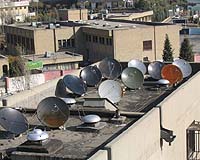 There was some more discussion. The colonel went on to say that… “If we see a crime we are obligated to prosecute it. If we do not see it, then it is not our business. For instance, we know that many people in Tehran drink alcohol in their homes. This is their business. As long as they do not drink in public, we will not go into their homes and stop them. If they drink in public, we are obligated to stop them.”
I think the lesson here is obvious…Keep your satellite dish in a chador and all will be well.
If you are looking for any words of insight on Iran’s response to the UN concerning its “essential right” to nuclear power --- forget about it. I have no insight. It’s the same old same old as far as I’m concerned, and most Iranians are ignoring the whole matter. We’re a bunch of ostriches over here… That said, many Iranians believe that an attack is imminent.
Friday, August 18, 2006
News that could change your life!
How's that for the perfect spam title?
I was watching a movie with a friend of mine who used to be a journalist. "You know what scares me most about being kidnapped?"
I know what scares *me* most, but I still ask, "What?"
"That I'll be held for months without any tweezers."
I laugh, "You have to let me post that on my blog."
"Just don't mention my name."
Well good news girls, the NYT reports that hairy eyebrows are in:
Now we just have to await the fashion world's ruling on stray facial hair and that troublesome bikini line.
I was watching a movie with a friend of mine who used to be a journalist. "You know what scares me most about being kidnapped?"
I know what scares *me* most, but I still ask, "What?"
"That I'll be held for months without any tweezers."
I laugh, "You have to let me post that on my blog."
"Just don't mention my name."
Well good news girls, the NYT reports that hairy eyebrows are in:
“For women who overpluck, this season will be about growing your eyebrows back so that they have a natural arch that extends out and ends in a beautiful point,” said Pat McGrath, a makeup artist for Max Factor and CoverGirl and the creative director for Procter & Gamble Beauty.
Ms. McGrath is one of the trend-setting stylists responsible for unleashing the feral eyebrow as this season’s beauty signature. At the Prada fall fashion show in Milan in February, she combed models’ eyebrows up with clear mascara so that they fanned out like plumage, lending their faces a wild expression which Ms. McGrath described as “sauvage.”
Now we just have to await the fashion world's ruling on stray facial hair and that troublesome bikini line.
Tuesday, August 15, 2006
So you say you wanna' revolution...
Tagged as: Iran: Party Talk
“Things have gotten much worse for us since Ahmadinejad took power,” a young university student tells us at a party. “Our choice of classes is limited. Many of our professors have been replaced. They even removed the benches from the campuses so that boys and girls cannot sit together.”
“They removed the benches?”
“Yes. People still sit on the walls, but all of the benches are gone. The worst part is that most Iranians are happy with this.”
“You think so?”
“They do not want boys and girls talking together.”
I have argued with Iranian friends that the regime does indeed represent many of their wishes, but they always disagree with me. My observation has been that most families want to control their children. They want to control who they see, where they go, and what they do. It is the very small minority who afford their children any measure of freedom. By children, I mean anybody who is not married yet: even then, the control continues.
The Iranian regime is parental. It cares for your soul, it punishes you for disobeying its rules, it shelters you from disturbing information, it reads your diary, and it destroys your porn stash. It is sometimes abusive, sometimes distant, sometimes illogical, sometimes it is even loving. Sometimes your mom will let you do something that your dad disapproves of; sometimes the opposite is true.
In Iran, you remain a child: dependent on the whims of your overprotective and abusive parents; sneaking out behind their backs; secretly disobeying them; expert at playing the good child.
Back to the party…
“They are especially controlling of their daughters,” I say.”
“You would be surprised how much boys are controlled in smaller towns and villages. Iranian families do not want their boys doing anything that they do not know about or approve of. They can be just as controlling of them as of the girls.”
“You are lucky you come from a family that allows you to be independent,” I tell her.
“Yes I am. We are different from most Iranian families, so we have to constantly lie about who we are and what we do. We even have to lie to relatives. It is so hard to always pretend.”
“It can be that way in America too. When your family is different from what is normal, people sometimes get in your business.”
“That’s because there are so many Christians in America. Sometimes they can be just as controlling as Muslims.”
A new group of guests arrive. They shake hands without introducing themselves which is normal for Iranians. “How have you been?” Our host asks.
“Well, you know… waiting for *them* to come.” We may not know their names, but we know who “them” is. “We have our bags packed. Toothbrushes, pajamas, a change of clothes, all neatly packed and waiting by the door.”
“When you are ready for them, they never come,” a young artist jokes.
“That’s true!” the woman laughs. “Exactly why we should always be ready.”
****
BTW, link to new post at Mideast Youth
Saturday, August 12, 2006
Mideast Youth
I have been invited to post with them despite the fact that I am neither particularly young(although I do like to think of myself as youthful)nor particularly middle eastern. Check me out on their site.
Memorial
Tagged as: Iran culture
“Oh my god, haven’t you heard what’s been going on with the UK.?”
“I heard something about a bomb on an airplane when I was in a taxi, but I thought it was just the normal stuff.”
“My god, no. It’s not normal,” my friend tells me. We are sitting in a fashionable Tehran restaurant. I have arrived there straight from the airport after having been in Iran’s hot Khuzestan Province. She and Keivan explain the events of the last 36 hours to me.
“We only had the television on for 30 minutes so that everyone could watch Nargess,” I explained. (Nargess is the newest serial to sweep Iran. Everyone is watching it.)
I was in Khuzestan attending the year-memorial for my friend who died last year. It was a much less hectic and heart-wrenching affair than the funeral. We’d all had a year of mourning, crying, and bouts of depression behind us. This does not mean that any of us miss her any less, it’s just that the months leading up to her death and the months following her death were overwhelming and difficult for many, many people and that now, most of her family and friends were recovering.
It was a relief to see everyone again. I have not traveled too far from Tehran (except outside Iran) since the funeral. Khuzestan was a blistering 48 degrees C. This is the type of heat that can only be described as a moving wall that has weight and force and sound. You can almost hear it: at least you can imagine hearing it: Whoooosh.
First there was a ceremony in the mosque. There were about 150 women there: almost all of them wearing the same black knee-highs, darker at the toes and heals with a dark black band across the top. The mosque was chilled to shivering. “In Khuzestan they are used to the heat,” everyone told me. Oh yeah, then why are their homes and offices and mosques kept so cold? They are only used to staying inside, not to the heat.
We had about 2 ½ hours of chanting followed by ½ hour of a sermon. All the while, children were playing, there were the requisite operatic mourners, and a quorum of chadoris who hide their faces under their chadors, shake their shoulders as if hysterically crying, and then emerge dry-eyed.
From the mosque we went to the cemetery. Close by was the year memorial for the family who died in what I assume was a car crash. Last year I thought it was only a son and father who had died because there were only two pictures. This year it was clear that there was a third death: probably a woman, maybe the mother. My heart burned (as Iranians would say) for that family. How do you come to terms with such a quick death. The men were clearly heart broken. They were sobbing. The women sat dry-eyed while the children handed out sweets to the gathered crowd.
Our own ceremony was under a tent to protect us from the hot sun. Even so, the marble tombstone was too hot to touch. After the ceremony, we went to lunch. Children who did not attend the memorial came for the lunch. It’s hard to imagine how people survive mourning without children around. It’s impossible to resist their joy and playfulness. You could see the lights switch on in the eyes of their aunts and uncles who had lost their mother and sister.
Friday, August 04, 2006
Mel Gibson Makes it Big in Iran
Now starring in his own tv spot on Iranian tv: Mel Gibson whose slurs during his drunken driving arrest are being embraced by the Iranian regime! Bombs in Lebanon interwoven with oscars in Hollywood: Mel's the hero of the moment.
He joins a fine tradition of western protestors who burn the American flag and effigies of Bush and Blair. Listen, I love free speech. I crave free speech, but I wouldn't want my protests hijacked by the Iranian regime or any other authoritarian regime. In dissent, I urge people to use symbols of freedom rather than symbols of authoritarianism -- unless, of course, you *do* want to align yourself with the authoritarians.
He joins a fine tradition of western protestors who burn the American flag and effigies of Bush and Blair. Listen, I love free speech. I crave free speech, but I wouldn't want my protests hijacked by the Iranian regime or any other authoritarian regime. In dissent, I urge people to use symbols of freedom rather than symbols of authoritarianism -- unless, of course, you *do* want to align yourself with the authoritarians.
Monday, July 31, 2006
Sigeh
Tagged as: Iran culture
Response to Angel:
Iranian shi’a have a rule (sigeh) that allows them to engage in a “temporary marriage” lasting anywhere for a few minutes to pretty much forever.
The joke going around Iran at the moment is that Bush has finally responded to the letter AN sent him a few months back. Bush wrote that he is interested in hearing more about sigeh.
Unfortunately, the joke works much better for Clinton than for Bush, but you get the idea.
Read more about sigeh here:
Women in pre-revolutionary, revolutionary and post-revolutionary Iran
Sigeh is not actually an Islamic practice, but a pre-Islamic one used in Arab tribes. In its pre-Islamic form women still resided with her family, her kin still retained rights, a woman could also dismiss a man, and any children begotten belonged to the wife's lineage. In Islam, sigeh changed, so that the child now belonged to the father. The practice of sigeh was primarily used as an urban function associated with long distance trade.
Monday, July 24, 2006
Dance the night away
Tagged as: Iran celebrations
Late one night last week, we drove west to a garden in the middle of nowhere for a wedding party. We drove by burning trash, industrial buildings, and military outposts. “This cannot be right,” we were thinking.
We drove onto an empty road and pulled up to a dented, dilapidated gate. It was dark. “No way is this it; it’s too dark.”
“No this is it,” the driver said. A police car drove by. Our driver leaned out the window to ask the police if this was the Garden we were looking for.
“It could be,” they answered and drove slowly away.
Keivan got out and knocked. The gate was opened by a sleepy Afghan. We see the lights of the party in the distance. “This is it!”
“If this were in America there would be signs and balloons everywhere.”
It only makes sense that in Iran a wedding party would be so coy. Once in, we danced with women dressed in tasteful gowns and men in sharp suits wearing silk ties around their necks.
A friend has just returned from Baghdad. “It’s horrible. People are really stressed. Baghdad is breaking up. Baghdad has neighborhood refugees now. People from one neighborhood are moving to others. It has become just too dangerous.”
We dance.
Sleep
Tagged as: Iran daily life
My friend wonders if there is a connection between living in Iran and problems sleeping. When you ask expats and Iranians who travel abroad about their vacations, they talk first about the amazing sleep they had. I, for instance, slept for two days the first time I left Iran.
My point is, you just never know what is going to happen. Sometimes I sit out on our balcony and think, Tehran before the bombing… Then I argue that there will be no bombing.
But it’s even smaller and less important than that. In a land where almost everyone breaks the law, at any moment you could be arrested. The laws here govern too much private business and not enough public business. There must be some law you are breaking, after all. If you’re not, you must be a child.
And it’s even smaller than that: will any of the day’s promises be kept? Will that guy I am working with show up for his 4:00 meeting? Will houseguests appear tonight? Will I be able to watch that tv show until the end or will the satellite be blocked? Is the repair guy a thief or a spy? Is my computer being infected by malware?
To live in Iran is to worry non-stop. The worry is like a low hum, barely audible.
Wednesday, July 19, 2006
Internet usage in Iran
Guess what! The whole nation of Iran is on a banwidth diet while the phone company renegotiates its bandwidth contract.
Just what you'd expect from a nation with time and money to waste...
Just what you'd expect from a nation with time and money to waste...
Monday, July 17, 2006
Gasoline
Iran, surprisingly, cannot refine its own oil. I did not know this when I first arrived here and was always baffled by the long lines at the pumps combined with the often empty reserve tanks. I thought it had to do with the (in)efficiency of measuring the reserves in the station’s tanks, not with the availability of gasoline.
On the highway, Iranians stop at every station they see to make sure their tanks are always filled. It’s not unusual to find stations in the middle of nowhere with no gasoline available to sell.
Iranians have giant plastic containers that they bring to the station to fill. They often drive around with these containers in the trunks of their cars. Any taxi driver you meet can tell you about witnessing a small accident that ended in a large explosion, confirming my speculation that Iran’s horrible accident fatality rate may have something to do with carrying gasoline in plastic containers.
And now, Iran may be running out of gasoline and running short on gasoline policy:
Iran, an Oil Giant, in a Gasoline Squeeze
On the highway, Iranians stop at every station they see to make sure their tanks are always filled. It’s not unusual to find stations in the middle of nowhere with no gasoline available to sell.
Iranians have giant plastic containers that they bring to the station to fill. They often drive around with these containers in the trunks of their cars. Any taxi driver you meet can tell you about witnessing a small accident that ended in a large explosion, confirming my speculation that Iran’s horrible accident fatality rate may have something to do with carrying gasoline in plastic containers.
And now, Iran may be running out of gasoline and running short on gasoline policy:
With demand far outstripping its domestic refining capacity, Iran buys foreign gasoline for slightly more than 50 cents a liter (about $2 a gallon) and sells it at the pump for about 8 cents a liter (less than 40 cents a gallon), the highest subsidies in the region.
The discount prices have further encouraged consumption and cut into the country’s export windfall. Waste and pollution are rampant. The cheap gas is smuggled out to other countries at the rate of some two million gallons a day, according to one study by Parliament.
Iran, an Oil Giant, in a Gasoline Squeeze
Sunday, July 16, 2006
f-ed up
Israel does Iran’s bidding
Tagged as: Iran: Israel
In college, I had a giant friend who told me that little guys were constantly picking fights with him: on the playground, in bars, everywhere. He was a really gentle guy, but it just drove him nuts. “They just want to prove themselves in a fight with me,” he would tell me. “It’s gotten to the point that I do not even like to go out.”
Is Israel the giant or the small guy? I would say a little of both. My allegory does not make any sense at all, and I probably should just delete it. What I really want to know is how could Israel allow itself to be lured into a war that will only serve to strengthen its enemies? It’s no secret anywhere that Iran is suspected of being behind Hezbollah’s kidnapping. It’s also no secret that Iran finances Hezbollah. There are even murals of Iranians “martyred” in battles fought with Hezbollah. Iran wants so many issues on the UN Security Council’s plate that no meaningful decisions can be reached. Now there is North Korea, Iran, and Israel to deal with. That’s quite a big serving.
Israel’s costly mistakes in Lebanon have been widely critiqued by many generally favorable to Israel. What makes them repeat those mistakes? Someone tell me.
Laura Zittrain Eisenberg argues that clear borders are essential for Israel (MERIA Volume 4, No. 3 - September 2000). In her section on Israel’s entry into Lebanon’s civil war she points out this crucial mistake:
A larger quote here:
Unfortunately for everyone, we are living in a time of inferior leaders.
Tagged as: Iran: Israel
In college, I had a giant friend who told me that little guys were constantly picking fights with him: on the playground, in bars, everywhere. He was a really gentle guy, but it just drove him nuts. “They just want to prove themselves in a fight with me,” he would tell me. “It’s gotten to the point that I do not even like to go out.”
Is Israel the giant or the small guy? I would say a little of both. My allegory does not make any sense at all, and I probably should just delete it. What I really want to know is how could Israel allow itself to be lured into a war that will only serve to strengthen its enemies? It’s no secret anywhere that Iran is suspected of being behind Hezbollah’s kidnapping. It’s also no secret that Iran finances Hezbollah. There are even murals of Iranians “martyred” in battles fought with Hezbollah. Iran wants so many issues on the UN Security Council’s plate that no meaningful decisions can be reached. Now there is North Korea, Iran, and Israel to deal with. That’s quite a big serving.
Israel’s costly mistakes in Lebanon have been widely critiqued by many generally favorable to Israel. What makes them repeat those mistakes? Someone tell me.
Laura Zittrain Eisenberg argues that clear borders are essential for Israel (MERIA Volume 4, No. 3 - September 2000). In her section on Israel’s entry into Lebanon’s civil war she points out this crucial mistake:
Begin relished the irony in the Jewish State rescuing oppressed Christians, while the rest of the world stayed mute. But Beirut was not Berlin, and Begin's insistence on viewing the Maronite situation in European, post-Holocaust terms removed him further from Lebanese realities than any of his predecessors.
A larger quote here:
Do Good Fences Make Good Neighbors?: Israel and Lebanon after the Withdrawal
Who is on the other side?
(The Israeli Perspective)
In the early 1980s Israel made its most dangerous blunder in assessing the intentions and relative power of its Lebanese friends and foes. Up until the 1970s the Zionist/Israeli exaggeration of a friendly Christian community of allies in Lebanon caused minimum damage because Israel did not predicate policy upon that faulty precept. While the increasingly unrealistic perception of a Maronite partner perhaps precluded the Yishuv from pursuing a more realistic and productive Lebanon policy, it had not exposed it to any special political or military threat. The same held true for the first two decades of Israeli statehood. But once the Lebanese civil war began in 1975, Israel fell into the common trap of relying on religious shorthand, Christian vs. Muslim, to distinguish the nature and intentions of the key actors and began to pursue policy in Lebanon accordingly.
But in actuality, the conflict was one between Maronites trying to preserve their traditional political and economic privileges in Lebanon versus everyone else trying to seize a larger piece of the Lebanese pie for themselves. Israel's interests in Lebanon were not "Christian" at all, but rather dictated by standard strategic political thinking, which made any anti-PLO (and later anti-Hizballah) force a potential ally. (17) Differences within and among the Israeli cabinet, military and intelligence services concerning the desirability and capability of the Phalange as an ally are well-documented in the many accounts of the 1982 war. There was general agreement over the usefulness of forcing the PLO away from the northern border and even destroying the organization, if possible, but Prime Minister Menahem Begin used the Maronite angle both in formulating strategy and in appealing to Israeli public opinion. Deeply steeped in the historical lore of Maronite friendliness, few Israelis initially balked at the depiction of Lebanese Christians threatened with genocide and a natural harmony of Christian and Israeli interests in the face of mutual Muslim, Palestinian, and Syrian foes.
Begin relished the irony in the Jewish State rescuing oppressed Christians, while the rest of the world stayed mute. But Beirut was not Berlin, and Begin's insistence on viewing the Maronite situation in European, post-Holocaust terms removed him further from Lebanese realities than any of his predecessors.
Despite behind-the-scenes diplomatic activity, support for the SLA, and its own military operations in July 1993 (Operation Accountability) and April 1996 (Grapes of Wrath), Israel failed to suppress Hizballah. Fatalities ran at 20-30 IDF soldiers per year. Attempting to avoid roadside bombs, the IDF began to ferry its soldiers to security zone bases by helicopter, a plan that worked only until a collision between two helicopters in February 1997 claimed 73 lives. From that tragedy the "Four Mothers" group was born, a grassroots movement initiated by four mothers of sons serving in Lebanon, with the goal of compelling the government to withdraw all Israeli troops from Lebanon. (18) The organization introduced and legitimized the concept of unilateral withdrawal in national debate, its message driven home by the relentless procession of IDF body bags from Lebanon. Hizballah had succeeded in making the security zone untenable.
(The Lebanese Perspective)
Israel was so focused on the PLO and its Lebanese and Syrian allies that it neglected to evaluate properly the Lebanese Shi`a's politicization in the early 1970s, marked by the rise to leadership of Musa al-Sadr, and the formation of Shi'a organizations such as Amal and the Islamic fundamentalist Hizballah. Although some Shi'a supported the Palestinians and the PLO, others--angered at oppressive PLO domination and PLO cross-border attacks that invited Israeli retaliatory strikes against their villages--responded to Israel's anti-PLO invasion of 1982 with relief and support. But as hostilities dragged on 1982, Israeli forces settled into the south, building new roads, posting road signs in Hebrew, commandeering facilities, and establishing bases or detention camps. These steps caused Israel to change in many Shi'a eyes from liberator to occupier. Despite the fact that a majority of the FLM and SLA foot soldiers were Shia, Israel had neither recognized nor rewarded the Shi'a as potential allies, taking their continued acquiescence for granted.
By 1985 Amal, founded to champion Shia rights within Lebanon, was being outgunned by Hizballah, which proclaimed a pan-Islamic fundamentalism. Funded by Iran and encouraged by Syria, Hizballah sought to drive the Israelis back across the border. Frequent declarations by the organization also stated an intention to remove Israel from Palestine and Jerusalem, as well. It is ironic that the PLO, target of the 1982 invasion, became Israel's peace partner in 1993, while many of the previously friendly Shi'a of south Lebanon joined Israel's new Hizballah enemy.
Missed Opportunity?
Hindsight is always 20/20, but it does appear that Israel missed a critical opportunity for salvaging some benefit from the 1982 invasion in the year or two immediately afterward. Unlike the situation in 1978, the PLO was really gone this time, and although the alliance with the Phalange had already soured, relations were still good with the Christians and Shia of south Lebanon. Had Israel withdrawn at that time, and/or accurately recognized the sensibilities and needs of the south Lebanese people, it might have earned the trust of a population genuinely interested in seeing the border quiet and secure. In a reflective post-withdrawal interview, Israel's coordinator for activity in Lebanon, Uri Lubrani, similarly suggests that Israel could and should have redeployed to the international border in 1984. (19) By failing to identify and accommodate the south Lebanese actors who remained after the PLO's expulsion, Israel helped provoke the creation of Hizballah, an enemy equally or more punishing than the PLO had ever been.
Unfortunately for everyone, we are living in a time of inferior leaders.
Wednesday, July 12, 2006
About the revolver
Tagged as: Iran: U.S.
(response to Matt’s question)
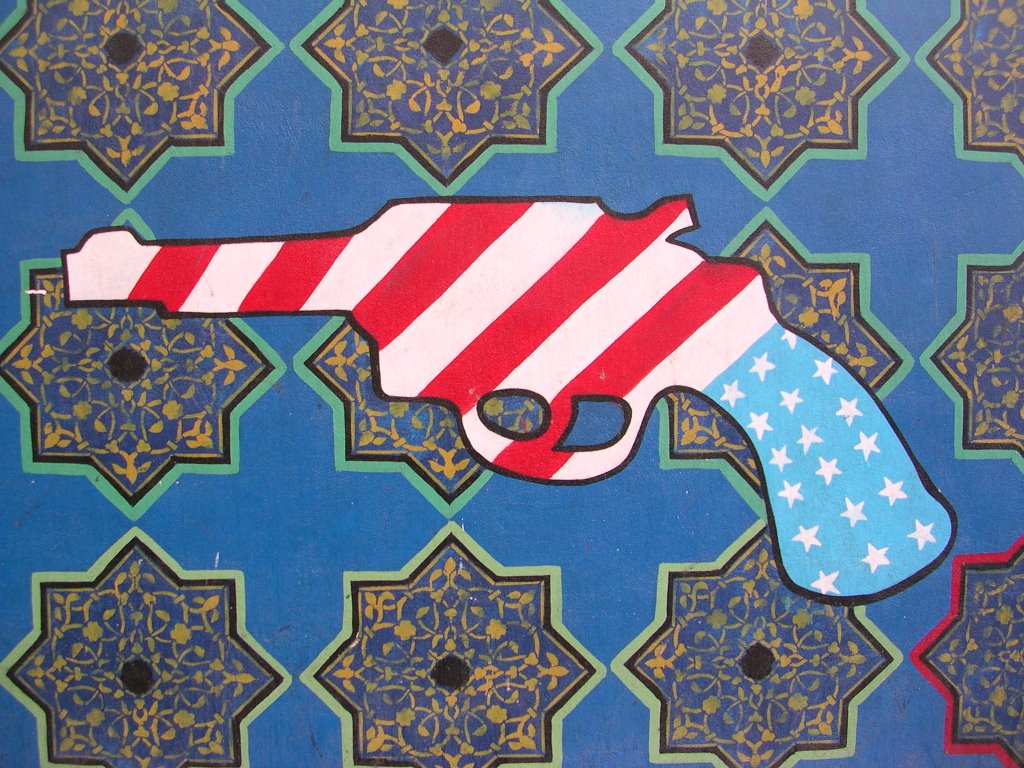
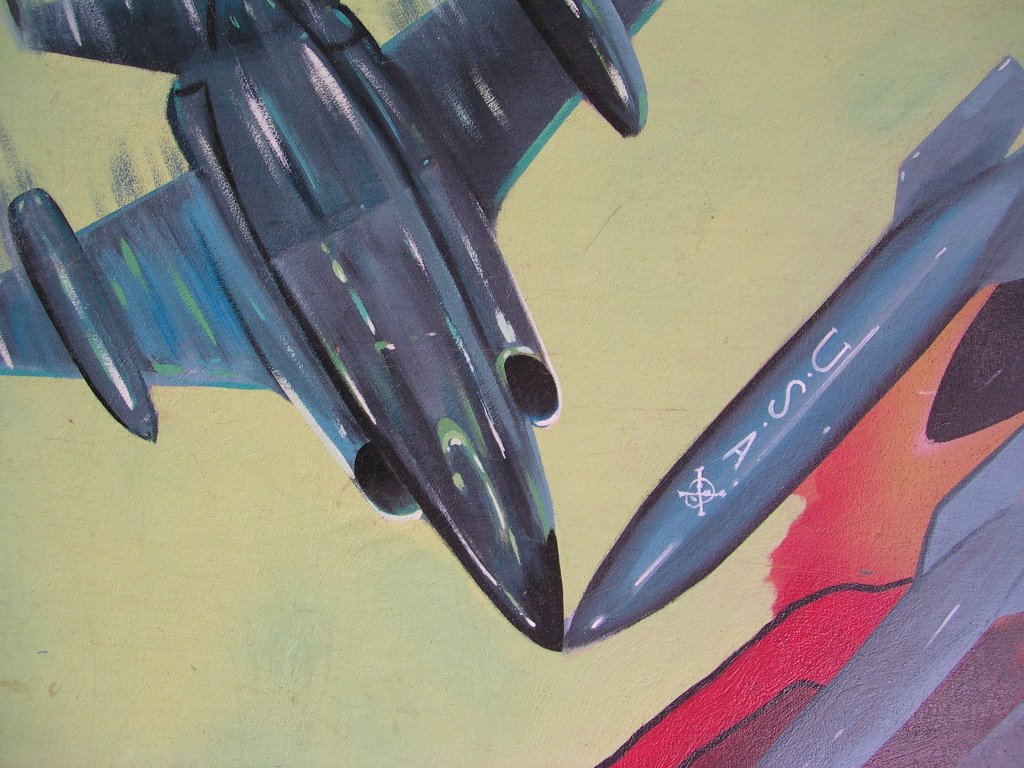
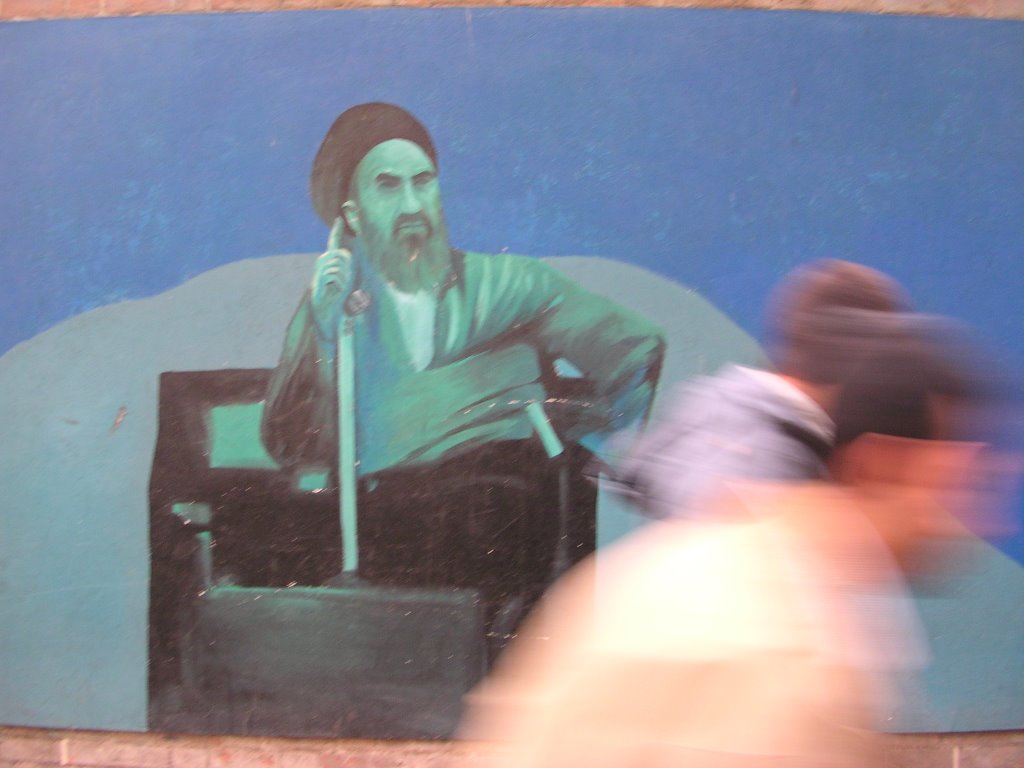
The photo of the revolver that is featured in this blog is from a mural in front of the former American Embassy. I am posting a few photos of that mural so that you get an idea of what it looks like.


(response to Matt’s question)
The photo of the revolver that is featured in this blog is from a mural in front of the former American Embassy. I am posting a few photos of that mural so that you get an idea of what it looks like.
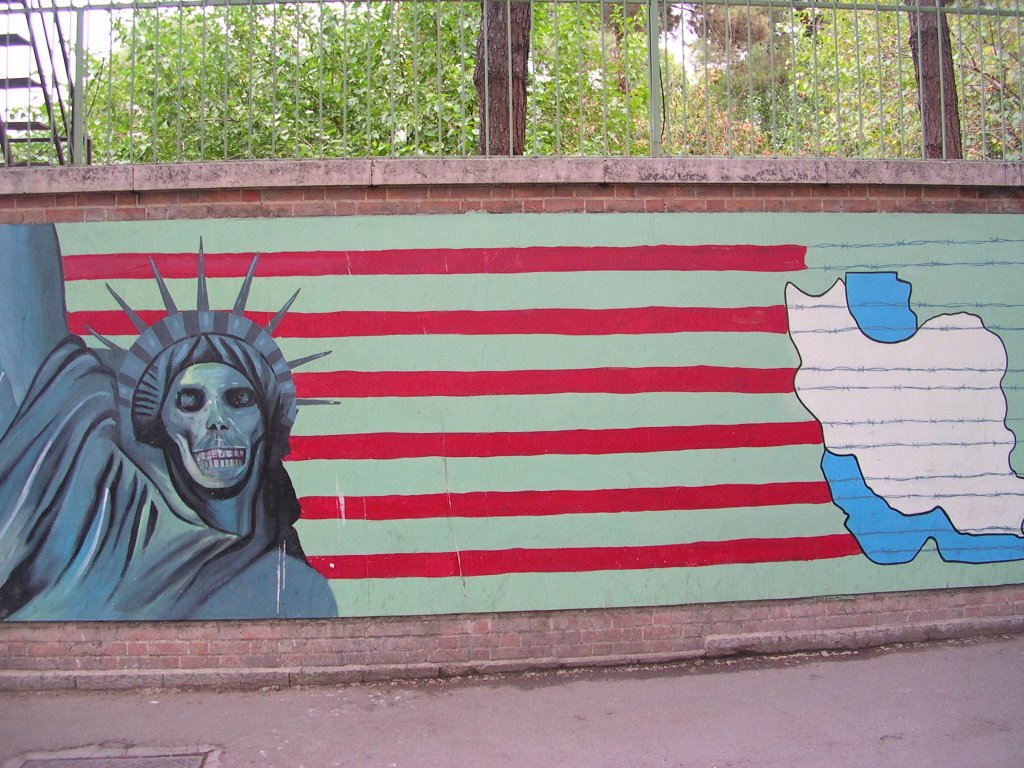
Tuesday, July 11, 2006
Head Butt
Tagged as: Iran: World Cup
Like every other football crazed nation, Iranians are talking about the World Cup and Zidane’s head butt. In fact, this has been the primary topic of conversation for two days now. I just read a couple of my Iranian friends Materazzi’s description of the incident translating it into approximate Farsi. The lines:
…Got a big laugh from my friends. “How Iranian of him,” Niloofar laughed. By this, she meant the way that Materazzi admits to insulting Zidane but does not rule out an insult to Zidane’s family, just one to his mother.
Like every other football crazed nation, Iranians are talking about the World Cup and Zidane’s head butt. In fact, this has been the primary topic of conversation for two days now. I just read a couple of my Iranian friends Materazzi’s description of the incident translating it into approximate Farsi. The lines:
'I did not call him a terrorist. I am not a cultured person and I don't even know what as Islamist terrorist is.'
He added: 'For me the mother is sacred, you know that.'
…Got a big laugh from my friends. “How Iranian of him,” Niloofar laughed. By this, she meant the way that Materazzi admits to insulting Zidane but does not rule out an insult to Zidane’s family, just one to his mother.
ESPNsoccernet - World Cup - Materazzi admits to insulting Zidane: "Materazzi, 32, told Gazetta dello Sport: 'I held his shirt for a few seconds only, then he turned to me and talked to me, jeering.
'He looked at me with a huge arrogance and said, `If you really want my shirt I'll give it to you afterwards'. I replied with an insult, that's true.'
Materazzi has not elaborated on what he did say, but one report suggested he responded with: `I'd rather take the shirt off your wife'.
He has denied, however, some of the more vile insults referring to his wife or sister or calling him a terrorist.
'It was one of those insults you're told dozens of times and that you often let fall on a pitch,' Materazzi said.
'I did not call him a terrorist. I am not a cultured person and I don't even know what as Islamist terrorist is.'
He added: 'For me the mother is sacred, you know that.'"
Sunday, July 09, 2006
Fun in the Sun
Tagged as: Iran and hijab
I thought I would write at least once in awhile during the past two weeks, but I did not. Why didn’t I? I cut the tip of a very important typing finger, and it hurt to type. Oh yeah, I also went to a friend’s wedding in a normally cold country that was in the grips of its three-week summer so it was sunny and gorgeous every day so we went to the beach and swam in the ocean and I actually wore a bikini in front of men and women and little children and big and small dogs and was still one of the most covered up women on the beach. I rode a bicycle, wore a summer dress, and spoke freely and openly with everyone. I slept a lot. I drank a lot less than I do in Iran, but I drank good wine and good beer instead of the staples available to us here. Friends returned from Greece with homemade red wine. They were excited about it, but I told them I had had enough homemade wine in the past few years.
I returned with Iran Air. Once again, I did not want to get on the plane, but then, once on, I had fun. I sat next to an ex-pat Iraqi family whose parents have taken refuge in Iran. Their parents are too scared to travel back to Baghdad. They like Iran. In the row next to ours was a couple who had not been in Iran for 15 years. They were beaming. Excited to see family and eat Iran’s famous sheep’s head and foot soup (calepache). (Talk about foot in mouth…) When we were just above Tehran, the man leaned to look out the window and shouted: “There is calepache everywhere in this city!” We landed to a great burst of applause from the passengers.
Everyone was covered up while we were still in the airport. I did not wear my headscarf until we landed. Soon, many of the women had taken theirs off as well. Iran Air is often carrying people who have not been in Iran in years and years. Those women cover every strand of hair on their heads: not from religious passion, but from fear.
The cold European country was filled with women in hijab: all of whom would be arrested in Iran for bad hijab. Hijab, as I have said before, is all about fashion. Moroccan women, for instance, wear tight-fitting scarves, form-fitted to their hair, and tied behind their necks. Then they wear long skirts, with tight tops, lots of jewelry and fashionable shoes. They look great. Why? Because, as so many Muslim evangelists tell me, hijab is a signal that the woman’s body is not part of the social discourse: it’s all about respect. Hijab is supposed to protect women from prying eyes and sexual violence, but I very much doubt that it does any of those things. Talk to any man: western or eastern: they are obsessed with women in hijab.
Hijab makes the women’s body the center of social discourse: all it does is eroticize the body. I’ll tell you what takes women’s bodies out of social discourse: it’s thousands of topless women at the beach.
More on hijab:
The Veil: Resistance or Repression?
Scarf and Make-up: the Modern Face of Islam
Women in Islam, veiled oppression or stigmatized misconception
http://www.bbc.co.uk/dna/ww2/A5838410#footnote10
A Pearl In Its Shell
Arab Feminists on Women's Rights: Cats and Dogs in the Developed World Have More Rights than Women in the Arab and Muslim World
Saturday, June 24, 2006
Fun
Tagged as: Iran daily life
1. “Some people think Iran is a hell because young people can’t go to discos or drink beer in bars. They have no imagination of what it means to have fun.”
M: “I grew up in the country, so Iran is a great place for me to have fun. You can never be disappointed by the nature here.”
ET: “It’s true that Iranians have a kind of fun that is really special and enjoyable, but I do believe that being young in Iran is a bit of a problem.”
1: “What do you mean?”
ET: “Well, you are always watched. There is so much pressure from family and from society.”
1: “Who says that?”
ET: “I see that myself. I see how young people have to put so much control on themselves because there is so much control on them.”
2: “That’s the first way to learn to lie. For instance, we get some money. Our parents ask us how we plan to spend it. We tell them a lie. We lie even when there is no reason to lie. We do not tell our parents where we are going or who we are going with. We do not tell them anything true. We are a lying people.”
ET: “All Iranians say that about themselves.”
Y: “What I like about working in Iran is that when I get angry in a meeting, the Iranians do not hold it against me. When the meeting is over, they slap my back and we are friends again. They know it is business. When I do business in Saudi Arabia, they do not accept the difference between business anger and personal anger.”
3: “Iranians show their emotions.”
ET: “No, Iranians are very controlled.”
3: “Do you think so?”
ET: “Particularly the women.”
4: “The women are really manipulative.”
1: “Because we have to be. That’s the only way for us to survive.”
K: “That’s what I always say. I’m with you.”
ET: “If the law were more fair, women would be less manipulative.”
1: “That’s true.”
Y: “The men are ruled by women.”
3: “No, it’s just natural here.”
ET: “Married men are like children. They cannot even feed themselves.”
2: “Our generation is better.”
ET: “Your generation is a lot better. I see a lot more 50-50 in younger couples.”
1: “Every generation has its lazy men and domineering women.”
2: “If you talk to ten young people in their 20s, only 2 will tell you that they want to get married. The others do not want to get married.”
1: “We have learned to lie so well that we don’t want to enter into a relationship of trust.”
2: “We had to learn to lie.”
3: “Do you wish the revolution never happened?”
2: “Of course I wish it never happened. We have fallen so far behind the rest of the world.”
1: “Me… I think the revolution has been a good thing. It has made us much more careful. We don’t believe things so easily. We think things through more carefully. Our decisions are more deliberate.”
Wednesday, June 21, 2006
Closing Time
All over Iran, businesses are closing early again today for a chance to say farewell to the world cup team. Keivan predicts a 3-0 loss for Iran. “Don’t say that,” Mohamad protests. “Everything you’ve said has come true.”
“It’s all Keivan’s fault,” I respond.
---
Was in a meeting with some Iranian businessmen. One was telling us that he went to Dubai to buy some hardware for his business. “They didn’t sell it to me. They won’t sell to Iranians.”
“Sanctions?”
“No, it’s not sanctions. They just won’t sell to Iran. The Arabs do not want to sell to Iran.”
“You’re sure it wasn’t sanctions?”
“I’m sure. They said to me: we won’t sell to Jews. I said, hey, I’m a muslim. My name is Mohamad, how can I be Jewish? They kept telling me they don’t sell to Jews.”
All of the men laughed. That was the end of that.
I was left thinking of the Brooklyn Mullah. He appears on Iranian tv every once in awhile and lectures on scripture. He has a really thick Brooklyn accent that shifts into what sounds to me like perfect Arabic when he needs to quote something. Last time I saw him he was speaking of the sheitan (devil) and identifying his works. It’s all so disorienting for me: the accent, the sermon, the black turban: I keep thinking he is a rabbi, but then what’s all this about hadith?
I think it was Lenny Bruce who said that all New Yorkers are Jewish. I guess the Brooklyn Mullah is no exception.
Saturday, June 17, 2006
Weekly Hike

Tagged as Iran daily life
I spent more time as a passenger than actually hiking this past Friday because traffic was so bad. First we got behind a long line of diesel spewing trucks going through winding mountain roads. Then there was a series of minor fender benders. Then there were the small towns where people were driving in and out of stores and kebabis and turning our 3 lane “highway” into a 6-lane highway: 5 lanes in the direction of Tehran, 1 lane in the direction north.
At one point we were stopped at a military checkpoint: on the lookout for bad hijab, alcohol, and unmarried men and women traveling together. Our driver gave the military guys some lip: just enough to let them know how unhappy she was being stopped. She refused to fix her hijab which wasn’t so bad anyway. They eventually waved us through without checking our trunk.
It probably helped that I am so foreign looking.
“Do you think I was too mouthy?”
“No, just mouthy enough,” I answered.
There were a lot of patrols at the mountain, but for the most part they seemed in good spirits. One sergeant (I recognized the stripes from the Beetle Bailey cartoon sergeant) was even joking with passing hikers about using his baton on them. It may sound like a macabre joke, but it was sweet.
Just after we saw this sergeant we did see soldiers leading three men and one woman down the mountain. One had his gun half-raised towards the back of the woman. In Iran it’s hard to tell when people are being arrested because they are actually breaking a real law or when they are being arrested arbitrarily. Who knows in this case?
I have seen the Iranian police control violent men with a degree of gentleness unimaginable in America. For instance, a man who went into a violent tantrum after learning that his seat on the bus had been sold to someone else was gently led away by the police when they showed up. This man had broken several windows, attacked bystanders and employees of the bus service, and was still squirming and twisting when the police led him away: without hand cuffs, without shooting him, without beating him.
There are a lot of different kinds of police in Iran.
Speaking of which, since last week’s game with Iran, we had heard about Iran’s new motorcycle cops: a band of tough-looking, clean shaven guys riding serious motorcycles. Powerful motorcycles are forbidden in Iran, so the site of 20 guys on brand new motorcycles is surprising. We saw them on our way home from the mountains. One group was riding south from the north of Iran, one riding north from Tehran. These guys were wearing form-fitting motorcycle gear that may be bullet proof for all I know. One even had a leather Red Bull jacket on. Do you think this was official dress? They have black helmets that hide their faces and look like they walked out of some Hollywood Commando movie. They look very, very unIranian.
Wednesday, June 14, 2006
Rumor of the week
Tagged as: Iran: World Cup
Under Construction has a description of post-game “celebrations” on Vali Asr Street.
Keivan’s doctor elaborated on the rumor I heard from the taxi driver that the mullahocracy specifically prohibited victory in Iran’s game with Mexico “Ali Daei works for intelligence,” the doctor told him while checking his blood pressure. “Did you see the way he was just running up and down the field? He wasn’t really part of the game. He was just moving.”
Many others have repeated the rumor which is at once funny and pathetic. This rumor is traveling through the over 40 age group. Young people are not passing this one on and laugh when they hear it. What it presumes is that Iran is such a great team that a couple of people can make a decision to win or lose. This rumor feeds right into Iranians combined sense of superiority and inferiority.
The World Cup is a great way to take your mind off nukes, sanctions, and despair. Hurray world cup!
Tuesday, June 13, 2006
I wrote an article
It's based on the notes I took for this blog. It's for the Prospect.
The Prospect has a good article that I only discovered yesterday: "Misreading Iran (again)."
BTW, didn't the Americans look tiny and boyish compared to the giant warriors on the Czech team? I was happy the score did not go to 4-0. Keivan''s brother was rooting for a 6-0 win for the Czechs.
The Prospect has a good article that I only discovered yesterday: "Misreading Iran (again)."
BTW, didn't the Americans look tiny and boyish compared to the giant warriors on the Czech team? I was happy the score did not go to 4-0. Keivan''s brother was rooting for a 6-0 win for the Czechs.
Monday, June 12, 2006
Sourakh, sourakhesh mikonand…
Tagged as: Iran: World Cup

Well, not exactly. “The mullahs did not want us to win. They told the players: ‘make sure you lose.’”
“No way.”
“You didn’t grow up here. You don’t know the lengths they would go to to keep us off the streets and to keep us from celebrating. We are a rich country with a great culture, but they have ruined us.”
When I got to my destination, I asked the people there what they think of the driver’s comments. “He’s crazy. The Iranian team played well; they just did not win.”
I have never been more invested in a game. You might think this is strange, but I really wanted Iran to win. Friends of ours took us to a football party in a young couple’s apartment in Tehran. The Iranian flag was draped over the door. We were welcomed into the couple’s home with sincere warmth.
The apartment was draped with flags. Faces were painted green and white; young women wore team t-shirts; horns were blaring; the music was loud. Within minutes a tray filled with vodka was passed around the room. The stereo was blaring Arash’s “Iran… Iran…” It was repeated so often that night, that I learned the words. It goes something like We are Iranian until we die; we speak in one voice: Iran, Iran…
It rhymes in Persian.
The room was crowded. The game started. Iran attacked and attacked and attacked. Each attack was met with wild cheers, “Imagine what the stadium must be like,” Keivan said. “This place is so loud.” They looked good, but it was Mexico that scored the first goal.
The Iranians first booed then cheered the Mexican goal. “This is good for Iran, now they will play better.”
They did play better and scored a goal to tie the game 1-1. The room went wild! There were fireworks in the streets.
Halftime arrived. I went outside for a bit of fresh air. “I was just in Europe,” a young man told me. “Every time I said I was Iranian, they said Ahmadinejad. I said we did not elect him. They don’t understand how we Iranians can love our country and hate our government.”
“My Iran is here,” the face-painted man said to me as he pointing to the apartment. “It is not there.” He pointed outside. “I love my Iran. My people are happy inside and sad outside.” He was practicing his English with me. I think most Iranians would be surprised to hear themselves called “my people” by a young medical student, but I might be wrong.
“Pray for my team,” a young woman said to me. “It moves me that you care about us.”
“God willing, we will win,” another added.
“They might even win,” Keivan said.
“Tying would be a victory.”
There was so much good humor and hope that when at 9:10 Iranian time, the Mexicans scored their second goal, no one despaired. When they scored their third goal within minutes, the room went quiet. All of Tehran went quiet.
A young man with green and white face paint, wrapped in an Iranian flag went into the bathroom to sulk. He sat on the ground with his head in his hands.
I wanted to cry.
A few minutes after the game, we were dancing to Arash songs. The sulking young man told me, “We are good losers. That is our problem. When we win we say it is from God; when we lose we say it is from God. That is why we are always losers. We are victims.”

Well, not exactly. “The mullahs did not want us to win. They told the players: ‘make sure you lose.’”
“No way.”
“You didn’t grow up here. You don’t know the lengths they would go to to keep us off the streets and to keep us from celebrating. We are a rich country with a great culture, but they have ruined us.”
When I got to my destination, I asked the people there what they think of the driver’s comments. “He’s crazy. The Iranian team played well; they just did not win.”
I have never been more invested in a game. You might think this is strange, but I really wanted Iran to win. Friends of ours took us to a football party in a young couple’s apartment in Tehran. The Iranian flag was draped over the door. We were welcomed into the couple’s home with sincere warmth.
The apartment was draped with flags. Faces were painted green and white; young women wore team t-shirts; horns were blaring; the music was loud. Within minutes a tray filled with vodka was passed around the room. The stereo was blaring Arash’s “Iran… Iran…” It was repeated so often that night, that I learned the words. It goes something like We are Iranian until we die; we speak in one voice: Iran, Iran…
It rhymes in Persian.
The room was crowded. The game started. Iran attacked and attacked and attacked. Each attack was met with wild cheers, “Imagine what the stadium must be like,” Keivan said. “This place is so loud.” They looked good, but it was Mexico that scored the first goal.
The Iranians first booed then cheered the Mexican goal. “This is good for Iran, now they will play better.”
They did play better and scored a goal to tie the game 1-1. The room went wild! There were fireworks in the streets.
Halftime arrived. I went outside for a bit of fresh air. “I was just in Europe,” a young man told me. “Every time I said I was Iranian, they said Ahmadinejad. I said we did not elect him. They don’t understand how we Iranians can love our country and hate our government.”
“My Iran is here,” the face-painted man said to me as he pointing to the apartment. “It is not there.” He pointed outside. “I love my Iran. My people are happy inside and sad outside.” He was practicing his English with me. I think most Iranians would be surprised to hear themselves called “my people” by a young medical student, but I might be wrong.
“Pray for my team,” a young woman said to me. “It moves me that you care about us.”
“God willing, we will win,” another added.
“They might even win,” Keivan said.
“Tying would be a victory.”
There was so much good humor and hope that when at 9:10 Iranian time, the Mexicans scored their second goal, no one despaired. When they scored their third goal within minutes, the room went quiet. All of Tehran went quiet.
A young man with green and white face paint, wrapped in an Iranian flag went into the bathroom to sulk. He sat on the ground with his head in his hands.
I wanted to cry.
A few minutes after the game, we were dancing to Arash songs. The sulking young man told me, “We are good losers. That is our problem. When we win we say it is from God; when we lose we say it is from God. That is why we are always losers. We are victims.”

Sunday, June 11, 2006
World Cup
Tagged as: Iran: World Cup
While the west may be worrying about AN’s nasty appeal to neo-Nazis worldwide and how that will be played out in Iran’s first game tonight: Iranians are just eager to celebrate a victory and have some public fun. (See Michael Slackman’s article: World Cup Tests Iranians' Ability to Have Fun in Public)
You would be hard-pressed to meet an Iranian in Iran who even knows what a nazi is (unless it’s a girl’s name, and then it is pronounced with a buzzing z rather than a ts z), let alone a neo-nazi.
For a great insight into Iran AND Iran’s sympathy with Germany, read: My Uncle Napoleon. The story takes place in a family compound in Tehran during world war 2. Nothing else provides more insight into Iran than this book. There is no analysis of Iran that even comes close to Iraj Pizishkzad’s rendition of Iranian society and culture.
Predictions: This morning’s taxi driver predicts a tie; Keivan predicts a 3-1 loss; Mohamad a 2-1 win; Niloofar thinks that it will be a 2-1 loss or a tie. "She's become Mexican," Mohamad complains. "She's not Iranian anymore." Everyone here believes that Mexico is a strong team. Iranians, however, need at least one victory in the World Cup. There is an eagerness to return to the streets for a bit of celebration.
Saturday, June 10, 2006
The Lost World
Tagged as: Iran daily life

Another Spring day in Iran...
A co-hiker described the place we went to as "The Lost World." Every time we turned the corner there was an unexpected landscape. We went from arid rock to meadow to swamp all in the course of an afternoon's hike. I am such a flatlander: every time we hike, 3 years olds pass me, Iranians laugh at me, and I never fail to fall on my ass at least once. It's great to live in the mountains for a change.
We went through a gourge to arrive at the first meadow where Iranian families and friends were picnicking and singing. A group of women had taken off their scarves and were drumming and singing in lovely high voices. Two young men walked arm in arm smoking a waterpipe. A young man prayed while his friends drank tea. Families made kebabs while fathers sang for their children. This was all capped off by the sounds of crickets and the smell of wild mint. I thought I was in a kind of paradise, and I was not alone: my companions felt that way too.
If you want to know what Iran could be: go for a hike.
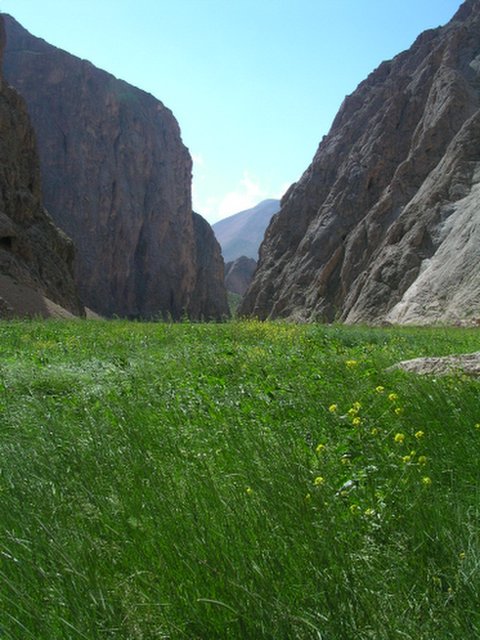
Another Spring day in Iran...
A co-hiker described the place we went to as "The Lost World." Every time we turned the corner there was an unexpected landscape. We went from arid rock to meadow to swamp all in the course of an afternoon's hike. I am such a flatlander: every time we hike, 3 years olds pass me, Iranians laugh at me, and I never fail to fall on my ass at least once. It's great to live in the mountains for a change.
We went through a gourge to arrive at the first meadow where Iranian families and friends were picnicking and singing. A group of women had taken off their scarves and were drumming and singing in lovely high voices. Two young men walked arm in arm smoking a waterpipe. A young man prayed while his friends drank tea. Families made kebabs while fathers sang for their children. This was all capped off by the sounds of crickets and the smell of wild mint. I thought I was in a kind of paradise, and I was not alone: my companions felt that way too.
If you want to know what Iran could be: go for a hike.
Tuesday, June 06, 2006
Negotiations
Tagged as: Iran: WMD
Iranians and Americans share one quality that is unimaginable to my European, particularly northern and western European, friends: the ability to act in unexpected ways. (I had originally written “illogical” but settled for unexpected…) What about when Reagan sold Iran arms through Israeli intermediaries? That was unexpected, wasn’t it? From both sides, wouldn’t you agree?
Then AN has, in my mind, the normal reaction to learning of the atrocities of the holocaust: shock and disbelief. Wouldn’t it be odd if that upon learning of the holocaust he was anything but shocked? We in the west respond as though he is denying the holocaust like a westerner who grew up with the knowledge of the holocaust might. Wow, then he gets a rise out of us and just goes on and on and on…Against logic and reason. But perhaps expected…
But then, I see, that there are Americans who are selling fashion gear that says “Nuke Iran.” While Bush may plan to nuke Iran, these guys think of it as a fashion statement. What the f*** is wrong with them? (I refuse to link to their site.)
So, despite the fact that negotiations are offered and negotiations are rebuked, despite the fact that most people I know think there is a 50-50 chance of Iran getting attacked…
I believe in the power of the unexpected. I believe in the success of negotiations.
---
What are the chances of the Iranian team winning the world cup?
Well, we hear that the regime is inviting football celebrations this year instead of discouraging them.
Tajrish
Went up Tehran’s hill to Tajrish where we shopped for framing supplies, fruits and vegetables, manteaus, and slippers. I love going there and being in the crowd of shoppers.
The bazaar at Tajrish is dank and rundown. When you arrive to the bazaar, you are greeted with shrimp, fish, sheep’s heads and tongues and feet, turkeys, chickens, and gorgeous fruits and vegetables. You walk down a narrow passageway that takes you by some premium produce stands selling fresh ginger packed in cotton, cherry tomatoes, and avocados. Then you smell pickled vegetables, pickled garlic, and barbecued liver. The light comes down in neat shafts from windows in the high ceiling. The place is packed with every kind of person Tehran has to offer. A lot of commerce passes in and out of the dank bazaar.
When we came out of the bazaar on the other side, we drank fresh melon ice drinks and watched men selling contraband. A well-dressed man approached this guy with an envelope filled with money. Drugs? Payola?
The young guy accepted the envelope, looked around and saw that the crowd did not care one whit about him and then walked over to a bush where he pulled out a white plastic bag filled with not the expected drugs, but dvds filled with western films.
The well-dressed man made his selections and walked away. The plastic bag returned to the bushes.
I finished my melon drink.
Tuesday, May 30, 2006
Best Spring Ever
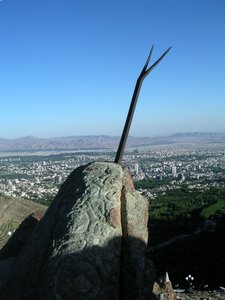
Rain and wind and grand lightning storms have conspired to make this a glorious spring in Tehran. We’ve had wind so strong that it breaks lightbulbs, blows over potted trees, opens closed windows and chimney flues, and unties headscarves. It also carries the city’s pollution away.
I’ve been trying to go walking in the mountains every weekend to savor the clear views of Tehran and smell all the honeysuckle and wild flowers blooming: a great change from diesel fumes.
A man in a white Peykan drove us home from a trip to Jamshidiei Park. His windshield was cracked and there was a photo of his father under the mirror. “This car is 40 years old. It’s a junker,” the man says.
“How can you say it’s a junker?” my co-hiker asks. “What other car runs for 40 years? You think the new Peugeots will run for 40 years? Will the Prides run for 40 years?”
“You’re right. This car has served me well.”
“Is that your father?” I ask.
“He died before the New Year.”
“May he rest in peace,” my friend says.
“I miss him. It was just the two of us. I miss him.”
We stop at a traffic light. A man with a violin plays “Tanha Mundam” (I am left alone). He comes to our window. The driver beckons him over. “Play for me. My heart needs music.”
The light turns green and we give the violinist tips.
“He was good,” I say.
“He knows one song,” the driver replies.
“They all know just one song,” my friend replies.
Sunday, May 28, 2006
Iran Chief Eclipses Power of Clerics - New York Times
Good article
Iran Chief Eclipses Power of Clerics - New York Times: "In this theocratic system, where appointed religious leaders hold ultimate power, the presidency is a relatively weak position. In the multiple layers of power that obscure the governance of Iran, no one knows for certain where the ultimate decisions are being made. But many of those watching in near disbelief at the speed and aggression with which the president is seeking to accumulate power assume that he is operating with the full support of Ayatollah Khamenei.
'Usually the supreme leader would be the front-runner in all internal and external issues,' said Hamidreza Taraghi, the political director of the strongly conservative Islamic Coalition Party. 'Here we have the president out front on all these issues, and the supreme leader is supporting him.'"
Saturday, May 27, 2006
conversation cont'd (see a couple of posts back)
Iran daily life
“If the Americans had not gone to Afghanistan, the Taliban would still be in power, and the women would still be in burkhas. Am I right? We need a hand outstretched in friendship now.”
“Oh c’mon… We don’t know how to take that hand. Every night the VOA tells us about democracy, and how we will have the support of the US if we just take the first step, and we do not take the first step.”
“How can we take that step? We need a helping hand.”
“Our problem is that we are essentially lazy,” K says.
“Lazy? You think so?”
“We don’t care about quality or about detail. Our 3000 year-old culture has not improved in 3000 years. All we do is whine and blame others for all of our problems.”
Man 2 lowers his head and shakes it. Man 1 smiles and says and nods his head in agreement.
K continues, “We don’t care about our own country. We don’t care about building our country. We must be the only country in the world whose citizens could care less what becomes of their country.”
“Not the only.”
“Okay. Maybe not. But my point is that instead of thinking ‘how can I improve my country?’ we think, ‘How can I line my pockets?”
“It’s the fault of the mullahs.” Man 2 makes a swirling gesture above his head to indicate their telltale turbans.”
“I don’t accept that,” K says. “After world war 2 Germany was destroyed. With the help of the Marshall Plan, they were able to rebuild. They could rebuild because they care about themselves and take responsibility for their own problems.”
“That’s what I am talking about,” Man 2 says. “Exactly. They got a helping hand.”
“But they knew what to do with it.”
“And they had Konrad Adenauer. Who do we have?” Man 1 says.
“It is the fault of the mullahs that we are this way.”
Tuesday, May 23, 2006
Dress code
It is ironic that Iran’s hijab requirement for all women despite religious beliefs has the opposite effect than described by the questionable and erroneous article stating that minorities will be required to wear identifying markers. If the regime really wanted to have visual identifiers for religious minorities, it could lift hijab requirements for non-Muslim women. This would have the intended effect without the negative publicity. In fact, many would welcome this development as a sign of progress. Hmmm…
Many religious minorities wear their own identifying markers: many Jewish men wear yarmulkes and many Christian women wear prominent crosses. It is really the Bahai who are the most oppressed. They are seen as apostates and have an extremely difficult life in Iran.
Good article Iran’s Jews by Angus McDowall:Iran's Jews struggle in the shadow of Holocaust denials
http://news.independent.co.uk/world/middle_east/article549814.ece
Monday, May 22, 2006
I’m tired of my blog…
Tagged as:Iran daily life
“There’s nothing to write about.”
“You’ve been here too long,” I tell my friend who keeps his own blog about Iran. “Everything seems normal to you.”
“That’s the problem, I know. I try to get away, but it’s still too normal. What’s strange is that every time I go abroad, all the talk is about Iran. Here we just laugh things off. There they take everything seriously. My God, this talk of flying gas chambers is really outrageous.”
“I feel like I am getting sucked into the hysteria. All I write about is political anymore. Dress code, nukes… it’s all getting on my nerves. If I don’t write about it, then I am dragged into it.”
“Oooohh… I see you wore your lovely red-striped ethnic identification clothing tonight.”
“Just another piece of mass hysteria.”
“The problem is Conrad Black’s paper publishes it and then everyone starts linking to it. The retraction gets less attention than the rumor.”
“People think that Iranians are as obsessed with the nuclear issue as they are, but in reality people here just have to deal with the every day pressures.”
“As if there is not enough to worry about… Like frigging taxis overcharging you, shopping, funerals…”
Everyday Pressures
“What do you think of Iran?” a nurse asks me.
“If I had never worked here, I would love it.” She laughs. “You’re lucky. You work with women. I have to work with men.”
“Iranian men break their promises.”
“Tell me about it…” Just then K opens the door of the doctor’s waiting room. “Except for my husband.” All of the women in the room laugh.
From the doctor’s office, I tag along with K as he heads downtown for an informal business meeting. I am tagging along. Their work completed, the men gather for tea and cigarettes. They are soon deep in conversation about Iran.
“The only honest thing an Iranian ever says is that Iranians are liars,” K says.
“Aha. Exactly,” Man 1 says.
“It’s gotten so much worse since the revolution. It’s all the fault of Jimmy Carter and the mullahs,” Man 2 says.
“We have 3000 years of history, but all we do is blame others for our problems. It’s the fault of the British, the Americans, on and on…”
“But shouldn’t they take some responsibility? Didn’t the British and Americans conspire to bring down Mossadegh? Was that our fault?”
“For a few million tuman, they were able to bring down a government: all they had to do is bribe a few people. We sell ourselves out cheap.”
more later...
Wednesday, May 17, 2006
The Hirsi Ali Case: "Voltaire and Erasmus Are Spinning in their Graves" - International - SPIEGEL ONLINE - News
The Hirsi Ali Case: "Voltaire and Erasmus Are Spinning in their Graves" - International - SPIEGEL ONLINE - News:
This is the subject of conversation here: Iranians may be Eddie Haskells, but the Dutch are Mother Superiors: stern but caring (as the one from the Flying Nun is described; often making bad decisions because of sanctimony.
"Holland's most famous immigrant -- Ayaan Hirsi Ali -- has been stripped of her citizenship overnight following television revelations about news that's long been public: she lied a little on her application for asylum years ago. The controversial decision by the country's immigration minister has sparked outrage, and many are calling it a dark day for Dutch democracy.
"
This is the subject of conversation here: Iranians may be Eddie Haskells, but the Dutch are Mother Superiors: stern but caring (as the one from the Flying Nun is described; often making bad decisions because of sanctimony.
Subscribe to:
Posts (Atom)