For my readers in Iran, the image above is from a speed test of my internet connection. It shows speeds of way less than a 14.4 modem. Internet speed is driving me nuts! As I am sure it is you.

The Donkey and the Date: On the Upcoming Municipal Council Elections in Iran:"There is an expression in Farsi that describes people who want contradictory things: those who want both the donkey and the date. These are people who are never mistaken, and see all situations in the context of their own interests. Iranians and their Euro-American supporters, those who advocate boycotting every election in the Islamic Republic, cannot have it both ways. They cannot argue that the office of the president (and all other elected offices) is politically impotent, while also lamenting the repressive nature of the Ahmadinejad presidency and how he is taking the country back to its early postrevolutionary period. This poses a dilemma for these universal boycotters. If elected officers make a difference, for worse or better, in the Islamic Republic, then why shouldn't citizens vote? There are many different positions on this question ranging from single-minded abolitionists, whose agenda is regime change in Iran, with or without the help of their neocon brethren, to those who recognize the differences between different factions, but argue that participating in elections legitimizes authoritarian institutions such as the Guardian Council. Although the reasons for boycotting elections may differ, the result is the same: low voter participation has devastating consequences for reform candidates."
“Iran only has water for about 85 million people, so you should hope that there won’t be too many more babies,” I say.
“We have great water,” Booming Voice says. “You should see the river in Borujerd; the water is sparkling and clean.”
“They are not counting that water. We have not even started using that water,” Tall Man says.
“The report I saw included all water resources in Iran.”
“Oh.”
“The way water leaks out of the pipes, there will not be enough water for 85 million people.”
“We’ll just drink oil,” Booming Voice jokes.




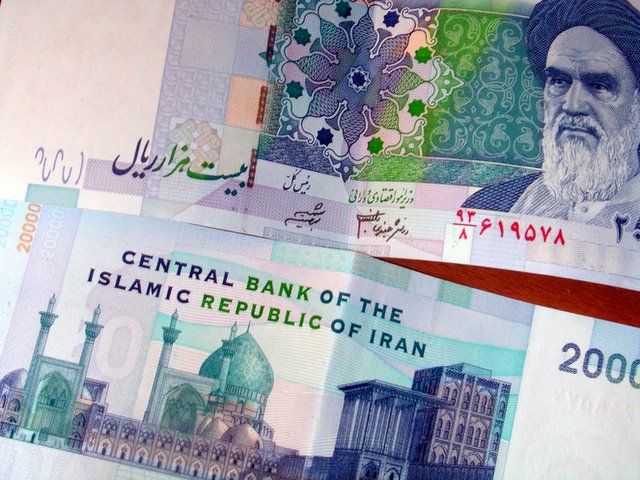
The new 20,000 tuman rial note... (Well the 2-year old note. There are so few in circulation that it still feels very new)


..At least 250 years before our country was founded, Persians were playing bluff-based card games with decks of four suits: coins, goblets, polo mallets and scimitars. In the late 18th century, their vying game As-Nas (My Beloved Ace) became the prototype for the 20-card French game poque. Introduced by Napoleon's troops to New Orleans, poque evolved into 52-card poker on Mississippi steamboats in the decades after the Louisiana Purchase. Union and Confederate soldiers played the game between battles, then brought it home to every state and territory. By 1970, when the first World Series of Poker was hosted by Benny Binion at his Horseshoe Casino in downtown Las Vegas, the variation of choice was no-limit Texas hold 'em. During the next 36 years, the number of challengers in the main event mushroomed from seven to 8,773, including players from 56 countries. But only one country besides the U.S. has produced more than one champion: Iran."
The driver looks over at the Mercedes next to us being driven by a hip young thing bobbing his head to Iranian pop. “The children of the revolution,” he says pointing to the young man. “Look at them. They have not worked a day in their lives. We have so much traffic because the only thing they do all day is drive around. They are without work. I work all day...”
“Look at Dubai: the apartments are better. The construction is better, the details are better. In Dubai, they have nothing. Nothing. They have to import dirt from Iran. Everything has to be imported. Iran has everything. We have the land, the marble, the stones, the bricks: everything we need. Still, apartments in Dubai are cheaper than apartments in Iran. Why?”
Me: “Why are you bothering those women? Do you think they’re cute?” I’d rather say: “are you flirting?” But, oh, the limitations of a non-native speaker.
Driver: “Nah, Babba… It’s not that. These girls: just look at them. All they do all day is spend Daddy’s money. They do not have to work a day in their lives. They are the obnoxious ones, not me.”
“There are some people in Iran who go to bed at night hungry and there are some people who have so much money that they do not know how to spend it. Do you think that’s right? It’s not right.”




: "“Criticizing the Islamic Republic Helps Dissidents Inside Iran”
No. President George W. Bush’s repeated statements of support for the Iranian people do not help normal Iranians. In the summer of 2003, the last time major riots took place in Tehran, Bush’s expression of solidarity with the rioters forced the reform-minded parliament to condemn American interference. At least one student leader, Abdullah Momeni, lamented that Bush’s statement had given the state “an excuse for repression.”
The Clinton administration, on the other hand, quickly grasped that publicly defending beleaguered Iranian reformists simply allowed the clerics to accuse reformers of being American lackeys. President Clinton also learned the cost of criticizing Iran’s unaccountable, clerical elite. During an otherwise quite conciliatory speech in 1999, then Secretary of State Madeleine Albright contrasted the elected and unelected branches of Iran’s government, and any potential benefits of her speech were drowned in a barrage of Iranian invective."


"Khomeini quoted Revolutionary Guard estimates that the war could not be won for at least five years, and only then if Iran had the following equipment:
'350 infantry brigades, 2,500 tanks, 300 fighter planes and 300 helicopters as well as the ability to make a substantial number of laser and atomic weapons which will be the necessity of the war at that time. The strength of the IRGC must be increased seven times and the Military by two-and-half times.'
But before anybody gets carried away, a word of caution. Khomeini at no point in the document suggests that he supported getting the bomb or that it would be religiously acceptable. All his known public utterances on the subject maintained that nuclear (as well as chemical and biological) weapons are haram (a position that has been carefully maintained by all other senior Iranian officials and clerics)."
Iran: At least 40 followers of Ayatollah Sayed Hossein Kazemeyni Boroujerdi arrested: "Iran: At least 40 followers of Ayatollah Sayed Hossein Kazemeyni Boroujerdi arrested
Source: Amnesty International
At least 41 followers of Shia cleric Ayatollah Sayed Hossein Kazemeyni Boroujerdi were reportedly arrested in the courtyard of his house in Tehran during the morning of 28 September. They are thought to have been taken to Section 209 of Evin Prison in Tehran, which is run by the Ministry of Intelligence. One was reportedly later released. There are fears that the Ayatollah may be at risk of imminent arrest.
On 30 June 2006 the Ayatollah conducted a large religious ceremony at the Shahid Keshvari stadium in Tehran. On 30 July, the security forces reportedly arrested several of his family and followers at their homes. The security forces also reportedly tried to arrest the Ayatollah himself, but were prevented from doing so by his followers."

Akbar Ganji - Letter to America - washingtonpost.com: "But the dangers of the Tehran regime are not limited to the nuclear question. The regime is dangerous mostly because it is willing to brutally trample on the democratic and human rights of the Iranian people. It is dangerous because it is willing to create gender apartheid in the name of religion and to suppress religious and ethnic minorities. Finally, it is dangerous because it considers all forms of dissent unforgivable sins. The real goal of the nuclear program is to make these policies permanent. In its negotiations with the Iranian regime, the West must not overlook this important fact."
“I don’t like to speak all the time with analogies, but I think the West is approaching Iran in exactly the wrong way. It’s like there is a dangerous element, a radical element in this country and perhaps at the moment it is holding us hostage. Rather like a terrorist who runs down the street with the police chasing after him and then takes refuge in a building. What should the police do? Negotiate with the people in the building until the people deliver the terrorist to them or the terrorist gives himself up; or attack the building, killing the terrorist but also killing lots of other people? If the United States were to attack Iran it would be like storming the building, a tragic mistake, because negotiation can resolve this dispute without anybody getting killed. ...”
“The best way to deal with Ahmadinejad would be if he were left alone for a couple of years. If he can’t use foreign pressure to repress more, he will face internal challenges. The most dangerous class is the workers – he told them he would raise their salaries. He has given them too much expectation, there’s a possibility they could strike.”
“Engagement with Iran has a much better effect for pushing the reforms, if the world wants to fully change the people, even those considered to be hardliners. Even they could become pro-Western. Why do I think that? Well, there’s a strategic element in foreign relations. The current situation for Iran isn’t good. We are surrounded by a lack of friends. We don’t have many Muslim allies – people are Iranians first, then Muslims. Engagement is the most effective weapon. We can use our capacity in the region to contain terrorism. Isolation just fires back. The ex-officials of US make sense – there need to be more talks.”
“Democracy is not like a plane, you can’t just export it. You have to have social basics and foundations on which to build democracy. People must want democracy if you want to create democracy. If you truly want to change this government, you have to bring in a completely democratic government. The voice must be heard in the West – I want to make a union between a peace loving Iran and a peace loving West.”
“The international community worries about Iran being a nuclear power. There is no reason to worry, it won’t be an atomic bomb that will destroy West. There is no such bomb. It will be Chernobyl style events that might destroy our own nation. All of this expertise and equipment were acquired on the black market. These factories and reactors lack safety standards. The West has very transparent reactors, and at the same time you have the greens and the environmental lobby keeping a check. When something is secret and unknown, you can have no confidence for safety. We should be worried, not you. You’re scared for us, and that’s very strange.”
“Higher education gives women a clearer understanding of inequality and oppression, and that understanding will produce change. It’s already happening, in vocal opposition to policies that sanction polygamy, temporary marriage, free divorce for men, and child custody to fathers and their families. If you pick up a women’s magazine in Tehran, you’ll find it’s full of stories of wives suffering at the hands of despotic husbands, a long list of wife-beatings, suicides and loss of children. At the moment it’s happening at this kind of anecdotal level because the courts discriminate against women, not just in terms of outlook or judgment but technically speaking, so a man’s testimony is equivalent to that of two women.”
“But change is inevitable, regardless of which faction holds the presidency. Education is giving Iranian women a new understanding of freedom, the freedom of choice, which is not displaced by sharia law. Ultimately the mullahs cannot make women wear the hijab or the chador, and the women of Iran are beginning to see this.”