Monday, July 31, 2006

Sigeh


Tagged as:

Response to Angel:

Iranian shi’a have a rule (sigeh) that allows them to engage in a “temporary marriage” lasting anywhere for a few minutes to pretty much forever.

The joke going around Iran at the moment is that Bush has finally responded to the letter AN sent him a few months back. Bush wrote that he is interested in hearing more about sigeh.

Unfortunately, the joke works much better for Clinton than for Bush, but you get the idea.

Read more about sigeh here:

Women in pre-revolutionary, revolutionary and post-revolutionary Iran

Sigeh is not actually an Islamic practice, but a pre-Islamic one used in Arab tribes. In its pre-Islamic form women still resided with her family, her kin still retained rights, a woman could also dismiss a man, and any children begotten belonged to the wife's lineage. In Islam, sigeh changed, so that the child now belonged to the father. The practice of sigeh was primarily used as an urban function associated with long distance trade.

Monday, July 24, 2006

Dance the night away

Tagged as:

Late one night last week, we drove west to a garden in the middle of nowhere for a wedding party. We drove by burning trash, industrial buildings, and military outposts. “This cannot be right,” we were thinking.

We drove onto an empty road and pulled up to a dented, dilapidated gate. It was dark. “No way is this it; it’s too dark.”

“No this is it,” the driver said. A police car drove by. Our driver leaned out the window to ask the police if this was the Garden we were looking for.

“It could be,” they answered and drove slowly away.

Keivan got out and knocked. The gate was opened by a sleepy Afghan. We see the lights of the party in the distance. “This is it!”

“If this were in America there would be signs and balloons everywhere.”

It only makes sense that in Iran a wedding party would be so coy. Once in, we danced with women dressed in tasteful gowns and men in sharp suits wearing silk ties around their necks.

A friend has just returned from Baghdad. “It’s horrible. People are really stressed. Baghdad is breaking up. Baghdad has neighborhood refugees now. People from one neighborhood are moving to others. It has become just too dangerous.”

We dance.

Sleep

Tagged as:

My friend wonders if there is a connection between living in Iran and problems sleeping. When you ask expats and Iranians who travel abroad about their vacations, they talk first about the amazing sleep they had. I, for instance, slept for two days the first time I left Iran.

My point is, you just never know what is going to happen. Sometimes I sit out on our balcony and think, Tehran before the bombing… Then I argue that there will be no bombing.

But it’s even smaller and less important than that. In a land where almost everyone breaks the law, at any moment you could be arrested. The laws here govern too much private business and not enough public business. There must be some law you are breaking, after all. If you’re not, you must be a child.

And it’s even smaller than that: will any of the day’s promises be kept? Will that guy I am working with show up for his 4:00 meeting? Will houseguests appear tonight? Will I be able to watch that tv show until the end or will the satellite be blocked? Is the repair guy a thief or a spy? Is my computer being infected by malware?

To live in Iran is to worry non-stop. The worry is like a low hum, barely audible.

Wednesday, July 19, 2006

Internet usage in Iran

Guess what! The whole nation of Iran is on a banwidth diet while the phone company renegotiates its bandwidth contract.

Just what you'd expect from a nation with time and money to waste...

Monday, July 17, 2006

Gasoline

Iran, surprisingly, cannot refine its own oil. I did not know this when I first arrived here and was always baffled by the long lines at the pumps combined with the often empty reserve tanks. I thought it had to do with the (in)efficiency of measuring the reserves in the station’s tanks, not with the availability of gasoline.

On the highway, Iranians stop at every station they see to make sure their tanks are always filled. It’s not unusual to find stations in the middle of nowhere with no gasoline available to sell.

Iranians have giant plastic containers that they bring to the station to fill. They often drive around with these containers in the trunks of their cars. Any taxi driver you meet can tell you about witnessing a small accident that ended in a large explosion, confirming my speculation that Iran’s horrible accident fatality rate may have something to do with carrying gasoline in plastic containers.

And now, Iran may be running out of gasoline and running short on gasoline policy:

With demand far outstripping its domestic refining capacity, Iran buys foreign gasoline for slightly more than 50 cents a liter (about $2 a gallon) and sells it at the pump for about 8 cents a liter (less than 40 cents a gallon), the highest subsidies in the region.

The discount prices have further encouraged consumption and cut into the country’s export windfall. Waste and pollution are rampant. The cheap gas is smuggled out to other countries at the rate of some two million gallons a day, according to one study by Parliament.


Iran, an Oil Giant, in a Gasoline Squeeze

Sunday, July 16, 2006

f-ed up

Israel does Iran’s bidding
Tagged as:

In college, I had a giant friend who told me that little guys were constantly picking fights with him: on the playground, in bars, everywhere. He was a really gentle guy, but it just drove him nuts. “They just want to prove themselves in a fight with me,” he would tell me. “It’s gotten to the point that I do not even like to go out.”


Is Israel the giant or the small guy? I would say a little of both. My allegory does not make any sense at all, and I probably should just delete it. What I really want to know is how could Israel allow itself to be lured into a war that will only serve to strengthen its enemies? It’s no secret anywhere that Iran is suspected of being behind Hezbollah’s kidnapping. It’s also no secret that Iran finances Hezbollah. There are even murals of Iranians “martyred” in battles fought with Hezbollah. Iran wants so many issues on the UN Security Council’s plate that no meaningful decisions can be reached. Now there is North Korea, Iran, and Israel to deal with. That’s quite a big serving.

Israel’s costly mistakes in Lebanon have been widely critiqued by many generally favorable to Israel. What makes them repeat those mistakes? Someone tell me.

Laura Zittrain Eisenberg argues that clear borders are essential for Israel (MERIA Volume 4, No. 3 - September 2000). In her section on Israel’s entry into Lebanon’s civil war she points out this crucial mistake:

Begin relished the irony in the Jewish State rescuing oppressed Christians, while the rest of the world stayed mute. But Beirut was not Berlin, and Begin's insistence on viewing the Maronite situation in European, post-Holocaust terms removed him further from Lebanese realities than any of his predecessors.


A larger quote here:

Do Good Fences Make Good Neighbors?: Israel and Lebanon after the Withdrawal
Who is on the other side?

(The Israeli Perspective)

In the early 1980s Israel made its most dangerous blunder in assessing the intentions and relative power of its Lebanese friends and foes. Up until the 1970s the Zionist/Israeli exaggeration of a friendly Christian community of allies in Lebanon caused minimum damage because Israel did not predicate policy upon that faulty precept. While the increasingly unrealistic perception of a Maronite partner perhaps precluded the Yishuv from pursuing a more realistic and productive Lebanon policy, it had not exposed it to any special political or military threat. The same held true for the first two decades of Israeli statehood. But once the Lebanese civil war began in 1975, Israel fell into the common trap of relying on religious shorthand, Christian vs. Muslim, to distinguish the nature and intentions of the key actors and began to pursue policy in Lebanon accordingly.

But in actuality, the conflict was one between Maronites trying to preserve their traditional political and economic privileges in Lebanon versus everyone else trying to seize a larger piece of the Lebanese pie for themselves. Israel's interests in Lebanon were not "Christian" at all, but rather dictated by standard strategic political thinking, which made any anti-PLO (and later anti-Hizballah) force a potential ally. (17) Differences within and among the Israeli cabinet, military and intelligence services concerning the desirability and capability of the Phalange as an ally are well-documented in the many accounts of the 1982 war. There was general agreement over the usefulness of forcing the PLO away from the northern border and even destroying the organization, if possible, but Prime Minister Menahem Begin used the Maronite angle both in formulating strategy and in appealing to Israeli public opinion. Deeply steeped in the historical lore of Maronite friendliness, few Israelis initially balked at the depiction of Lebanese Christians threatened with genocide and a natural harmony of Christian and Israeli interests in the face of mutual Muslim, Palestinian, and Syrian foes.

Begin relished the irony in the Jewish State rescuing oppressed Christians, while the rest of the world stayed mute. But Beirut was not Berlin, and Begin's insistence on viewing the Maronite situation in European, post-Holocaust terms removed him further from Lebanese realities than any of his predecessors.

Despite behind-the-scenes diplomatic activity, support for the SLA, and its own military operations in July 1993 (Operation Accountability) and April 1996 (Grapes of Wrath), Israel failed to suppress Hizballah. Fatalities ran at 20-30 IDF soldiers per year. Attempting to avoid roadside bombs, the IDF began to ferry its soldiers to security zone bases by helicopter, a plan that worked only until a collision between two helicopters in February 1997 claimed 73 lives. From that tragedy the "Four Mothers" group was born, a grassroots movement initiated by four mothers of sons serving in Lebanon, with the goal of compelling the government to withdraw all Israeli troops from Lebanon. (18) The organization introduced and legitimized the concept of unilateral withdrawal in national debate, its message driven home by the relentless procession of IDF body bags from Lebanon. Hizballah had succeeded in making the security zone untenable.


(The Lebanese Perspective)

Israel was so focused on the PLO and its Lebanese and Syrian allies that it neglected to evaluate properly the Lebanese Shi`a's politicization in the early 1970s, marked by the rise to leadership of Musa al-Sadr, and the formation of Shi'a organizations such as Amal and the Islamic fundamentalist Hizballah. Although some Shi'a supported the Palestinians and the PLO, others--angered at oppressive PLO domination and PLO cross-border attacks that invited Israeli retaliatory strikes against their villages--responded to Israel's anti-PLO invasion of 1982 with relief and support. But as hostilities dragged on 1982, Israeli forces settled into the south, building new roads, posting road signs in Hebrew, commandeering facilities, and establishing bases or detention camps. These steps caused Israel to change in many Shi'a eyes from liberator to occupier. Despite the fact that a majority of the FLM and SLA foot soldiers were Shia, Israel had neither recognized nor rewarded the Shi'a as potential allies, taking their continued acquiescence for granted.

By 1985 Amal, founded to champion Shia rights within Lebanon, was being outgunned by Hizballah, which proclaimed a pan-Islamic fundamentalism. Funded by Iran and encouraged by Syria, Hizballah sought to drive the Israelis back across the border. Frequent declarations by the organization also stated an intention to remove Israel from Palestine and Jerusalem, as well. It is ironic that the PLO, target of the 1982 invasion, became Israel's peace partner in 1993, while many of the previously friendly Shi'a of south Lebanon joined Israel's new Hizballah enemy.


Missed Opportunity?

Hindsight is always 20/20, but it does appear that Israel missed a critical opportunity for salvaging some benefit from the 1982 invasion in the year or two immediately afterward. Unlike the situation in 1978, the PLO was really gone this time, and although the alliance with the Phalange had already soured, relations were still good with the Christians and Shia of south Lebanon. Had Israel withdrawn at that time, and/or accurately recognized the sensibilities and needs of the south Lebanese people, it might have earned the trust of a population genuinely interested in seeing the border quiet and secure. In a reflective post-withdrawal interview, Israel's coordinator for activity in Lebanon, Uri Lubrani, similarly suggests that Israel could and should have redeployed to the international border in 1984. (19) By failing to identify and accommodate the south Lebanese actors who remained after the PLO's expulsion, Israel helped provoke the creation of Hizballah, an enemy equally or more punishing than the PLO had ever been.


Unfortunately for everyone, we are living in a time of inferior leaders.

Wednesday, July 12, 2006

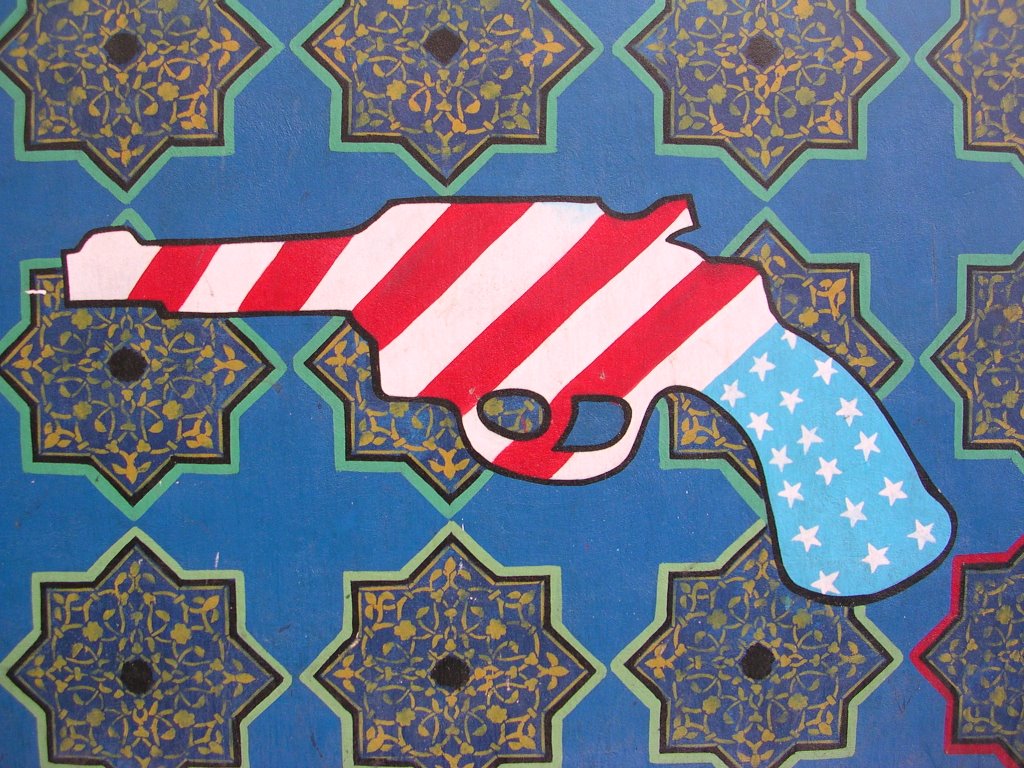
About the revolver

Tagged as:

(response to Matt’s question)

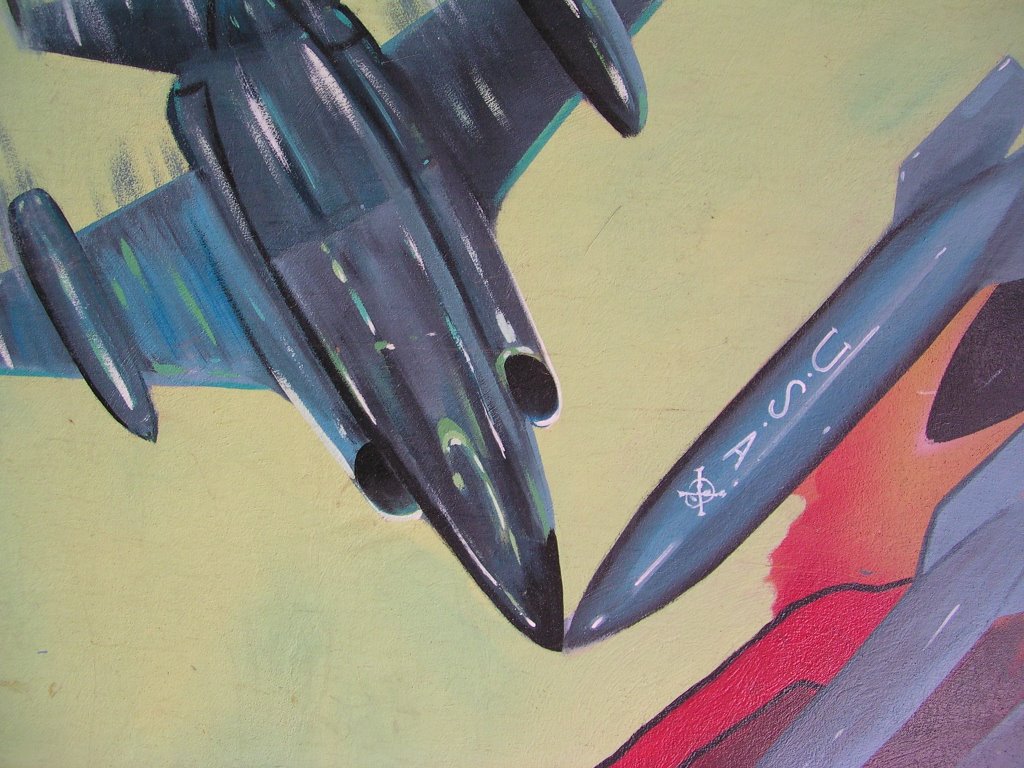
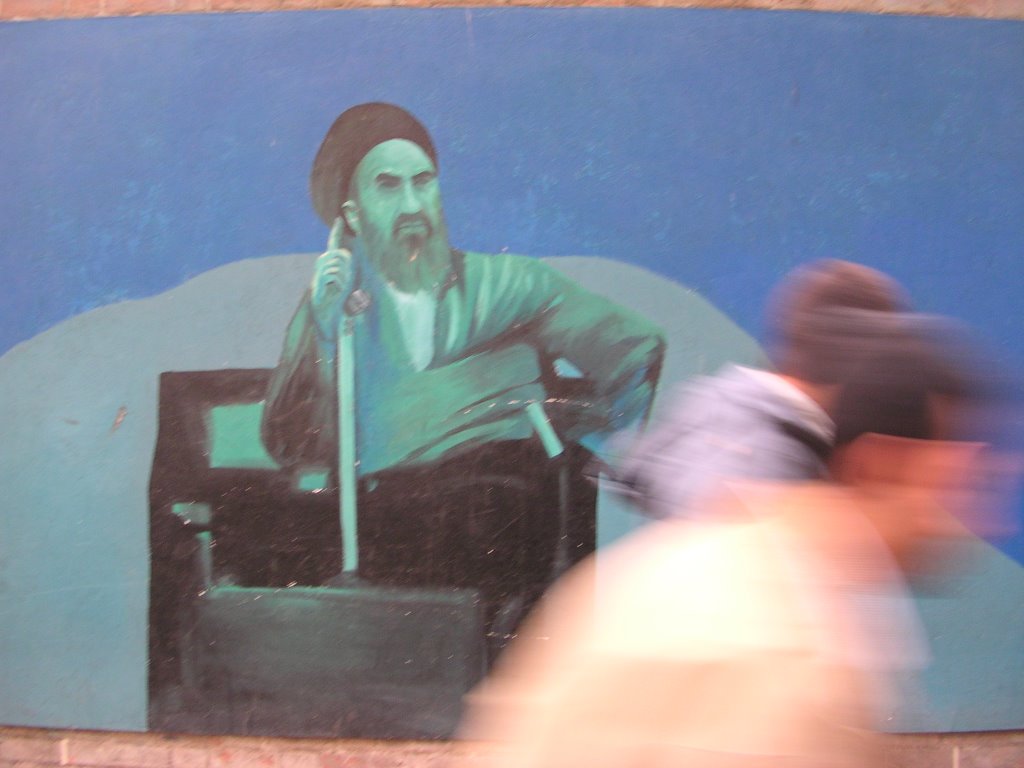
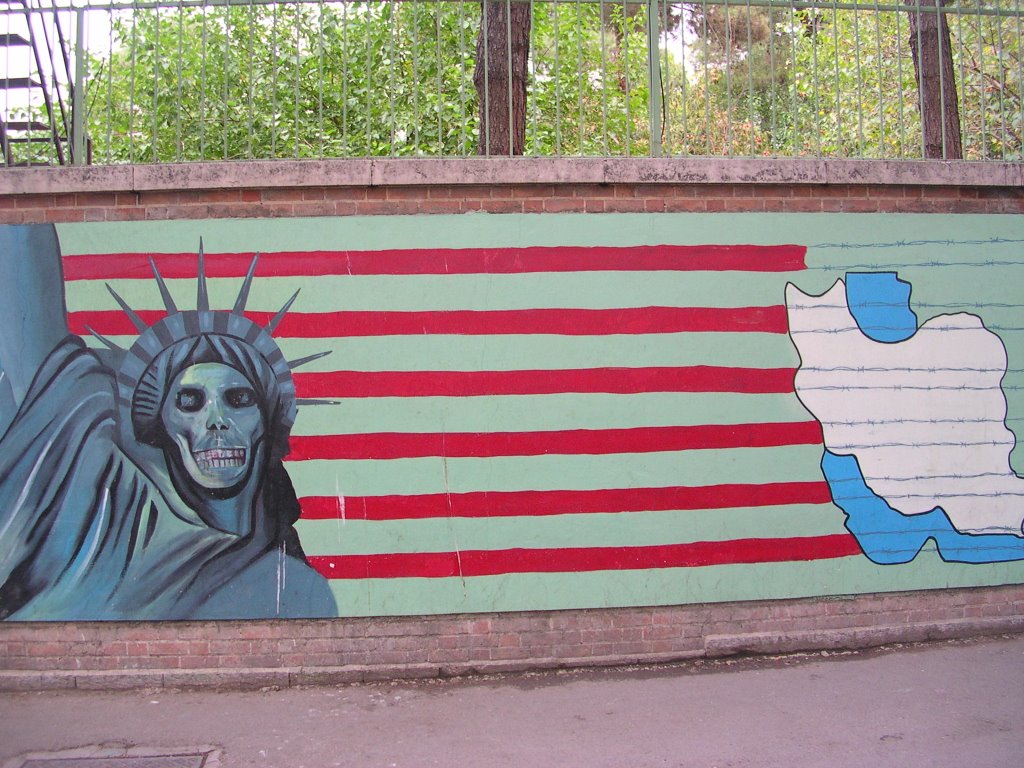
The photo of the revolver that is featured in this blog is from a mural in front of the former American Embassy. I am posting a few photos of that mural so that you get an idea of what it looks like.


Tuesday, July 11, 2006

Head Butt

Tagged as:

Like every other football crazed nation, Iranians are talking about the World Cup and Zidane’s head butt. In fact, this has been the primary topic of conversation for two days now. I just read a couple of my Iranian friends Materazzi’s description of the incident translating it into approximate Farsi. The lines:

'I did not call him a terrorist. I am not a cultured person and I don't even know what as Islamist terrorist is.'

He added: 'For me the mother is sacred, you know that.'


…Got a big laugh from my friends. “How Iranian of him,” Niloofar laughed. By this, she meant the way that Materazzi admits to insulting Zidane but does not rule out an insult to Zidane’s family, just one to his mother.
ESPNsoccernet - World Cup - Materazzi admits to insulting Zidane: "Materazzi, 32, told Gazetta dello Sport: 'I held his shirt for a few seconds only, then he turned to me and talked to me, jeering.

'He looked at me with a huge arrogance and said, `If you really want my shirt I'll give it to you afterwards'. I replied with an insult, that's true.'

Materazzi has not elaborated on what he did say, but one report suggested he responded with: `I'd rather take the shirt off your wife'.

He has denied, however, some of the more vile insults referring to his wife or sister or calling him a terrorist.

'It was one of those insults you're told dozens of times and that you often let fall on a pitch,' Materazzi said.

'I did not call him a terrorist. I am not a cultured person and I don't even know what as Islamist terrorist is.'

He added: 'For me the mother is sacred, you know that.'"

Sunday, July 09, 2006

Fun in the Sun

Tagged as:

I thought I would write at least once in awhile during the past two weeks, but I did not. Why didn’t I? I cut the tip of a very important typing finger, and it hurt to type. Oh yeah, I also went to a friend’s wedding in a normally cold country that was in the grips of its three-week summer so it was sunny and gorgeous every day so we went to the beach and swam in the ocean and I actually wore a bikini in front of men and women and little children and big and small dogs and was still one of the most covered up women on the beach. I rode a bicycle, wore a summer dress, and spoke freely and openly with everyone. I slept a lot. I drank a lot less than I do in Iran, but I drank good wine and good beer instead of the staples available to us here. Friends returned from Greece with homemade red wine. They were excited about it, but I told them I had had enough homemade wine in the past few years.

I returned with Iran Air. Once again, I did not want to get on the plane, but then, once on, I had fun. I sat next to an ex-pat Iraqi family whose parents have taken refuge in Iran. Their parents are too scared to travel back to Baghdad. They like Iran. In the row next to ours was a couple who had not been in Iran for 15 years. They were beaming. Excited to see family and eat Iran’s famous sheep’s head and foot soup (calepache). (Talk about foot in mouth…) When we were just above Tehran, the man leaned to look out the window and shouted: “There is calepache everywhere in this city!” We landed to a great burst of applause from the passengers.

Everyone was covered up while we were still in the airport. I did not wear my headscarf until we landed. Soon, many of the women had taken theirs off as well. Iran Air is often carrying people who have not been in Iran in years and years. Those women cover every strand of hair on their heads: not from religious passion, but from fear.

The cold European country was filled with women in hijab: all of whom would be arrested in Iran for bad hijab. Hijab, as I have said before, is all about fashion. Moroccan women, for instance, wear tight-fitting scarves, form-fitted to their hair, and tied behind their necks. Then they wear long skirts, with tight tops, lots of jewelry and fashionable shoes. They look great. Why? Because, as so many Muslim evangelists tell me, hijab is a signal that the woman’s body is not part of the social discourse: it’s all about respect. Hijab is supposed to protect women from prying eyes and sexual violence, but I very much doubt that it does any of those things. Talk to any man: western or eastern: they are obsessed with women in hijab.

Hijab makes the women’s body the center of social discourse: all it does is eroticize the body. I’ll tell you what takes women’s bodies out of social discourse: it’s thousands of topless women at the beach.


More on hijab:
The Veil: Resistance or Repression?

Scarf and Make-up: the Modern Face of Islam

Women in Islam, veiled oppression or stigmatized misconception
http://www.bbc.co.uk/dna/ww2/A5838410#footnote10

A Pearl In Its Shell


Arab Feminists on Women's Rights: Cats and Dogs in the Developed World Have More Rights than Women in the Arab and Muslim World

Saturday, June 24, 2006

Fun

Tagged as:

1. “Some people think Iran is a hell because young people can’t go to discos or drink beer in bars. They have no imagination of what it means to have fun.”

M: “I grew up in the country, so Iran is a great place for me to have fun. You can never be disappointed by the nature here.”

ET: “It’s true that Iranians have a kind of fun that is really special and enjoyable, but I do believe that being young in Iran is a bit of a problem.”

1: “What do you mean?”

ET: “Well, you are always watched. There is so much pressure from family and from society.”

1: “Who says that?”

ET: “I see that myself. I see how young people have to put so much control on themselves because there is so much control on them.”

2: “That’s the first way to learn to lie. For instance, we get some money. Our parents ask us how we plan to spend it. We tell them a lie. We lie even when there is no reason to lie. We do not tell our parents where we are going or who we are going with. We do not tell them anything true. We are a lying people.”

ET: “All Iranians say that about themselves.”

Y: “What I like about working in Iran is that when I get angry in a meeting, the Iranians do not hold it against me. When the meeting is over, they slap my back and we are friends again. They know it is business. When I do business in Saudi Arabia, they do not accept the difference between business anger and personal anger.”

3: “Iranians show their emotions.”

ET: “No, Iranians are very controlled.”

3: “Do you think so?”

ET: “Particularly the women.”

4: “The women are really manipulative.”

1: “Because we have to be. That’s the only way for us to survive.”

K: “That’s what I always say. I’m with you.”

ET: “If the law were more fair, women would be less manipulative.”

1: “That’s true.”

Y: “The men are ruled by women.”

3: “No, it’s just natural here.”

ET: “Married men are like children. They cannot even feed themselves.”

2: “Our generation is better.”

ET: “Your generation is a lot better. I see a lot more 50-50 in younger couples.”

1: “Every generation has its lazy men and domineering women.”

2: “If you talk to ten young people in their 20s, only 2 will tell you that they want to get married. The others do not want to get married.”

1: “We have learned to lie so well that we don’t want to enter into a relationship of trust.”

2: “We had to learn to lie.”

3: “Do you wish the revolution never happened?”

2: “Of course I wish it never happened. We have fallen so far behind the rest of the world.”

1: “Me… I think the revolution has been a good thing. It has made us much more careful. We don’t believe things so easily. We think things through more carefully. Our decisions are more deliberate.”

Wednesday, June 21, 2006

Closing Time

All over Iran, businesses are closing early again today for a chance to say farewell to the world cup team. Keivan predicts a 3-0 loss for Iran. “Don’t say that,” Mohamad protests. “Everything you’ve said has come true.”

“It’s all Keivan’s fault,” I respond.

---

Was in a meeting with some Iranian businessmen. One was telling us that he went to Dubai to buy some hardware for his business. “They didn’t sell it to me. They won’t sell to Iranians.”

“Sanctions?”

“No, it’s not sanctions. They just won’t sell to Iran. The Arabs do not want to sell to Iran.”

“You’re sure it wasn’t sanctions?”

“I’m sure. They said to me: we won’t sell to Jews. I said, hey, I’m a muslim. My name is Mohamad, how can I be Jewish? They kept telling me they don’t sell to Jews.”

All of the men laughed. That was the end of that.

I was left thinking of the Brooklyn Mullah. He appears on Iranian tv every once in awhile and lectures on scripture. He has a really thick Brooklyn accent that shifts into what sounds to me like perfect Arabic when he needs to quote something. Last time I saw him he was speaking of the sheitan (devil) and identifying his works. It’s all so disorienting for me: the accent, the sermon, the black turban: I keep thinking he is a rabbi, but then what’s all this about hadith?

I think it was Lenny Bruce who said that all New Yorkers are Jewish. I guess the Brooklyn Mullah is no exception.

Saturday, June 17, 2006

Weekly Hike


Tagged as

I spent more time as a passenger than actually hiking this past Friday because traffic was so bad. First we got behind a long line of diesel spewing trucks going through winding mountain roads. Then there was a series of minor fender benders. Then there were the small towns where people were driving in and out of stores and kebabis and turning our 3 lane “highway” into a 6-lane highway: 5 lanes in the direction of Tehran, 1 lane in the direction north.

At one point we were stopped at a military checkpoint: on the lookout for bad hijab, alcohol, and unmarried men and women traveling together. Our driver gave the military guys some lip: just enough to let them know how unhappy she was being stopped. She refused to fix her hijab which wasn’t so bad anyway. They eventually waved us through without checking our trunk.

It probably helped that I am so foreign looking.

“Do you think I was too mouthy?”

“No, just mouthy enough,” I answered.

There were a lot of patrols at the mountain, but for the most part they seemed in good spirits. One sergeant (I recognized the stripes from the Beetle Bailey cartoon sergeant) was even joking with passing hikers about using his baton on them. It may sound like a macabre joke, but it was sweet.

Just after we saw this sergeant we did see soldiers leading three men and one woman down the mountain. One had his gun half-raised towards the back of the woman. In Iran it’s hard to tell when people are being arrested because they are actually breaking a real law or when they are being arrested arbitrarily. Who knows in this case?

I have seen the Iranian police control violent men with a degree of gentleness unimaginable in America. For instance, a man who went into a violent tantrum after learning that his seat on the bus had been sold to someone else was gently led away by the police when they showed up. This man had broken several windows, attacked bystanders and employees of the bus service, and was still squirming and twisting when the police led him away: without hand cuffs, without shooting him, without beating him.

There are a lot of different kinds of police in Iran.

Speaking of which, since last week’s game with Iran, we had heard about Iran’s new motorcycle cops: a band of tough-looking, clean shaven guys riding serious motorcycles. Powerful motorcycles are forbidden in Iran, so the site of 20 guys on brand new motorcycles is surprising. We saw them on our way home from the mountains. One group was riding south from the north of Iran, one riding north from Tehran. These guys were wearing form-fitting motorcycle gear that may be bullet proof for all I know. One even had a leather Red Bull jacket on. Do you think this was official dress? They have black helmets that hide their faces and look like they walked out of some Hollywood Commando movie. They look very, very unIranian.

Wednesday, June 14, 2006

Rumor of the week

Tagged as:

Under Construction has a description of post-game “celebrations” on Vali Asr Street.

Keivan’s doctor elaborated on the rumor I heard from the taxi driver that the mullahocracy specifically prohibited victory in Iran’s game with Mexico “Ali Daei works for intelligence,” the doctor told him while checking his blood pressure. “Did you see the way he was just running up and down the field? He wasn’t really part of the game. He was just moving.”

Many others have repeated the rumor which is at once funny and pathetic. This rumor is traveling through the over 40 age group. Young people are not passing this one on and laugh when they hear it. What it presumes is that Iran is such a great team that a couple of people can make a decision to win or lose. This rumor feeds right into Iranians combined sense of superiority and inferiority.

The World Cup is a great way to take your mind off nukes, sanctions, and despair. Hurray world cup!

Tuesday, June 13, 2006

I wrote an article

It's based on the notes I took for this blog. It's for the Prospect.

The Prospect has a good article that I only discovered yesterday: "Misreading Iran (again)."

BTW, didn't the Americans look tiny and boyish compared to the giant warriors on the Czech team? I was happy the score did not go to 4-0. Keivan''s brother was rooting for a 6-0 win for the Czechs.

Monday, June 12, 2006

Sourakh, sourakhesh mikonand…

Tagged as:


Well, not exactly. “The mullahs did not want us to win. They told the players: ‘make sure you lose.’”

“No way.”

“You didn’t grow up here. You don’t know the lengths they would go to to keep us off the streets and to keep us from celebrating. We are a rich country with a great culture, but they have ruined us.”

When I got to my destination, I asked the people there what they think of the driver’s comments. “He’s crazy. The Iranian team played well; they just did not win.”

I have never been more invested in a game. You might think this is strange, but I really wanted Iran to win. Friends of ours took us to a football party in a young couple’s apartment in Tehran. The Iranian flag was draped over the door. We were welcomed into the couple’s home with sincere warmth.

The apartment was draped with flags. Faces were painted green and white; young women wore team t-shirts; horns were blaring; the music was loud. Within minutes a tray filled with vodka was passed around the room. The stereo was blaring Arash’s “Iran… Iran…” It was repeated so often that night, that I learned the words. It goes something like We are Iranian until we die; we speak in one voice: Iran, Iran…

It rhymes in Persian.

The room was crowded. The game started. Iran attacked and attacked and attacked. Each attack was met with wild cheers, “Imagine what the stadium must be like,” Keivan said. “This place is so loud.” They looked good, but it was Mexico that scored the first goal.

The Iranians first booed then cheered the Mexican goal. “This is good for Iran, now they will play better.”

They did play better and scored a goal to tie the game 1-1. The room went wild! There were fireworks in the streets.

Halftime arrived. I went outside for a bit of fresh air. “I was just in Europe,” a young man told me. “Every time I said I was Iranian, they said Ahmadinejad. I said we did not elect him. They don’t understand how we Iranians can love our country and hate our government.”

“My Iran is here,” the face-painted man said to me as he pointing to the apartment. “It is not there.” He pointed outside. “I love my Iran. My people are happy inside and sad outside.” He was practicing his English with me. I think most Iranians would be surprised to hear themselves called “my people” by a young medical student, but I might be wrong.

“Pray for my team,” a young woman said to me. “It moves me that you care about us.”

“God willing, we will win,” another added.

“They might even win,” Keivan said.

“Tying would be a victory.”

There was so much good humor and hope that when at 9:10 Iranian time, the Mexicans scored their second goal, no one despaired. When they scored their third goal within minutes, the room went quiet. All of Tehran went quiet.

A young man with green and white face paint, wrapped in an Iranian flag went into the bathroom to sulk. He sat on the ground with his head in his hands.

I wanted to cry.

A few minutes after the game, we were dancing to Arash songs. The sulking young man told me, “We are good losers. That is our problem. When we win we say it is from God; when we lose we say it is from God. That is why we are always losers. We are victims.” Posted by Picasa

Sunday, June 11, 2006

World Cup

Tagged as:

While the west may be worrying about AN’s nasty appeal to neo-Nazis worldwide and how that will be played out in Iran’s first game tonight: Iranians are just eager to celebrate a victory and have some public fun. (See Michael Slackman’s article: World Cup Tests Iranians' Ability to Have Fun in Public)

You would be hard-pressed to meet an Iranian in Iran who even knows what a nazi is (unless it’s a girl’s name, and then it is pronounced with a buzzing z rather than a ts z), let alone a neo-nazi.

For a great insight into Iran AND Iran’s sympathy with Germany, read: My Uncle Napoleon. The story takes place in a family compound in Tehran during world war 2. Nothing else provides more insight into Iran than this book. There is no analysis of Iran that even comes close to Iraj Pizishkzad’s rendition of Iranian society and culture.

Predictions: This morning’s taxi driver predicts a tie; Keivan predicts a 3-1 loss; Mohamad a 2-1 win; Niloofar thinks that it will be a 2-1 loss or a tie. "She's become Mexican," Mohamad complains. "She's not Iranian anymore." Everyone here believes that Mexico is a strong team. Iranians, however, need at least one victory in the World Cup. There is an eagerness to return to the streets for a bit of celebration.

Saturday, June 10, 2006

The Lost World

Tagged as:


Another Spring day in Iran...

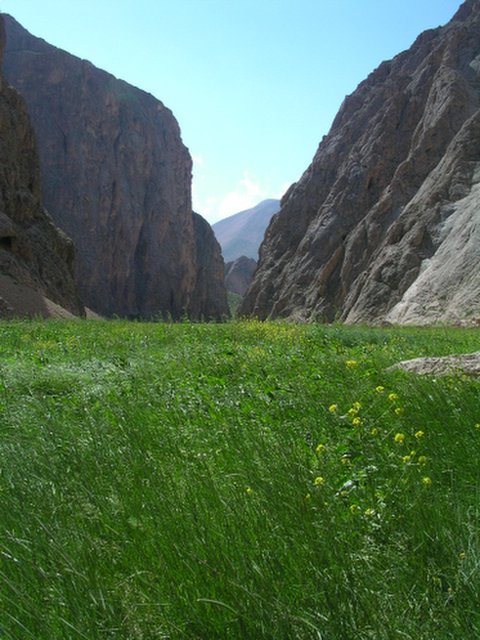
A co-hiker described the place we went to as "The Lost World." Every time we turned the corner there was an unexpected landscape. We went from arid rock to meadow to swamp all in the course of an afternoon's hike. I am such a flatlander: every time we hike, 3 years olds pass me, Iranians laugh at me, and I never fail to fall on my ass at least once. It's great to live in the mountains for a change.

We went through a gourge to arrive at the first meadow where Iranian families and friends were picnicking and singing. A group of women had taken off their scarves and were drumming and singing in lovely high voices. Two young men walked arm in arm smoking a waterpipe. A young man prayed while his friends drank tea. Families made kebabs while fathers sang for their children. This was all capped off by the sounds of crickets and the smell of wild mint. I thought I was in a kind of paradise, and I was not alone: my companions felt that way too.

If you want to know what Iran could be: go for a hike. Posted by Picasa

Tuesday, June 06, 2006

Negotiations

Tagged as:

Iranians and Americans share one quality that is unimaginable to my European, particularly northern and western European, friends: the ability to act in unexpected ways. (I had originally written “illogical” but settled for unexpected…) What about when Reagan sold Iran arms through Israeli intermediaries? That was unexpected, wasn’t it? From both sides, wouldn’t you agree?

Then AN has, in my mind, the normal reaction to learning of the atrocities of the holocaust: shock and disbelief. Wouldn’t it be odd if that upon learning of the holocaust he was anything but shocked? We in the west respond as though he is denying the holocaust like a westerner who grew up with the knowledge of the holocaust might. Wow, then he gets a rise out of us and just goes on and on and on…Against logic and reason. But perhaps expected…


But then, I see, that there are Americans who are selling fashion gear that says “Nuke Iran.” While Bush may plan to nuke Iran, these guys think of it as a fashion statement. What the f*** is wrong with them? (I refuse to link to their site.)


So, despite the fact that negotiations are offered and negotiations are rebuked, despite the fact that most people I know think there is a 50-50 chance of Iran getting attacked…

I believe in the power of the unexpected. I believe in the success of negotiations.

---

What are the chances of the Iranian team winning the world cup?

Well, we hear that the regime is inviting football celebrations this year instead of discouraging them.

Tajrish

Went up Tehran’s hill to Tajrish where we shopped for framing supplies, fruits and vegetables, manteaus, and slippers. I love going there and being in the crowd of shoppers.

The bazaar at Tajrish is dank and rundown. When you arrive to the bazaar, you are greeted with shrimp, fish, sheep’s heads and tongues and feet, turkeys, chickens, and gorgeous fruits and vegetables. You walk down a narrow passageway that takes you by some premium produce stands selling fresh ginger packed in cotton, cherry tomatoes, and avocados. Then you smell pickled vegetables, pickled garlic, and barbecued liver. The light comes down in neat shafts from windows in the high ceiling. The place is packed with every kind of person Tehran has to offer. A lot of commerce passes in and out of the dank bazaar.
When we came out of the bazaar on the other side, we drank fresh melon ice drinks and watched men selling contraband. A well-dressed man approached this guy with an envelope filled with money. Drugs? Payola?

The young guy accepted the envelope, looked around and saw that the crowd did not care one whit about him and then walked over to a bush where he pulled out a white plastic bag filled with not the expected drugs, but dvds filled with western films.

The well-dressed man made his selections and walked away. The plastic bag returned to the bushes.

I finished my melon drink.

Tuesday, May 30, 2006

Best Spring Ever


Rain and wind and grand lightning storms have conspired to make this a glorious spring in Tehran. We’ve had wind so strong that it breaks lightbulbs, blows over potted trees, opens closed windows and chimney flues, and unties headscarves. It also carries the city’s pollution away.

I’ve been trying to go walking in the mountains every weekend to savor the clear views of Tehran and smell all the honeysuckle and wild flowers blooming: a great change from diesel fumes.

A man in a white Peykan drove us home from a trip to Jamshidiei Park. His windshield was cracked and there was a photo of his father under the mirror. “This car is 40 years old. It’s a junker,” the man says.

“How can you say it’s a junker?” my co-hiker asks. “What other car runs for 40 years? You think the new Peugeots will run for 40 years? Will the Prides run for 40 years?”

“You’re right. This car has served me well.”

“Is that your father?” I ask.

“He died before the New Year.”

“May he rest in peace,” my friend says.

“I miss him. It was just the two of us. I miss him.”
We stop at a traffic light. A man with a violin plays “Tanha Mundam” (I am left alone). He comes to our window. The driver beckons him over. “Play for me. My heart needs music.”

The light turns green and we give the violinist tips.

“He was good,” I say.

“He knows one song,” the driver replies.

“They all know just one song,” my friend replies.

ShareThis