Saturday, June 11, 2005

FT.com / Middle East & Africa - Islamic virtue takes a back seat on Iran's new-look campaign trail:

"'If a candidate tries to escape from democracy and shows toughness, it won't work,' said Hamid-Reza Jalaei-Pour, a sociology professor at Tehran university.

For the first time in Iran, there is a candidate clearly running for a party. Mostafa Moein, a reformist contender, was chosen by Mosharekat, the main reformist group. In a reality check to polished electioneering, Dr Moein appeared on Wednesday on state television in an interview with Saeed Hajjarian, the leading reformist journalist partially paralysed by an assassination attempt by Islamic vigilantes in 2000.

'You are an example to our young,' Dr Moein told Mr Hajjarian, whose questions were run as subtitles because of his slurred speech.

But just a week before the election, candidates are struggling to motivate a disillusioned electorate. Iranians are sceptical about politics and politicians' promises after wearying years of revolution, high unemployment and inflation, and Mr Khatami's battles with unelected state institutions. 'Not even all the changes in the way of campaigning may be enough to make people vote,' says Mr Jalaei-Pour. 'We have had 25 years of sloganeering, so now it's very difficult to fool Iranians.'"


[emphasis mine]

Friday, June 10, 2005

Watching from Shariati Street

Our friend thinks that there was a revolution two nights ago. She was out on Shariati Street where the crowd was tearing down election posters and young women were burning their headscarves.
Anyone else see anything like this?

Our crowd was celebratory and peaceful. I cannot imagine a more mellow group of football celebrants. They had fun without getting into fights.

"Imagine what this would be like if these guys had a few beers in them," K commented.

"They'd probably toppling cars and setting them on fire like sports fans everywhere else."

Thursday, June 09, 2005

Iran qualifies to 2006 World Cup

1-0
Iran has qualified for the World Cup and, on top of that, has qualified undefeated.

I was talking on the telephone when the final second ticked off. There were whoops and the sound of firecrackers. "It sounds like Iran won." (Hey, I saw the rerun of the game at midnight… I'm new to soccer: remember, I'm an American.)

K came to get me off the phone. "Let's go out," he said. "Let's celebrate!" I thought he was joking, but he wasn't. We went out. All of our neighbors were out. Some of them had boxes of pastries and were passing them out passersby. We turned the corner and went on to the main street. Rafsanjani supporters were out with giant SUVs blaring electronica and trays filled with fruit drinks. Moeen supporters were handing out pastries to people in cars stopped at the light.

We made it to Valiasr right before the major traffic started. We arrived just in time to see thousands of celebrants running down the street with faces painted and flags waving in the wind.

Drivers honked their horns and young men blew these noisemakers. There were firecrackers galore. Some of the flags were simply green, white, and red. Most were the current Iranian flag.

Young men danced in the street. Iranian men are really sexy dancers. (Although I hear that Iranian women don't find their dancing sexy. Well, foreign women do. Trust me.) We came across a group singing and dancing. A woman in her late 60s was encouraging people to clap. "What's your problem!" she would yell to passive onlookers. "Clap! Sing!"

Rafsanjani's campaign was out in force. Young people were covered with his stickers. They were dancing and yelling.

The Qalibaf campaign handed out zero alcohol beer from an Efes truck. I can't remember the exact slogan printed on the truck. I think it translated to something like "Life goes better with Qalibaf." So many people were running after the truck that you would have thought they were receiving 2.5% beer.

We saw a small, solemn group of Moeen supporters who held his poster up over their heads and walked quietly up and down the streets.

Later we saw a yellow hummer driving through the crowd. "Is Schwarzenegger in town?" I asked.

Groups of celebrants seemed to wander in and wander out from all directions. People were happy and relaxed and somewhat anticipatory. Did anything more dramatic happen? I do not know.

Wednesday, June 08, 2005

The Big Game
K's nephew predicts that tonight the Iranian national soccer team will beat the Bahrain team Doh-heech (2-0). A tie would make them one of the first teams to qualify for the World Cup. ( Read the story )

But more importantly, this big game is happening just 9 days short of the election. 12,000 police will be on the street. Their mandate is to use as little force as possible because the government does not want a forceful confrontation with crowds of young Iranians at this time.

Rafsanjani is ready to claim the team's victory for himself. His campaign plans to keep a high profile tonight. Rumor has it that there are already Rafsanjani soccer victory campaign posters ready.

Despite all the shiny, happy campaign images around, I have not met a single person who plans to vote. Friends tell us that even the fashionable youth sporting Rafsanjani headbands do not plan to vote. It's just fashion and money and little bit of guerilla marketing.

Yesterday I saw a group of teen-aged girls tearing down campaign posters on fashionable Valiasr Street. It was 3:00 in the afternoon. The girls were not making any effort to be secretive about their actions.

Posters come up, posters go down.

That said, Iranian agencies are already planning their world cup tours. Iranians have the greatest confidence in their team. Go Iran!

Tuesday, June 07, 2005

Hashemi
I don't get the whole Rafsanjani fashion craze and, neither, it seems, do other bloggers. ( Farideh Nicknazar on Open Democracy's Iran Blog writes, "What I find interesting, and I have never seen this done before, is to see young trendy women (with makeup and minimum head cover) showing off headbands with "Hashemi" written on them in English... Why in English?")

Last night a friend of our's got a call from a friend: "I'm performing tonight, why don't you come see me?" he asked.

She agreed, called a couple of friends, and made her way to Rafsanjani's headquarters. "It was so strange," she told us. "The place was filled with chic young women wearing tiny little headscarves." (That description fits her as well.) "I could not believe it. I stuck my hair in my scarf because I thought that maybe I will have problems later. He's having these concerts every night."

"It's kind of the Rafsanjani disco," K joked.

Our friend laughed. "It was weird. The place was filled with chic, young women and mullahs."
The Nation | Blog | Editor's Cut | Bloggers of Iran | Katrina vanden Heuvel:

"Did you know that on the eve of the Iranian presidential election, that country--with 70 percent of its population under 30--has 75,000 bloggers? I find that pretty stunning--and I'm usually skeptical of blog-hype."


Get a list of her top ten Iranian blogs.

Monday, June 06, 2005


Sometimes even the second most polluted city in the world has clear skies. Posted by Hello

Living in Iran without a job

What to do if you are a foreigner living in Iran without a job
When you live in Iran, you start to realize how much pleasure there is in casual social drinking. I am not a big drinker. I come from a long line of lightweights. But in Iran, I really miss having the occasional social drink. When Iranians drink, they down a bottle of vodka in one sitting. (I know, I know: this is not always the case. But most Iranians in Iran drink to get drunk.)

K loves to tell this story:
The first time I came to Iran, my brothers took me out for a drink. When I say out, it was really out! It was the middle of winter. There was snow everywhere, and we walked to a park. They brought out a bottle of this horrible vodka and poured drinks. I mean, they had these tall glasses filled with vodka. I'm good for a shot or two, but a water glass filled with vodka? I don't think so. I was shocked. They drank these tall glasses like they were filled with water. I was terrified we would be arrested walking home. We passed soldiers and police. We were obviously drunk, but they did not care.

Iranians have forgotten how to have a casual drink.


Foreigners make a big deal of the casual drink, but there really is something to it. It is pleasurable to have wine with dinner. Sometimes I really want a beer after a hard day. Most of all, I want to drink in public.

But there is no more boring topic than whining about alcohol. Oh, unless it's whining about the hijab. Or whining about being bored. Which is why I am offering this tip to foreigners in Iran: Don't complain about being bored. I mean, there is so much you could do: you could learn Persian, hike, learn to ride a horse, travel, volunteer on an archaeological dig, volunteer with an NGO, write, paint, draw, dream, walk, shop, watch tv, go to the movies, visit museums, drink coffee, read, learn to play the tar, take lessons from real philosophers…

Being bored is just plain boring.

That said, there are things I would really like to do: go swimming in the ocean in my swimsuit with K, wear a short skirt outside, spend a lazy afternoon drinking a beer and eating croquettes…

Wednesday, June 01, 2005

My first Joke

I told a joke…
We were in a taxi (as usual…). An SUV cut us off. "What does he think he is doing?" our driver complained.

I said, "We have a joke: where does a 500 pound gorilla sit?... Anywhere he likes."
(Just to prove that I can tell a joke in Persian: "250 kilo-ee gorilla koja mishineh? … Har ja keh mekhad.")

The driver laughed and said, "Exactly!" A few seconds later he said, "We have a joke too. Where does Rafsanjani sit? … Anywhere he likes."

Grapes in the Tajrish market Posted by Hello

Tuesday, May 31, 2005

Blogging about the Election

Yahoo has a round up of Iranian bloggers blogging about the election. They know a lot more about Iranian politics than I do.


Bloggers of Iran - Yahoo! News: "Blogging has gone international in a big way.

And in
Iran, blogging means that news, ideas and rumors are bypassing traditional censors. As one of Iran's leading bloggers recently pointed out at opendemocracy.net, Iran's blogs are generating 'an unprecedented amount of information [and] pre-election news has...been much more transparent.' In fact, Hossein Derakhshan argued, ' it will probably be one of the most open and transparent elections Iran has ever seen.'"

Monday, May 30, 2005

Nuclear Power...

Last night's tv news was abuzz with stories about this NYT article:

Across Iran, Nuclear Power Is a Matter of Pride - New York Times:

"TEHRAN, May 28 - From nuclear negotiators to student dissidents, from bazaar merchants to turbaned mullahs, Iranians agree: the right to develop nuclear power is a point of national pride.

James Hill for The New York Times

At Friday Prayer last week at the Imam Khomeini Square in Isfahan, soldiers and others raised a hand in a gesture against the United States. The banner proclaimed the right of Iran to develop nuclear energy.

'For a country to have nuclear energy means that it has made progress in all other fields as well, so other countries have to respect its technology,' said Nilufar, 29, a graduate student in energy management at the prestigious Sharif Industrial University. Nilufar, covered in black so only her face was showing, agreed to be interviewed on such a delicate topic only if her family name was not used."

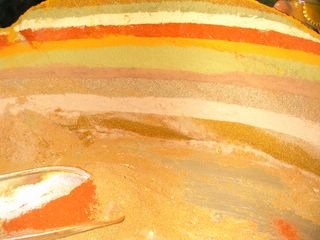
Advieh in the Arak bazaar.  Posted by Hello

Gloves

The secret of gloves
The secret of the gloves has finally been revealed to me!

When I first arrived in Iran, I noticed that many of the women wore gloves: even in the middle of the summer! This, I quickly deduced, had nothing to do with the requirements of the hijab. The women who wore gloves spanned the spectrum of religious dress. Some of the glove-wearers wore the full black chador and some a barely there scarf with a short manteau.

Were they, perhaps, germ-phobic, I wondered?

I asked several people. No one had an answer. And then, I filed my glove question way back in the recesses of my brain.

A friend of a friend was visiting. Her mother is Indonesian and her father is Dutch. It was her first visit to Iran. Immediately, she understood the secret of the gloves. "It's so that your hands are not ten shades darker than the rest of your arms." D'oh.

I quickly confirmed this with a brand new friend of mine who is a glove-wearer. "All I have to is go out into the sun for ten minutes, and my skin gets darker," she explained.

That should give you some info about how pale I am.
I changed the template...
Again. The other template reminded me of the time we took a copy of the US constitution, burned the edges, and mounted it on wood with shellac and shoe polish.

This one's not perfect, but I am too lazy for perfect.

Friday, May 27, 2005

Family Life

About families for San Diegan
I have written about family life off and on since the beginning of this blog. Family life in Iran can be summed up simply: heaven for children, hell for teenagers and young adults, resignation for the middle-aged… Old? Depends.

Children in Iran live in a particular children's heaven: they get sweets before dinner and are not put to be early when guests arrive. They are always part of the conversation. Cousins and friends are often underfoot.


In many Iranian families, the age differences are smoother than in American families (I am sure this is changing as families get smaller). Uncles and nephews hang out like friends. Sometimes I am a bit shocked at the bossiness of children here. But, what can I say?

A friend who grew up in England but lives here now and has a young son in school here tells us that at school Iranian girls are really disciplined, but the boys are totally out of control. Boys are allowed to do everything and that respect for elders is broken at the schools. That may be why the majority of university students are girls.

Iranians complain that the revolution has weakened their family bonds. "Brother cannot trust brother," Iranians tell you.

K's interpretation is a little different: "The revolution made people retreat into their homes where they got on each other's backs too much. They have nothing to do now except butt into each others' lives."

JeeGAR

JeeGAR
"I wish that the foreign journalists in Iran would try to find some new topics," K said to me last night.

"Like what."

"Like what they like about Iran."

"I like the spring," I told him. "Iran has the best spring that I've ever experienced."

It also has my very favorite dining experience: an outdoor seat in a parking spot, liver ("JeeGAR" in Persian) kebab, basil, lemon, coke, and fresh flat bread. "If you write about this, Iranians living abroad will cry," K tells me.

This may sound awful, but trust me, it's not. Our favorite spot is located between a butcher and a bakery which means everything you eat is fresh. It's a particularly popular spot for grandfathers and their young grandsons. Friends of the owner take turns at the grill. And you are treated as like royalty.

It's a bit like my favorite meal in Holland: the herring close to Iran's embassy in The Hague.

WTO Talks

W.T.O. to Start Talks to Admit Iran - New York Times:

"The World Trade Organization announced Thursday that it would start talks to admit Iran as a member, a reward for Tehran's agreement to continue to freeze its nuclear activities.

Mohammad Reza Alborzi, an Iranian envoy, said today that the W.T.O. 'has done service to itself by correcting a wrong.'

The decision came after the United States, in a small but important conciliatory gesture, dropped its long-standing opposition to Iranian membership in the organization, which governs global trade.

'It is a long overdue decision but it is a positive decision,' said Mohammad Reza Alborzi, Iran's ambassador to the United Nations in Geneva, in a telephone interview. 'We have a Persian proverb: 'A fish is always fresh, even if it is caught when you go fishing late in the day.' '"

Wednesday, May 25, 2005

Interview With Iranian Presidential Candidate - New York Times:

"Q. In the Arab world, the governments have good relations with the U.S. but their people do not like America. But Iranian people like the United States even though the government has bad relations with the U.S. How can you explain that?

A. Maybe one reason is the Palestinian issue which the Arab people have a greater sensitivity about and the other one is the situation the U.S. created in Iraq. The reason is because the U.S. supports Arab dictatorial regimes. But in Iran the U.S. has this serious problem with Iranian people as well. Those who express such interests say that the United States is an influential country with large industries, an advanced country with good products and these sorts of things. But there is a larger number opposed because of this hostile attitude of the United States."

Tuesday, May 24, 2005

Guardian Unlimited | Special reports | Khamenei orders election ban rethink:
"'It's appropriate that all individuals in the country be given the choice from various political tendencies,' he said. 'Therefore, it seems that [the] qualification of Mr Mo'ein and Mr Mehralizadeh [should] be reconsidered.'

Mr Khamenei's unexpected concession to reformists is almost certainly dictated by fears of a damagingly low voter turnout, leaving the clerical regime open to the charge that it lacks democratic legitimacy.

It may also be calculated to reduce the electoral strength of Mr Rafsanjani, the frontrunner, whose candidacy Mr Khamenei opposes. Despite calls for a boycott, many reform-minded voters were expected to vote for Mr Rafsanjani to prevent a hardliner being elected. Mr Khamenei is ideologically opposed to the candidacy of Mr Mo'ein, who has promised to release political prisoners and said he would consider suspending Iran's nuclear programme. He also regards Mr Rafsanjani as a potential rival.

Senior government figures have acknowledged that a high turnout is vital to reinforce the regime's democratic credentials in the face of US and European pressure for it to abandon its nuclear aspirations.

The wholesale exclusion of reformists risked deepening voter disillusionment, already widespread because of hardliners' systematic obstruction of the reform-minded programme of the outgoing president, Mohammed Khatami."

Sunday, May 22, 2005

Wrapped in plastic

Plastic wrapping
I took an inter-city bus ride this Iranian weekend. On the way out we saw a pretty dismal Iranian film, The Ziggurat Goddess, about a young man whose wife and child die in the attack on the WTC in NY. The only notable part was the ability of the documentary footage to make my heart beat fast and my breath short.

On the way back, we saw an equally dismal film: this time from Hollywood. Cutthroat Island was its name if anyone is interested. From my window seat, we had a great view of the flowers. Families were out picking berries from the trees that grow along the highway. At one point the wind picked up. A particularly resourceful group held a chador under a tree a let the wind do all of the work. The berries flew off the tree straight into the chador. It was brilliant.

Every new Peugeot we saw was still wrapped in plastic. The fenders, the seats, and the steering wheels were still covered in plastic wrap. Iranians love plastic wrap. Offices leave the plastic on their office chairs along with the tag. If something comes wrapped in plastic, it stays wrapped in plastic.
Reverse Engineering
K and I were watching the news the other night. Most nights, Khatami cuts a ribbon at some new bottling plant or oil refinery or similar manufacturing site. On this particular evening a group of mullahs were walking around an airplane in a manufacturing plant somewhere in the world. Iran plans to build its own aircraft, the happy announcer reported.

"They're probably reverse engineering a Tupolov," K said.

"They'll leave the plastic wrap on the nose cone," I responded.
Thanks for the comments…
You guys are great...

Monday, May 16, 2005

New template
Some of you may have noticed that I (finally) changed the template. Now you can actually leave comments, which, frankly, terrifies me. I am terrified that you will comment and terrified that you won't.

So, remember when you see all those 0s in the archives, that we only just today turned on the comment function.

A nation of philosophers…

Iranians still study philosophy and go to lectures. I joined them to hear some philosophers lecture at the gorgeous Philosopher's Institute in downtown Tehran. On the way, my taxi driver asked me: "Are Iranian drivers good or bad?" (This is the most common question structure: Is America good or is Iran good? Do you like your father better or your mother better? Is Iranian food good or is American food good?)

"If they were good, there would not be so many accidents in Iran, would there?"

"We drive badly because of the mullahs."

"So, the mullahs are responsible for your driving?"

"Yes. Get rid of them, and we will be better drivers."

"Do you really think so?"

"Why not? We Iranians are without law. That's because of the mullahs."

Was my driver a philosopher of an idiot?

One of the philosophers speaking tried to engage the Iranians in a discussion of the ways in which Iranian philosophy could be used in the West. Unfortunately, there were too many academics in the room so instead of engaging in discussion, they spent time showing off their knowledge and making points of their own. Get a few drinks in them, though, and I bet you can have some interesting chats…
Iran Daily: "Darvishi, a UNESCO Award Nominee
TEHRAN, March 13--Music Committee of the United Nations Educational Scientific and Cultural Organization's Tehran office has nominated Iranian musician and composer, Mohammad Reza Darvishi for UNESCO music award for 2005.
Head of UNESCO Music Committee, Mohammad Sarir told the Persian daily Hamshahri that UNESCO's prize this year focuses on music diversity, cultural rights and objectives that can increase the people's knowledge about strategies and principles that influence music diversity.
Famous personalities such as Dimitri Shostakovich, Leonard Bernstein, Elvieh Messian, Ravi Shankar, Herbert von Karayan, Tariq Hakim (from Saudi Arabia), Alim Qasimov (from Azerbaijan) and Mohammad Reza Shajarian (from Iran) were among the earlier recipients of the UNESCO award."

Saturday, May 14, 2005

Iran Ruling Frees Man Jailed for Poll on U.S.: "THE WORLD
Iran Ruling Frees Man Jailed for Poll on U.S.
From Reuters

TEHRAN — Iran has freed a leading political prisoner jailed for publishing a survey indicating that Iranians favored resuming dialogue with their supposed archfoe the United States, his lawyer said Friday.

Abbas Abdi was sentenced in 2003 to 4 1/2 years in prison for 'selling intelligence to the enemy,' referring to the poll, which found that three-quarters of Iranians wanted their country to have a dialogue with the U.S.

ADVERTISEMENT
But Iran's Supreme Court ruled last week that the United States was not officially defined as an enemy, and Abdi was released after 30 months in prison.

'This is an unprecedented ruling, because five senior judges, including a cleric, suggest the United States is not an enemy,' said Abdi's lawyer, Saleh Nikbakht.

Abdi was one of the student leaders who took dozens of U.S. diplomats hostage at their Tehran embassy in 1979 and held them for 444 days. Like many of the former hostage-takers, Abdi became a reformist advocating warmer ties with the West.

Washington severed relations with Iran in 1980 as a result of the hostage crisis, and any suggestion of talks with the U.S. is highly sensitive."

Friday, May 13, 2005

The International Book Fair

I twice visited the International Book Fair last week. I was one of hundreds of thousands of visitors. The fair was absolutely packed.

There were huge halls filled with books in English. It was a feast for a book-lover such as me. I wandered from stall to stall browsing the thousands of books on display. The most popular English books were definitely the art and design books. People were snatching them up.

Many of the books were academic, remainders, and technical. There was a dearth of novels. Most of the novels were by Charles Dickens, Jane Austen, and Shakespeare. I did see a literary critique of Salman Rushdie and about 30 books on Israel. All of them were published by reputable academic presses.

There were two stands that were noticeable for their total lack of visitors: one was the stand offered by Hamas and the other was a Jihad stand. In the two days I visited, I did not see one person visit either stand. In fact, people were walking as far from the stands as they could.

There were plenty of stands offering Islamic texts. They were busy. A stand run by a big Canadian with Suffi poetry and other Suffi texts was selling out. "Where was that guy from?" my Iranian friends asked me. "He was Canadian."

"Ehh…" they responded a bit shocked. "We thought he was Afghani."

"There are Muslims in Canada," I tell them.

Later we visit a stand run by a British Muslim who speaks very good Persian (but even better English ;) ). My young friends ask him several times where he is from "originally." They refuse to accept his answer tha he is British. Exasperated, he responds, "Not all British people are white. Many of them look like me."
Talks with Taxi Drivers, Part 115….

Well, I have been lazy. It's one of the drawbacks of "going native." I have written about this before… Things no longer seem strange to me.

I have even commented that the driving habits of Tehranians have gotten much better. Then I got into a taxi with three touring friends. At one point the driver pulled a standard move: pulling out into moving traffic in order to make a left turn. It was clear to me that we would not be hit, but our three friends all flinched and yelled in fright at the exact same moment. Is it possible that driving habits have not improved at all?

A friend tells me there were 26,000 traffic deaths last year. That would mean that, in fact, driving habits have not improved in the least.

"You foreigners should relax," a driver tells me when I ask him to slow down. "We know what we are doing."

"Hey," I respond, "you guys still have the highest accident rate in the world. Maybe it's time you became a little less relaxed."

***

Another driver asks me when Bush will come to Iran? "You don't really want him here," I respond.

"I don't want him to attack us, you're right. No one wants a foreign power to attack their country. But I do want him to visit us."

***

K and I are waiting for a taxi when a young woman pulls over. "I'm going to Valiasr Square she tells us. Do you want a ride?" This is not uncommon in Iran. People often pull over to give foreigners a lift somewhere. They feel sorry for us.

K and I hop in. We thank her. "We wouldn't want your wife to have a bad experience here and write a book," she tells K. We all laugh.

It turns out she is studying English so that she can apply for a visa to Australia, get citizenship there, and then try to get a job in America working for Industrial Light and Magic.

***

"How did Bush manage to become president again if Americas hate him so much?" a driver asks me.

"Who do you think the next president of Iran will be?" I respond.

He laughs. "Oh I get it."

***

K is sitting up front chatting with a driver about politics. The driver is going on an on about how evil the British are. At a certain point he turns to K and says, "Your wife's not British, is she?"

I laugh. "It's a little late to ask," I respond in Persian. The poor driver is shocked. "Your wife understands Persian," he says to K.

"Yeah. Some say that she understands more than I do," he responds. "But don't worry, she's not English."

When we pull up to our house, the driver says, "Make sure to tell Americans how much we like them. Iranians love Americans. We have no problem with the people. It's just our two governments that have problems."

I promise to pass on his message. I even put it in bold.

Thursday, April 21, 2005

TV…
The only thing entertaining right now is football. There was a serial that ended a few weeks ago that featured a trio of do-gooding Iranians driving a truck filled with medicine to Iraq. On crossing the border, they get arrested by the Americans (many of whom are played by black Iranians) who claim that they are terrorists who are transporting guns. There are some funny scenes, but the basic message is: Americans are stupid and mean and culturally insensitive.

In conversations with the man playing the Iraqi translator, the translator asserts that the Americans are responsible for the violence between Sunnis and Shiites and that they are all brothers.


Iraq Chief Says a Mass Killing, Under Dispute, Did Take Place
Polar Express
Our DVD guy was arrested. I've never met him, but we have to find a new source for films.

We can buy cartoons, so I bought Polar Express. Just as I was warned by countless reviewers, it was indeed a horror movie. You've got these kids traveling with some weird guy on a train with a ghost and then you end up in the North Pole, which is actually world-war 2 era Europe. The elves are all dressed alike in red. They are the subjects of a dictator: Santa Claus. It is unclear whether he is a benevolent dictator or one who rules through terror.

His appearance is attended by hundreds of thousands of red-clad elves who are what? Nazis? Facists? Islamists? Government employees? I am not sure. I am reminded of the huge Death to America rallies that take place during revolution-week and the thousands of black-chadored women marching with their fists in the air. It is not all that different looking.

The appearance of Santa Claus causes awe, but it is hard to tell whether this is because the elves like him or because they fear him. Even the party they throw to "celebrate" Christmas eve seems forced. It's as though they have been ordered to have fun. "Have fun or lose your job!" It's a little bit like forcing people to vote. The turnout is high, but the participation is low.

Well, merry Christmas.

Friday, April 08, 2005

Religion as law…Opinion as fact
It has been some years since I lived in America. In all that time, I have been unwilling and incapable of becoming an expatriate in the sense of how I have seen it lived by many expatriates: as knee-jerk anti-Americanism. When listening to their anti-American rants, I have often felt that it is much easier to count the sins of a nation/people than its virtues. Not that I want to close my eyes to the mistakes, injustices, and even evils of my nation/people, no not that. I just cannot close my eyes to its virtues. I cannot close my eyes to the idea of America as an unfinished project rather that as something complete, dead, and defined. As a child I struggled with conflicting views of America: one that saw America through the eyes of the Viet Nam war and one that saw America through the eyes of my immigrant relatives. I struggled to reconcile these conflicting views of America and was able to. As a result, my understanding of America is complex. I can never relinquish my American identity. It is not an identity that I shrink from. This does not mean that I am always proud of it or uncritical of it. No. It means that it is mine, and it is complex, and I will not disown it. I have been proud and amused by the way American ingenuity is so touted by us. I guess the real ingenuity is giving so many of the world's population opportunities to invent, work, and study. That has been our true ingenuity.

That said, I feel that my identity is under attack. Will my Americanism become a relic? Will people find me out of date, quaint even? Are free press, free speech, immigration, religious freedom, and the separation of church and state all coming under attack?

I have a friend here in Iran who is brilliant in his field but cannot complete his studies here because somebody (or bodies) has determined that he is not Islamic enough. Iran is a country that has shown itself willing to lose most of its best and brightest to the rest of the world: all in the name of ideology. America, having become wildly paranoid since 9/11, will no longer issue visas to these people. Trust me, they will go elsewhere. When they do go elsewhere, America will suffer.

My religion is a minority religion in both the US and in Iran. I do not want to live under the religious rule of either. I do not want them to live under the rules of my religion either. Why would I? When religions rule, they set themselves up as superior to civil law and other religious beliefs. Many Muslims believe that they should only do business with other Muslims. Many Christians believe the same. (To be fair, other peoples and religions believe the same, but I am only addressing the dominant religions of America and Iran.) This is how they interpret their religious mandate in the world. Disrespecting the wishes and even the legal protections of others is acceptable under religious rule because the ruling interpretation of God's word is more important than anything else. And that is key: interpretation. Law is always subject to interpretation. Proponents of religious law, however, can always claim that God is on their side which essentially means that you must bow to God's word. The ruling interpretation of God's word often needs to combine their interpretation with violence in order to enforce their ideas. After all, violence is acceptable with God on your side. We've all seen it.

When I was nine or ten, I heard a story from the Talmud about a group of Rabbis arguing about a law. One of the Rabbis argued that God was on his side and that he could prove that by performing a series of small miracles. None of the miracles was enough to convince the other Rabbis that their reasoning was incorrect and that they should change their opinion so that it was in alignment with the opinion of the Rabbi who had God on his side. In the end, God approves of their dissent. God says, "The Law is not in heaven."

Law is subject to change and interpretation.

Monday, April 04, 2005

Happy Sizdeh Bedar
On the thirteenth day after the New Year, Iranians go out for a picnic. I mean, just about everyone in the entire country goes outside to play badminton and eat a picnic lunch. It is the most amazing holiday. It is fun. It is peaceful. It is delightful. It is nicer than you imagine.

We picnicked with a group of foreigners, which means we had cold food. Most Iranians cannot imagine a cold lunch. They bring gas burners and kebabis with them so that they can eat stews and kebabs, and of course, the all important: hot tea.

Note to America: please do not attack Iran. It won't work. Iranians are nationalists… just like us. As a writer in a recent edition of the Economist (print, read in the back of a taxi, sorry no direct quote) wrote: with notable exceptions, Americans of all political stripes are pro-American. Get it? We may hate our administration at any given time, but we would band together if attacked… Am I right? That said, how many Iranians do you know who, when pushed, do not share a similar feeling about Iran? Attacking will strengthen the current group in power, not weaken it.

Happy Sizdeh Bedar.
Here is a correspondence between me and Hooman of Whoman. I decided to respond to his points in this blog. Then I found that I could not exactly argue with his points because in many ways he is exactly right. The only thing I will not give up on is the idea of change. K says, "Iranians take a long time to decide to change, but once they do: they do." I'll let Hooman speak for himself. Maybe one day, I will respond in detail.

Your blog remains a fresh breath of air. I enjoyed your last post, that's perhaps why I am writing to give some inputs although I don't know if you are interested in having any.

"Iranians are smarter about the world of politics than I am."

Don't be so sure of that. Iranians (specially older generations) usually brag about their political "insights" and flaunt them. As you know it is a pastime among many to talk politics with a spin that Don Quixote would have used.

I think Iranians waste a lot of their creative energy and vision by fighting their own windmills, dreaming unrealistic dreams, and an evasive culture (that you touched on in a later post). They would be better off if they kept their head out of the sand instead of burying it in there.

The fact is that their political remarks are not well-thought out or well-researched with solid evidences to back them up. They could be equally wrong as they could be right on specific topics. It is not that hard to be correct 50% of the time when things are hazy and uncertain.

"Iranians have an open and resilient culture that is unbelievably open to change."

I can agree with resilience of the culture, but open? I am not so sure. The downside of this resilience is that every time the culture bounces back up, it ends up having more cues and formalities added to otherwise simple interaction of people. Evasiveness and its burden on the culture have built up this way in the course of time.

Monday, March 28, 2005

Fires, visiting, new year's tv, and the latest fashion news

Fires
The last time I wrote, K and I were on our way to search out the best fire-leaping district. We walked for 2 ½ hours and saw a few boys lighting firecrackers, caught site of some private bonfires, and got sore feet. We returned to our neighborhood only to find that we were living in Chahar Shanbeh Souri-Central. In our small neighborhood, there were several bonfires. Our tiny street (2 whole blocks) featured 3 or 4 bonfires. The whole neighborhood was out: from newborns to one-foot in the gravers. Young men were dancing in the street. There was music and singing. I didn't know we lived in such a happening place.

It was so wonderful to see Iranians having fun in public. Fun is such a great thing. I feel pretty red after a night of fires and dancing.

Fashion
The next day, we flew south and joined millions of Iranian tourists visiting Kouzestan's spring. Ahwaz's river was so high that it reached the stairs of the Hotel Fajr. Flowers were everywhere. Women were in their new manteaus: short, salmon, and tight. Southerners were wearing these tiny little scarves woven with metallic threads. Every other young woman seemed to have one. So, last year the new scarf fashion was a shawl that let your bangs show and the back of your pony tail. This year's seems to be an oversized handkerchief that can just be tied under your chin and shows even more of the back of your hair than the shawl. Pretty soon we'll be wearing skull caps.

Haven't seen too much fashion back in Tehran yet, but then, no one is here.

TV
TV is much better during the New Year's holidays than it is during religious holidays. There's a pretty funny serial on now that features a pizza parlor, a Mercedes, several goofy men who end up in and out of jail for a series of misunderstandings, and silly women. We've been enjoying it.

There is a campy tv game show with a series of silly feats that feels like it must have been borrowed from Japanese tv. I find it pretty funny. People seem to either love it or hate it. K is in the second camp. I am in the first. There is also an Iranian version of the Weakest Link. Anyone who has ever seen Ann Robinson tear apart the contestants of the British version of this game show would be amused by the Iranian version. While Iranians are capable of making insults, those insults are subtle and require a pretty thorough understanding of Iranian manners in order to be understood. Mostly, Iranians are so unfailingly polite that the type of insult that is the hallmark of the Weakest Link is impossible for them. Every time someone loses, the host politely wishes him luck and says something cloyingly nice.

Here is a sampling of the movies on Iranian tv: Whale rider, Troy, Shanghai Knights, The Inlaws, Lord of the Rings (parts 1, 2, & 3), Antz… The only movies that don't get heavily censored are the movies with casts of men or cartoons. This means most of the movies worth watching are violent or cartoons. The only time I have seen real men and women touching on Iranian tv was when they were fighting. If they had been hugging, that would have been cut. Sword through the belly, okay. Man and wife showing affection: cut!

We saw our fair share of satellite tv during our multiple New Year's visits. Most people were watching Tapesh 2 or PMC: both of which feature mainly, but not solely, Iranian music videos. For the most part, the videos suck. Most of those shot in California seem to be shot at the same location. The men wear all white or all black, have no style, and have forgotten how to dance. (Iranian men are great dancers!) Mostly naked women dance in the background. The other type of video features a stage with flashing lights. Everyone's favorite videos were: Kamran and Hooman singing Toro Micham, Arash singing Boro Boro, and a woman (what was her name?) singing Mirdamad.
Coming soon... Norooz holiday report: until then, Ted Rall's "Guide to Zoroastrian America"
Yahoo! News - Ted Rall
The New York Times > Magazine > The Security Adviser: Is a State Sponsor of Terrorism Winning?:
"Yes, Iran, the nation the Bush administration calls the greatest state sponsor of terrorism, is having some good days, largely at our expense. In the 1980's, Iran suffered an estimated one million casualties in a seven-year war against Iraq. From Iran's perspective, the purpose of the war was to place Iraq's majority Shiite religious faction in charge, to unseat Saddam Hussein, to protect the Shiite holy places and, perhaps, to get its hands on Iraq's vast oil deposits. The costly war ended in a draw, after the two sides exhausted themselves. Seventeen years later, Iran has now achieved three of those four war goals, thanks to 13,000 American casualties and scores of billions of American-taxpayer dollars."

Tuesday, March 15, 2005

Wow, it's been more than one year

"Our friends are all asking when our crazy daughter is coming home," my mother tells me.

"And we say, 'which crazy daughter?'" my dad chips in.

"Tell them they can call me crazy to my face. I will just laugh and agree with them. I won't even get offended."

You want to hear the craziest thing? There are things I really like about living here. Yes, there are things I like about Iran. Iranians seem to think that I only write about the negative aspects of life here. Not true. (To be fair, Iranians outside of Iran think I'm pretty positive…)

Living in Iran means that you get sucked into all of its attending neuroses: depression, passive aggression (or 'tarof'), uncertainty, indecisiveness, etc… Like others here, sometimes I get overwhelmed by uncertainty and depression. Sometimes I am paranoid; sometimes I am desperate; often I am frustrated. I am never bored; I am often amazed; and sometimes I am dazzled.

The two things that dazzled me most this year were these: K's cousin playing the drum while his brother-in-law sang and the capacity that Iranians have for change that does not compromise their core identity.

The first represents one of the unexpected pleasures of life among Iranian culture anywhere that I have experienced: unexpectedly some banker or engineer will start singing in a beautiful, clear voice while another plays the traditional drum or traditional stringed instrument. (Sorry their proper names escape me.) This year I have cried as K's sister sang folk songs she learned from their parents and been overwhelmed by the quality of amateur musicianship.

The second is connected. Iranian culture is open and changeable while retaining its essential identity. Oh the change I have seen in one year… Possibly much of the change is internal. Possibly I have become a keener observer, a more nuanced observer. Possibly I things have changed as much as I think they have.

I can't quite describe the changes in this post. It needs time. I will be attempting to describe these changes in my next few posts, but don't expect too much in the next couple of weeks…
Happy New Year
K and I always joke about the number of new years we get to celebrate. My favorite one is Persian New Year. Here are its advantages:
Timing: I mean, who can beat the Spring equinox for a new year's celebration?
Timing again: Iranians and other Norooz celebrants all over the world celebrate the New Year at the same moment: the exact moment of the equinox. It's comforting to know that families in Los Angeles are cheering in the New Year at the same time as families in Tehran.
Haft Sin (Seven "s's" – sounds like some new fangled management theory right?): Iranians put out a table covered with all sorts of things beginning with "s." These items represent common new year's themes including renewal, wisdom, health, and prosperity. You usually see a goldfish, sprouts, pudding, coins, eggs, and other items. I love the table. It's beautiful.

Tonight, bonfires will be lit all over Iran (and California) and people will be jumping over them saying: "Give me your red and take from me my yellow." (The symbolism is so obvious that it would be silly to explain.) I plan to make my leap as well.

For the next month, Iranians will look so spiffy in their new clothes, the streets and buildings will shine because they are so friggin clean, and Tehran's air will smell like flowers instead of smog.

Happy New Year all.

Monday, March 14, 2005

The draft

When I was much younger and less nuanced and against the draft, my mother said to me: "The problem with getting rid of the draft is that the military is then made up of people who *want* to be there." Or people with no other options, I would add now.

Now my mother might add that another side effect of having no draft is that most people don't know anyone in the military.

Iran has a draft. Wealthy people can buy their way out of the draft. College graduates have a fairly simple run of duty. Non-graduates, like everywhere, get stuck with the brunt of the service.

A young friend of ours will enter the military just after Norooz (the Persian New Year).

Our young friend is brilliant. He can brag that he is been arrested for cavorting with the opposite sex (a badge of honor among young Iranians since it is becoming more and more difficult to get arrested for hanging out together). He is handsome. His English is wonderful. He is friendly and a fast learner. He goes to movies. He is secular. He lifts weights. He gains weight. He loses weight.

He is normal. He is comfortably middle class which means that his family does not have enough money to pay for an exemption. He did not make the right choice of study when he entered university and as a result lost interest and dropped out. It's not a simple manner to change majors in Iran. And now, he's stuck with serving out a full-term in the military.

The point I am trying to make is that in countries with a draft, the military is made up of people you know. They are not strangers. They are your friends, your family, and the sons of people you know.
Another book to read: The Persian Puzzle

The Persian Puzzle: An Interview With Kenneth Pollack
As far as regime change, I think you need to look back at Iran's history. First off, regime change is coming—it's clear that the Iranian people generally want a very different form of government. It's coming very slowly. Most Iranians are sick and tired of revolutions. They've had one for the last 25 years, and they don't want another one. Those who've tried to spark another revolution have failed time and again. I don't think there's any evidence that somehow, if the U.S. gave these guys the high sign, it would make regime change somehow more likely. Every time the U.S. has tried to interfere in Iranian affairs to help a particular group of Iranians, it's backfired on us, and hurt the group we tried to help. Look, regime change will eventually happen, but this isn't an answer to the very short-term problem of the nuclear program.
Interesting interview... must read book: Lipstick Jihad
Lipstick Jihad: An Interview With Azadeh Moaveni

Yes, I think this is the biggest difference between the US and Iran -- how honesty is interpreted. American culture is incredibly forthright. There’s this premium on telling it like it is and being frank. Iranian culture, and Farsi, the language, is really evasive; it has all these rituals and cues and formalities in how people deal with one another.

I think evasiveness took on a whole new meaning after the revolution. You suddenly had Islamic conservative values governing how society was run, which pushed a lot of things behind closed doors and under veils and chadors. Private behavior became much more weighted.

I write in the book about eroticization. It’s not explicit, ever, but the emphasis on covering and the hidden and forbidden was sexualizing because everyone was very preoccupied with that. Nothing about how you conduct your private life is at all apparent from the way you look to everyone else. Evasiveness, privacy and eroticization all came together in the post-revolutionary culture.

Saturday, March 12, 2005

Norooz, fires, fireworks, and satellite dishes
About three nights ago, the chief of police appeared on television to announce that the police will no longer break up the celebrations that occur on the last Tuesday before the new year. On the last Tuesday before the new year, Iranians (and other Norooz –“new day” – celebrants) light small bonfires and jump over them while shouting: “Take my yellow from me and give me your red.” It is a wonderful celebration that I enjoyed on the beaches near Santa Cruz. The chief announced to all Iranians that the police would view this as a cultural celebration and do what they could to keep it safe and help people enjoy it even more, rather than breaking it up. He went on to announce that the police would no longer raid people’s homes looking for satellite dishes.

Iranians have an open and resilient culture that is unbelievably open to change. (I plan to write a post on this soon. So watch this space…) This is not a static culture or static society. Don’t let the nuclear issue become more important than a true understanding of Iran and Iranian culture. Pay attention, folks.
Long time, no write…
Even longer since I started this post…

So… a lot has happened: Ashura, UFOs, better relations with America, and a resumption of uranium enrichment. What’s that you say? Better relations with America? ( Read between the lines…) Worse relations with Iran? That too. Iranians are sure that America plans to attack.

Iranians are smarter about the world of politics than I am. “Iranians have political brains,” one older friend told me. “Americans are much simpler.”

When the Iranians I know say that Americans are simple, they mean it as a compliment. Elaine Schiolino writes in her book Persian Mirrors that it is meant as an insult. Well, maybe it was, and maybe it is. In fact, I am sure it was and is. I do, however, believe that it is becoming a compliment. Iranians of all stripes seem to find American simplicity refreshing. “It’s so easy to work with Americans,” a nationalist Iranian tells me. “They say something, and they do it. They tell you what they can and cannot do. Everything is so straightforward.” (They are not speaking about our politicians, mind you. They are also clearly not speaking about many of our CEOs.)

“I find so much more common ground between American culture and Iranian culture than between Iranian culture and the culture of Europe or Asia.”

“For instance?”

“Americans are religious. They understand religion. When I go to Europe, they think I am backwards because I am religious. Americans understand that. They don’t find it odd.”

Will America attack Iran? Has Iran purposely screwed up nuclear proliferation negotiations with the EU in order to get America to participate in the discussions? Their chief negotiator is busy insulting the EU representatives, saying things like they cannot make up their mind without crossing the Atlantic.

Today (well not today anymore) I received an email with an article from Ray McGovern that concerned attacking Iran. Well, all options are on the table, aren’t they? Listen carefully, I will only say this 10,000 times, Iranians need to clean up their own mess. The regime will not change if America attacks. It will get stronger. (Am I wrong, or didn’t we just fulfill Khomeini’s prophecy that Iraq would become an Islamic state if Iran refrained from taking Baghdad itself and left it for the future? What do you think would happen here?)

Iranians worry too. “It is always people like us who suffer in war,” a friend just told me.

I try not to worry, but I worry too. I do not want to see war. I do not want the people I know and love to be bombed. I don’t even want to see people I do not like bombed. That’s what a sissy I have become.

As usual, the Onion has the best analysis:
(http://www.theonion.com/news/index.php?issue=4110&n=0&ref=myy)

Wednesday, February 16, 2005

Snow, internet…
There was a lot of snow here in Iran. Northern Tehran looked like a Christmas postcard with the evergreens covered in white snow. I associate the snow with my Internet problems, but that is probably not fair. It’s probably the new restrictions on internet sites that are causing all of the problems. The same thing happened last year when the government tried to forbid free internet use. In the end, they relented somewhat (not 100%). I mean, even extremists need to do business over the internet.

They turned off the gas for several days in parts of Tehran. People did not have heat or hot water for several days. Iran does not have enough gas to go around. They ran out. “The government’s first priority is pocketing the money from gas sales,” a fellow taxi passenger complained. “They don’t care about us.”

Who knows if it was the lack of gas that led to the tragic fire in one of Tehran’s oldest mosques? Sixty people were killed when something fell on the oil-burning heater in the women’s section of the mosque. The word in the taxis is that it was not an accident. “There was an explosion. It was a bomb,” a driver explained to us.

“I have a friend who works next door. He heard the explosion. It was a bomb,” my fellow traveler agrees.

I am sure it was an accident.

“After 26 years of hearing their lies, how can we believe a word they say?” Our driver said. (Everyone knows who “they” is, right?)

“I don’t hear them,” I reply.

“You’re lucky that you have not spoken our language for the last 26 years,” our driver laughs.

K’s TV rant
“Take a hot shower now because who knows when our gas will be turned off,” K said. “But you’ll notice that we always have television. That’s because the government doesn’t want us to forget them: it’s all mullah, all the time. This is Iranian tv: flower, flower, waterfall, bird, mountain, flower, river, butterfly, mullah, water, mountain, sky, mullah, flower.”

“Don’t forget crying,” I added.

The Islamic month of Moharram has begun. This is the month that commemorates Hossein’s martyrdom, which means that the crying has begun all over again. The television is filled with men crying. One tells the story. The others cry. Last year, I was mesmerized by the occasion. The singing and stories can be so beautiful. Unfortunately, most of what is shown is so filled with bathos that your gut reaction is that you are watching comedy. That said, our neighborhood has one of the best azans (religious singers) that I have ever heard. I am looking forward to following his group as they march through the neighborhood.

You know all of those months we have: national dairy month? Hispanic heritage month? Kite flying month? Etc… Imagine if the only entertainment you had during those months was from your grade school teachers, earnestly trying to get you interested in these months with filmstrips and activities? Do you have that picture in your mind? Okay, that’s Iranian tv.

Saturday, February 12, 2005

Fajr TV
It’s been a week of revolutionary tv punctuated with French spy movies. Two days ago I was channel surfing when I caught sight of chanting masses with their red, blood-covered hands lifted high in the air. My stomach turned as I remembered my friends’ stories of being beaten during the marches. I could not see the red hands without imagining them at the other end of the blood.

Later in the week, the day before the 26th anniversary of Khomeini’s arrival in Tehran, channel 2 showed a documentary about the revolution over and over again. The scenes look like a French film from the 70s. Most of the men are wearing flared pants and sporting big, thick mustaches. There is something touching and heart-wrenching about the documentary. The people in the streets are so excited, so filled with optimism and enthusiasm. The shah looks so sad and filled with regret. It is somewhat painful to watch this documentary. It is different from most of the other clips they show of the revolution. Most of the others are carefully edited to show only the Islamic part of the revolution. The documentary shown on the day before the anniversary is quieter and less contrived.

“Khomeini’s speech on arriving in Iran is now forbidden,” I am told. Many of his writings are also forbidden.

Those serials I wrote about earlier: the ones that portray the time of the shah… Remember those? K has forbidden anyone to watch them in our home. “The way they portray Jews may be ridiculous,” he tells me, “but the way they portray women is just nasty. They turn women into monsters who only care about money and control. The men are weaklings who are manipulated by the women.”

“They want you to think that in the time of the shah, women controlled everything,” his sister comments.

Another serial we don’t watch.
Yes Virginia, there is a snowman
Iranians build snowmen too. There is more than two-feet of snow in our garden right now, and it’s still coming down. Our neighbors have snowmen in their gardens, and their kids are out right now having snowball fights to celebrate a snow day! Hurray!
Men wander the streets with shovels offering to shovel roofs, sidewalks, and driveways. They can earn more shoveling snow in a couple of hours than most Iranians do in a day.

The mountains are white. The sky is white. If you drive 15 minutes down from our house, the snow turns to rain.

The little stores have run out of deli-meat and baguettes: emergency cold-weather food.

It’s great here. I love snow. But it does interfere a bit with out internet connection, which is why this is a few days late. Still, the snow is still coming

Wednesday, February 02, 2005

Tuesday, February 01, 2005

Speaking of Geography

Perhaps the Persian Gulf is not really the Persian Gulf... The other day I saw a poster abvertising a conference located on Kish Island in the Persian golf.
It’s the 26th anniversary…
…of the revolution in Iran. Twenty-six years. The television is filled with revolutionary footage, which is interesting because the footage never shows men and women together, and I know they marched together, or uncovered women, and I know that most of the women marching were uncovered. The revolution-related soap operas portray Shah supporters as greedy, ridiculous, clueless, and, in many cases, Jewish. “I never watch the revolution serial,” a friend told me. “It’s always ridiculous.” Every revolution needs its photo, film, and history editors who assist in re-creating events that did not exactly happen, doesn’t it? Don’t trust history you learn in school or in the movie theaters is the lesson here.

Which reminds me, I read little paperback called The Revolutionists about America’s own revolutionists. It was like reading a manual for the Iraqi insurgents (who should, by now, realize how slim their support is among Iraqis themselves) with its stories of Samuel Adams and the Sons of Liberty whose main activities seemed to be inciting the British troops to violence and creating martyrs who could gain public sympathy.

It seems that public sympathy for the Iraqi-based insurgents is pretty god-damn slim. Millions turned out to vote despite the fact that their lives were credibly threatened and many were killed. Think of that the next time you consider sitting an election out because it is raining.

The Iraqis in Iran were, by reports, positive. They were excited to vote and photos in the newspapers here showed genuinely happy men and women casting their votes. In interviews with Iraqis here, they said that they wanted American troops to stay in Iraq. The Iranian government says that it wants the American troops to leave and shows nightly images of the dead and dying in Iraq along with text that says something like: “Democracy American Style,” the Iraqis in Iran want the troops to stay, and Iranians want the Americans to invade Iran.

“Look,” an Iranian tells me, “if Iran and America did not have something going on under the table, then why is Karzai in Iran? Why are our relationships with Afghanistan improving?”

The nightly news showed pictures of Karzai and Khatami signing an agreement to build a new highway between the two countries. “Oh, so now it will be even easier to smuggle drugs into Iran,” I commented.

“That’s what everyone is saying,” said K.

There is no sign of improvement in the official communications between America and Iran though. Seymour Hersh’s article about covert pentagon operations aimed at discovering hidden nuclear sites in Iran made the news all over the country. The day after I read his article in the New Yorker, I was at a gathering with some pretty influential Iranian businessmen who told me how happy they were that relations between our two countries were improving. “That’s not what I hear,” I responded. To which one responded: “Don’t read the news and don’t connect to the Internet and don’t listen to any official pronouncements.”

I laughed.

Thursday, January 06, 2005

Paper play

I learned a new word today. The word for bureaucracy in Persian translates literally to “paper play.” Okay. What could be more pleasing than that?
The Persian Gulf
In an issue that united Iranians of all stripes (http://hoder.com/weblog/archives/012895.shtml) and was a constant feature of nightly news here in Iran, National Geographic changed its mind and has decided that the gulf we all know as the Persian Gulf really is the Persian Gulf and not the Arabian Gulf.
The New York Times > AP > International > Iran Celebrates Cartographic Victory: "Iran claimed victory after it learned that National Geographic had revised its world atlas to highlight the name ``Persian Gulf'' over the alternative ``Arabian Gulf.'' But the U.S. cartographer said such revisions are common.

Iran had said in November that it would ban from its territory new edition of the atlas, as well as National Geographic journalists, until the map for the Gulf region was changed. It objected to the eighth edition's printing the term Arabian Gulf in parenthesis beside the more commonly used Persian Gulf."
For Whoman
(I am sorry that Whoman is feeling less opinionated now, but I, for one, do not see this as a barrier to blogging. Why should it be?)

What I really wanted to write for Whoman was that it has been a snowy winter here in Tehran. While the snow has yet to stick on the streets, it is sticking in the mountains which are this incredible white with black rock sticking out here and there. When the pollution clears, Tehran is stunning. The skies are a bright, bright blue. The mountains are etched into the sky with whiffs of snow blowing off the peaks. Wow.

Unfortunately the pollution is horrid this winter. Everyone prays for rain, snow, and wind so that they can have one or two clean days. When there is no “weather,” we have these incredibly yellow skies combined with the overpowering smell of ozone. The government actually closed down schools and auto repair facilities for one day in a mostly successful effort to bring the pollution down.

Monday, January 03, 2005

Catch up
It’s hard to believe that there was an earthquake the same day as the one in Bam, which made me think of a panel from Art Spiegelman’s comic In the Shadow of No Towers [Not a link to Amazon: a link to a bio page on Spiegelman with some actual drawing samples]: Waiting for the Other Shoe to Drop. [Go to the bottom of the page to see the panel I am thinking of.] Well the other shoe dropped, and it was much worse than the first. The earthquake in Bam started with reports of 80,000 dead and edged down to 26,000 (still a lot). The earthquake in Sumatra started with 500 dead and leapt up and keeps leaping up.

Iranian television news reported that Europeans were celebrating New Year’s and spending millions and millions on fireworks in the face of this catastrophe. I saw the images and said, “Pretty lame fireworks this year: clearly not professional.” K was outraged, “You see how they twist everything to their own advantage,” he sneered at the hooded newscaster. The next day I read this article in the Guardian:

For Sweden's prime minister, celebrating New Year's after the devastating earthquake and tsunami in Asia felt ``completely wrong.'' Paris draped black cloth along the Champs-Elysees. Elsewhere, prayers substituted for parties in the final minutes of 2004.

Even for those far from Asian and African shores where the giant waves killed more than 120,000, the disaster was too overwhelming for a carefree leap into 2005.


Iranian television has been peppered with Christmas commercials. Some of the shopping areas have Christmas trees up and Santa displays. I predict a full-blown Iranian celebration of Christmas within ten years. Why not? It’s just another one of their prophet’s birthdays. It is easily adjustable to Islam by taking out the whole son of God thing.

Speaking of Christmas, a few nights ago a mullah gave a sermon on television preaching against discrimination against other religions. Judaism and Christianity are part of the continuum, he told viewers. They are equal to Islam. (This was reported to me second-hand.)

Much of the Western view of Islam would have you believe that there is a monolith of belief in the Islamic world and that that belief is antagonistic to any other religion or culture. There is no monolith. There is no one source of interpretation. There is critique (at least in Iran… I cannot speak for anywhere else.) Iranian television is filled with the critique. Iranian society is even more filled with it. There is no monolith folks. Plus, it seems to me that much of the critique has to do with culture and not religion. (Save this thought for another post…)

One question: if, according to reports in the New York Times (okay, so I cannot find the link, so sue me), the American media does a piss poor job representing the depth of religious thought and diversity in America (Sharpton vs Robertson in a religious debate comes to mind), why would you even pretend to believe that they could accurately present the debate within Islam to us?

Tuesday, December 28, 2004

The military police

This is something that I have wanted to write about for awhile: the uniforms of the Iranian military police. They wear these outfits that look like they were designed for the Tintin cartoon strip. And the worst part of it is, they know how frigging silly they look. It’s clear that they are embarrassed by their uniforms. The worst part of the uniform is their white boots. In combination with their red hats, they become doubly silly looking. The young men slink in their uniforms. They appear as though they are trying to make themselves smaller. They look like they *know* they have “kick me” signs taped to their backs that they are not allowed to remove.

They are out in force these days assisting the traffic cops with their efforts to improve the driving habits of Iranians. Today, as I strolled to do my shopping our corner was just filled with these guys. There were three of the guys in the silly uniforms looking with envy at their colleagues, the traffic cops, in their sleek black boots, shiny black jackets, and helmets. One of the traffic cops had a microphone on and was urging drivers to follow basic driving etiquette. When a motor biker zoomed through a red light he called, “Hajh Agha, Hajh Agha!” (Mr. Hajh – doesn’t really translate well). The biker paid no attention. Those calls were joined by, “Faster! Move on! Drive on! Stop! Make your turn!” and other helpful hints.

Just to ease your mind… I’ve been told that Iran is getting new uniforms for the military police. (I don’t really think they are the military police, but Iranians tell me they are.)

Wednesday, December 22, 2004

Finger across throat, slide to the right

Most Iranians I meet are really curious about Americans and the way Iranians are perceived by the outside world. If you’ve been reading any part of this blog, you know that. I tell them that most foreigners do not know the difference between Iran and Iraq or between Arabs and Iranians. This surprises and upsets them.

“I watch an American movie almost every night to learn more about your culture,” one bearded man told me recently.

“Then I don’t think you’ve learned much about my culture,” I answered.

He continued, “That’s how I know you do not have the problems with poverty that we do.”

“We do have problems with poverty,” I told him. “We have 40 million uninsured people and one of the lowest health care standards in the developed world. Our poor are fat because fast food is cheap. Iran’s poor are healthy looking because nutritious food is cheap here.”

“That’s true,” he answered.

[I am always amazed at how healthy looking Iran’s poor are. Fast food is still a luxury here, and it is expensive. Many fruits and vegetables are cheap in Iran. Only the rich can afford to be fat in Iran. For less than the price of a Hardee’s Burger, you can have an excellent meal. Meat is expensive. Greens are cheap. Case in point: herbs. Iranians eat tons of fresh herbs. For about 50 cents they can get a gigantic bunch of mixed herbs. The equivalent would cost us about $20. I am always scavenging and saving herb scraps that Iranians would throw away. They think I’m weird.]


The man continued by telling me about family he has in Germany. “Their neighbor is a German woman. She is a good friend to my brother’s family and visits often. She loves my brother’s family, and they love her. Recently they asked her to come visit Iran with them. She said no. When they asked her why not, she answered [the throat-cutting gesture: finger across throat, slide to the right]. We were so disappointed that she felt that way about us.”

[Another reason that poor men look especially good in Iran is that they cannot afford to be fashion victims. Young Iranian men have a pathetic sense of style (sorry boys). They use way too much hair gel and shape their hair into bizarre shapes. They sport odd shaped facial hair growths, cell phones, pointy shoes or converse tennies, and wear American logo-wear --- most of it fake. Poor men can’t afford all that shit.]
The University Directors…

…Are frustrated and angry. This is no secret. This is taxi-talk, man-on-the-street talk, tv-talk, Khameini-talk.

In one car our driver said: “I was watching tv, and I could not believe it! There was a meeting with the directors of all these universities and Khameini was there and the cameras were there and they were complaining about bad management. I called Hajh Agha [Mr. Hajh refers to any man who has been to Mecca or any man at all depending on the speaker] and I said, ‘Turn on the tv! The university directors are saying what you are saying, and they are saying it to Khameini!’”

In another car we heard:

“I was watching with my sister, and we were in shock. I turned to her and asked: ‘Was there a revolution I did not hear about?’ There were university directors from all over the country, and they were so frustrated that they could not keep their mouths shut. ‘Our country’s problems aren’t big,’ one said. ‘They are complex and knotty, and they need delicate hands to untangle. We don’t have delicate hands, but if we look hard enough we can find someone who does.’”

We made comments about the hands comment. I asked, “Who do they mean by the someone?”

K answered, “I don’t know.” No one else in the car knew either.

The conversation continued: “There was a woman from Isfahan who said: ‘We don’t have money; we don’t have resources; we have people in positions that they should not be; and people who should be in those positions that are not.’”

They are speaking for the entire country.

Sunday, December 19, 2004

I'm acting like a blogger. I am linking to an article--maybe not a blog, but still...

The first paragraph of Thomas Friedman's opinion piece made me laugh out loud. I read it to an Iranian friend who also laughed. Neither of us had to read the second paragraph to know the right response...

The New York Times > Opinion > Op-Ed Columnist: A Political Arabesque:

"I have long believed that any American general or senior diplomat who wants to work in Iraq should have to pass a test. It would be a very simple test. It would consist of only one question: 'Do you think the shortest distance between two points is a straight line?'

If you answered 'Yes,' you would not be allowed to work in Iraq. You could go to Korea, Japan or Germany - but not Iraq. Only those who understand that in the Middle East the shortest distance between two points is never a straight line should be allowed to carry out U.S. policy there."

Friday, December 17, 2004

One nation, under God

I read an editorial in some respectable newspaper somewhere that critiqued the pledge of allegiance and the late addition of “One nation under God.” (And, once again, I am proving to be a horrid blogger because I did not blog it at the time and cannot find it now…) The writer provided a whole list of groups who could be offended by this reference including Muslims. This, the writer claimed, was because it mentioned God and not Allah.

Allah means God. It’s just the Arabic word for God. My Koran is translated into Persian and English. In the Persian translation, Allah is Khoda. Khoda is the Persian word for God. In my English version, however, Allah is Allah. The Torah is the Tawrat. Jesus is Isa. Mary is Maryum. Moses is Musa. Abraham is Ibrahim. Jonah is Younes. And on and on. This poor translation makes it seem as though Islam is something other than a continuation of Judeo-Christianity.

In the Koran, God is still angry with his chosen people (an anger begun in the Old Testament or Tawrat). That has not changed. I expect he will remain angry. I think most members of the tribe would agree with me in this statement. The Koran continually refers to God’s need to hold a mountain over the heads of his chosen tribe in order to get them to accept his word. That’s nothing new, is it?

(No matter what kind of feminist I am, I cannot accept that God is a she. If that’s true, then I must be a man.)

So, the long and the short of it is, that there may be many reasons to be critical of the comment: One nation under God. But one of them is not that it leaves out Allah.

Sunday, December 12, 2004

A nation of hypocrites

What does enforcing an interpretation of religious beliefs on the unwilling do? It creates a nation of hypocrites.

What does enforcing an interpretation of religious beliefs on the willing do? It creates a minority of disgusted believers.
What believer needs or wants to be forced to believe? No one that I know of. It’s insulting.

We were in the home of a devout woman. She has been to Mecca 5 times. She can chant the Koran in a deep gravelly voice. I am certain that she is trying to die on a pilgrimage to Mecca. But boy does she resent the mullah-ocracy. I was a bit shocked by some of the things that were said about them.

It’s no real surprise though. The mullahs in Iran represent bureaucracy more than religion and where is there a people anywhere in the world who loves their bureaucrats?
But you cannot play pool with men…
I went out with some friends and K. It was raining and snowing so we decided to duck into this upscale Chuckie Cheese type place (without Chuckie and all the cheese…). There were lots of families there playing air hockey and vending games. We went upstairs to play pool.

It was fun until the morals police came to tell me I could not play. I had an overwhelming urge to throw off my headscarf, undress, and dance naked on the pool table. But instead I went outside to take a walk. That was smarter.

Okay, so you can play miniature golf, air hockey, squash, and golf with men. You can sit on one’s lap in a shared taxi. You can ski or snowboard with a man. But you cannot play pool. Must be something in the Koran about that…

Wednesday, December 08, 2004

Response to email

I am responding to this email in the blog, because it is filled with questions that I often receive in emails. It’s from Samantha:

Hello,

I came accrossed your blog "A view from Iran." Firstly, I would like to say that it is quite well written and would like to thank you all for writing your opinions and perspectives when such might not be the best option in a highly regulated society.

Me: Thanks. Anybody who says that the blog is well-written must be smart, charming, and most wonderful.

Anyway, am I right in thinking that one of the writers is an American woman?

Me: That would be me. T.

Someday, probably within the next three years I would like to visit Tehran perhaps for only a week or two, but if possible working with a social work/development initiative.

I am curious as to the challenges big and small an American woman living in Tehran might face beyond the obvious regulations regarding wearing hijab/chador and gender segregations. For instance how do women seek public transport, accommodations etc?

Me: Public transport is no problem. The buses and metros are sex-segregated – Thank God. If you are a woman getting on to a crowded subway car, wouldn’t you rather be in a car crowded with women than one crowded with men? Women smell better. Plus they are nicer when packed in like sardines. The metros also have family cars that both men and women can ride in.

Women ride in the back of city buses. You often see buses half-filled with men practically standing on one another for space while the women are leisurely sitting. It’s not fair, but it works to our advantage.

Intercity buses are not nearly as sex-segregated. Families and couples can sit together, but a single man cannot sit next to a strange single woman.

Minibuses are just crowded. Shared taxis are also crowded. It’s a great place for Iranians on dates because physical proximity (think: sitting on one another’s laps) is permissible.

Accommodations are different for foreigners than for Iranians. Only on rare occasions would a foreign woman be hassled over accommodations.


How does one deal with nationalist contempt (or indeed not deal at all.) Is Iran "safe?" I am not really sure where to start with my questions, so any advice you give is welcomed.

Me: I have NEVER experienced any nationalist contempt. Iranians love foreigners (oh, that is if you are not Afghani or Arab.) On top of that, they adore Americans. I mean, we could not be more loved in Texas itself. It’s such a pleasure being loved. I have often used this space to encourage my fellow citizens to treat Iranians like princes and princesses when you meet them. That’s the way they treat me.

I always tell people that there is no one with more access in Iran than a western woman. We get access to both men and women. The dangers that exist in Iran are no different (for us) than the dangers we face in our own countries. I am not saying that Iran is the safest place on earth. All I am saying is that if you are not coming here to organize a revolution, then you should be okay by keeping up the normal defenses that you would anywhere else.
It’s all a big mistake…
A friend of mine that I will call "Jeff" wrote to tell me of a dream he had about Iran’s uranium enrichment program:

Your blog got me thinking and I remembered a dream I had some time ago.
I dreamt that the whole uranium enrichment program was a big misunderstanding – what the Iranian government was really embarking upon was an Iranian Enrichment Program. I'm not sure what that would be– some sort of cultural exchange, I suppose.


Iranians are tough negotiators. It’s clear to me that they understood that the EU was the more desperate of the two parties. The EU was desperate to show America that it could negotiate a treaty with Iran. Iranians had to have known this going in.

And what should Iran be desperate for? Iranians may be desperate for improved relations, but their government is not. They would like relations to be bad enough to keep them in power and good enough to keep their consuming citizens happy (or, should I say, complacent). Believe me, these guys are smarter than we are. I think that most people think that the regime is idealistic instead of what it really is: realpolitik-al (is that a word?)

Do they really think that we want to drink this stuff?

Last night I went to the pharmacy with K’s nephew. He needed some things, and I wanted some rubbing alcohol. They handed me a tiny bottle of rubbing alcohol. “Don’t you have anything bigger?” I asked. “Or is rubbing alcohol really expensive here?”

“No it’s cheap,” the woman answered and then called to her manager, “Should I get a bigger bottle for them?”

The manager came out to look at us. K’s nephew said, “Don’t worry, we’re not going to drink the stuff. We have something much better at home.” This comment made the whole store full of people start laughing.

“I can give you two small bottles,” our clerk told us.

“Look, I just want to clean my ears with the stuff,” I said. I turned to my partner in crime and asked: “Do they really think we want to drink rubbing alcohol?”

“Yes.”

“You’re joking.”

“Iranians do.”

“Well,” I responded, “I have often felt that I was being served rubbing alcohol. Now I know that it’s true.”

Anybody know where you can buy cat litter in Tehran?

Contact me: resoponses@gmail.com

Hijab

A couple of friends of ours have been picked up for violating the Islamic dress code. (Which is what? I have been reading the Koran and so far the only thing I have read is that a woman should hide her private parts and her ornaments. What exactly does that mean? Isn’t the definition of “private parts” more social than religious? The whole hijab thing is seeming more like a fetish to me than any religious doctrine. It’s just like the injunction against eating pigs. Why make such a fuss over some parts and not about others? At this point, however, I have not completed reading the Koran, and I am *not* an expert.) They had to attend a class on hijab. I got the sense that it was kind of like driving school after being ticketed. “There were at least a 1000 people there. There was even a 14 year old girl. I mean, she was just a little girl,” our friend told me. “Everybody had at least one relative with them and some people brought there entire families. They showed us a film, gave us a lecture, and sent us home.”

The other night, I was stopped by one of these guards of Islam who did not realize that I was a foreigner. “You can’t dress like that,” he told me. I was baffled. I was wearing loose fitting Levi’s, a men’s baggy windbreaker, and my scarf. Without the scarf, they would have assumed I was a man. Only in a country like Iran could I have been accused of provocative dress.

K came to my rescue. He was livid. He really cannot abide anyone telling anyone else how to dress. The two other times that someone had the nerve to tell me that too much hair was showing, K really let loose with verbal abuse. “If I were to accept their comments and say nothing, this place would really be Hell,” he told me. “It’s none of their business.”

Monday, November 22, 2004

Television
K used to complain about the flowers, streams, waterfalls, and mountains that made up a good portion of Iranian television viewing. Now he loves them. After Ramadan's grim and, frankly, nasty programming, we are both happy to watch flowers with Shajarian's voice singing along. Last night we both enjoyed watching birds flying across the tv screen.

During Ramadan our television viewing was dominated by anti-Israel, anti-America marches, war movies, children's war programs, and religious discussions. Iranian tv did show a few decent serials. The best was Mr. Mashallah about the family of a man who decides to find work in Malaysia. He pays some shady character--introduced to him by a member of his family—his entire life savings for a plane ticket and connections in Malaysia. The man cheats him. Mr. Mashallah feels he cannot face his family and pretends to be in Malaysia. It was funny, human, and sweet. There were a couple of other serials in this category as well, but I did not watch them.

Everyone in Iran (except for maybe the diplomats) watched Mr. Mashallah. It was far and away the most-watched program of the year. It was repeated three times each day, so there was a good chance you would get to see it. The most popular showing was about an hour after sunset. It was rare to get or make a phone call during that hour.

Iranian tv also showed the infamous Egyptian serial: Conspiracy of the Elders of Zion. In Persian it was called simply: Conspiracy. A live action children's program made during the Iran-Iraq war and shown during Ramada featured horrific war footage combined with live action animation of US and Israeli tanks running over dolls. A new children's cartoon features children being attacked by Israeli soldiers and tanks. Pretty grim programming for children.

Iranian tv is showing Michael Moore's Fahrenheit 911 over and over again. The news is a vehicle for showing explosions in Iraq and Gaza. Every act of violence is blamed on a combination of America, Al Qaeda, and the Mossad (working together, I might add). Sports news is still okay. Last night we did see that horrible fight at the Pacers game. "Afghanistan must be okay," K commented. "They never show it."

I have been getting increasingly depressed about the television programming. Maybe it was always like this, and I am depressed only because my Persian has improved. Who knows? Our friend reassures me by saying, "Look the regime has given up on propaganda. It didn't work for the generation born after the revolution, and they don't really believe in it anymore."

Monday, November 15, 2004

Guardian Unlimited | Special reports | Iran bows to EU pressure to freeze uranium programme

While negotiations between nations are always filled with brinksmanship, it's hard for me to believe that Iran will ever agree to an indefinite freeze on uranium enrichment. Iranians of all stripes think that Iran should have this capability. It does not seem to matter on what side of the political divide they sit. Many exiles agree. Why shouldn't Iran have the right to enrich uranium? they ask. They don't seem to question Iran's presumed need for nuclear warheads. (Meanwhile, many of them have demonstrated against nuclear power plants in their new countries.) In my whole time here, I have only met one person who disagreed with the government's policy, and he works for the Iranian government.

Look Iranians, you are getting parts from Russia: home of the Chernobyl disaster. Remember Chernobyl? Most of your buildings are not earthquake proof. I am going to personally ask you all to consider retro-fitting existing buildings, implementing a strict construction inspection regime, and making the inspectors bribe-proof before you enrich uranium.

It's just a personal request from me.

Thanks for considering it.

Friday, November 12, 2004

Tarof

I have written before about the complicated system of manners that Iranians call tarof. When I first arrived I hated it. Then I grew accustomed to it. Then I learned more about it. And now…

Now I think it is one of the most dangerous factors affecting Iranian society. The thing is, Iranians agree with this assessment.

Exiled Iranians--who do not live in LA--have learned (for the most part) to love life without tarof. They have become direct and efficient. When they return to Iran (or when they visit LA), they experience major tarof shock. One friend described a trip to LA as "suffocating." Another friend visiting Iran after 19 years in Europe had this to say: "It’s just a way for people to do what *they* want to do. Tarof has nothing to do with my needs and desires as a guest. It's all about the host."

That's how I experienced tarof when I first arrived. As I learned to function within tarof, I learned to make it work for me as well. That's the point.

The point is that tarof is manipulative. It's a system of manipulation.

"It's so much better now," the same friend tells me. "At least people are talking about it now. Before, no one even spoke about tarof."

I know people who have not attended weddings because they did not want to tell surprise out-of-town guests that they had an appointment elsewhere. You can't expect to keep appointments here, but you can make them. And you do make them. A friend made a doctor's appointment 3 months in advance only to find that he was on vacation when she arrived at his office.

Tarof keeps people from being direct. It slows down the economy. It drives people crazy. Young Iranians are rebelling against it, and I wish them luck.

World Qods Day

Today is the day of a huge anti-Israel rally. World Qods Day. Qods is the name for the Dome of the Rock in Jerusalem: the third holiest site in Islam. For two weeks, television programming has been mainly anti-Israel & anti-America. "They're getting people on to the streets again," K said, as we watched the early-morning coverage of the demonstration near the university in Tehran.

This, of course, is combined with the drama of Arafat's death. "They're saying that Israel poisoned him."

It's an election year in Iran. Most of the programming shows Rafsanjani and Khameini. Rafsanjani is poised to be the "once and future" president of Iran.

K and I were mesmerized by hours and hours of programming featuring Khameini meeting with the families of people killed during the Iran-Iraq war. (We watched for about an hour.) Families came who had lost all of their sons, one son, one husband, four brothers… They kissed Khameini. His aides wrote the names of the families. Khameini promised to visit some of them. Sometimes he gave a young man his checked scarf: a symbol of the Hezbollah. His aides brought him a new scarf.

Later in the week, we saw a speech by Khameini to students in Tehran. I recognized some of the students. (Believe it or not… K often recognizes people in the audience of speeches. That's the nature of Iran. It's not such a very big country.). They seemed to spontaneously and wholeheartedly break out into chants of "Death to America." About a month ago, in Isfahan, the crowd barely joined in for the obligatory "Death to America" chant. That said, it's impossible to gauge how Iranians feel about politics by their participation in chants and demonstrations. Superficial assessments get you nowhere in Iran.

Tuesday, November 02, 2004

Okay, here is my theory on why both the opposition and the regime in Iran support Bush. The regime is hoping for a close election that would leave Bush acting like he has a mandate without the actual mandate. Just like the last 4 years, btw. The best thing that could happen to the regime in Iran is a Bush electoral college win.

They would love to have four more years of Bush's rhetoric and the resulting wedge between America and the rest of the world. Kerry is too subtle for them.

The opposition hopes that Bush will have a clear victory that would show American support for Bush's policies. This, they believe, would keep the Iranian regime wondering whether or not they would be the next target.

That's just my theory... no more, no less.

ShareThis