Tagged as: Iran taxis
“You know what our problem is,” our taxi driver tells my friend Mohammad who is sitting up front, “we don’t pay taxes.”
“Oh c’mon, Iranians already whine because they have to pay 10,000 tumans a year for house taxes.” (About 10 euros.)
“It doesn’t matter. We should pay more.”
“Why should that change anything? The regime does not answer to us. They still won’t answer to us with taxes either.”
“No, the driver is right,” I jump in. “As long as Iranians don’t pay taxes the government will not answer to them.”
“There is no country in the world with no taxes AND a government that answers to them. You have to have taxes,” the driver says. “Look at Europe. They pay a lot of taxes. They have good roads, good hospitals, governments that answer to them.”
“They pay too much.”
“Maybe, but they get a lot.”
“As long as you don’t pay taxes, the government says what are you complaining about? We pay *you*, you don’t pay us,” I add.
“She’s right. We need to take it step-by-step. Things won’t change overnight, but things will never change without taxes.”
Never heard anyone argue in favor of taxes before… Hmmm… Instead of soldiers and bombs, maybe America should send over a team of accountants and CPAs.

Tuesday, August 29, 2006


Sunday, August 27, 2006
Growing up in Iran
“By the time they are six, Iranian children are already schizophrenic,” a young friend tells me and my friend. “I mean, when we were six, we already knew there were two worlds: one at home and one at school. We knew that we could not talk about what went on at home with our classmates. We knew how to keep secrets. Soon, we understood who we could joke with and who we had to tell that our parents prayed 100 times a day. In school, we had to learn to pray and we would look at each other and laugh. We had to chant “Death to America” every morning, and to pass each grade we had to talk about how much we hated America and how much we loved Mohammad. It’s crazy. That’s why Iranians develop such a good sense of humor. We make a joke about everything.”
“Are things still that way?” another friend asks.
“I don’t know. It was during the war with Iraq then. It was a more intense time.”
“Keivan’s niece still has to hate America and pass Koran classes. They don’t chant Down with America at her school, but some schools do. When she was younger they chanted every morning.” Sometimes I think it is good. Knowledge of the Koran means that they do not depend on the mullahs for interpretation. Iran’s youth are much better versed in the ambiguities of the Koran than their parents.
When I am out with children, they do not let me tell people that I am from America. Given the warm response I have received from almost every Iranian I have met, I wondered what they were so nervous about. Now I know: it’s school that makes them worried.
“Are things still that way?” another friend asks.
“I don’t know. It was during the war with Iraq then. It was a more intense time.”
“Keivan’s niece still has to hate America and pass Koran classes. They don’t chant Down with America at her school, but some schools do. When she was younger they chanted every morning.” Sometimes I think it is good. Knowledge of the Koran means that they do not depend on the mullahs for interpretation. Iran’s youth are much better versed in the ambiguities of the Koran than their parents.
When I am out with children, they do not let me tell people that I am from America. Given the warm response I have received from almost every Iranian I have met, I wondered what they were so nervous about. Now I know: it’s school that makes them worried.
Thursday, August 24, 2006
Sweating Out the Truth in Iran
A bit of recommended reading:
Sweating Out the Truth in Iran
By MAZIAR BAHARI
Sweating Out the Truth in Iran
By MAZIAR BAHARI
WORKING as a journalist in Iran embodies the definition of insanity: doing the same thing over and over again without getting any results. That’s how I felt at the height of the conflict in Lebanon, when I asked officials about Iran’s relations with Hezbollah, bearing in mind that posing such questions can be a futile, dangerous and sometimes even lethal exercise.
How was Iran helping Hezbollah? Did Iran really start the war to divert attention from its uranium enrichment program (which it vowed this week to continue)? Was Iran, as Hezbollah’s ally, if not patron, willing to put its money where its mouth was and enter the conflict?
Questions, questions. Of course no one answered.
So as a good Iranian, I indulged in fantasy. Fantasizing has become something of a national sport here. Our president, Mahmoud Ahmadinejad, predicted that the national soccer team would finish third or fourth in the World Cup. He also thinks we can become a nuclear powerhouse, even though we have a hard time manufacturing safety matches or making light bulbs with life expectancies of more than two weeks. By the way, the soccer team didn’t make it out of the first round.
Wednesday, August 23, 2006
9 Million Satellite Fans Can Be Wrong

In case you missed it, I posted about the satellite crackdown on Mideast Youth… Now I am posting on the follow-up.
The chief of police was interviewed by a young woman during a youth-oriented call-in show on state radio. “Colonel,” the young woman asked, “is having a satellite dish really illegal?”
“Yes, miss, parliament passed a law against it.”
“Then you mean to tell me that there are 12 million Tehranis and that 9 million of them are criminals?”
“Just because many people do something does not mean that it is not against the law.”
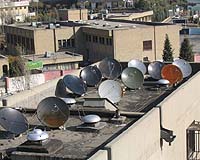 There was some more discussion. The colonel went on to say that… “If we see a crime we are obligated to prosecute it. If we do not see it, then it is not our business. For instance, we know that many people in Tehran drink alcohol in their homes. This is their business. As long as they do not drink in public, we will not go into their homes and stop them. If they drink in public, we are obligated to stop them.”
I think the lesson here is obvious…Keep your satellite dish in a chador and all will be well.
If you are looking for any words of insight on Iran’s response to the UN concerning its “essential right” to nuclear power --- forget about it. I have no insight. It’s the same old same old as far as I’m concerned, and most Iranians are ignoring the whole matter. We’re a bunch of ostriches over here… That said, many Iranians believe that an attack is imminent.
Friday, August 18, 2006
News that could change your life!
How's that for the perfect spam title?
I was watching a movie with a friend of mine who used to be a journalist. "You know what scares me most about being kidnapped?"
I know what scares *me* most, but I still ask, "What?"
"That I'll be held for months without any tweezers."
I laugh, "You have to let me post that on my blog."
"Just don't mention my name."
Well good news girls, the NYT reports that hairy eyebrows are in:
Now we just have to await the fashion world's ruling on stray facial hair and that troublesome bikini line.
I was watching a movie with a friend of mine who used to be a journalist. "You know what scares me most about being kidnapped?"
I know what scares *me* most, but I still ask, "What?"
"That I'll be held for months without any tweezers."
I laugh, "You have to let me post that on my blog."
"Just don't mention my name."
Well good news girls, the NYT reports that hairy eyebrows are in:
“For women who overpluck, this season will be about growing your eyebrows back so that they have a natural arch that extends out and ends in a beautiful point,” said Pat McGrath, a makeup artist for Max Factor and CoverGirl and the creative director for Procter & Gamble Beauty.
Ms. McGrath is one of the trend-setting stylists responsible for unleashing the feral eyebrow as this season’s beauty signature. At the Prada fall fashion show in Milan in February, she combed models’ eyebrows up with clear mascara so that they fanned out like plumage, lending their faces a wild expression which Ms. McGrath described as “sauvage.”
Now we just have to await the fashion world's ruling on stray facial hair and that troublesome bikini line.
Tuesday, August 15, 2006
So you say you wanna' revolution...
Tagged as: Iran: Party Talk
“Things have gotten much worse for us since Ahmadinejad took power,” a young university student tells us at a party. “Our choice of classes is limited. Many of our professors have been replaced. They even removed the benches from the campuses so that boys and girls cannot sit together.”
“They removed the benches?”
“Yes. People still sit on the walls, but all of the benches are gone. The worst part is that most Iranians are happy with this.”
“You think so?”
“They do not want boys and girls talking together.”
I have argued with Iranian friends that the regime does indeed represent many of their wishes, but they always disagree with me. My observation has been that most families want to control their children. They want to control who they see, where they go, and what they do. It is the very small minority who afford their children any measure of freedom. By children, I mean anybody who is not married yet: even then, the control continues.
The Iranian regime is parental. It cares for your soul, it punishes you for disobeying its rules, it shelters you from disturbing information, it reads your diary, and it destroys your porn stash. It is sometimes abusive, sometimes distant, sometimes illogical, sometimes it is even loving. Sometimes your mom will let you do something that your dad disapproves of; sometimes the opposite is true.
In Iran, you remain a child: dependent on the whims of your overprotective and abusive parents; sneaking out behind their backs; secretly disobeying them; expert at playing the good child.
Back to the party…
“They are especially controlling of their daughters,” I say.”
“You would be surprised how much boys are controlled in smaller towns and villages. Iranian families do not want their boys doing anything that they do not know about or approve of. They can be just as controlling of them as of the girls.”
“You are lucky you come from a family that allows you to be independent,” I tell her.
“Yes I am. We are different from most Iranian families, so we have to constantly lie about who we are and what we do. We even have to lie to relatives. It is so hard to always pretend.”
“It can be that way in America too. When your family is different from what is normal, people sometimes get in your business.”
“That’s because there are so many Christians in America. Sometimes they can be just as controlling as Muslims.”
A new group of guests arrive. They shake hands without introducing themselves which is normal for Iranians. “How have you been?” Our host asks.
“Well, you know… waiting for *them* to come.” We may not know their names, but we know who “them” is. “We have our bags packed. Toothbrushes, pajamas, a change of clothes, all neatly packed and waiting by the door.”
“When you are ready for them, they never come,” a young artist jokes.
“That’s true!” the woman laughs. “Exactly why we should always be ready.”
****
BTW, link to new post at Mideast Youth
“Things have gotten much worse for us since Ahmadinejad took power,” a young university student tells us at a party. “Our choice of classes is limited. Many of our professors have been replaced. They even removed the benches from the campuses so that boys and girls cannot sit together.”
“They removed the benches?”
“Yes. People still sit on the walls, but all of the benches are gone. The worst part is that most Iranians are happy with this.”
“You think so?”
“They do not want boys and girls talking together.”
I have argued with Iranian friends that the regime does indeed represent many of their wishes, but they always disagree with me. My observation has been that most families want to control their children. They want to control who they see, where they go, and what they do. It is the very small minority who afford their children any measure of freedom. By children, I mean anybody who is not married yet: even then, the control continues.
The Iranian regime is parental. It cares for your soul, it punishes you for disobeying its rules, it shelters you from disturbing information, it reads your diary, and it destroys your porn stash. It is sometimes abusive, sometimes distant, sometimes illogical, sometimes it is even loving. Sometimes your mom will let you do something that your dad disapproves of; sometimes the opposite is true.
In Iran, you remain a child: dependent on the whims of your overprotective and abusive parents; sneaking out behind their backs; secretly disobeying them; expert at playing the good child.
Back to the party…
“They are especially controlling of their daughters,” I say.”
“You would be surprised how much boys are controlled in smaller towns and villages. Iranian families do not want their boys doing anything that they do not know about or approve of. They can be just as controlling of them as of the girls.”
“You are lucky you come from a family that allows you to be independent,” I tell her.
“Yes I am. We are different from most Iranian families, so we have to constantly lie about who we are and what we do. We even have to lie to relatives. It is so hard to always pretend.”
“It can be that way in America too. When your family is different from what is normal, people sometimes get in your business.”
“That’s because there are so many Christians in America. Sometimes they can be just as controlling as Muslims.”
A new group of guests arrive. They shake hands without introducing themselves which is normal for Iranians. “How have you been?” Our host asks.
“Well, you know… waiting for *them* to come.” We may not know their names, but we know who “them” is. “We have our bags packed. Toothbrushes, pajamas, a change of clothes, all neatly packed and waiting by the door.”
“When you are ready for them, they never come,” a young artist jokes.
“That’s true!” the woman laughs. “Exactly why we should always be ready.”
****
BTW, link to new post at Mideast Youth
Saturday, August 12, 2006
Mideast Youth
I have been invited to post with them despite the fact that I am neither particularly young(although I do like to think of myself as youthful)nor particularly middle eastern. Check me out on their site.
Memorial
Tagged as: Iran culture
“Oh my god, haven’t you heard what’s been going on with the UK.?”
“I heard something about a bomb on an airplane when I was in a taxi, but I thought it was just the normal stuff.”
“My god, no. It’s not normal,” my friend tells me. We are sitting in a fashionable Tehran restaurant. I have arrived there straight from the airport after having been in Iran’s hot Khuzestan Province. She and Keivan explain the events of the last 36 hours to me.
“We only had the television on for 30 minutes so that everyone could watch Nargess,” I explained. (Nargess is the newest serial to sweep Iran. Everyone is watching it.)
I was in Khuzestan attending the year-memorial for my friend who died last year. It was a much less hectic and heart-wrenching affair than the funeral. We’d all had a year of mourning, crying, and bouts of depression behind us. This does not mean that any of us miss her any less, it’s just that the months leading up to her death and the months following her death were overwhelming and difficult for many, many people and that now, most of her family and friends were recovering.
It was a relief to see everyone again. I have not traveled too far from Tehran (except outside Iran) since the funeral. Khuzestan was a blistering 48 degrees C. This is the type of heat that can only be described as a moving wall that has weight and force and sound. You can almost hear it: at least you can imagine hearing it: Whoooosh.
First there was a ceremony in the mosque. There were about 150 women there: almost all of them wearing the same black knee-highs, darker at the toes and heals with a dark black band across the top. The mosque was chilled to shivering. “In Khuzestan they are used to the heat,” everyone told me. Oh yeah, then why are their homes and offices and mosques kept so cold? They are only used to staying inside, not to the heat.
We had about 2 ½ hours of chanting followed by ½ hour of a sermon. All the while, children were playing, there were the requisite operatic mourners, and a quorum of chadoris who hide their faces under their chadors, shake their shoulders as if hysterically crying, and then emerge dry-eyed.
From the mosque we went to the cemetery. Close by was the year memorial for the family who died in what I assume was a car crash. Last year I thought it was only a son and father who had died because there were only two pictures. This year it was clear that there was a third death: probably a woman, maybe the mother. My heart burned (as Iranians would say) for that family. How do you come to terms with such a quick death. The men were clearly heart broken. They were sobbing. The women sat dry-eyed while the children handed out sweets to the gathered crowd.
Our own ceremony was under a tent to protect us from the hot sun. Even so, the marble tombstone was too hot to touch. After the ceremony, we went to lunch. Children who did not attend the memorial came for the lunch. It’s hard to imagine how people survive mourning without children around. It’s impossible to resist their joy and playfulness. You could see the lights switch on in the eyes of their aunts and uncles who had lost their mother and sister.
“Oh my god, haven’t you heard what’s been going on with the UK.?”
“I heard something about a bomb on an airplane when I was in a taxi, but I thought it was just the normal stuff.”
“My god, no. It’s not normal,” my friend tells me. We are sitting in a fashionable Tehran restaurant. I have arrived there straight from the airport after having been in Iran’s hot Khuzestan Province. She and Keivan explain the events of the last 36 hours to me.
“We only had the television on for 30 minutes so that everyone could watch Nargess,” I explained. (Nargess is the newest serial to sweep Iran. Everyone is watching it.)
I was in Khuzestan attending the year-memorial for my friend who died last year. It was a much less hectic and heart-wrenching affair than the funeral. We’d all had a year of mourning, crying, and bouts of depression behind us. This does not mean that any of us miss her any less, it’s just that the months leading up to her death and the months following her death were overwhelming and difficult for many, many people and that now, most of her family and friends were recovering.
It was a relief to see everyone again. I have not traveled too far from Tehran (except outside Iran) since the funeral. Khuzestan was a blistering 48 degrees C. This is the type of heat that can only be described as a moving wall that has weight and force and sound. You can almost hear it: at least you can imagine hearing it: Whoooosh.
First there was a ceremony in the mosque. There were about 150 women there: almost all of them wearing the same black knee-highs, darker at the toes and heals with a dark black band across the top. The mosque was chilled to shivering. “In Khuzestan they are used to the heat,” everyone told me. Oh yeah, then why are their homes and offices and mosques kept so cold? They are only used to staying inside, not to the heat.
We had about 2 ½ hours of chanting followed by ½ hour of a sermon. All the while, children were playing, there were the requisite operatic mourners, and a quorum of chadoris who hide their faces under their chadors, shake their shoulders as if hysterically crying, and then emerge dry-eyed.
From the mosque we went to the cemetery. Close by was the year memorial for the family who died in what I assume was a car crash. Last year I thought it was only a son and father who had died because there were only two pictures. This year it was clear that there was a third death: probably a woman, maybe the mother. My heart burned (as Iranians would say) for that family. How do you come to terms with such a quick death. The men were clearly heart broken. They were sobbing. The women sat dry-eyed while the children handed out sweets to the gathered crowd.
Our own ceremony was under a tent to protect us from the hot sun. Even so, the marble tombstone was too hot to touch. After the ceremony, we went to lunch. Children who did not attend the memorial came for the lunch. It’s hard to imagine how people survive mourning without children around. It’s impossible to resist their joy and playfulness. You could see the lights switch on in the eyes of their aunts and uncles who had lost their mother and sister.
Friday, August 04, 2006
Mel Gibson Makes it Big in Iran
Now starring in his own tv spot on Iranian tv: Mel Gibson whose slurs during his drunken driving arrest are being embraced by the Iranian regime! Bombs in Lebanon interwoven with oscars in Hollywood: Mel's the hero of the moment.
He joins a fine tradition of western protestors who burn the American flag and effigies of Bush and Blair. Listen, I love free speech. I crave free speech, but I wouldn't want my protests hijacked by the Iranian regime or any other authoritarian regime. In dissent, I urge people to use symbols of freedom rather than symbols of authoritarianism -- unless, of course, you *do* want to align yourself with the authoritarians.
He joins a fine tradition of western protestors who burn the American flag and effigies of Bush and Blair. Listen, I love free speech. I crave free speech, but I wouldn't want my protests hijacked by the Iranian regime or any other authoritarian regime. In dissent, I urge people to use symbols of freedom rather than symbols of authoritarianism -- unless, of course, you *do* want to align yourself with the authoritarians.
Monday, July 31, 2006
Sigeh
Tagged as: Iran culture
Response to Angel:
Iranian shi’a have a rule (sigeh) that allows them to engage in a “temporary marriage” lasting anywhere for a few minutes to pretty much forever.
The joke going around Iran at the moment is that Bush has finally responded to the letter AN sent him a few months back. Bush wrote that he is interested in hearing more about sigeh.
Unfortunately, the joke works much better for Clinton than for Bush, but you get the idea.
Read more about sigeh here:
Women in pre-revolutionary, revolutionary and post-revolutionary Iran
Sigeh is not actually an Islamic practice, but a pre-Islamic one used in Arab tribes. In its pre-Islamic form women still resided with her family, her kin still retained rights, a woman could also dismiss a man, and any children begotten belonged to the wife's lineage. In Islam, sigeh changed, so that the child now belonged to the father. The practice of sigeh was primarily used as an urban function associated with long distance trade.
Monday, July 24, 2006
Dance the night away
Tagged as: Iran celebrations
Late one night last week, we drove west to a garden in the middle of nowhere for a wedding party. We drove by burning trash, industrial buildings, and military outposts. “This cannot be right,” we were thinking.
We drove onto an empty road and pulled up to a dented, dilapidated gate. It was dark. “No way is this it; it’s too dark.”
“No this is it,” the driver said. A police car drove by. Our driver leaned out the window to ask the police if this was the Garden we were looking for.
“It could be,” they answered and drove slowly away.
Keivan got out and knocked. The gate was opened by a sleepy Afghan. We see the lights of the party in the distance. “This is it!”
“If this were in America there would be signs and balloons everywhere.”
It only makes sense that in Iran a wedding party would be so coy. Once in, we danced with women dressed in tasteful gowns and men in sharp suits wearing silk ties around their necks.
A friend has just returned from Baghdad. “It’s horrible. People are really stressed. Baghdad is breaking up. Baghdad has neighborhood refugees now. People from one neighborhood are moving to others. It has become just too dangerous.”
We dance.
Late one night last week, we drove west to a garden in the middle of nowhere for a wedding party. We drove by burning trash, industrial buildings, and military outposts. “This cannot be right,” we were thinking.
We drove onto an empty road and pulled up to a dented, dilapidated gate. It was dark. “No way is this it; it’s too dark.”
“No this is it,” the driver said. A police car drove by. Our driver leaned out the window to ask the police if this was the Garden we were looking for.
“It could be,” they answered and drove slowly away.
Keivan got out and knocked. The gate was opened by a sleepy Afghan. We see the lights of the party in the distance. “This is it!”
“If this were in America there would be signs and balloons everywhere.”
It only makes sense that in Iran a wedding party would be so coy. Once in, we danced with women dressed in tasteful gowns and men in sharp suits wearing silk ties around their necks.
A friend has just returned from Baghdad. “It’s horrible. People are really stressed. Baghdad is breaking up. Baghdad has neighborhood refugees now. People from one neighborhood are moving to others. It has become just too dangerous.”
We dance.
Sleep
Tagged as: Iran daily life
My friend wonders if there is a connection between living in Iran and problems sleeping. When you ask expats and Iranians who travel abroad about their vacations, they talk first about the amazing sleep they had. I, for instance, slept for two days the first time I left Iran.
My point is, you just never know what is going to happen. Sometimes I sit out on our balcony and think, Tehran before the bombing… Then I argue that there will be no bombing.
But it’s even smaller and less important than that. In a land where almost everyone breaks the law, at any moment you could be arrested. The laws here govern too much private business and not enough public business. There must be some law you are breaking, after all. If you’re not, you must be a child.
And it’s even smaller than that: will any of the day’s promises be kept? Will that guy I am working with show up for his 4:00 meeting? Will houseguests appear tonight? Will I be able to watch that tv show until the end or will the satellite be blocked? Is the repair guy a thief or a spy? Is my computer being infected by malware?
To live in Iran is to worry non-stop. The worry is like a low hum, barely audible.
My friend wonders if there is a connection between living in Iran and problems sleeping. When you ask expats and Iranians who travel abroad about their vacations, they talk first about the amazing sleep they had. I, for instance, slept for two days the first time I left Iran.
My point is, you just never know what is going to happen. Sometimes I sit out on our balcony and think, Tehran before the bombing… Then I argue that there will be no bombing.
But it’s even smaller and less important than that. In a land where almost everyone breaks the law, at any moment you could be arrested. The laws here govern too much private business and not enough public business. There must be some law you are breaking, after all. If you’re not, you must be a child.
And it’s even smaller than that: will any of the day’s promises be kept? Will that guy I am working with show up for his 4:00 meeting? Will houseguests appear tonight? Will I be able to watch that tv show until the end or will the satellite be blocked? Is the repair guy a thief or a spy? Is my computer being infected by malware?
To live in Iran is to worry non-stop. The worry is like a low hum, barely audible.
Wednesday, July 19, 2006
Internet usage in Iran
Guess what! The whole nation of Iran is on a banwidth diet while the phone company renegotiates its bandwidth contract.
Just what you'd expect from a nation with time and money to waste...
Just what you'd expect from a nation with time and money to waste...
Monday, July 17, 2006
Gasoline
Iran, surprisingly, cannot refine its own oil. I did not know this when I first arrived here and was always baffled by the long lines at the pumps combined with the often empty reserve tanks. I thought it had to do with the (in)efficiency of measuring the reserves in the station’s tanks, not with the availability of gasoline.
On the highway, Iranians stop at every station they see to make sure their tanks are always filled. It’s not unusual to find stations in the middle of nowhere with no gasoline available to sell.
Iranians have giant plastic containers that they bring to the station to fill. They often drive around with these containers in the trunks of their cars. Any taxi driver you meet can tell you about witnessing a small accident that ended in a large explosion, confirming my speculation that Iran’s horrible accident fatality rate may have something to do with carrying gasoline in plastic containers.
And now, Iran may be running out of gasoline and running short on gasoline policy:
Iran, an Oil Giant, in a Gasoline Squeeze
On the highway, Iranians stop at every station they see to make sure their tanks are always filled. It’s not unusual to find stations in the middle of nowhere with no gasoline available to sell.
Iranians have giant plastic containers that they bring to the station to fill. They often drive around with these containers in the trunks of their cars. Any taxi driver you meet can tell you about witnessing a small accident that ended in a large explosion, confirming my speculation that Iran’s horrible accident fatality rate may have something to do with carrying gasoline in plastic containers.
And now, Iran may be running out of gasoline and running short on gasoline policy:
With demand far outstripping its domestic refining capacity, Iran buys foreign gasoline for slightly more than 50 cents a liter (about $2 a gallon) and sells it at the pump for about 8 cents a liter (less than 40 cents a gallon), the highest subsidies in the region.
The discount prices have further encouraged consumption and cut into the country’s export windfall. Waste and pollution are rampant. The cheap gas is smuggled out to other countries at the rate of some two million gallons a day, according to one study by Parliament.
Iran, an Oil Giant, in a Gasoline Squeeze
Sunday, July 16, 2006
f-ed up
Israel does Iran’s bidding
Tagged as: Iran: Israel
In college, I had a giant friend who told me that little guys were constantly picking fights with him: on the playground, in bars, everywhere. He was a really gentle guy, but it just drove him nuts. “They just want to prove themselves in a fight with me,” he would tell me. “It’s gotten to the point that I do not even like to go out.”
Is Israel the giant or the small guy? I would say a little of both. My allegory does not make any sense at all, and I probably should just delete it. What I really want to know is how could Israel allow itself to be lured into a war that will only serve to strengthen its enemies? It’s no secret anywhere that Iran is suspected of being behind Hezbollah’s kidnapping. It’s also no secret that Iran finances Hezbollah. There are even murals of Iranians “martyred” in battles fought with Hezbollah. Iran wants so many issues on the UN Security Council’s plate that no meaningful decisions can be reached. Now there is North Korea, Iran, and Israel to deal with. That’s quite a big serving.
Israel’s costly mistakes in Lebanon have been widely critiqued by many generally favorable to Israel. What makes them repeat those mistakes? Someone tell me.
Laura Zittrain Eisenberg argues that clear borders are essential for Israel (MERIA Volume 4, No. 3 - September 2000). In her section on Israel’s entry into Lebanon’s civil war she points out this crucial mistake:
A larger quote here:
Unfortunately for everyone, we are living in a time of inferior leaders.
Tagged as: Iran: Israel
In college, I had a giant friend who told me that little guys were constantly picking fights with him: on the playground, in bars, everywhere. He was a really gentle guy, but it just drove him nuts. “They just want to prove themselves in a fight with me,” he would tell me. “It’s gotten to the point that I do not even like to go out.”
Is Israel the giant or the small guy? I would say a little of both. My allegory does not make any sense at all, and I probably should just delete it. What I really want to know is how could Israel allow itself to be lured into a war that will only serve to strengthen its enemies? It’s no secret anywhere that Iran is suspected of being behind Hezbollah’s kidnapping. It’s also no secret that Iran finances Hezbollah. There are even murals of Iranians “martyred” in battles fought with Hezbollah. Iran wants so many issues on the UN Security Council’s plate that no meaningful decisions can be reached. Now there is North Korea, Iran, and Israel to deal with. That’s quite a big serving.
Israel’s costly mistakes in Lebanon have been widely critiqued by many generally favorable to Israel. What makes them repeat those mistakes? Someone tell me.
Laura Zittrain Eisenberg argues that clear borders are essential for Israel (MERIA Volume 4, No. 3 - September 2000). In her section on Israel’s entry into Lebanon’s civil war she points out this crucial mistake:
Begin relished the irony in the Jewish State rescuing oppressed Christians, while the rest of the world stayed mute. But Beirut was not Berlin, and Begin's insistence on viewing the Maronite situation in European, post-Holocaust terms removed him further from Lebanese realities than any of his predecessors.
A larger quote here:
Do Good Fences Make Good Neighbors?: Israel and Lebanon after the Withdrawal
Who is on the other side?
(The Israeli Perspective)
In the early 1980s Israel made its most dangerous blunder in assessing the intentions and relative power of its Lebanese friends and foes. Up until the 1970s the Zionist/Israeli exaggeration of a friendly Christian community of allies in Lebanon caused minimum damage because Israel did not predicate policy upon that faulty precept. While the increasingly unrealistic perception of a Maronite partner perhaps precluded the Yishuv from pursuing a more realistic and productive Lebanon policy, it had not exposed it to any special political or military threat. The same held true for the first two decades of Israeli statehood. But once the Lebanese civil war began in 1975, Israel fell into the common trap of relying on religious shorthand, Christian vs. Muslim, to distinguish the nature and intentions of the key actors and began to pursue policy in Lebanon accordingly.
But in actuality, the conflict was one between Maronites trying to preserve their traditional political and economic privileges in Lebanon versus everyone else trying to seize a larger piece of the Lebanese pie for themselves. Israel's interests in Lebanon were not "Christian" at all, but rather dictated by standard strategic political thinking, which made any anti-PLO (and later anti-Hizballah) force a potential ally. (17) Differences within and among the Israeli cabinet, military and intelligence services concerning the desirability and capability of the Phalange as an ally are well-documented in the many accounts of the 1982 war. There was general agreement over the usefulness of forcing the PLO away from the northern border and even destroying the organization, if possible, but Prime Minister Menahem Begin used the Maronite angle both in formulating strategy and in appealing to Israeli public opinion. Deeply steeped in the historical lore of Maronite friendliness, few Israelis initially balked at the depiction of Lebanese Christians threatened with genocide and a natural harmony of Christian and Israeli interests in the face of mutual Muslim, Palestinian, and Syrian foes.
Begin relished the irony in the Jewish State rescuing oppressed Christians, while the rest of the world stayed mute. But Beirut was not Berlin, and Begin's insistence on viewing the Maronite situation in European, post-Holocaust terms removed him further from Lebanese realities than any of his predecessors.
Despite behind-the-scenes diplomatic activity, support for the SLA, and its own military operations in July 1993 (Operation Accountability) and April 1996 (Grapes of Wrath), Israel failed to suppress Hizballah. Fatalities ran at 20-30 IDF soldiers per year. Attempting to avoid roadside bombs, the IDF began to ferry its soldiers to security zone bases by helicopter, a plan that worked only until a collision between two helicopters in February 1997 claimed 73 lives. From that tragedy the "Four Mothers" group was born, a grassroots movement initiated by four mothers of sons serving in Lebanon, with the goal of compelling the government to withdraw all Israeli troops from Lebanon. (18) The organization introduced and legitimized the concept of unilateral withdrawal in national debate, its message driven home by the relentless procession of IDF body bags from Lebanon. Hizballah had succeeded in making the security zone untenable.
(The Lebanese Perspective)
Israel was so focused on the PLO and its Lebanese and Syrian allies that it neglected to evaluate properly the Lebanese Shi`a's politicization in the early 1970s, marked by the rise to leadership of Musa al-Sadr, and the formation of Shi'a organizations such as Amal and the Islamic fundamentalist Hizballah. Although some Shi'a supported the Palestinians and the PLO, others--angered at oppressive PLO domination and PLO cross-border attacks that invited Israeli retaliatory strikes against their villages--responded to Israel's anti-PLO invasion of 1982 with relief and support. But as hostilities dragged on 1982, Israeli forces settled into the south, building new roads, posting road signs in Hebrew, commandeering facilities, and establishing bases or detention camps. These steps caused Israel to change in many Shi'a eyes from liberator to occupier. Despite the fact that a majority of the FLM and SLA foot soldiers were Shia, Israel had neither recognized nor rewarded the Shi'a as potential allies, taking their continued acquiescence for granted.
By 1985 Amal, founded to champion Shia rights within Lebanon, was being outgunned by Hizballah, which proclaimed a pan-Islamic fundamentalism. Funded by Iran and encouraged by Syria, Hizballah sought to drive the Israelis back across the border. Frequent declarations by the organization also stated an intention to remove Israel from Palestine and Jerusalem, as well. It is ironic that the PLO, target of the 1982 invasion, became Israel's peace partner in 1993, while many of the previously friendly Shi'a of south Lebanon joined Israel's new Hizballah enemy.
Missed Opportunity?
Hindsight is always 20/20, but it does appear that Israel missed a critical opportunity for salvaging some benefit from the 1982 invasion in the year or two immediately afterward. Unlike the situation in 1978, the PLO was really gone this time, and although the alliance with the Phalange had already soured, relations were still good with the Christians and Shia of south Lebanon. Had Israel withdrawn at that time, and/or accurately recognized the sensibilities and needs of the south Lebanese people, it might have earned the trust of a population genuinely interested in seeing the border quiet and secure. In a reflective post-withdrawal interview, Israel's coordinator for activity in Lebanon, Uri Lubrani, similarly suggests that Israel could and should have redeployed to the international border in 1984. (19) By failing to identify and accommodate the south Lebanese actors who remained after the PLO's expulsion, Israel helped provoke the creation of Hizballah, an enemy equally or more punishing than the PLO had ever been.
Unfortunately for everyone, we are living in a time of inferior leaders.
Wednesday, July 12, 2006
About the revolver
Tagged as: Iran: U.S.
(response to Matt’s question)
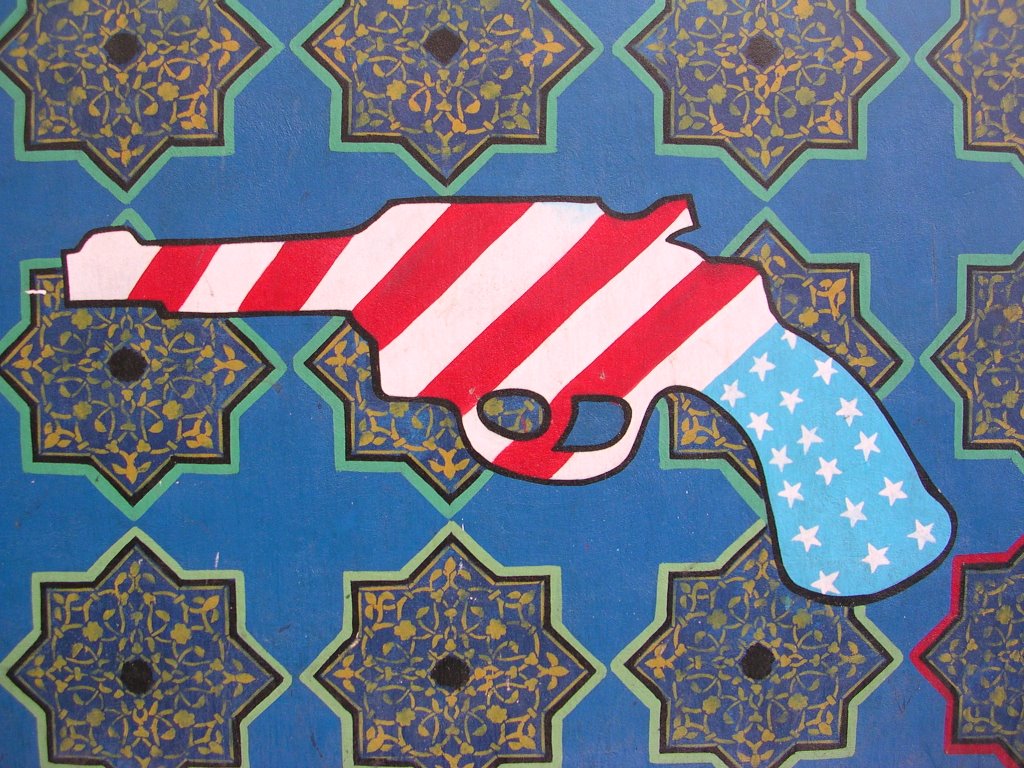
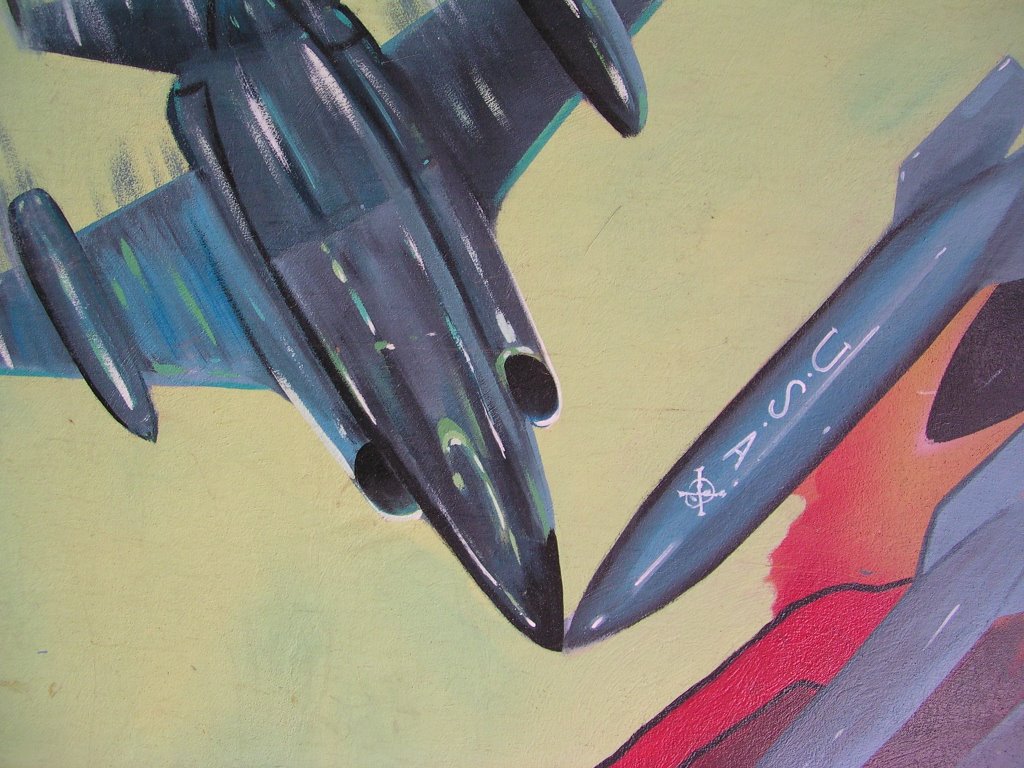
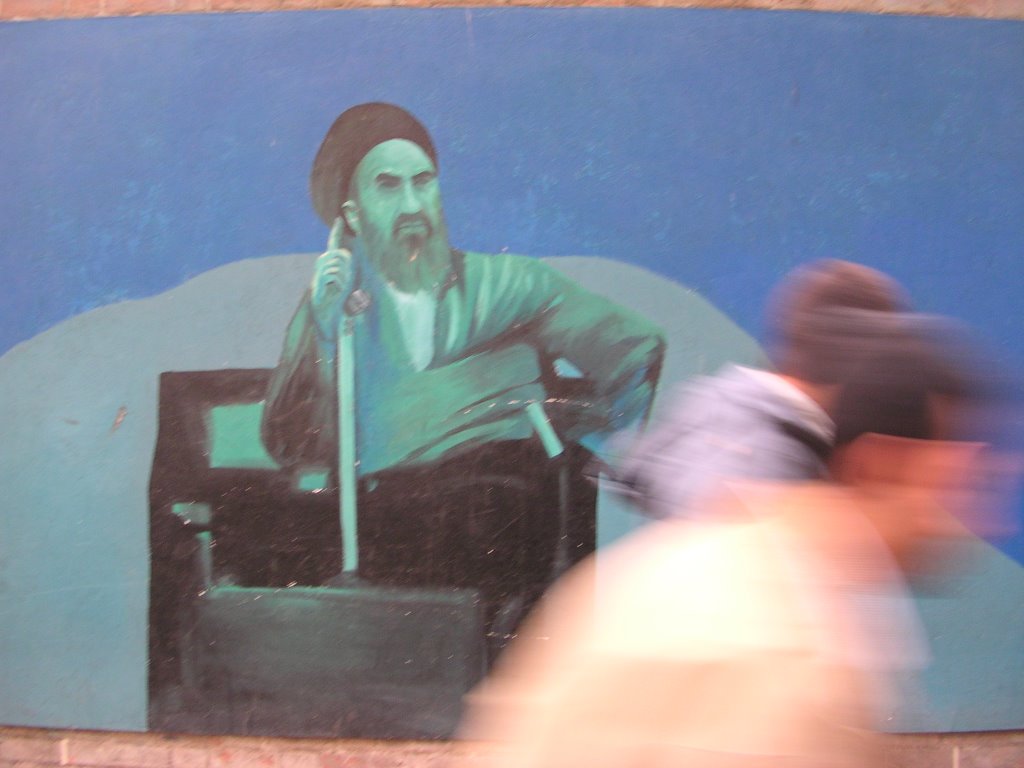
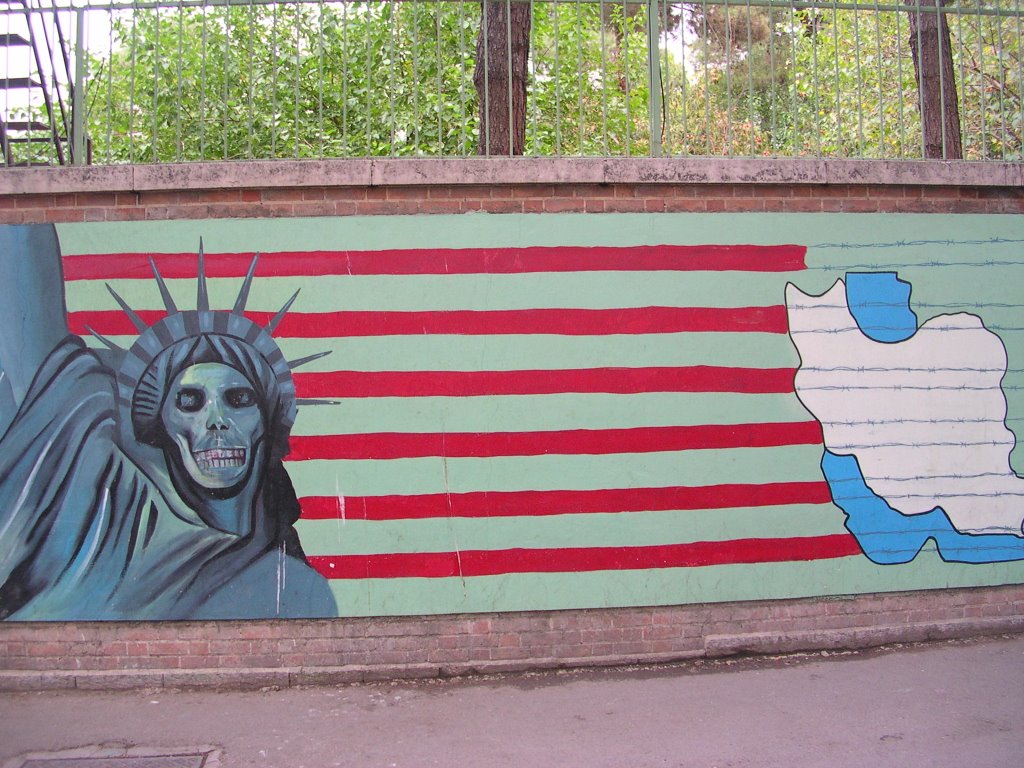
The photo of the revolver that is featured in this blog is from a mural in front of the former American Embassy. I am posting a few photos of that mural so that you get an idea of what it looks like.


(response to Matt’s question)
The photo of the revolver that is featured in this blog is from a mural in front of the former American Embassy. I am posting a few photos of that mural so that you get an idea of what it looks like.
Tuesday, July 11, 2006
Head Butt
Tagged as: Iran: World Cup
Like every other football crazed nation, Iranians are talking about the World Cup and Zidane’s head butt. In fact, this has been the primary topic of conversation for two days now. I just read a couple of my Iranian friends Materazzi’s description of the incident translating it into approximate Farsi. The lines:
…Got a big laugh from my friends. “How Iranian of him,” Niloofar laughed. By this, she meant the way that Materazzi admits to insulting Zidane but does not rule out an insult to Zidane’s family, just one to his mother.
Like every other football crazed nation, Iranians are talking about the World Cup and Zidane’s head butt. In fact, this has been the primary topic of conversation for two days now. I just read a couple of my Iranian friends Materazzi’s description of the incident translating it into approximate Farsi. The lines:
'I did not call him a terrorist. I am not a cultured person and I don't even know what as Islamist terrorist is.'
He added: 'For me the mother is sacred, you know that.'
…Got a big laugh from my friends. “How Iranian of him,” Niloofar laughed. By this, she meant the way that Materazzi admits to insulting Zidane but does not rule out an insult to Zidane’s family, just one to his mother.
ESPNsoccernet - World Cup - Materazzi admits to insulting Zidane: "Materazzi, 32, told Gazetta dello Sport: 'I held his shirt for a few seconds only, then he turned to me and talked to me, jeering.
'He looked at me with a huge arrogance and said, `If you really want my shirt I'll give it to you afterwards'. I replied with an insult, that's true.'
Materazzi has not elaborated on what he did say, but one report suggested he responded with: `I'd rather take the shirt off your wife'.
He has denied, however, some of the more vile insults referring to his wife or sister or calling him a terrorist.
'It was one of those insults you're told dozens of times and that you often let fall on a pitch,' Materazzi said.
'I did not call him a terrorist. I am not a cultured person and I don't even know what as Islamist terrorist is.'
He added: 'For me the mother is sacred, you know that.'"
Sunday, July 09, 2006
Fun in the Sun
Tagged as: Iran and hijab
I thought I would write at least once in awhile during the past two weeks, but I did not. Why didn’t I? I cut the tip of a very important typing finger, and it hurt to type. Oh yeah, I also went to a friend’s wedding in a normally cold country that was in the grips of its three-week summer so it was sunny and gorgeous every day so we went to the beach and swam in the ocean and I actually wore a bikini in front of men and women and little children and big and small dogs and was still one of the most covered up women on the beach. I rode a bicycle, wore a summer dress, and spoke freely and openly with everyone. I slept a lot. I drank a lot less than I do in Iran, but I drank good wine and good beer instead of the staples available to us here. Friends returned from Greece with homemade red wine. They were excited about it, but I told them I had had enough homemade wine in the past few years.
I returned with Iran Air. Once again, I did not want to get on the plane, but then, once on, I had fun. I sat next to an ex-pat Iraqi family whose parents have taken refuge in Iran. Their parents are too scared to travel back to Baghdad. They like Iran. In the row next to ours was a couple who had not been in Iran for 15 years. They were beaming. Excited to see family and eat Iran’s famous sheep’s head and foot soup (calepache). (Talk about foot in mouth…) When we were just above Tehran, the man leaned to look out the window and shouted: “There is calepache everywhere in this city!” We landed to a great burst of applause from the passengers.
Everyone was covered up while we were still in the airport. I did not wear my headscarf until we landed. Soon, many of the women had taken theirs off as well. Iran Air is often carrying people who have not been in Iran in years and years. Those women cover every strand of hair on their heads: not from religious passion, but from fear.
The cold European country was filled with women in hijab: all of whom would be arrested in Iran for bad hijab. Hijab, as I have said before, is all about fashion. Moroccan women, for instance, wear tight-fitting scarves, form-fitted to their hair, and tied behind their necks. Then they wear long skirts, with tight tops, lots of jewelry and fashionable shoes. They look great. Why? Because, as so many Muslim evangelists tell me, hijab is a signal that the woman’s body is not part of the social discourse: it’s all about respect. Hijab is supposed to protect women from prying eyes and sexual violence, but I very much doubt that it does any of those things. Talk to any man: western or eastern: they are obsessed with women in hijab.
Hijab makes the women’s body the center of social discourse: all it does is eroticize the body. I’ll tell you what takes women’s bodies out of social discourse: it’s thousands of topless women at the beach.
More on hijab:
The Veil: Resistance or Repression?
Scarf and Make-up: the Modern Face of Islam
Women in Islam, veiled oppression or stigmatized misconception
http://www.bbc.co.uk/dna/ww2/A5838410#footnote10
A Pearl In Its Shell
Arab Feminists on Women's Rights: Cats and Dogs in the Developed World Have More Rights than Women in the Arab and Muslim World
I thought I would write at least once in awhile during the past two weeks, but I did not. Why didn’t I? I cut the tip of a very important typing finger, and it hurt to type. Oh yeah, I also went to a friend’s wedding in a normally cold country that was in the grips of its three-week summer so it was sunny and gorgeous every day so we went to the beach and swam in the ocean and I actually wore a bikini in front of men and women and little children and big and small dogs and was still one of the most covered up women on the beach. I rode a bicycle, wore a summer dress, and spoke freely and openly with everyone. I slept a lot. I drank a lot less than I do in Iran, but I drank good wine and good beer instead of the staples available to us here. Friends returned from Greece with homemade red wine. They were excited about it, but I told them I had had enough homemade wine in the past few years.
I returned with Iran Air. Once again, I did not want to get on the plane, but then, once on, I had fun. I sat next to an ex-pat Iraqi family whose parents have taken refuge in Iran. Their parents are too scared to travel back to Baghdad. They like Iran. In the row next to ours was a couple who had not been in Iran for 15 years. They were beaming. Excited to see family and eat Iran’s famous sheep’s head and foot soup (calepache). (Talk about foot in mouth…) When we were just above Tehran, the man leaned to look out the window and shouted: “There is calepache everywhere in this city!” We landed to a great burst of applause from the passengers.
Everyone was covered up while we were still in the airport. I did not wear my headscarf until we landed. Soon, many of the women had taken theirs off as well. Iran Air is often carrying people who have not been in Iran in years and years. Those women cover every strand of hair on their heads: not from religious passion, but from fear.
The cold European country was filled with women in hijab: all of whom would be arrested in Iran for bad hijab. Hijab, as I have said before, is all about fashion. Moroccan women, for instance, wear tight-fitting scarves, form-fitted to their hair, and tied behind their necks. Then they wear long skirts, with tight tops, lots of jewelry and fashionable shoes. They look great. Why? Because, as so many Muslim evangelists tell me, hijab is a signal that the woman’s body is not part of the social discourse: it’s all about respect. Hijab is supposed to protect women from prying eyes and sexual violence, but I very much doubt that it does any of those things. Talk to any man: western or eastern: they are obsessed with women in hijab.
Hijab makes the women’s body the center of social discourse: all it does is eroticize the body. I’ll tell you what takes women’s bodies out of social discourse: it’s thousands of topless women at the beach.
More on hijab:
The Veil: Resistance or Repression?
Scarf and Make-up: the Modern Face of Islam
Women in Islam, veiled oppression or stigmatized misconception
http://www.bbc.co.uk/dna/ww2/A5838410#footnote10
A Pearl In Its Shell
Arab Feminists on Women's Rights: Cats and Dogs in the Developed World Have More Rights than Women in the Arab and Muslim World
Saturday, June 24, 2006
Fun
Tagged as: Iran daily life
1. “Some people think Iran is a hell because young people can’t go to discos or drink beer in bars. They have no imagination of what it means to have fun.”
M: “I grew up in the country, so Iran is a great place for me to have fun. You can never be disappointed by the nature here.”
ET: “It’s true that Iranians have a kind of fun that is really special and enjoyable, but I do believe that being young in Iran is a bit of a problem.”
1: “What do you mean?”
ET: “Well, you are always watched. There is so much pressure from family and from society.”
1: “Who says that?”
ET: “I see that myself. I see how young people have to put so much control on themselves because there is so much control on them.”
2: “That’s the first way to learn to lie. For instance, we get some money. Our parents ask us how we plan to spend it. We tell them a lie. We lie even when there is no reason to lie. We do not tell our parents where we are going or who we are going with. We do not tell them anything true. We are a lying people.”
ET: “All Iranians say that about themselves.”
Y: “What I like about working in Iran is that when I get angry in a meeting, the Iranians do not hold it against me. When the meeting is over, they slap my back and we are friends again. They know it is business. When I do business in Saudi Arabia, they do not accept the difference between business anger and personal anger.”
3: “Iranians show their emotions.”
ET: “No, Iranians are very controlled.”
3: “Do you think so?”
ET: “Particularly the women.”
4: “The women are really manipulative.”
1: “Because we have to be. That’s the only way for us to survive.”
K: “That’s what I always say. I’m with you.”
ET: “If the law were more fair, women would be less manipulative.”
1: “That’s true.”
Y: “The men are ruled by women.”
3: “No, it’s just natural here.”
ET: “Married men are like children. They cannot even feed themselves.”
2: “Our generation is better.”
ET: “Your generation is a lot better. I see a lot more 50-50 in younger couples.”
1: “Every generation has its lazy men and domineering women.”
2: “If you talk to ten young people in their 20s, only 2 will tell you that they want to get married. The others do not want to get married.”
1: “We have learned to lie so well that we don’t want to enter into a relationship of trust.”
2: “We had to learn to lie.”
3: “Do you wish the revolution never happened?”
2: “Of course I wish it never happened. We have fallen so far behind the rest of the world.”
1: “Me… I think the revolution has been a good thing. It has made us much more careful. We don’t believe things so easily. We think things through more carefully. Our decisions are more deliberate.”
1. “Some people think Iran is a hell because young people can’t go to discos or drink beer in bars. They have no imagination of what it means to have fun.”
M: “I grew up in the country, so Iran is a great place for me to have fun. You can never be disappointed by the nature here.”
ET: “It’s true that Iranians have a kind of fun that is really special and enjoyable, but I do believe that being young in Iran is a bit of a problem.”
1: “What do you mean?”
ET: “Well, you are always watched. There is so much pressure from family and from society.”
1: “Who says that?”
ET: “I see that myself. I see how young people have to put so much control on themselves because there is so much control on them.”
2: “That’s the first way to learn to lie. For instance, we get some money. Our parents ask us how we plan to spend it. We tell them a lie. We lie even when there is no reason to lie. We do not tell our parents where we are going or who we are going with. We do not tell them anything true. We are a lying people.”
ET: “All Iranians say that about themselves.”
Y: “What I like about working in Iran is that when I get angry in a meeting, the Iranians do not hold it against me. When the meeting is over, they slap my back and we are friends again. They know it is business. When I do business in Saudi Arabia, they do not accept the difference between business anger and personal anger.”
3: “Iranians show their emotions.”
ET: “No, Iranians are very controlled.”
3: “Do you think so?”
ET: “Particularly the women.”
4: “The women are really manipulative.”
1: “Because we have to be. That’s the only way for us to survive.”
K: “That’s what I always say. I’m with you.”
ET: “If the law were more fair, women would be less manipulative.”
1: “That’s true.”
Y: “The men are ruled by women.”
3: “No, it’s just natural here.”
ET: “Married men are like children. They cannot even feed themselves.”
2: “Our generation is better.”
ET: “Your generation is a lot better. I see a lot more 50-50 in younger couples.”
1: “Every generation has its lazy men and domineering women.”
2: “If you talk to ten young people in their 20s, only 2 will tell you that they want to get married. The others do not want to get married.”
1: “We have learned to lie so well that we don’t want to enter into a relationship of trust.”
2: “We had to learn to lie.”
3: “Do you wish the revolution never happened?”
2: “Of course I wish it never happened. We have fallen so far behind the rest of the world.”
1: “Me… I think the revolution has been a good thing. It has made us much more careful. We don’t believe things so easily. We think things through more carefully. Our decisions are more deliberate.”
Wednesday, June 21, 2006
Closing Time
All over Iran, businesses are closing early again today for a chance to say farewell to the world cup team. Keivan predicts a 3-0 loss for Iran. “Don’t say that,” Mohamad protests. “Everything you’ve said has come true.”
“It’s all Keivan’s fault,” I respond.
---
Was in a meeting with some Iranian businessmen. One was telling us that he went to Dubai to buy some hardware for his business. “They didn’t sell it to me. They won’t sell to Iranians.”
“Sanctions?”
“No, it’s not sanctions. They just won’t sell to Iran. The Arabs do not want to sell to Iran.”
“You’re sure it wasn’t sanctions?”
“I’m sure. They said to me: we won’t sell to Jews. I said, hey, I’m a muslim. My name is Mohamad, how can I be Jewish? They kept telling me they don’t sell to Jews.”
All of the men laughed. That was the end of that.
I was left thinking of the Brooklyn Mullah. He appears on Iranian tv every once in awhile and lectures on scripture. He has a really thick Brooklyn accent that shifts into what sounds to me like perfect Arabic when he needs to quote something. Last time I saw him he was speaking of the sheitan (devil) and identifying his works. It’s all so disorienting for me: the accent, the sermon, the black turban: I keep thinking he is a rabbi, but then what’s all this about hadith?
I think it was Lenny Bruce who said that all New Yorkers are Jewish. I guess the Brooklyn Mullah is no exception.
“It’s all Keivan’s fault,” I respond.
---
Was in a meeting with some Iranian businessmen. One was telling us that he went to Dubai to buy some hardware for his business. “They didn’t sell it to me. They won’t sell to Iranians.”
“Sanctions?”
“No, it’s not sanctions. They just won’t sell to Iran. The Arabs do not want to sell to Iran.”
“You’re sure it wasn’t sanctions?”
“I’m sure. They said to me: we won’t sell to Jews. I said, hey, I’m a muslim. My name is Mohamad, how can I be Jewish? They kept telling me they don’t sell to Jews.”
All of the men laughed. That was the end of that.
I was left thinking of the Brooklyn Mullah. He appears on Iranian tv every once in awhile and lectures on scripture. He has a really thick Brooklyn accent that shifts into what sounds to me like perfect Arabic when he needs to quote something. Last time I saw him he was speaking of the sheitan (devil) and identifying his works. It’s all so disorienting for me: the accent, the sermon, the black turban: I keep thinking he is a rabbi, but then what’s all this about hadith?
I think it was Lenny Bruce who said that all New Yorkers are Jewish. I guess the Brooklyn Mullah is no exception.
Subscribe to:
Posts (Atom)