Are Iranians hostile to westerners? This is a broad question, but we still get it all the time. What I told a group when someone asked me this question was that the first religion in Iran is hospitality. For the most part, Iranians are delightfully hospitable to westerners: particularly American westerners.
I was greeted with warmth, disbelief, and curiosity everywhere I travelled in Iran. I have never travelled anywhere else where people were so happy to see me. I cannot stress this enough. The Iranians that I met were incredibly welcoming. You can read a bit of a recap of my feelings about Iran in this post: I heart Iran.
Edo River: I have met Bahais in Iran. You might want to read this post I wrote in 2003:
The Women's Party
Next Question:
from Christopher:
Can ahmadinejad do something about the no tie with a jacket thing? it really doesn't seem to be working.
Stay tuned!

Saturday, June 30, 2007


Wednesday, June 27, 2007
Link to my earlier post on benzine rationing
I heard Frances Harrison tell people that taxi driving is a second job for many, many Iranian men and that many keep their second job a secret from even their families.
In that spirit, I am linking to my earlier post on rationing, which includes my prediction that this move will be disastrous for poor and middle class women:
Benzine rationing
Tomorrow I will post a response to the next question about Iran.
In that spirit, I am linking to my earlier post on rationing, which includes my prediction that this move will be disastrous for poor and middle class women:
Benzine rationing
Tomorrow I will post a response to the next question about Iran.
Friday, June 22, 2007
Question 2: Is there a chance that there will be political change in Iran?
Of course people ask us this question. What did you expect? Iran is portrayed as a pariah, arming Al Qaeda, the Shi'a death squads, and promoting terrorism. (Wait, or is the US funding Al Qaeda?[Warning to folks in Iran: a youtube video: takes lots of bandwidth!])Iran is the bogeyman.
The short answer is: Iran changes all the time. There is change in Iran today! There will be change tomorrow. There was change yesterday. Iran's path is unclear. It's future is unclear. The regime seems to think that the only way to guarantee its survival is by making sure young men and women don't hold hands in public and that women wear black and men take the gel out of their hair. I am being a bit facetious, but sometimes it really does seem that way to me.
Most people do not want another revolution (it seems)... they want slow change for the better, not the worse.
Iranians have never been happy with their governments. In Being Modern in Iran (fabulous book, by the way!)Fariba Adelkhah quotes from a source writing in the 1800s: he wrote that Iranians love their country and hate their government.
So maybe nothing will change.
Next post from me will be Jack from Canada's question: Are they in any way hostile to westerners? His question is one we get regularly.
The short answer is: Iran changes all the time. There is change in Iran today! There will be change tomorrow. There was change yesterday. Iran's path is unclear. It's future is unclear. The regime seems to think that the only way to guarantee its survival is by making sure young men and women don't hold hands in public and that women wear black and men take the gel out of their hair. I am being a bit facetious, but sometimes it really does seem that way to me.
Most people do not want another revolution (it seems)... they want slow change for the better, not the worse.
Iranians have never been happy with their governments. In Being Modern in Iran (fabulous book, by the way!)Fariba Adelkhah quotes from a source writing in the 1800s: he wrote that Iranians love their country and hate their government.
So maybe nothing will change.
Next post from me will be Jack from Canada's question: Are they in any way hostile to westerners? His question is one we get regularly.
What people we meet want to know about Iran
Question 1: Hejab
It's true. We have been a bit lax communicating with you dear readers. We have been busy and not busy at the same time. Perhaps it's best to say that we are distracted.
I thought you, particularly you Iranian readers, would be interested in what the people we meet want to know about Iran. Here goes:

Did you have to wear a burqa?
No. I have never worn a burqa, but it would not surprise me if in a few years we all were wearing one. It seems to be the perfect solution to the harsh rays of the sun. In fact, I never saw an Iranian woman in a burqa. In the south, near Bandar Abbas, I did see women in masks:

Most Iranian women wear a simple scarf:

or a fashionable scarf (left)or a chador (right):

But I never saw a burqa. I bet you could find a woman or two in Iran in a burqa, I just never saw them.
Next post... Question 2: Is there a chance that there will be political change in Iran?
Have you got a question? Post it in the comments.
It's true. We have been a bit lax communicating with you dear readers. We have been busy and not busy at the same time. Perhaps it's best to say that we are distracted.
I thought you, particularly you Iranian readers, would be interested in what the people we meet want to know about Iran. Here goes:

Did you have to wear a burqa?
No. I have never worn a burqa, but it would not surprise me if in a few years we all were wearing one. It seems to be the perfect solution to the harsh rays of the sun. In fact, I never saw an Iranian woman in a burqa. In the south, near Bandar Abbas, I did see women in masks:

Most Iranian women wear a simple scarf:
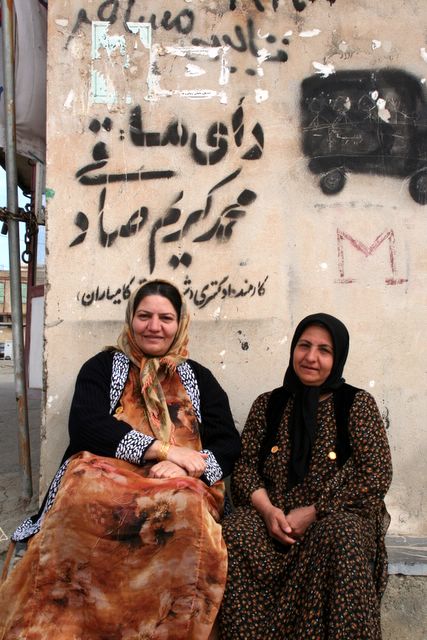
or a fashionable scarf (left)or a chador (right):

But I never saw a burqa. I bet you could find a woman or two in Iran in a burqa, I just never saw them.
Next post... Question 2: Is there a chance that there will be political change in Iran?
Have you got a question? Post it in the comments.
Tuesday, June 12, 2007

Monday, June 04, 2007
Welcome to Chicago

orangepalm
Originally uploaded by rbgwi68
(For my Iranian readers without the most excellent Flickr access plugin for Firefox Access Flickr, the picture above is of an orange plastic palm tree: you know the type because you have all seen them.)
For those of you who have never been to Iran, one of the typical features of the roundabouts that are at the entrance and exit of just about every single Iranian city is an orange or lime green plastic palm tree or some other equally odd and most often plastic or light-up sculptural feature. So imagine my surprise as we were making our descent into Chicago, coming in on a clear evening over lake Michigan, when I looked down and saw an orange plastic palm tree lit up just outside the airport!
Welcome to Chicago!
Sunday, May 27, 2007
Iran... just what you would expect...
Sadly...
Keivan is on the phone with a friend: "The Iranian government needs no excuse to arrest people. They say that the money from foreign governments is bringing activists into danger. But the truth is that they do not need an excuse to close down ngos and arrest activists."
Well... it is a distressing time in Iran. The past few months have been the worst time for me in Iran. It was the first time in our almost four years there that we saw life in Iran the way that people outside the country sometimes imagine it: as repressive and oppressive. The night before we left for vacation we had kebab in a teahouse north of Tehran. When we left, we ran into a huge roadblock manned by fresh-faced religious police who all looked about 16 years old. They stopped every car looking for alcohol and infringements on morality. People we know have been arrested. Others have heard rumors of their own impending arrest. (These people are not even activists!)
A dear friend who is a teacher complained of rumors in the teaching community of a second "cultural revolution." "I survived the first," she told me, "because I am small, and I could hide so well, but many of my friends were executed."
Young people may dismiss these fears and do dismiss them, but for the middle-aged and older, the current patterns of behavior are distressingly reminiscent of more repressive times.
I leave you with this quote from Shaul Bakhash's article about his wife Haleh Esfandiari.
Keivan is on the phone with a friend: "The Iranian government needs no excuse to arrest people. They say that the money from foreign governments is bringing activists into danger. But the truth is that they do not need an excuse to close down ngos and arrest activists."
Well... it is a distressing time in Iran. The past few months have been the worst time for me in Iran. It was the first time in our almost four years there that we saw life in Iran the way that people outside the country sometimes imagine it: as repressive and oppressive. The night before we left for vacation we had kebab in a teahouse north of Tehran. When we left, we ran into a huge roadblock manned by fresh-faced religious police who all looked about 16 years old. They stopped every car looking for alcohol and infringements on morality. People we know have been arrested. Others have heard rumors of their own impending arrest. (These people are not even activists!)
A dear friend who is a teacher complained of rumors in the teaching community of a second "cultural revolution." "I survived the first," she told me, "because I am small, and I could hide so well, but many of my friends were executed."
Young people may dismiss these fears and do dismiss them, but for the middle-aged and older, the current patterns of behavior are distressingly reminiscent of more repressive times.
I leave you with this quote from Shaul Bakhash's article about his wife Haleh Esfandiari.
When Haleh was initially prevented from leaving Iran and the interrogations began, it was principally at my insistence that we did not "go public." Repeatedly I was told by those who supposedly understand the inner workings of Iran: "Don't worry; it's only an interrogation; once they have finished with their questions, they will let her go."
Once Haleh was arrested, however, silence was no longer an option. It is preposterous that she is accused of conspiring to overthrow the Iranian government by organizing conferences and encouraging dialogue between Iranians and Americans. The Wilson Center issued a fact sheet; Lee Hamilton, its president and director, held a news conference; and I began to speak openly about Haleh's frightening predicament.
Tuesday, May 22, 2007
Holiday...
May 22, 2007
"People are really nervous," a friend told us. "They are calling each other every few hours to make sure that one of them has not been arrested."
We know. We were busy calling one of our friends regularly to make sure that she was still sleeping in her own bed.
So what do people in Iran do when they are worried about being arrested? Here's the drill:
1. Sell all the alcohol.
2. Backup everything on the computer and then reformat the hard drives.
3. Call people with connections to find out if they can verify any rumors.
4. Carry an extra toothbrush everywhere.
5. Don't answer the door for unexpected visitors.
6. Wait.
We are on holiday now. Planning for our trip was kind of a nightmare. Since the arrest of Haleh Esfandiari and the crackdown on hejab, many of our friends have been nervous. Keivan received some veiled warnings. Another heard rumors of her impending arrest from family friends living abroad. (Neither were arrested btw) We decided to stop blogging for a while and keep a low profile.
But now we are on vacation, and oh how great the world is. So goodbye to Iran for a bit and hello world! Feeling very safe and sound.
"People are really nervous," a friend told us. "They are calling each other every few hours to make sure that one of them has not been arrested."
We know. We were busy calling one of our friends regularly to make sure that she was still sleeping in her own bed.
So what do people in Iran do when they are worried about being arrested? Here's the drill:
1. Sell all the alcohol.
2. Backup everything on the computer and then reformat the hard drives.
3. Call people with connections to find out if they can verify any rumors.
4. Carry an extra toothbrush everywhere.
5. Don't answer the door for unexpected visitors.
6. Wait.
We are on holiday now. Planning for our trip was kind of a nightmare. Since the arrest of Haleh Esfandiari and the crackdown on hejab, many of our friends have been nervous. Keivan received some veiled warnings. Another heard rumors of her impending arrest from family friends living abroad. (Neither were arrested btw) We decided to stop blogging for a while and keep a low profile.
But now we are on vacation, and oh how great the world is. So goodbye to Iran for a bit and hello world! Feeling very safe and sound.
Tuesday, May 08, 2007
Rationing, subsidies, and other economic problems
“How much money do you think Iran makes off of oil sales?” Keivan asked me.
“I don’t know… $16 billion?”
“Actually, $40 billion. They spend $16 billion on gasoline subsidies.”
“That’s a lot.”
The thing is, the proposed rationing idea sucks.
In the rationing card scheme, each car receives a rationing card. This means that owning more cars means receiving more subsidized petrol, not less. It’s a bad idea all around. There is no reward for real conservation. It simply continues to reward the wiley and the wealthy. The wealthy because they have more cars and cars that get better mileage and the wiley because buying up old gas-guzzling paykans means getting more cheap gasoline.
Iran does need price reform. Rationing, however, is a recipe for disaster. Instead, the price should go up, contracts should be renegotiated, and salaries should also increase.
The price of gas will make everything more expensive. The price of doing nothing, however, increases every year.
That said, I cannot believe that the card will go into effect this year. There is still hearty debate in Iran’s parliament and there is fear of disrupting the economy further right now.
References:
Iranian Energy Subsidies
If you want to read lots and lots about energy policy click here: Sacrificing Our Children to the 'Corn God'
Intelligent Analysis about Iran
“I don’t know… $16 billion?”
“Actually, $40 billion. They spend $16 billion on gasoline subsidies.”
“That’s a lot.”
The thing is, the proposed rationing idea sucks.
In the rationing card scheme, each car receives a rationing card. This means that owning more cars means receiving more subsidized petrol, not less. It’s a bad idea all around. There is no reward for real conservation. It simply continues to reward the wiley and the wealthy. The wealthy because they have more cars and cars that get better mileage and the wiley because buying up old gas-guzzling paykans means getting more cheap gasoline.
Iran does need price reform. Rationing, however, is a recipe for disaster. Instead, the price should go up, contracts should be renegotiated, and salaries should also increase.
The price of gas will make everything more expensive. The price of doing nothing, however, increases every year.
That said, I cannot believe that the card will go into effect this year. There is still hearty debate in Iran’s parliament and there is fear of disrupting the economy further right now.
References:
Iranian Energy Subsidies
If you want to read lots and lots about energy policy click here: Sacrificing Our Children to the 'Corn God'
Intelligent Analysis about Iran
Thursday, May 03, 2007
Gas Rationing, Benzine Cards (Part 1)
 Gasoline in Iran is heavily subsidized. It costs less than 10 cents a liter. For years, there have been rumors of rationing to control the rampant use of gasoline and to help normalize the economy. All I can say is that it is more complicated than that. Let me start with my predictions for the effects on poor men and women:
Taxi driving is, in many ways, the male equivalent of prostitution in Iran. A man can make a few bucks a day driving around an old Paykan (9 miles to the gallon) or someone else’s newer car. The point is, these men are operating under the radar. They do not have official taxi licenses even though they may work for official taxi agencies. My local taxi agency employs only two people who have official taxi licenses.
Rumor has it that the official drivers will get an extra ration. This same rumor says that individual car owners will get 3 liters of gasoline a day (that won’t even take the Paykan 10 miles.) “I will be retiring when the rationing begins,” my driver told me yesterday. “I am tired anyway. I’ll go to Shomal and spend my days with my wife. The younger men are really in a bad way though. They don’t know what will happen to them when rationing begins.”
“They don’t have official licenses?”
“Only two of them do.”
So what will happen? This will be a disaster for poor women who, I predict, will be forced out onto the streets by the rationing. One of my friends told me about overhearing this conversation in an apartment building in one of Tehran’s poorest neighborhoods:
“The landlord is coming today for the rent,” a man called out to his 15-year old daughter. “I don’t care how you get it. Don’t come back here until you have the money.”
What do you think, will there be more of these conversations post-rationing or fewer?
Some Links:
Iran considers gas rationing
Iran to start gas rationing
Gasoline smart card delay
NOTE: I have cross-posted this at Mideast Youth. If you have comments, please leave them there.
Thursday, April 26, 2007
Bad Hejab
“Nuclear power is our inalienable right,” the staff of my favorite supermarket greets me as I walk into the bustling store. “It’s all your fault that the police are outside picking up women.” They are joking of course. They like to make fun of me when I come into the store.
Some people I know have yet to see the packs of police ushering women into awaiting minibuses, but my regular stomping grounds are in the heart of bad-hejabland. “At least the police are polite here,” a taxi driver tells me. They have to be polite. They are being watched by neighbors with cameras and internet connections. “You should see them over at some of the other spots. They are really going after women with force and being rough.”
A few nights ago Iranian tv featured some official denying that women had been picked up by force. “We’re just talking to them. We have not begun arresting anyone.”
“It’s nothing,” everyone says to me. “They do this every year.”
“I’ve been here more than three years, and I have never seen the police so organized about picking up women before. I’ve never seen them flag down cars before.”
“You’re right,” people admit.
Say whatever you would like: that we are wrong to take this issue so seriously, that most Iranians support the crackdown on hejab, that this will pass… I will tell you this: enforcing hejab makes me feel insecure and mistrustful. I am nervous walking down the street. I do not trust anyone. Why should I? I am wearing this scarf and manteau by force. Therefore, there can be no trust. If I had come to the decision to wear hejab on my own, and wore it because of choice, faith, or even subtle social pressure, that would be different. But I wear hejab because of force and that force has been even more visible the past week. Force will never allow me to make a religious choice of my own free will. It's a ridiculous notion.
The crackdown is a very visible symbol of oppression. So, some men are being picked up (or spoken with) for wearing ties or too much hair gel. That hardly compares to the insecurity of being a woman.
Links:
Anger at Iran dress restrictions
Islamica Community Forums: Anger at Iran dress restrictions
Iran police move into fashion business
Iran police swoop on slipping headscarves
Summer Veil Program in Iran, By Kamangir
Some people I know have yet to see the packs of police ushering women into awaiting minibuses, but my regular stomping grounds are in the heart of bad-hejabland. “At least the police are polite here,” a taxi driver tells me. They have to be polite. They are being watched by neighbors with cameras and internet connections. “You should see them over at some of the other spots. They are really going after women with force and being rough.”
A few nights ago Iranian tv featured some official denying that women had been picked up by force. “We’re just talking to them. We have not begun arresting anyone.”
“It’s nothing,” everyone says to me. “They do this every year.”
“I’ve been here more than three years, and I have never seen the police so organized about picking up women before. I’ve never seen them flag down cars before.”
“You’re right,” people admit.
Say whatever you would like: that we are wrong to take this issue so seriously, that most Iranians support the crackdown on hejab, that this will pass… I will tell you this: enforcing hejab makes me feel insecure and mistrustful. I am nervous walking down the street. I do not trust anyone. Why should I? I am wearing this scarf and manteau by force. Therefore, there can be no trust. If I had come to the decision to wear hejab on my own, and wore it because of choice, faith, or even subtle social pressure, that would be different. But I wear hejab because of force and that force has been even more visible the past week. Force will never allow me to make a religious choice of my own free will. It's a ridiculous notion.
The crackdown is a very visible symbol of oppression. So, some men are being picked up (or spoken with) for wearing ties or too much hair gel. That hardly compares to the insecurity of being a woman.
Links:
Anger at Iran dress restrictions
Islamica Community Forums: Anger at Iran dress restrictions
Iran police move into fashion business
Iran police swoop on slipping headscarves
Summer Veil Program in Iran, By Kamangir
Sunday, April 22, 2007
Riding with dogs in taxis
“Please fix your scarf,” the taxi driver said to me. “Not because of me, but because the religious police are checking. I don’t care what you wear.”
“It’s not good enough?”
“Make it good enough for them.” I fumed a bit and then retreated into my thoughts. Up front Keivan and the driver discussed the crackdown on hejab.
“I was taking a young woman and she had her small dog with her. The religious police pulled us over. They said, We are impounding your car, arresting the girl, and letting the dog loose on the streets where it will be killed. I said, Hajh Agah, (Mister Hajh: a term of respect given to a man who has made pilgrimage to Mecca) you can’t do that. How can you take my car from me? How will I earn a living? And this young woman, what is wrong with her hejab? She is properly covered. There is no law against having a dog. And you have to consider that maybe the dog was sick, and we just came from the veterinarian.”
Riding in the car was testimony to the fact that he was able to talk his way out of the arrest and that the dog survived.
“It’s not good enough?”
“Make it good enough for them.” I fumed a bit and then retreated into my thoughts. Up front Keivan and the driver discussed the crackdown on hejab.
“I was taking a young woman and she had her small dog with her. The religious police pulled us over. They said, We are impounding your car, arresting the girl, and letting the dog loose on the streets where it will be killed. I said, Hajh Agah, (Mister Hajh: a term of respect given to a man who has made pilgrimage to Mecca) you can’t do that. How can you take my car from me? How will I earn a living? And this young woman, what is wrong with her hejab? She is properly covered. There is no law against having a dog. And you have to consider that maybe the dog was sick, and we just came from the veterinarian.”
Riding in the car was testimony to the fact that he was able to talk his way out of the arrest and that the dog survived.
Hejab crackdown...
“The news is reporting that 93% of the population approves of the crackdown on hejab,” our cab driver told us.
“If that is true, there is no need to enforce hejab,” I responded.
“Don’t the women have mothers? Fathers? Brothers? Sisters? What business is it of the government,” the driver added. “On my wedding day, my wife asked me: What is your opinion of hejab? I said, What you wear is your business. All I want is your heart. If your heart is mine then you can wear whatever you want. If your heart is not mine, then wearing ten chadors won’t make a difference.”
The traffic on Jordan was, as usual, crawling. Since yesterday afternoon flocks of smiling religious police added to the traffic slowdown by standing on the street peering into each car that passed by. Above each checkpoint, another flock stood with a minibus and young women that they have pulled over for bad hejab.
And it isn’t just hejab, as my next post will tell you.
Pictures of Iranian women in hijab here.
“If that is true, there is no need to enforce hejab,” I responded.
“Don’t the women have mothers? Fathers? Brothers? Sisters? What business is it of the government,” the driver added. “On my wedding day, my wife asked me: What is your opinion of hejab? I said, What you wear is your business. All I want is your heart. If your heart is mine then you can wear whatever you want. If your heart is not mine, then wearing ten chadors won’t make a difference.”
The traffic on Jordan was, as usual, crawling. Since yesterday afternoon flocks of smiling religious police added to the traffic slowdown by standing on the street peering into each car that passed by. Above each checkpoint, another flock stood with a minibus and young women that they have pulled over for bad hejab.
And it isn’t just hejab, as my next post will tell you.
Pictures of Iranian women in hijab here.
Saturday, April 21, 2007
I heart Iran
I am so sad…
For so long, our blog has been exempt from the kinds of commenter fist fights that we are having now.
Listen… Despite what you all might think, I love Iran. Yes, you read correctly. I love the country. That might be why both Keivan and I can be so critical sometimes. It is out of a kind of passion for what Iran is, was, and can become.
Iran is far from monolithic or doomed… It is diverse and delightful and filled with people who are unbelievably welcoming. Can you imagine Iranians traveling to America or Europe and being met with sincere kindness by 99.9% of the people they run across? Yet, when I travel Iran, I *am* met with kindness. Yes me. An American. I tell everyone who asks that I am American. Yes I do. I tell everyone. I tell the Revolutionary Guards and the soldiers and the police and the school girls and their mothers and brothers and fathers and friends. I tell cab drivers and business men and oil execs and refugees. Everywhere I go, I am met with kindness. When Iranians say to me, “It’s your government we hate, not you.” I say, “The government represents me. I may not have voted for it, but you must hold me and other Americans responsible for its actions.” Yes. They should, but they don’t.
The West sees images of Iranians throwing smoke bombs and burning flags and shouting down with America… You don’t see the 16-year old girl trying out her English with me. You don’t see the soldiers who greet me with jokes. You don’t see the families who have served me countless dinners. You don’t see any of this.
The West has chosen to demonize Iran. I don’t agree with Iran’s politics; I don’t agree with its legal system; I don’t agree with a lot of things here. Iran is flawed. Well aren’t we all…?
Do I have to turn off the comments for awhile? I will start deleting comments that are not civil and self-serving. I hate to do that... I will not delete comments of people who disagree with me or others as long as they are civil. You are on notice.
For so long, our blog has been exempt from the kinds of commenter fist fights that we are having now.
Listen… Despite what you all might think, I love Iran. Yes, you read correctly. I love the country. That might be why both Keivan and I can be so critical sometimes. It is out of a kind of passion for what Iran is, was, and can become.
Iran is far from monolithic or doomed… It is diverse and delightful and filled with people who are unbelievably welcoming. Can you imagine Iranians traveling to America or Europe and being met with sincere kindness by 99.9% of the people they run across? Yet, when I travel Iran, I *am* met with kindness. Yes me. An American. I tell everyone who asks that I am American. Yes I do. I tell everyone. I tell the Revolutionary Guards and the soldiers and the police and the school girls and their mothers and brothers and fathers and friends. I tell cab drivers and business men and oil execs and refugees. Everywhere I go, I am met with kindness. When Iranians say to me, “It’s your government we hate, not you.” I say, “The government represents me. I may not have voted for it, but you must hold me and other Americans responsible for its actions.” Yes. They should, but they don’t.
The West sees images of Iranians throwing smoke bombs and burning flags and shouting down with America… You don’t see the 16-year old girl trying out her English with me. You don’t see the soldiers who greet me with jokes. You don’t see the families who have served me countless dinners. You don’t see any of this.
The West has chosen to demonize Iran. I don’t agree with Iran’s politics; I don’t agree with its legal system; I don’t agree with a lot of things here. Iran is flawed. Well aren’t we all…?
Do I have to turn off the comments for awhile? I will start deleting comments that are not civil and self-serving. I hate to do that... I will not delete comments of people who disagree with me or others as long as they are civil. You are on notice.
Tuesday, April 17, 2007
Sisters, Modesty is Like Angel Making You
Okay, I made that up. But it is not too far from the type of English you might really read on a billboard in Iran.
Which brings me to announcements of a planned increased religious police presence on the streets of Iran: the authorities have announced that they are going start arresting annoying people and enforcing hijab.
What does that mean? What is proper hijab/hejab? Who are public nuisances? Listen, people may argue that enforcing hejab is Iran’s version of keeping topless men out of restaurants… But my question is this: if it is the same then do thousands of clothing police roam the streets of Santa Cruz intimidating topless men trying to get into restaurants? It seems to me that if the police have to regulate personal behavior then the rules are in need of a bit of a review.
Which brings me to announcements of a planned increased religious police presence on the streets of Iran: the authorities have announced that they are going start arresting annoying people and enforcing hijab.
What does that mean? What is proper hijab/hejab? Who are public nuisances? Listen, people may argue that enforcing hejab is Iran’s version of keeping topless men out of restaurants… But my question is this: if it is the same then do thousands of clothing police roam the streets of Santa Cruz intimidating topless men trying to get into restaurants? It seems to me that if the police have to regulate personal behavior then the rules are in need of a bit of a review.
Monday, April 16, 2007
BS is BS in any language
Turned on the satellite and **click** Bill O’Reilly:
“I am not worried about North Korea because I think China can contain them. Iran, on the other hand, I do worry about. If they get nuclear weapons they *will* give them to the terrorists and POOF Cleveland goes up in smoke.”
It was the last minute of Oprah.
POOF Cleveland goes up in smoke.
Every time I see these FOX news pundits I am reminded of the regime: They use the same tactics: bs, hyperbole, fear, and ignorance (their own and ours).
Sometimes the regime gets it right. Sometimes FOX news gets it right. Most of the time both depend on our lack of critical thinking skills and, in the case of FOX, our inalienable right to be entertained to numb us into inaction.
“I am not worried about North Korea because I think China can contain them. Iran, on the other hand, I do worry about. If they get nuclear weapons they *will* give them to the terrorists and POOF Cleveland goes up in smoke.”
It was the last minute of Oprah.
POOF Cleveland goes up in smoke.
Every time I see these FOX news pundits I am reminded of the regime: They use the same tactics: bs, hyperbole, fear, and ignorance (their own and ours).
Sometimes the regime gets it right. Sometimes FOX news gets it right. Most of the time both depend on our lack of critical thinking skills and, in the case of FOX, our inalienable right to be entertained to numb us into inaction.
Saturday, April 14, 2007
Missing, 2
A great piece of reporting from FT's Najmeh Bozorgmehr and Guy Dinmore
Just why Robert Levinson, a former Federal Bureau of Investigation agent and now private investigator, should venture into Iran to meet a American fugitive wanted for murder in the US remains a mystery that the highest Bush administration authorities are trying to unravel.
As the Financial Times revealed this week, Mr Levinson disappeared on March 8 after a six-hour meeting on the Iranian island of Kish with Dawud Salahuddin, an American who converted to Islam and was recruited by revolutionaries to assassinate an Iranian opposition activist near Washington in 1980.
Friends of Mr Levinson are mystified that he took the risk of travelling for such a meeting. They fear he is the victim of a sting operation by Iranian secret services engaged in an escalating "dirty war" between the US and Iran, involving hostage-taking and covert cross-border operations.
Mr Salahuddin, who fled to Iran after the 1980 murder and has at times expressed interest in returning to the US to face justice, told the FT in Tehran that he, too, feared Mr Levinson was an "innocent victim" of the clash between what he calls Iran's paranoia about the US and Washington's misguided foreign policy.
Mr Salahuddin said they registered a room in the Maryam hotel before he, too, was detained that night but released the next day after his Iranian passport was checked. Mr Levinson has not been heard from since. Iran's foreign ministry says it does not know where he is. The US believes he is in detention.
Thursday, April 12, 2007
RIP
Indulge me...
Kurt Vonnegut: Those cigarettes sure took a long time to kill him...
I started reading him when I was 14, and I never stopped.
(Timequake) (I know I should link to the site where I found that quote, but it did not link to Timequake, so I won't link to it.)
My friend at Miniver Cheevy wrote his own obit. Unlike him, I never became disaffected with Vonnegut. I loved him: limitations and all.
Kurt Vonnegut: Those cigarettes sure took a long time to kill him...
I started reading him when I was 14, and I never stopped.
Then I'm going down the steps, and my wife calls up, "Where are you going?" I say, "Well, I'm going to go buy an envelope." And she says, "You're not a poor man. Why don't you buy a thousand envelopes? They'll deliver them, and you can put them in a closet." And I say, "Hush." So I go down the steps here, and I go out to this newsstand across the street where they sell magazines and lottery tickets and stationery. I have to get in line because there are people buying candy and all that sort of thing, and I talk to them. The woman behind the counter has a jewel between her eyes, and when it's my turn, I ask her if there have been any big winners lately. I get my envelope and seal it up and go to the postal convenience center down the block at the corner of 47th Street and 2nd Avenue, where I'm secretly in love with the woman behind the counter. I keep absolutely poker-faced; I never let her know how I feel about her. One time I had my pocket picked in there and got to meet a cop and tell him about it. Anyway, I address the envelope to Carol in Woodstock. I stamp the envelope and mail it in a mailbox in front of the post office, and I go home. And I've had a hell of a good time. And I tell you, we are here on Earth to fart around, and don't let anybody tell you any different.
(Timequake) (I know I should link to the site where I found that quote, but it did not link to Timequake, so I won't link to it.)
My friend at Miniver Cheevy wrote his own obit. Unlike him, I never became disaffected with Vonnegut. I loved him: limitations and all.
Wednesday, April 11, 2007
Leaving Iran...
There are several ways to leave Iran. Among them: marry an American, claim asylum in the Netherlands if you are gay, apply for a student visa or residency, or win the Green Card lottery. For Christians and Jews and Ba’hais, there is another way: asylum based on religion. It requires a few months stay in Vienna or another city where paperwork is processed and “homeless” Iranians find temporary housing before moving on to new homes in Orange County, Chicago, or Virginia.
If Muslims could do the same they would. They would pick up and move out in higher numbers than the minorities. Iranian law may be harder on minorities, but the minorities I know express no more displeasure with their lives in Iran than do the Muslims I know.
Awhile ago, a Ba’hai family that I met told me that Iranian society had become more tolerant since the revolution. The law, they explained, had become less tolerant, but their neighbors and friends had become more tolerant.
I asked a young Jewish friend how his parents felt. He told me that they would agree. “Before the revolution, Iranians were much more religious. If my father would visit a shop or the home of a Muslim, they would clean everything. They felt he was dirty. Now, it is never a problem. Muslims shake my hand all the time. Most of my friends are Muslims.”
“My grandmother was that way,” Keivan added. “She would clean the house from top to bottom if a Christian came over. My mother, no. I had a Christian friend who was always over.”
An Armenian friend of ours recently made the move to Vienna to await her paperwork for residency in the US. “My father is broken-hearted. He loves Iran,” she told me. “Iran saved our family. They were refugees from Turkey. They all love Iran so much, but it is too hard to continue. He is sick of lying all the time so we are moving to America.”
Soon, Iran will have almost no religious minorities. They won’t be able to point to their “big” Jewish community of 30,000. In Hamadan, where the tomb of Esther and Mordecai is located, only 17 Jews are left. Iran reports that there are 30,000 Jews here, but every day the number gets smaller. It isn’t because of any “special” persecution. It’s just that they *can* leave.
If Muslims could do the same they would. They would pick up and move out in higher numbers than the minorities. Iranian law may be harder on minorities, but the minorities I know express no more displeasure with their lives in Iran than do the Muslims I know.
Awhile ago, a Ba’hai family that I met told me that Iranian society had become more tolerant since the revolution. The law, they explained, had become less tolerant, but their neighbors and friends had become more tolerant.
I asked a young Jewish friend how his parents felt. He told me that they would agree. “Before the revolution, Iranians were much more religious. If my father would visit a shop or the home of a Muslim, they would clean everything. They felt he was dirty. Now, it is never a problem. Muslims shake my hand all the time. Most of my friends are Muslims.”
“My grandmother was that way,” Keivan added. “She would clean the house from top to bottom if a Christian came over. My mother, no. I had a Christian friend who was always over.”
An Armenian friend of ours recently made the move to Vienna to await her paperwork for residency in the US. “My father is broken-hearted. He loves Iran,” she told me. “Iran saved our family. They were refugees from Turkey. They all love Iran so much, but it is too hard to continue. He is sick of lying all the time so we are moving to America.”
Soon, Iran will have almost no religious minorities. They won’t be able to point to their “big” Jewish community of 30,000. In Hamadan, where the tomb of Esther and Mordecai is located, only 17 Jews are left. Iran reports that there are 30,000 Jews here, but every day the number gets smaller. It isn’t because of any “special” persecution. It’s just that they *can* leave.
Tuesday, April 10, 2007
What has Iran ever done for me?
A commenter recently asked:
Another commenter responded that Iran houses more refugees than any other country in the world. That is true. There are many Afghanis and Iraqis here. Someone from the UN told me that it is hard to count the number of Afghanis because they make every effort to disappear into Iranian society.
Going back a bit more than 50 years, we should not forget that Iranian diplomats were instrumental in saving many Jews during the Holocaust and that many Armenians found refuge in Iran as well when they were being killed by the Turks.
That's not too shabby, I would say...
what are the main contributions to the health and happiness of the world that iran has made outside of its borders in the last 50 years?
Another commenter responded that Iran houses more refugees than any other country in the world. That is true. There are many Afghanis and Iraqis here. Someone from the UN told me that it is hard to count the number of Afghanis because they make every effort to disappear into Iranian society.
Going back a bit more than 50 years, we should not forget that Iranian diplomats were instrumental in saving many Jews during the Holocaust and that many Armenians found refuge in Iran as well when they were being killed by the Turks.
That's not too shabby, I would say...
Subscribe to:
Posts (Atom)