
Friday, May 15, 2009
Eurovision!
I never feel more American then during the Eurovison competition. This entry from the Netherlands embodies everything the competition means to me. I'll let you interpret what I mean by that. Enjoy!


Monday, May 11, 2009
The brain drain

These girls were photographed (by me, Tori) in front of Golestan Palace in Tehran. They are not from the class of 1993.
My friend Maryam's high school class of 1993 is now gathering on Facebook. She showed us pictures of the group of teenaged girls posed in their black hoods and manteaus in the school's hidden playground. "We threw rocks at those windows all the time," she laughed. "Here we are throwing away our books. It was the last day of school and those books were from our religious studies classes."
Her school was a public school not too far from Palestine Square and the "Den of Espionage". In her class of 32 girls, 20 that she knows of now live abroad. 20! That she knows of. I told her that I am pretty sure that I am the only one of my classmates living abroad. (Any Central High School '78 graduates out there that want to challenge my assumption?)
"Of those 20," Maryam continued, "at least four have non-Iranian husbands." I am willing to be that as time passes that number will go way up. Most of my Iranian (women) friends living abroad are married to foreigners. They must think I'm nuts with my Iranian husband.
Wednesday, May 06, 2009
My Uncle Napoleon
I've said it before, and I'll say it again: My Uncle Napoleon is the best book about Iran that I ever read. It's author, Iraj Pezechkzad, will be at Stanford. So if you are lucky enough to be in the area (I'm not, unfortunately), go hear him speak!
Details at Payvand. http://www.payvand.com/news/09/may/1042.html
Details at Payvand. http://www.payvand.com/news/09/may/1042.html
Sunday, May 03, 2009
Campaigning: Mir-Hossein Mousavi Style

Photograph from a rally for Moussavi in Mashad.
Originally uploaded by mookoo1
Note: this is part of a series that we are starting on the current election campaign in Iran
We learn from Ghalam News, Mousavi's website, that his supporters are suggesting methods for spreading the word about his campaign. One suggests that supporters offer rides to travelers in order to gain an opportunity to promote Mousavi's campaign for the presidency.
The Mousavi campaign has selected green as its color (the red hankies and armbands may draw more attention than the green,, but you can still catch site of a few in the above photo). Supporters are being asked to wear green armbands or wave green flags. Some hardliners (Kayhan) have accused the campaign of trying to foment revolution (remember the Orange Revolution?)

“Our symbols are religious, not velvet,” Abolfazl Fateh, Mr Mousavi’s campaign manager, was quoted as saying by Kalemeh, the internet site.
Mr Shamsolvaezin said reformists were not inciting a revolution by adopting a symbolic colour and hardliners were worried because they do not know their own society well enough and think it is on the verge of an explosion.
Monday, April 20, 2009
Just in case you thought anti-Semitism was overblown...
...Ahamdinejad gives a speech that could have been written a hundred years ago by any classic anti-Semite. Jews are humiliating the world financially? Zionism is the most racist of all political movements? Somebody has been reading their Protocols of the Elders of Zion...(I heard that in a television interview last night, not sure where to find it... But clearly he was gearing up for his talk today.)
He knows his audience well, I'll give him that. I am sure that he feels he scored a victory as the Europeans got up and left the conference...
"And in fact in compensation for the dire consequences of racism in Europe, they helped bring to power the most cruel and repressive racist regime in Palestine," Mr Ahmadinejad said.
"They sent migrants from Europe, the United States ... in order to establish a racist government in the occupied Palestine."
He knows his audience well, I'll give him that. I am sure that he feels he scored a victory as the Europeans got up and left the conference...
"And in fact in compensation for the dire consequences of racism in Europe, they helped bring to power the most cruel and repressive racist regime in Palestine," Mr Ahmadinejad said.
"They sent migrants from Europe, the United States ... in order to establish a racist government in the occupied Palestine."
Wednesday, March 25, 2009
Black banners

If I lived in Iran, I would have a closet filled with black just to keep up with all the mourning I would have to do. It’s not as though I do not grieve here in Amsterdam as well, it’s just that I don’t wear black.
If I were in Iran, I would be painting a black banner. It would say that the young man who died was dearly loved by me and that I would never forgive him for dying.
If I were in Iran, I would be mixing orange syrup into cold water and passing out tea and dates filled with walnuts to each new guest.
If I were in Ahwaz, families would be camping in the park a few blocks away, enjoying the new year’s vacation and the perfect weather. They would walk by the house covered in black banners and know that a young person had died. They would nod their heads in sympathy and thank god for the good fortune to be healthy and whole.
But I am in Amsterdam. At least it is dreary. I couldn’t take a cloudless day right now.
Monday, March 23, 2009
Obama's Norouz Message
Kamran and I have guest posts up at Harry's Place. (Mine is Naivety, Diplomacy, and Threats and Kamran's is Obama’s positive New Year message to Iran, even though Kamran originally called it a Wolf in Sheep's Clothing.
Here are excerpts:
A Wolf in Sheep's Clothing:
The Iranian regime wants us Iranians to believe that President Obama is a wolf in sheep’s clothing. This message is their response to Obama’s election and policies regarding talks with Iran. Don’t forget that Ahmadinejad said that a black man could never be president of America. That means they were not prepared to deal with someone who would publicly offer a hand for dialogue and a better relationship.
Is President Obama sincere in his attempts to start a better relationship with Iran? We still need to wait and see. What is clear by now, is that if his policy of engagement fails it won’t be the fault of the US alone. It is fine if Obama want to quote our beloved poet, Saadi, to show respect and understanding of our long history, but we have heard this before, we have been there, and we know that game very well,
The US needs to come up with concrete steps and let us Iranians know what they are offering publicly. The one thing that Iranians from all walks of life agree on is our desire to be an independent nation. We won’t accept anything less.
There are a lot of measures that the US government can take to build trust. Not all of those have to do with the Iranian government’s willingness to start dialogue with the US. I see Obama’s New Year message as positive, but we need more than that.
At the same time the response of Ayatollah Ali Khamenei, the Supreme Leader of Iran, can be understood as nothing other than asking the US to go down on its knees and beg for forgiveness and take responsibility for the manipulation of the last 500 years of Iranian society. His demand for changes without discussion is the same as the American policy of demanding preconditions for talks.
Read the rest
--
Diplomacy, Naivety, and Threats
Everywhere I went in Iran, I met people who claimed to despise the actions of their government and the clerical regime. Taxi drivers, hotel clerks, waiters, government employees, mothers, fathers, accountants and butchers all expressed dismay and disgust at the Iranian government. Yet after four years living there I realized that despising the regime is a kind of national sport in Iran. It’s not new or even confined to the current regime. A nineteenth century French diplomat described Persians as “full of adoration for the country itself, they do not believe in any means of running it.” (You can read that quote in Fariba Adelkhah’s great book Being Modern in Iran.) The only politicians Iranians respect are those, like Mossadeq, who never had the opportunity to screw up because they were removed from office forcibly. While the actions of their government have very real consequences for the daily life of every single citizen of Iran, in reality most Iranians see it as superfluous: at best, defenders of Iran’s national interests; at worst, another tyranny to survive.
Since my stay in Iran, I have come to see the sanctions and the lack of diplomacy as counter-productive. The lack of official diplomacy with Iran since the revolution has, on one hand, been a boon for America’s image in that country. It meant that I was welcomed and beloved in every corner of Iran, despite what you might think if you are a viewer of Fox News. It’s fantastic to be an American in Iran. In fact, I doubt there is a more pro-American population outside of Texas. Why? Because we have not compromised with a corrupt and despised regime as we have in other parts of the world. That said, I don’t see that the lack of diplomacy and the sanctions have done any favors for Iran’s opposition or its people. The sanctions have strengthened the most powerful supporters of the regime who now have a stranglehold on the economy; read Abbas Milani’s article “U.S. Foreign Policy and the Future of Democracy in Iran.” (pdf). They have forced millions of Iranians into dependency on the government itself for work, food and basic necessities.
Read the Rest
Here are excerpts:
A Wolf in Sheep's Clothing:
The Iranian regime wants us Iranians to believe that President Obama is a wolf in sheep’s clothing. This message is their response to Obama’s election and policies regarding talks with Iran. Don’t forget that Ahmadinejad said that a black man could never be president of America. That means they were not prepared to deal with someone who would publicly offer a hand for dialogue and a better relationship.
Is President Obama sincere in his attempts to start a better relationship with Iran? We still need to wait and see. What is clear by now, is that if his policy of engagement fails it won’t be the fault of the US alone. It is fine if Obama want to quote our beloved poet, Saadi, to show respect and understanding of our long history, but we have heard this before, we have been there, and we know that game very well,
The US needs to come up with concrete steps and let us Iranians know what they are offering publicly. The one thing that Iranians from all walks of life agree on is our desire to be an independent nation. We won’t accept anything less.
There are a lot of measures that the US government can take to build trust. Not all of those have to do with the Iranian government’s willingness to start dialogue with the US. I see Obama’s New Year message as positive, but we need more than that.
At the same time the response of Ayatollah Ali Khamenei, the Supreme Leader of Iran, can be understood as nothing other than asking the US to go down on its knees and beg for forgiveness and take responsibility for the manipulation of the last 500 years of Iranian society. His demand for changes without discussion is the same as the American policy of demanding preconditions for talks.
Read the rest
--
Diplomacy, Naivety, and Threats
Everywhere I went in Iran, I met people who claimed to despise the actions of their government and the clerical regime. Taxi drivers, hotel clerks, waiters, government employees, mothers, fathers, accountants and butchers all expressed dismay and disgust at the Iranian government. Yet after four years living there I realized that despising the regime is a kind of national sport in Iran. It’s not new or even confined to the current regime. A nineteenth century French diplomat described Persians as “full of adoration for the country itself, they do not believe in any means of running it.” (You can read that quote in Fariba Adelkhah’s great book Being Modern in Iran.) The only politicians Iranians respect are those, like Mossadeq, who never had the opportunity to screw up because they were removed from office forcibly. While the actions of their government have very real consequences for the daily life of every single citizen of Iran, in reality most Iranians see it as superfluous: at best, defenders of Iran’s national interests; at worst, another tyranny to survive.
Since my stay in Iran, I have come to see the sanctions and the lack of diplomacy as counter-productive. The lack of official diplomacy with Iran since the revolution has, on one hand, been a boon for America’s image in that country. It meant that I was welcomed and beloved in every corner of Iran, despite what you might think if you are a viewer of Fox News. It’s fantastic to be an American in Iran. In fact, I doubt there is a more pro-American population outside of Texas. Why? Because we have not compromised with a corrupt and despised regime as we have in other parts of the world. That said, I don’t see that the lack of diplomacy and the sanctions have done any favors for Iran’s opposition or its people. The sanctions have strengthened the most powerful supporters of the regime who now have a stranglehold on the economy; read Abbas Milani’s article “U.S. Foreign Policy and the Future of Democracy in Iran.” (pdf). They have forced millions of Iranians into dependency on the government itself for work, food and basic necessities.
Read the Rest
Friday, January 09, 2009
Photos, blogs, and the continuing attack on women's rights
Just in case my loyal fan base has been wondering what I am up to... well it's obvious that I am not blogging... Here's an update on some of the things that have kept me busy for the past month:

Iason Athanasiadis has a show of photographs of Iran up at the Craft and Folk Art Museum in Los Angeles. Many of my friends know the photographer, so I know how dedicated he is to getting a good photo. If you can't make it to his show, you can still buy our book.

Blogging Basiji
Apparently Iran's Revolutionary Guards are embarking on a 10,000 blog campaign. Hamid Tehrani writes about their efforts at Harvard's Internet and Democracy blog. From the tone of his article, it sounds as though the effort will be as successful as Orrin Hatch's ballads:
Iranian regime terrified of a few women

They are so terrified of women that they are harassing women's rights activists claiming that they compromise national security and then harassing the lawyers who defend them. Shirin Ebadi's home and office were invaded by state actors. They closed down her office and have been coming up with increasingly ridiculous charges against her. From an LA Times article:
Finally, I have been working a on a group blog: Riveter Posts. If you want to keep up with daily life in Iran, I urge you to read Catharina's accounts. She's been living in Iran for more than forty years now and is sharing her experiences with us now. Here's a short post she wrote on repairing her house:

Iason Athanasiadis has a show of photographs of Iran up at the Craft and Folk Art Museum in Los Angeles. Many of my friends know the photographer, so I know how dedicated he is to getting a good photo. If you can't make it to his show, you can still buy our book.
Blogging Basiji
Apparently Iran's Revolutionary Guards are embarking on a 10,000 blog campaign. Hamid Tehrani writes about their efforts at Harvard's Internet and Democracy blog. From the tone of his article, it sounds as though the effort will be as successful as Orrin Hatch's ballads:
The presence of 10,000 Basiji blogs without interesting content and quality will fail to attract readers or promote any ideas. The Islamic Republic’s state-controlled media has been a failure for three decades. The Iranian regime in recent years launched several TV channels, but even poor-quality satellite dishes became a must-have for millions of Iranians to access banned foreign films, music clips or news.
Iranian regime terrified of a few women

They are so terrified of women that they are harassing women's rights activists claiming that they compromise national security and then harassing the lawyers who defend them. Shirin Ebadi's home and office were invaded by state actors. They closed down her office and have been coming up with increasingly ridiculous charges against her. From an LA Times article:
"They were looking for some excuses to shut down our center and increase pressure on us," said Mohammed Seifzadeh, another Iranian human rights attorney and confidant of Ebadi.
Then authorities accused Ebadi of evading taxes on cases she took without pay. Tax officials came to her office several days ago to inquire about financial records, which Ebadi said were not at the office.
Ebadi called the tax fraud allegation absurd, saying she hasn't charged any of her clients for legal work in 15 years.
"If the law and legal procedures are taken into consideration, I am not a tax dodger," she said. "But if . . . they treat us outside the law, they can do whatever they want."
Finally, I have been working a on a group blog: Riveter Posts. If you want to keep up with daily life in Iran, I urge you to read Catharina's accounts. She's been living in Iran for more than forty years now and is sharing her experiences with us now. Here's a short post she wrote on repairing her house:
I knew it was going to be bad, but in reality it’s so much worse than I thought it would be. I could live with the painters, who only broke a glass table, scratched up a solid wooden cabinet, dropped and broke some porcelain statues and made a mess when they sanded the walls and ceilings. I survived all of that. But then arrived a very nice gentleman who would repair and fix my parquet floor. At the same time some carpenters would fix the stairway and several doors to the bathrooms. They took the doors with them so they could fix them in their own workshop. So there I was: radiators taken outside as the floors beneath them needed fixing (and it was freezing at night), not a toilet or bathroom in the house with a door, and my whole house, including everything stored inside the closets, covered with a thick layer of dust because of the abrasing of the parquet floors. That’s when I started to cry. And what a coincidence! It was Tasua when all of Iran cries for the death of Imam Hossein. This was the first time ever that I cried with them.
Monday, December 15, 2008
An eye for an eye
Wrath and the desire for revenge: those must be the most human emotions. When I meet people who are forgiving and compassionate in the face of great personal disaster, I am in awe. I think I have met two such people. Well, maybe one. But trust me, his forgiveness is awe-inspiring, compassionate, and smart. It's also completely baffling. I mean, who wouldn't want to personally torture the executioners of a loved one?
As much as we might enjoy a Dirty Harry film or a Charles Bronson revenge flick, the reality of "an eye for an eye" is a gruesome one that reveals the darkest part of our humanity. (I almost wrote "lizard brain," but couldn't actually imagine a lizard committing an act of vengeance.) Thomas Erbrink's article in Sunday's Washington Post, about a young woman blinded and disfigured in an acid attack by a spurned lover who has successfully lobbied to have her attacker blinded by acid, graphically illustrates the moral problems at the heart of legal systems that allow for vengeance. The very legality of corporal punishment, no matter how rare or common it might be, allows victims and their families to unleash their dark revenge monsters.
This monster exists inside most of us. I mean, how could it not? It's only natural to want to revenge a wrong. Imagining a vicious crime committed against me or someone I love is enough to make my blood boil... the reality of it... well that would be even worse.) Reading Erdbrink's article, made me feel incredibly sad that such a vicious crime was committed in the first place, and that the woman and her family have spent so much time and energy to ensure that the perpetrator gets a dose of his own medicine by having 5 drops of acid placed in each of his two eyes. Will fewer men stalk and harm women as a result? Somehow, I doubt it.
On a closing note, a few weeks ago, a friend told us the story of a European woman who was raped in Iran and who called for the men accused of the rape to be executed. This case was particularly difficult for European diplomats who spend so much of their time in Iran campaigning against the death penalty. The second one of their own citizens had the opportunity, she called for execution.
This is what the law is for: to protect us from the worst of ourselves, not to transform us into vigilantes.
Other blogs discussing this:
Sharazad
Here, There, and Everywhere
Feministe
I know there are a lot more, and even more in Persian, but I'll stop there. I do want to borrow a comment left by Mrss at The Kvetcher:
As much as we might enjoy a Dirty Harry film or a Charles Bronson revenge flick, the reality of "an eye for an eye" is a gruesome one that reveals the darkest part of our humanity. (I almost wrote "lizard brain," but couldn't actually imagine a lizard committing an act of vengeance.) Thomas Erbrink's article in Sunday's Washington Post, about a young woman blinded and disfigured in an acid attack by a spurned lover who has successfully lobbied to have her attacker blinded by acid, graphically illustrates the moral problems at the heart of legal systems that allow for vengeance. The very legality of corporal punishment, no matter how rare or common it might be, allows victims and their families to unleash their dark revenge monsters.
This monster exists inside most of us. I mean, how could it not? It's only natural to want to revenge a wrong. Imagining a vicious crime committed against me or someone I love is enough to make my blood boil... the reality of it... well that would be even worse.) Reading Erdbrink's article, made me feel incredibly sad that such a vicious crime was committed in the first place, and that the woman and her family have spent so much time and energy to ensure that the perpetrator gets a dose of his own medicine by having 5 drops of acid placed in each of his two eyes. Will fewer men stalk and harm women as a result? Somehow, I doubt it.
On a closing note, a few weeks ago, a friend told us the story of a European woman who was raped in Iran and who called for the men accused of the rape to be executed. This case was particularly difficult for European diplomats who spend so much of their time in Iran campaigning against the death penalty. The second one of their own citizens had the opportunity, she called for execution.
This is what the law is for: to protect us from the worst of ourselves, not to transform us into vigilantes.
Other blogs discussing this:
Sharazad
Here, There, and Everywhere
Feministe
I know there are a lot more, and even more in Persian, but I'll stop there. I do want to borrow a comment left by Mrss at The Kvetcher:
In this culture (which I know something of, though I’m American.) It’s likely that if they blind him, his family will force a close female relative (a younger unmarried sister or cousin most likely) to dedicate the rest of her life as his full time caregiver. She will never be allowed to marry or pursue a career or education, and she will have no choice in this. In this respect, I would rather he die than destroy another innocent woman’s life.
Tuesday, November 25, 2008
Stop the Execution of Farzad Kamangir
I don't normally call for political action on this blog, but we just heard that there is a strong possibility that a Kurdish teacher and activist may be executed tonight.
I took these instructions on how to act from the site of the International Campaign for Human Rights:
I took these instructions on how to act from the site of the International Campaign for Human Rights:
Write to Iranian leaders to stop the execution of Farzad Kamangar, a 32 year old Kurdish teacher and social activist, sentenced to death following an unfair trial.
Cut and paste the following letter into your email. In the subject line write: "Stop the Exceution of Farzad Kamangar"
Send your email to:
* Supreme Leader of the Islamic Republic, Ayatollah Seyd Ali Khamenei: info(at)leader.ir
* Head of the Judiciary, Ayatollah Mahmoud Hasemi Shahroudi: info(at)dadgostary-tehran.ir
* President of the Islamic Republic, Mahmoud Ahmadinejad: dr-ahmadinejad(at)president.ir
* Ambassador of the Islamic Republic of Iran to the UN, Mohammad Khazaee: iran(at)un.int
* CC: info(at)iranhumanrights.org
-----------------------------------------------------------------------------------------------------------------
Your Excellencies,
I am writing you to express my concerns about serious violations of international and Iranian standards in the trial of Farzad Kamangar, whose death sentence of 25 February 2008 by Branch 30 of the Tehran Revolutionary Court has reportedly been upheld and confirmed by the Supreme Court.
In imparting my concerns I also appeal to you to commute the sentence and order a new investigation and trial under your supervision, both to ensure justice in this case and to protect the integrity of the Judiciary itself.
Security agents arrested Mr. Kamangar around July 2006 in Tehran. Mr. Kamangar was held incommunicado for seven months, and even after that, contacts to his family were very limited; there have been none since the beginning of the Persian New Year, 21 March 2008. Being held incommunicado violates Principle 19 of the United Nations Body of Principles for the Protection of All Persons under Any Form of Detention or Imprisonment, adopted by the United Nations General Assembly in 1988.
Mr. Kamangar has been denied access to his lawyer, before, during and after his trial, which violates Principles 17 and 18 of the Body of Principles, as well as Article 14 (3) (b) of the International Covenant on Civil and Political Rights (ICCPR), which the Islamic Republic of Iran ratified on 24 June 1975
While the charges against him have been changed in the course of his case, Mr. Kamangar has been denied any and all information concerning the case against him. This violates Article 9 (2) of ICCPR, as well as Principles 10 and 11 of the Body of Principles.
Evidence confirmed by multiple sources strongly suggests that Mr. Kamangar has been tortured during his detention. Your Excellency, I do not need to remind you that torture, as well as ill-treatment in detention, are egregious violations of human rights, and prohibited by Article 7 of the ICCPR.
Your Excellencies, I am confident that an objective review of Mr. Kamangar’s trial will lead to the conclusion that no factual evidence whatsoever was presented in support of the charges against him. According to his attorney, there is no evidence confirming the charge against him (Mohareb, taking up arms against state) in his interrogation records, his file, in the prosecutor's presentation in court or in the judges ‘decision.
Indeed, Mr. Kamangar was reportedly informed that he had been identified by intelligence and security officials as Mohareb prior to his trial.
It appears that the result of this trial was prepared in advance and that the trial was staged in order to give the appearance of a proper legal process leading to this result. Mr. Kamangar was not allowed the possibility to prepare a defense, and he was afforded no fair hearing before an impartial court. His trial in Branch 30 of Revolutionary Court in Tehran lasted no more than seven (7) minutes, three (3) of which were consumed by the reading of the indictment against him by the prosecutor. Neither Mr. Kamangar nor his lawyer was permitted to speak at his trial. Thus, Article 14 of the ICCPR was violated.
Your Excellencies, the life of a person hangs in the balance and is dependent on your decision. Given these grave violations of international standards and those governing the judicial system of the Islamic Republic, I sincerely hope you will give positive consideration to a review of the case.
Sincerely,
Monday, November 10, 2008
The Right to be Inconsequential
I'll open this post from my sister with a question for my parents: Has the sanctity of your marriage been threatened in any way shape or form by the marriages of gay and lesbian couples? I think 49 years of marriage gives you the right to answer as experts. (Happy Anniversary!)
Ruthie the Riveter on Prop 8:
For those of our readers who don't keep up on California politics, you can read more about Prop 8 here:
Schwarzenegger's reaction to the vote
Prop 8 and the San Jose Community
Vote no on prop 8
Andrew Sullivan on Prop 8
Some people even want you to vote yes.
Text of prop 8 in pdf format
Ruthie the Riveter on Prop 8:
Over the last several days, friends, family and colleagues from around the country have asked me why proposition 8 passed in California? In California of all places? I have three words for that - marketing, marketing, marketing. The supporters of prop 8 were very good at marketing the fear. They told a compelling story of fear for our children. By the time the opposition was able to get the story out, it was only an answer to the fear.
What if the story that was told was one that I had experienced? When my kids were in 1st and 4th grades they rode the bus to school. And every morning we would meet up with the other kids, moms and dads at the bus stop while we waited for the bus to arrive. At our bus stop, there were my two kids - half Filipino, half Caucasian; there was another child being raised in a single parent household, that child was also half African American and half Caucasian; there were two other children - half southeast Asian, half Caucasian, and finally there was one other child at the bus stop being raised in a two parent household; sometimes the mom was there waiting for the bus and other times her step mom was there waiting for the bus and a lot of times, they were both there waiting for the bus with their daughter. The only thing any of us had in common was that we all wanted to make sure that our kids got to school ok. We wanted to make sure that they were wearing their uniforms, brushing their teeth, and doing their homework. There were days where one of us had to run off to work to make sure we made that early morning meeting and we felt comfortable leaving our kids with any one of the other parents. We laughed about our kids together, and we worried about our kids together. We were the villiage that it takes to raise a child. Am I better or worse for the experience? No. Are my kids better or worse for the experience? No. In fact, it was so inconsequential that when we all had to go our separate ways when the school shut down, and we had to find ourselves a new village, that I hadn't even thought of it until today. Whether straight, gay, white, black, or brown we all want the same rights to worry about our families and to laugh about our families. More importantly, we want the right to be inconsequential.
For those of our readers who don't keep up on California politics, you can read more about Prop 8 here:
Schwarzenegger's reaction to the vote
Prop 8 and the San Jose Community
Vote no on prop 8
Andrew Sullivan on Prop 8
Some people even want you to vote yes.
Text of prop 8 in pdf format
Saturday, November 08, 2008
The Obama Effect
I am trying to convince my youngest sister (author of the love letter to our parents) to start keeping a blog. Soon, she'll have her own. Until then, I am posting her latest email to me:
I think its been three weeks, that's how long I've been holding my breath. And on Tuesday, November 4th at 8:01 pm pacific time i was able to exhale. I think our whole country exhaled at the same time - it might have been the winds of change that were felt at that moment. And the entire world was in Grant Park in Chicago, also known as the Windy City. Weathermen might call it the lake effect, those of us who live by the ocean blame it on the tides, but this wind, on this day, at this moment is what we call the Obama Effect. And when I awoke from a most restful night of sleep on Wednesday, November 5, I realized that I had forgotten to pay my rent- the Obama Effect, at least that was what I told my landlord. Later that afternoon, while waiting for my 6th grader to get home from school, and wondering why he still wasn't home 40 minutes after school had been dismissed, I realized it was my carpool day - the Obama Effect. I'm wondering, can I blame the pile of dishes in the sink on the Obama Effect? Maybe not, but at least I'm breathing again, and with every breath I take there is hope - that, for sure, is the Obama Effect.
Wednesday, November 05, 2008
10. Tips about dealing with Iran for President-elect Obama
My long-term companion turned to me this morning and said, “The regime better watch out now. They can no longer argue that America doesn’t want to talk. With Obama as president, they can’t keep making America their enemy.”
He’s right; an Obama presidency means “all options are REALLY on the table.”
 (Thanks to Kamangir for the translation of this cartoon from Vahid Nikgoo's blog)
Of course President-elect Obama will have his Iran experts: people who have studied the country’s politics, society, revolution, history, and language more thoroughly than I would ever dream of doing. There are people who know the rules of taarof better than Iranians themselves and who understand the historical roots of certain forms of behavior better as well. There will be people who have examined the DNA of Iran’s leadership and who know just how many misspellings were in that fake Oxford diploma (It sounds as though it was forged by the same people who sold my friend fake Johnny Walker whiskey featuring a label with 17 misspellings.) I won’t let this stop me from offering my free advice to the next president.
1. Bluster is bad
Do not make threats that will not or cannot be carried out. Ever. There are circuitous ways to threaten Iran, if that is necessary. This means, of course, explaining to Americans that diplomacy is a subtle game and that we cannot always come out and condemn or threaten openly and still expect to be taken seriously. Direct bluster simply makes us look weak.
(related posts: Interview 3: Gary Sick talks about negotiating with Iran
Negotiating with Iranians)
2. Don’t say that you respect the history of the great people of Iran…
…And then revoke visas while people are in flight to the US, detain them without reason, or insult their intelligence.
3. Temper the demands for transparency
Demanding immediate transparency from Iran is like demanding that all Americans learn a second language. Tomorrow.
Have you ever worked with someone from Iran? And by from Iran, I mean someone who has not had the opportunity or need to adapt to the new culture? Many (not all, by any stretch of the imagination) have what my friend calls a “bazaari mentality.” There are secrets, deals, patronage, and negotiations ad nauseum. Decision-making is a very private affair and the reasoning behind a decision is deemed unnecessary. (I know that Iranians are not alone in this... just saying that it comes naturally)
Iranian culture is not, by nature or nurture, a transparent culture. Look, Ahmadinejad can’t even give a straight answer to a question about the ages of his children. The very power structure of Iran’s government is a secret even to those participating in it. It is secret, even though it is openly documented. Even where there are NO secrets, many of my Iranian friends construct secrets and conspiracies. (Earthquake in Bam: underground nuclear testing; fire at mosque: explosion, let's not even get into 9/11, the holocaust, or the moonwalk...)
A friend of mine, who has become Americanized, wondered why his own father would tell people he ate kebab for lunch when instead he ate chicken with rice. “What’s wrong with chicken?” he asked, baffled. “Why did my father feel like he had to tell people he ate kebab?”
There have to be ways to ease into a transparent relationship, rather than demand one. How? Ask the experts.
4. Doubt and challenge your experts
The first thing I learned when I went to Iran is that my expat Iranian friends did not have any idea what Iran was like. They had frozen it in time, at its very nastiest. Once I got past this, I realized that their view was extremely limited by their class and geographical location. Many of the people I spoke with extrapolated the feelings of all Iranians based on the feelings and beliefs of their own family members. I have been guilty of this as well, but not nearly so desperately as many of the people I met inside and outside Iran. Iran is a seriously classist society. Seriously. It's also "placist." Here's one of my favorite examples (one that I heard tens, if not hundreds, of times):
Why do people think we have camels in Iran? There are no camels in Iran. (News flash: I saw a camel on Dibaji Jonubi in Tehran!)
The next thing I learned is that experts can be too, let's say, "expert." Knowing the historical, cultural, and linguistic roots of certain forms of behaviors means attributing meaning where there may be none. Iran, like the US, has a culture that changes. It is a dynamic, modern culture where every single action is not necessarily as self-aware or as historically rooted as the experts think it is. Society is still changing in Iran. Many of the young people we met there have cut all ties with tradition: some consciously, some in a nihilistic manner, and some for no reason at all.
5. All Iranians hate the regime…
NOT. Even those who tell me quite openly and vehemently that they hate the regime don’t really hate them. I know that so many people I know and love would love to believe that what they really long for is freedom and democracy, but what I saw in Iran were strong familial efforts to control the behavior of their children. Some use the regime as an excuse, albeit a valid one. Allowing their children the social freedom that nearly all adolescents and young adults long for could bring them into dangerous conflict with the religious police. Ok, I’ll give them that. Despite that, I sincerely believe that despite social changes in some social classes in Iran and some cosmopolitan areas, most families in Iran want to control their families.
6. Do not fall for the argument that Western culture is decadent…
If you cannot argue in favor of Western culture, then do not negotiate with the regime in Iran. If you cannot argue in favor of our family values and our society, just surrender now. If you cannot argue in favor the rights of women and minorities, give up hope. If you cannot champion free speech with all of its messiness, all is lost. If you cannot be proud of our open debates and disagreements, don't even go to Iran.
7. Walk a mile in their shoes…
Attempting to empathize with our foes has been demonized, yet there can be no meaningful peace until we start to do that. Empathy does not require capitulation, but it can lead to real discussions and more productive negotiations. Americans cannot continue to view the world only in terms of our own self-interest. We have to at least be able to imagine the interests of others.
Here are some places to start:
Sardasht: Iran's rallying cry, root of nuclear ambitions, by Borzou Daragahi
About the Iran Coup, 1953 and in the NYT
If you're really ambitious, read My Dear Uncle Napoleon.
And don't forget to visit the blogs in my blogroll and keep up with Global Voices.
8. Remember, Iranians still educate some of the best engineers in the world at Tehran University, their best political analysts are realistic and sharp, and many get their news from a variety of sources.
It does not make sense to speak to Iranians as though they are a nation of children.
9. The next revolution will not be televised…
When I tell my Iranian friends that I believe the current regime has infiltrated society to such an extent that it cannot be easily or happily removed, they tell me that Iran is full of surprises. It even surprises itself. I know that it surprised me.
10. Absolutely gotta repudiate torture, close Guantanamo, and observe the Geneva Convention.
And here is one tip for Iran's regime:
Do not make the mistake of thinking that an Obama presidency means that you can pull a Khrushchev. You have no choice now but to negotiate in good faith.
He’s right; an Obama presidency means “all options are REALLY on the table.”
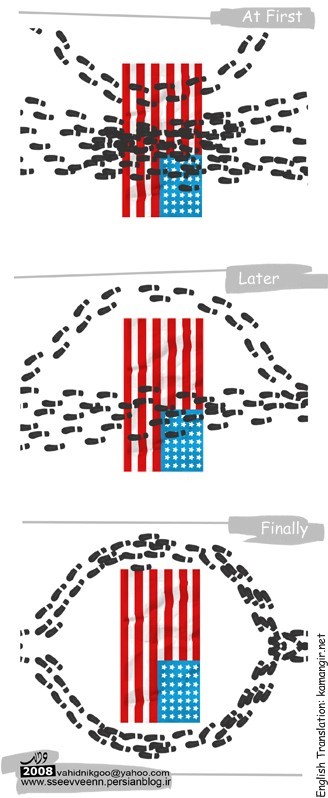 (Thanks to Kamangir for the translation of this cartoon from Vahid Nikgoo's blog)
Of course President-elect Obama will have his Iran experts: people who have studied the country’s politics, society, revolution, history, and language more thoroughly than I would ever dream of doing. There are people who know the rules of taarof better than Iranians themselves and who understand the historical roots of certain forms of behavior better as well. There will be people who have examined the DNA of Iran’s leadership and who know just how many misspellings were in that fake Oxford diploma (It sounds as though it was forged by the same people who sold my friend fake Johnny Walker whiskey featuring a label with 17 misspellings.) I won’t let this stop me from offering my free advice to the next president.
1. Bluster is bad
Do not make threats that will not or cannot be carried out. Ever. There are circuitous ways to threaten Iran, if that is necessary. This means, of course, explaining to Americans that diplomacy is a subtle game and that we cannot always come out and condemn or threaten openly and still expect to be taken seriously. Direct bluster simply makes us look weak.
(related posts: Interview 3: Gary Sick talks about negotiating with Iran
Negotiating with Iranians)
2. Don’t say that you respect the history of the great people of Iran…
…And then revoke visas while people are in flight to the US, detain them without reason, or insult their intelligence.
3. Temper the demands for transparency
Demanding immediate transparency from Iran is like demanding that all Americans learn a second language. Tomorrow.
Have you ever worked with someone from Iran? And by from Iran, I mean someone who has not had the opportunity or need to adapt to the new culture? Many (not all, by any stretch of the imagination) have what my friend calls a “bazaari mentality.” There are secrets, deals, patronage, and negotiations ad nauseum. Decision-making is a very private affair and the reasoning behind a decision is deemed unnecessary. (I know that Iranians are not alone in this... just saying that it comes naturally)
Iranian culture is not, by nature or nurture, a transparent culture. Look, Ahmadinejad can’t even give a straight answer to a question about the ages of his children. The very power structure of Iran’s government is a secret even to those participating in it. It is secret, even though it is openly documented. Even where there are NO secrets, many of my Iranian friends construct secrets and conspiracies. (Earthquake in Bam: underground nuclear testing; fire at mosque: explosion, let's not even get into 9/11, the holocaust, or the moonwalk...)
A friend of mine, who has become Americanized, wondered why his own father would tell people he ate kebab for lunch when instead he ate chicken with rice. “What’s wrong with chicken?” he asked, baffled. “Why did my father feel like he had to tell people he ate kebab?”
There have to be ways to ease into a transparent relationship, rather than demand one. How? Ask the experts.
4. Doubt and challenge your experts
The first thing I learned when I went to Iran is that my expat Iranian friends did not have any idea what Iran was like. They had frozen it in time, at its very nastiest. Once I got past this, I realized that their view was extremely limited by their class and geographical location. Many of the people I spoke with extrapolated the feelings of all Iranians based on the feelings and beliefs of their own family members. I have been guilty of this as well, but not nearly so desperately as many of the people I met inside and outside Iran. Iran is a seriously classist society. Seriously. It's also "placist." Here's one of my favorite examples (one that I heard tens, if not hundreds, of times):
Why do people think we have camels in Iran? There are no camels in Iran. (News flash: I saw a camel on Dibaji Jonubi in Tehran!)
The next thing I learned is that experts can be too, let's say, "expert." Knowing the historical, cultural, and linguistic roots of certain forms of behaviors means attributing meaning where there may be none. Iran, like the US, has a culture that changes. It is a dynamic, modern culture where every single action is not necessarily as self-aware or as historically rooted as the experts think it is. Society is still changing in Iran. Many of the young people we met there have cut all ties with tradition: some consciously, some in a nihilistic manner, and some for no reason at all.
5. All Iranians hate the regime…
NOT. Even those who tell me quite openly and vehemently that they hate the regime don’t really hate them. I know that so many people I know and love would love to believe that what they really long for is freedom and democracy, but what I saw in Iran were strong familial efforts to control the behavior of their children. Some use the regime as an excuse, albeit a valid one. Allowing their children the social freedom that nearly all adolescents and young adults long for could bring them into dangerous conflict with the religious police. Ok, I’ll give them that. Despite that, I sincerely believe that despite social changes in some social classes in Iran and some cosmopolitan areas, most families in Iran want to control their families.
6. Do not fall for the argument that Western culture is decadent…
If you cannot argue in favor of Western culture, then do not negotiate with the regime in Iran. If you cannot argue in favor of our family values and our society, just surrender now. If you cannot argue in favor the rights of women and minorities, give up hope. If you cannot champion free speech with all of its messiness, all is lost. If you cannot be proud of our open debates and disagreements, don't even go to Iran.
7. Walk a mile in their shoes…
Attempting to empathize with our foes has been demonized, yet there can be no meaningful peace until we start to do that. Empathy does not require capitulation, but it can lead to real discussions and more productive negotiations. Americans cannot continue to view the world only in terms of our own self-interest. We have to at least be able to imagine the interests of others.
Here are some places to start:
Sardasht: Iran's rallying cry, root of nuclear ambitions, by Borzou Daragahi
About the Iran Coup, 1953 and in the NYT
If you're really ambitious, read My Dear Uncle Napoleon.
And don't forget to visit the blogs in my blogroll and keep up with Global Voices.
8. Remember, Iranians still educate some of the best engineers in the world at Tehran University, their best political analysts are realistic and sharp, and many get their news from a variety of sources.
It does not make sense to speak to Iranians as though they are a nation of children.
9. The next revolution will not be televised…
When I tell my Iranian friends that I believe the current regime has infiltrated society to such an extent that it cannot be easily or happily removed, they tell me that Iran is full of surprises. It even surprises itself. I know that it surprised me.
10. Absolutely gotta repudiate torture, close Guantanamo, and observe the Geneva Convention.
And here is one tip for Iran's regime:
Do not make the mistake of thinking that an Obama presidency means that you can pull a Khrushchev. You have no choice now but to negotiate in good faith.
Tuesday, October 21, 2008
Return of the Stolen Bike

Yes folks, my dear bicycle, which was stolen from in front of the house 2 months ago, showed up a block away, still locked, with just a tiny bit of damage to the chain guard. Oh happy day!
Monday, October 20, 2008
Harleys in Lebanon
From Borzou Daragahi's piece at the LA Times:
"Once you get on a Harley you feel that you are really free and that your spirit is always up high and you're going through the wind," said Abraham Kadoumy, 51, who discovered motorcycle culture when he lived in Los Angeles in the late 1970s and early '80s.
"Freedom is what it's all about," he says.
Harley-Davidsons also have deep roots in Lebanon. Police here have been riding them for decades. In fact, bike dealer Tarraf says he fell in love with Harleys after getting a lift on one stolen from the cops during the 15-year civil war.
Sunday, October 19, 2008
Cezanne? No! Seh Zan
When we hopped on the train from Amsterdam to Rotterdam to attend the opening evening of the Iranian Film Festival, I had no idea what to expect other than music from the incredibly talented Pejamn Akbarzadeh. When we arrived at the cinema, I heard that we would be seeing "Cezanne"

Hmm... I thought, Cezanne, what does he have to do with Iran? The answer was that we were seeing "Seh Zan," Three Women, by the director of Women's Prison Manijeh Hekmat.

The film followed a woman, her daughter, and mother. The central figure tries so hard to control every aspect of her life from the potential loss of an historically significant carpet to the lives of her daughter and mother. As a result, she (physicall) loses all three: the carpet, her senile mother, and her young daughter. Her efforts to find them do, however, give her insight into the inner world of her daughter and mother.
I loved the film, despite the fact that our friend Shervin Nekuee thought that the ending was weak. "Most Iranian films have the same problem," he said, "They don't have strong endings." (I would say that a notable exception is Cafe Transit, which had a really strong ending.)
Okay: weak strong, the film had me and Kamran talking about it the next day. Kamran told me about the Radio Zamaneh interview with the director and then interviews with filmhouse owners who talked about why they are not booking her film (nobody wants to see it, they say). (We are going to discuss this in another post.)
On the way back to Amsterdam, we were joined by the (unknown to us) Dutch director Pim van Hoeve, who seemed interested in constructing a romantic comedy around our friend Pejman. He obviously has a great sense of character: Pejman would make the perfect protagonist: he's talented, charming, and mysterious. Proof of his talent:
More things to look at:
Three Women in Chicago
Director
Manijeh Hekmat sells cigarettes to earn a living
Hassan Rezai writes about the conditions in Women's prisons in Iran.
Myspace page with music from the Iranian band 127 who make an appearance in the film Three Women.

Hmm... I thought, Cezanne, what does he have to do with Iran? The answer was that we were seeing "Seh Zan," Three Women, by the director of Women's Prison Manijeh Hekmat.

The film followed a woman, her daughter, and mother. The central figure tries so hard to control every aspect of her life from the potential loss of an historically significant carpet to the lives of her daughter and mother. As a result, she (physicall) loses all three: the carpet, her senile mother, and her young daughter. Her efforts to find them do, however, give her insight into the inner world of her daughter and mother.
I loved the film, despite the fact that our friend Shervin Nekuee thought that the ending was weak. "Most Iranian films have the same problem," he said, "They don't have strong endings." (I would say that a notable exception is Cafe Transit, which had a really strong ending.)
Okay: weak strong, the film had me and Kamran talking about it the next day. Kamran told me about the Radio Zamaneh interview with the director and then interviews with filmhouse owners who talked about why they are not booking her film (nobody wants to see it, they say). (We are going to discuss this in another post.)
On the way back to Amsterdam, we were joined by the (unknown to us) Dutch director Pim van Hoeve, who seemed interested in constructing a romantic comedy around our friend Pejman. He obviously has a great sense of character: Pejman would make the perfect protagonist: he's talented, charming, and mysterious. Proof of his talent:
More things to look at:
Three Women in Chicago
Director
Manijeh Hekmat sells cigarettes to earn a living
Hassan Rezai writes about the conditions in Women's prisons in Iran.
Myspace page with music from the Iranian band 127 who make an appearance in the film Three Women.
Thursday, October 16, 2008
The Wind Will Take Us Away
If you aren't reading Sahand's site Punch the Sun regualarly, then you do not know what you are missing. So don't miss this week's beautiful poem by Forough Farrokhzad. If you haven't read her, well then you are in for a treat!
(BTW, I also love the Kiarostami film that uses the poem's title as its own)
(BTW, I also love the Kiarostami film that uses the poem's title as its own)
Intro to The Ayatollah Begs to Differ
Haven't read the book, but that does not stop me from enjoying the intro. Found via the blog: Fudzail. UPDATE: Just realized that the well-written commentary on Fudzail's site was from Iran Writes.
Now that you've seen it, I have 2 comments:
1. Only a man could claim to be "sometimes" reminded that he is living under Islamic rule. For women, the reminder is relentless.
2. I agree that the lack of fear is surprising in Iran; that there *can* be no palpable sense of secret police. I do, however, think that if he were to stay for a really extended time, say a year or two, he would have a different view. (If he had an American wife staying with him, I'm positive he would have a different view.)
I would also argue, that if he were a woman, he would think differently as well. Every woman I know who returned to Iran after spending a significant amount of time abroad, had the sense of being watched. Many of the Iranian women I met, who had become accustomed to life in the UK or the US or the Netherlands or any number of other places, had lost much of their ability to maneuver easily in the society. It wasn't even an issue of "ability," it was an issue of willingness.
It was so much easier for me than for my expat Iranian friends. My taarof mishaps were excused, my aggressiveness accepted... People expected me to be inflexible, selfish, and miserly. With those kinds of expectations, it's easy to impress. I was treated like a full grown child: spoiled and doted upon. Trust me, had I been culturally Iranian I would have been taken to task for every misstep: whether perceived or purposeful.
I would love to hear from expat Iranian women out there who want to chime in and tell me how wrong/right I am.
I'll even tag a few:
Pedestrian at Sidewalk Lyrics
Homeyra at Forever Under Construction
Beja at A Voice of Two Cities
Ava at Love Jihadi
(I hope commenters will add to this list and chime in with their own experiences)
Friday, October 03, 2008
Tehrangeles: Starbucks, sushi, and Chabad House
I was hanging out with a 22 year-old Iranian-Dutch woman who was telling me about her summer trip to LA to visit cousins. (Raise your hand if you have cousins in LA. I know I do, and I’m not even Iranian.)
“You wouldn’t believe it,” she told me, “My cousin drove for an hour to buy sweets so she wouldn’t have to buy them from the Jewish baker. She said, ‘I want my money in the pocket of a Muslim, not of a Jew.’”
Part of me was appalled, and part sympathetic. After all, when I was growing up, we bought from Jews whenever we could. That was the rule. My father still complains about certain university types who did not understand the importance of supporting Jewish merchants and would buy from anyone. “They just don’t understand how hard it is to earn a living,” he says.
Irangeles, apparently, is starkly divided by religion: Iranian- Jews, Muslims, Christians, and Bahai’s divided by semi-strict borders. “Even the coffee shops,” my young friend says. She told me of her cousin’s dismay when a group of Jewish 20-somethings dared to step foot in the coffee shop they were visiting. “They have their own. What are they doing here?” When my friend expressed her disgust with her cousin’s attitude, she was met with a blank stare. “We just don’t do that kind of thing in Amsterdam.” To be fair, Iranians in the Netherlands are pretty divided by political lines. It is true, however, that the 20-somethings are more likely to blur those lines than their parents.
--
Starbucks, sushi, Chabad House. Starbucks, sushi, Chabad House. A little Spanish, a lot of Persian, some Hebrew. That’s what Kamran and I experienced when we visited LA last Spring.
In a Persian restaurant in Westwood, a young Baha’i told us how disheartening it was to try to bring the Irangeles community together. He confirmed our Iranian-Dutch friend’s experience of the strong religious divisions in the community. Another man we met told us that when young Iranians arrive in Irangeles, they are comfortable crossing the borders between the religious communities. “They don’t seem to care at all about religious divisions at all. They’re just so much more relaxed than those of us who grew up in this community.”
--
Yesterday Kamran and I had lunch with some friends who live in Iran. “Do you think anti-Semitism is growing among Iranians?” I asked. (An article in the Washington Post had been haunting me since I read it.)
“Do you mean anti-Zionism?”
“No. I mean anti-Semitism.”
They told me that the young people born after the revolution to parents who lived most of their lives with the current regime had, in fact, become more susceptible to the message of the regime. “I mean, my friend’s younger sister has no problem throwing off her hejab and wearing a bikini in public, but when she talks you are surprised to hear her echo the message of the regime.” She’s not unique, just specific.
“You wouldn’t believe it,” she told me, “My cousin drove for an hour to buy sweets so she wouldn’t have to buy them from the Jewish baker. She said, ‘I want my money in the pocket of a Muslim, not of a Jew.’”
Part of me was appalled, and part sympathetic. After all, when I was growing up, we bought from Jews whenever we could. That was the rule. My father still complains about certain university types who did not understand the importance of supporting Jewish merchants and would buy from anyone. “They just don’t understand how hard it is to earn a living,” he says.
Irangeles, apparently, is starkly divided by religion: Iranian- Jews, Muslims, Christians, and Bahai’s divided by semi-strict borders. “Even the coffee shops,” my young friend says. She told me of her cousin’s dismay when a group of Jewish 20-somethings dared to step foot in the coffee shop they were visiting. “They have their own. What are they doing here?” When my friend expressed her disgust with her cousin’s attitude, she was met with a blank stare. “We just don’t do that kind of thing in Amsterdam.” To be fair, Iranians in the Netherlands are pretty divided by political lines. It is true, however, that the 20-somethings are more likely to blur those lines than their parents.
--
Starbucks, sushi, Chabad House. Starbucks, sushi, Chabad House. A little Spanish, a lot of Persian, some Hebrew. That’s what Kamran and I experienced when we visited LA last Spring.
In a Persian restaurant in Westwood, a young Baha’i told us how disheartening it was to try to bring the Irangeles community together. He confirmed our Iranian-Dutch friend’s experience of the strong religious divisions in the community. Another man we met told us that when young Iranians arrive in Irangeles, they are comfortable crossing the borders between the religious communities. “They don’t seem to care at all about religious divisions at all. They’re just so much more relaxed than those of us who grew up in this community.”
--
Yesterday Kamran and I had lunch with some friends who live in Iran. “Do you think anti-Semitism is growing among Iranians?” I asked. (An article in the Washington Post had been haunting me since I read it.)
“Do you mean anti-Zionism?”
“No. I mean anti-Semitism.”
They told me that the young people born after the revolution to parents who lived most of their lives with the current regime had, in fact, become more susceptible to the message of the regime. “I mean, my friend’s younger sister has no problem throwing off her hejab and wearing a bikini in public, but when she talks you are surprised to hear her echo the message of the regime.” She’s not unique, just specific.
Subscribe to:
Posts (Atom)